Tag: United States

  • There’s now no doubt that the US is preparing for war with Iran

    Spread the love

    Original article by Paul Rogers republished from Open Democracy under a Creative Commons Attribution-NonCommercial 4.0 International licence.

    Netanyahu meets Harris July 2024.  | Kenny Holston/The New York Times/Bloomberg via Getty Images.

    This week, the US quietly deployed more weapons to Israel – particularly those that will be effective against Iran

    US and Israeli leaders have celebrated this week’s death of Hamas military commander Yahya Sinwar. But while attention is focused on what it means for Gaza and the unlikely possibility of a ceasefire – few have noticed what this means for the much wider US-Iran war.

    The US has, of course, put its military might, money and rhetoric behind Israel in its devastating operations in Gaza since last October. More specifically, the US even has a little-noticed permanent military presence in Israel itself – an advanced long-range over-the-horizon X-Band Radar system in the Negev. It is believed to be particularly effective against Iranian medium-range ballistic missiles. 

    But this week, two recent developments point to the US preparing for direct confrontation with Iran as it sharpens its ammunition and shares even more weaponry with its ally Israel. 

    First, we saw the US use long-range B-2 stealth bombers in attacks on underground weapons stores in Yemen for the first time. Only the US has these weapons which are thought to be the world’s most powerful ‘bunker-busters’ and can reach 200-feet underground. If there is a war with Iran it will be one of the very few means of inflicting damage on some of Iran’s most heavily protected targets.

    That might sound scaremongering but the bombing of the Houthi targets in Yemen with these tools looks uncomfortably like a dry run for any conflict with Iran. 

    Secondly, we saw the deployment of an advanced US anti-missile system to Israel, again involving US military personnel. This is the THAAD weapon (terminal high-altitude aerial defence) which will supplement Israel’s own system that has not been as effective as the Israeli Defence Forces (IDF) would like.

    From an IDF perspective, if Netanyahu agrees to a substantial military attack on Iran, the likely response from Iran will be to do its best to swamp Israeli missile defences. Thus, the US THAAD deployment will reduce the risk of an effective Iranian response.

    This all seems a far cry from the repeated US calls for a ceasefire, but these are best seen as part of a smoke screen, behind which lies a long-term enemy

    This all seems a far cry from the repeated US calls for a ceasefire, but these are best seen as part of a smoke screen, behind which lies a long-term enemy. Most Europeans, including the British, tend to forget that ever since the Iranian Revolution in 1979 it has been Iran that is seen in Washington as by far the worst threat to US political and economic interests in the Middle East. 

    This fits in substantially with the Israeli position where Iran is, in the longer term as by far the greatest threat to its security – far worse than Hamas, Hezbollah or any other political movement.   Moreover, an an Iran equipped with nuclear weapons really would be seen as an existential threat. That existential threat may not fully extend to the US view, but Iran is by some measure the greatest challenge to US Middle East policy.

    As one US military journal put it this week:

    “Israeli military strikes are targeting Iran’s armed allies across a nearly 2000-mile stretch of the Middle East and threatening Iran itself. The efforts raise the possibility of an end to two decades of Iranian ascendancy in the region, to which the 2003 US invasion of Iraq inadvertently gave rise.” 

    Israel wants rid of the regime in Tehran but that would also be a very good outcome for the many hawkish elements in the US political system. While world attention may be on the war in Gaza with this week’s killing of Yahya Sinwar, a potential conflict involving Iran may turn out to be even more significant.

    Original article by Paul Rogers republished from Open Democracy under a Creative Commons Attribution-NonCommercial 4.0 International licence.

  • ‘I Care About Little Kids Dying’: Ocasio-Cortez Hits Back at Fetterman Over Gaza

    Spread the love

    Original article by Olivia Rosane republished from Common Dreams under Creative Commons (CC BY-NC-ND 3.0).

    U.S. Rep. Alexandria Ocasio Cortez (D-N.Y.) speaks during a press conference to call for a cease-fire between Israel and Hamas in front of the U.S. Capitol in Washington, D.C. on November 13, 2023.  (Photo: Mandel Ngan/AFP via Getty Images)

    “I care about human rights,” said the New York congresswoman in response to her Democratic colleague in the Senate. “I care that billions of U.S. tax dollars’ worth of weapons are carrying out unspeakable atrocities.”

    New York Rep. Alexandria Ocasio-Cortez criticized fellow Democrat and Pennsylvania Sen. John Fetterman on Wednesday for failing to hold the U.S.-armed Israeli military accountable for killing and harming civilians in the Gaza Strip.

    Ocasio-Cortez’s remarks came in response to Fetterman’s dismissal of her earlier call for an arms embargo on Israel, which has received billions of dollars worth of weapons and other military aid since the Hamas-led October 7 attack.

    “The tragedy in Gaza is 100% on Hamas,” Fetterman wrote on social media with a screengrab of a Hill headline outlining Ocasio-Cortez’s remarks. “Stop using civilians and hospitals as shields, surrender, and release all remaining hostages—and this ends.”

    Ocasio-Cortez then retweeted Fetterman’s words with her own rebuttal.

    “I dunno man. I care about little kids dying,” the New York lawmaker replied. “I care about human rights. I care that billions of U.S. tax dollars’ worth of weapons are carrying out unspeakable atrocities. I care enough for us to do better.”

    “Hope this bleak dunk attempt gets you whatever it is you’re going for,” she concluded.

    The exchange comes as Israel has intensified its assault on northern Gaza in recent days, bombing homes and schools-turned-shelters in the Jabalia refugee camp and issuing new evacuation orders for the beleaguered region yet placing snipers on roofs and shooting people who try to flee. On Saturday, the Palestinian Deputy Observer to the United Nations Majed Bamya called Israel’s escalation in the north a “genocide within the genocide” and the World Food Program said that no food had been able to reach the area since October 1, warning that the ramped up attacks were having “a disastrous impact on food security for thousands of Palestinian families.” However, 50 trucks carrying aid including food were allowed to enter the north on Wednesday.

    Ocasio-Cortez’s remarks that prompted Fetterman’s rejoinder came in response to the weekend’s atrocities.

    “The horrors unfolding in northern Gaza are the result of a completely unrestrained Netanyahu gov, fully armed by the Biden admin while food aid is blocked and patients are bombed in hospitals,” she wrote on social media on Monday. “This is a genocide of Palestinians. The U.S. must stop enabling it. Arms embargo now.”

    Ocasio-Cortez has been an outspoken critic of Israel’s assault on Gaza and the U.S. response. She backed a House resolution calling for a cease-fire weeks into the war, and demanded an end to the flow of weapons from the House floor in March, when she described Israel’s actions in Gaza as an “unfolding genocide.”

    Fetterman, meanwhile, has faced protests from some of his more progressive constituents over his hardline pro-Israel stance.

    On Tuesday, news broke that the Biden administration had reportedly written a letter to the Israeli government threatening to cut off the flow of weapons to the country unless it took “urgent and sustained actions” to improve the humanitarian situation in Gaza within 30 days.

    Original article by Olivia Rosane republished from Common Dreams under Creative Commons (CC BY-NC-ND 3.0).

  • Alarm as Pentagon Confirms Deployment of US Troops to Israel

    Spread the love

    Original article by Jake Johnson republished from Common Dreams under Creative Commons (CC BY-NC-ND 3.0).

    U.S. Defense Department spokesperson Pat Ryder holds a press conference at the Pentagon on September 12, 2024. (Photo: Celal Gunes/Anadolu via Getty Images)

    “Netanyahu is as close as he has ever been to his ultimate wish: making the U.S. fight Iran on Israel’s behalf,” wrote one journalist.

    The Pentagon confirmed Sunday that it has authorized the deployment of an advanced antimissile system and around 100 U.S. troops to Israel as the Netanyahu government prepares to attack Iran—a move that’s expected to provoke an Iranian response.

    Maj. Gen. Pat Ryder, press secretary for the U.S. Defense Department, said in a statement that at President Joe Biden’s direction, the Pentagon approved the “deployment of a Terminal High-Altitude Area Defense (THAAD) battery and associated crew of U.S. military personnel to Israel to help bolster Israel’s air defenses” in the wake of Iran’s ballistic missile attack earlier this month.

    “The THAAD Battery will augment Israel’s integrated air defense system,” said Ryder. “This action underscores the United States’ ironclad commitment to the defense of Israel, and to defend Americans in Israel, from any further ballistic missile attacks by Iran.”

    The Pentagon’s statement came shortly after The Wall Street Journal and other outlets reported on the Biden administration’s plans.

    It is not clear when the U.S. troops are set to arrive in Israel. The U.S. currently has some 40,000 soldiers stationed across the Middle East.

    “We risk becoming entangled in another catastrophic war that will inevitably harm innocent civilians and may cost billions of U.S. taxpayer dollars.”

    Iran fired roughly 200 ballistic missiles at Israel on October 1 in response to the assassinations of Hezbollah’s leader and Hamas’ political chief. Most of the Iranian missiles were shot down with the help of the U.S., whose Navy fired interceptors at the missiles.

    Journalist Séamus Malekafzali argued the U.S. deployment of troops and the THAAD system shows that “the Israelis are clearly planning something for Iran that is going to cause a retaliation they know their own systems are unable to take.”

    “U.S. troops being deployed to Israel in this matter is seismic,” Malekafzali added. “The U.S. military is now inextricably involved in this war, directly, without any illusions of barriers. Netanyahu is as close as he has ever been to his ultimate wish: making the U.S. fight Iran on Israel’s behalf.”

    Israel’s cabinet met Thursday to discuss a potential response to Iran’s October 1 missile barrage. One unnamed Israeli source told The Times of Israel that “no big decisions” were made at the cabinet meeting. Speaking to reporters earlier this month, Biden said that U.S. and Israeli officials were “discussing” the possibility of an attack on Iranian oil infrastructure.

    Iran has warned of a “crushing” response to any Israeli attack.

    In a statement Sunday, progressive U.S. Reps. Pramila Jayapal (D-Wash.), Barbara Lee (D-Calif.), James McGovern (D-Mass.), and Greg Casar (D-Texas) said that “military force will not solve the challenge posed by Iran.”

    “We need meaningful de-escalation and diplomacy—not a wider war,” the lawmakers added. “Nothing in current law authorizes the United States to conduct offensive military action against Iran. We risk becoming entangled in another catastrophic war that will inevitably harm innocent civilians and may cost billions of U.S. taxpayer dollars.”

    Original article by Jake Johnson republished from Common Dreams under Creative Commons (CC BY-NC-ND 3.0).

  • Interview: Harris or Trump doesn’t matter for Gaza genocide

    Spread the love

    Original article by Nandini Naira Archer republished from Open Democracy under a Creative Commons Attribution-NonCommercial 4.0 International licence.

    Pro-Palestine protest outside the Democratic National Convention in Chicago in August 2024. | Fatih Aktas/Anadolu via Getty Images

    A year on and no end in sight to genocide – thanks to US support for Israel, which will continue beyond election

    A year on from the outset of Israel’s war on Gaza, Israeli forces have killed more than 42,000 Palestinians – and this is just the confirmed death toll. A recent study by the Lancet medical journal projected that the death toll could exceed 186,000 when counting indirect deaths – from starvation and diseases due to the Israeli blockade on humanitarian aid, food, water and medicines.

    To take stock of where we’re at and whether this nightmare is likely to end any time soon, openDemocracy spoke to Tariq Kenney-Shawa, a foreign policy analyst based in New York and US Policy Fellow at Al-Shabaka: The Palestinian Policy Network.

    openDemocracy: It’s been a year since this latest iteration of Israel’s war on Gaza commenced. Is the end in sight? What’s Israel’s end game?

    Tariq: Unfortunately, I don’t see any light at the end of the tunnel here. There is no end in sight to Israel’s genocide in Gaza. And that’s mainly because Israel hasn’t faced an ounce of accountability or pressure to de-escalate from the international community (the US and other western benefactors) to end this.

    Get our free Daily Email Get one whole story, direct to your inbox every weekday. Sign up now

    I’ve tended to be doubtful when people insist that Israel doesn’t have a plan in Gaza and is just destroying and killing for the sake of it. Israel does have a plan and it has been acting on it. It truly sees this moment in history, as well as the blank check from the US, as a golden strategic opportunity to take leaps towards its ultimate goal of ‘maximum land with minimum Palestinians’ and wider regional domination through brute force.

    Israel’s end game in Gaza is erasure, and for the last 12 months, they’ve been laying the foundation for a new reality in Gaza for us all to see. In addition to “thinning out the population,” as Netanyahu said, through genocide, collective punishment, and ethnic cleansing, Israel has been effectively chopping up the Strip into smaller, more controllable enclaves that will come to represent the new “facts on the ground.”

    openDemocracy: Has anything about the conflict surprised you?

    Tariq: I think one of the most surprising aspects about both the genocide in Gaza and now Israel’s escalation across the region is that it has gone on uninterrupted and without international intervention for so long, despite the fact that just about every massacre has been broadcast for the world to see on social media.

    As someone who is part of a generation that grew up being taught that the phrase “never again” really meant something, this is what I have found most jarring. Of course, Gaza is not the first time the international “rules-based” order has been exposed as a crutch for Western hegemony. From Vietnam to Iraq, the West’s selective application of international law has long been exposed for what it is. But Gaza is the first postwar genocide both entirely perpetrated by a Western ally and funded, facilitated, and justified by the West itself, not to mention the first to be so thoroughly recorded for the world to see.

    openDemocracy: Now with recent escalations including Iran, do you think realistically we’re on the verge of all-out war in the region?

    Tariq: I think we are already seeing an all-out regional war by every definition of the term. Israeli fighter jets are bombing Gaza, the West Bank, Lebanon, Syria, Yemen, and Iran. This is not to mention the strikes the US, UK, and other Israeli benefactors have carried out on Israel’s behalf.

    It boils down to this: Israel will continue to escalate across the region in hopes of achieving its extremist, expansionist goals as long as the US taxpayer continues to foot the bill and US assets and personnel are off the coast of Haifa to come to Israel’s defence if need be.

    openDemocracy: It seems that the Biden administration actually gave Israel the green light to mount large-scale attacks on Lebanon. Has the US ever really been interested in stabilising the region? Does the US want an all-out war?

    Tariq: The Biden Administration has either explicitly or implicitly (through uninterrupted weapons transfers and diplomatic shielding) given Israel the green light for a year of genocide and regional escalation.

    I believe it is clear that the US ultimately shares the same strategic objectives as Israel, which range from silencing Palestinians once and for all to destroying groups like Hezbollah to causing significant damage to Iran. These are all outcomes that the US would celebrate (just take the public statement the US made following Israel’s assassination of Hassan Nasrallah as one example).

    Does the Biden Administration wish Israel could go about some of their operations differently? Perhaps. But at the end of the day, the costs of Israel’s unparalleled violence, the mass death of Arabs and the destruction of their lands, is a price the US is willing to accept. If the US didn’t want an all-out war, they would stop giving Israel all the weapons and diplomatic space to keep escalating at will. Because while every US administration has been pro-Israel, other US presidents have stood up to Israel when they felt US interests were at risk.

    openDemocracy: Do you think things will change after the US elections on November 5?

    Tariq: Nothing will fundamentally change, regardless of who wins the elections on November 5. For Palestinians, the genocide will continue because neither candidate has exhibited any indication that they intend to hold Israel accountable for war crimes and genocide or use any of the ample leverage that the US has to influence Israel’s conduct.

    In fact, it’s the opposite. Donald Trump insists he would let Israel “finish the job” in Gaza, while Kamala Harris promises that she will continue the Biden Administration’s policy of giving Israel “everything it needs” and continues to make it clear that she intends to be a carbon copy of the Biden Administration. The truth is, both Harris and Trump spell continued disaster for both Palestinians and the wider region, and there is no “lesser evil” here.

    The truth is, the Biden administration’s resume on Israel-Palestine, even long before October 7, has in many ways mirrored that of Trump’s.

    If Biden wanted to make good on his commitment to a “two-state solution,” he would have at least started by reversing the norm shattering pro-Israel policies of his predecessor. The Biden Administration has actually given Israel more military and diplomatic assistance than any previous administration.

    The only substantial difference between Trump and Biden has been their rhetoric. But one could argue that Biden’s lofty, yet empty words actually does more harm than good by distracting us from the fact that he has given Israel everything it needed to get away with genocide right in front of our eyes. If Harris wins in November, it will be more of the same, and you don’t need to take my word for it, she has made it abundantly clear herself.

    Original article by Nandini Naira Archer republished from Open Democracy under a Creative Commons Attribution-NonCommercial 4.0 International licence.

  • Israel’s War on Gaza and Beyond Has Cost US Taxpayers At Least $22.76 Billion: Report

    Spread the love

    Original article by Brett Wilkins republished from Common Dreams under Creative Commons (CC BY-NC-ND 3.0). 

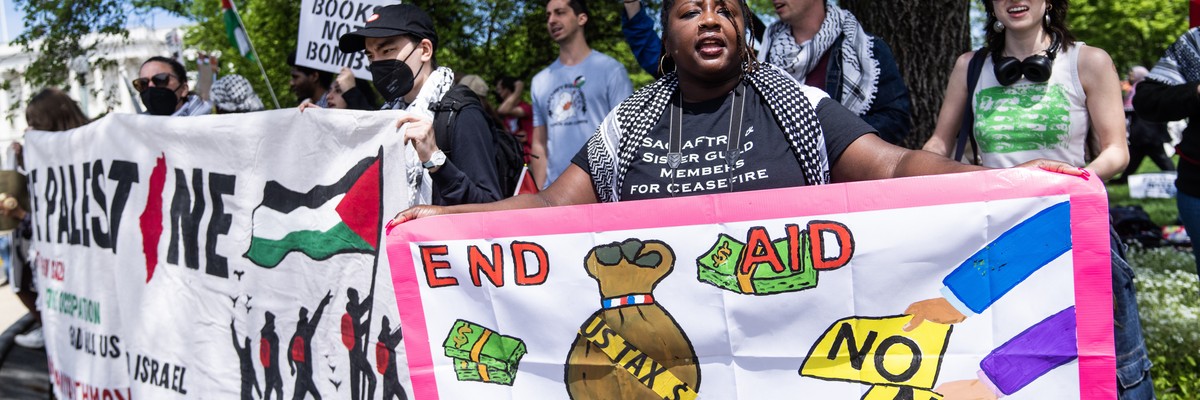
    Demonstrators calling for no funding for Israel in the conflict in Gaza are seen outside the U.S. Capitol before the House passed the foreign aid package on Saturday, April 20, 2024. (Photo: Tom Williams/CQ-Roll Call, Inc via Getty Images)

    “It has been difficult for the U.S. public, journalists, and members of Congress to get an accurate understanding of the amount of military equipment and financial assistance that the U.S. government has provided.”

    U.S. armed aid to Israel and related spending on American militarism in the Middle East cost taxpayers at least $22.76 billion over the past year, according to new research published Monday.

    The Costs of War Project at Brown University’s Watson Institute for International & Public Affairs—which has long been the premier source for statistics on the human and economic costs of ongoing U.S.-led post-9/11 wars and militarism in the Middle East and beyond—called the $22.76 billion estimate “conservative.”

    “This figure includes the $17.9 billion the U.S. government has approved in security assistance for Israeli military operations in Gaza and elsewhere since October 7—substantially more than in any other year since the U.S. began granting military aid to Israel in 1959,” report authors Linda Bilmes, William Hartung, and Stephen Semler wrote. “Yet the report describes how this is only a partial amount of the U.S. financial support provided during this war.”

    In addition to the repeated multibillion-dollar rounds of military aid to Israel, related U.S. operations in the region, particularly bombing and shipping defense in and near Yemen—where Houthi rebels have attacked maritime commerce and launched missiles at Israel—have cost over $2 billion since last October.

    “It has been difficult for the U.S. public, journalists, and members of Congress to get an accurate understanding of the amount of military equipment and financial assistance that the U.S. government has provided to Israel’s military during the past year of war,” the report states. “There is likewise little U.S. public awareness of the costs of the United States military’s own related operations in the region, particularly in and around Yemen.”

    The analysis adds that regional hostilities “have escalated to become the most sustained military campaign by U.S. forces since the 2016-19 air war” against the so-called Islamic State in Iraq and Syria.

    “The Costs of War project has an obligation to look at the consequences of the U.S. backing of Israel’s military operations after October 7, especially as it reverberates throughout the region,” Costs of War director Stephanie Savell said in a statement. “Our project examines the human and budgetary costs of U.S. militarism at home and abroad, and for the last year, people in Gaza have suffered the highest consequences imaginable.”

    According to the Gaza Health Ministry and international agencies, Israel’s yearlong assault on Gaza has left at least 149,000 Palestinians dead, maimed, or missing, and millions more forcibly displaced, starved, or sickened. U.S. military aid to Israel has continued in successive waves, even as the country stands trial for genocide at the International Court of Justice.

    The Hamas-led October 7 attack on resulted in more than 1,100 Israeli and other deaths—at least some of which were caused by so-called “friendly fire” and intentional targeting under the Hannibal Directive—with more than 240 people kidnapped.

    Although the Costs of War Project report mainly covers U.S. aid to Israel since last October, it also notes that since 1948—the year the modern state of Israel was founded, largely through the ethnic cleansing of Palestine’s Arabs—American taxpayers have contributed over a quarter trillion inflation-adjusted dollars to the key Mideast ally.

    A second report published Monday by the Costs of War Project found that around 90% of Gaza’s population has been forcibly displaced by the Israeli onslaught and 96% of Gazans face “acute levels of food insecurity.” The publication cites a letter sent last week by a group of U.S. physicians to President Joe Biden—who has repeatedly declared his “unwavering” support for Israel—stating that “it is likely that the death toll from this conflict is already greater than 118,908, an astonishing 5.4% of Gaza’s population.” That figure includes 62,000 deaths due to starvation.

    “In addition to killing people directly through traumatic injuries, wars cause ‘indirect deaths’ by destroying, damaging, or causing deterioration of economic, social, psychological and health conditions,” report author Sophia Stamatopoulou-Robbins wrote. “These deaths result from diseases and other population-level health effects that stem from war’s destruction of public infrastructure and livelihood sources, reduced access to water and sanitation, environmental damage, and other such factors.”

    The new report comes less than two weeks after Israel secured yet another U.S. armed aid package, this one worth $8.7 billion. Meanwhile, the Federal Emergency Management Agency said it faced a nearly $9 billion shortfall for Hurricane Helene relief efforts.

    Original article by Brett Wilkins republished from Common Dreams under Creative Commons (CC BY-NC-ND 3.0).