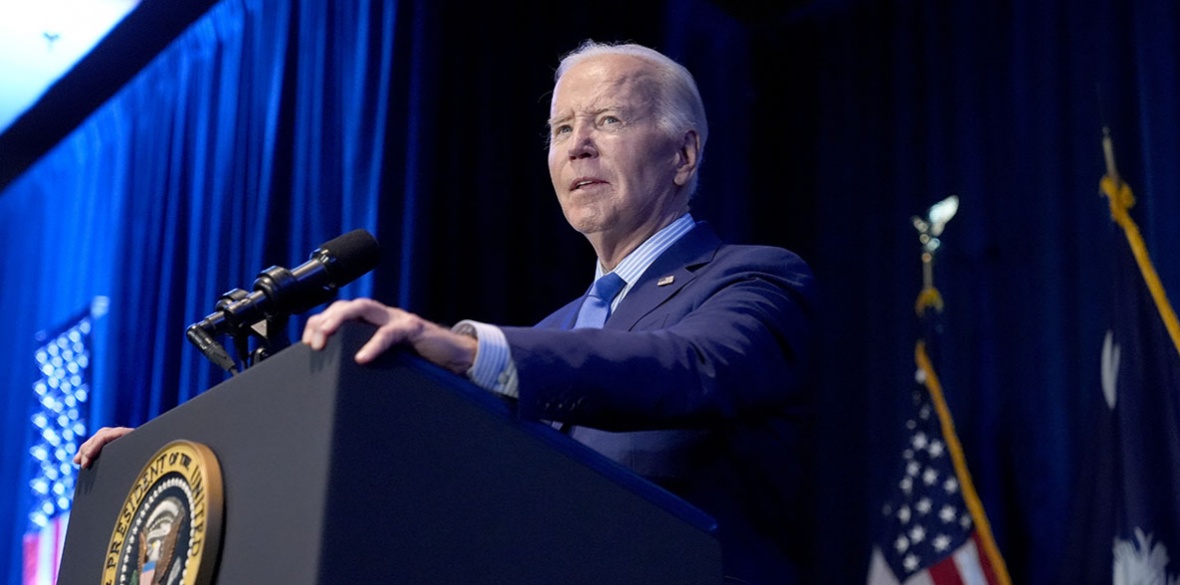
President Joe Biden speaks at South Carolina’s First in the Nation dinner at the South Carolina State Fairgrounds in Columbia, S.C., January 27, 2024
THE killing of three US soldiers along the Jordan-Syria border is inseparable from the war in Gaza.
It risks a spiralling Middle East war, a risk heightened by the reflex blaming of Iran and the clamour for revenge driven by hawkish US politicians in an election year.
Attacks on US forces will always be presented in mass media as unprovoked. British politicians too will depict them as acts of illegal terrorism which need to be punished to shore up the “international rules-based order.”
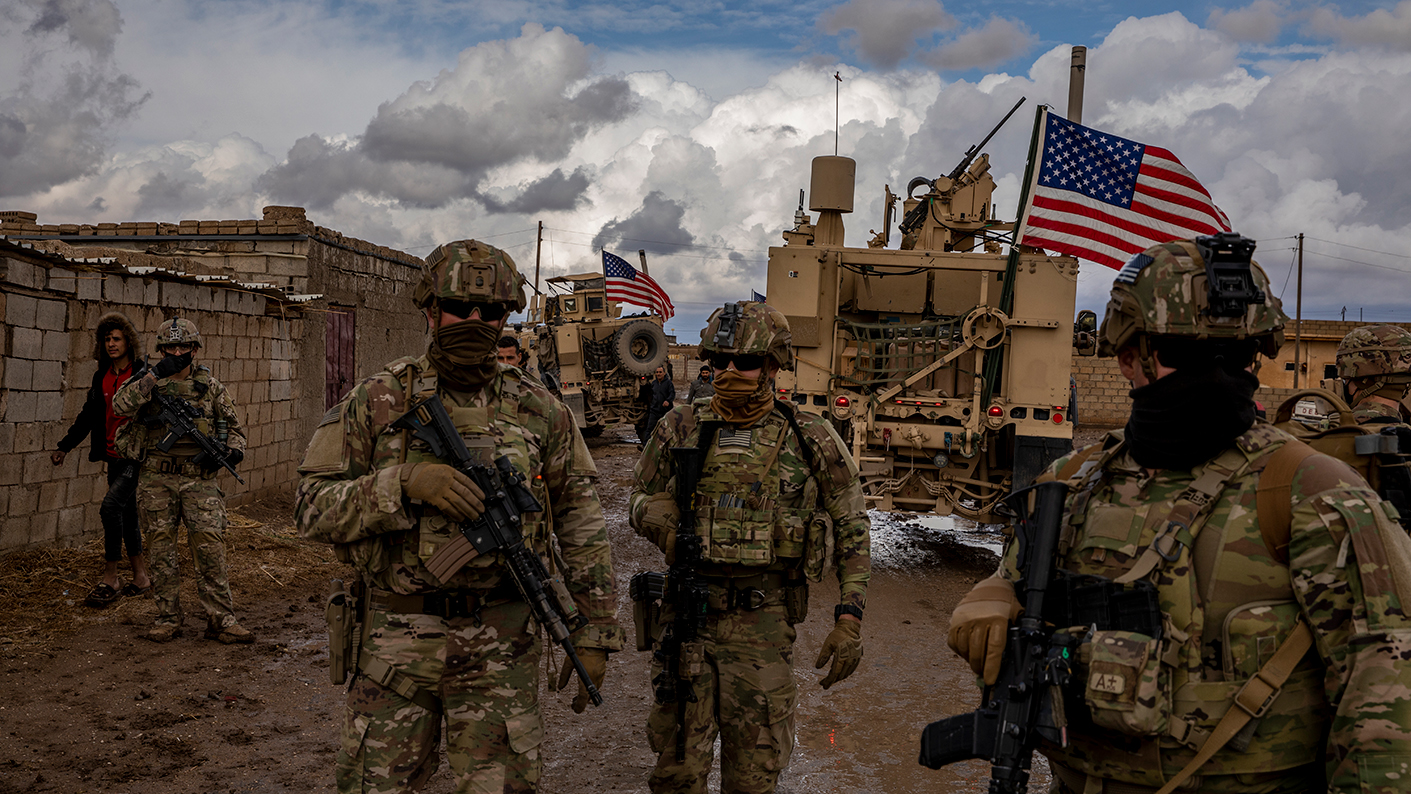
We should therefore be clear: US troops would not be under attack in the Middle East if they were not stationed in the Middle East, often against the wishes of the host countries.
…
Stationing your troops in a country against its wishes is not upholding an “international rules-based order” — it is an act of contempt for international law.
Sen. Tom Cotton (R-Ark.) walks through the Senate subway after a vote in the U.S. Capitol on January 9, 2024. (Photo: Bill Clark/CQ-Roll Call, Inc. via Getty Images)
“After years of working to block and undermine diplomatic alternatives, these people may be closer than ever to realizing their dream of war with Iran.”
Warhawks in the United States wasted no time agitating for direct military conflict with Iran after a drone attack on a military base just inside Jordan’s border with Syria on Sunday killed three American troops and injured dozens more.
Both Republican and Democratic members of Congress called on U.S. President Joe Biden to quickly respond with strikes inside Iran, which denied any connection to Sunday’s attack.
“The only answer to these attacks must be devastating military retaliation against Iran’s terrorist forces, both in Iran and across the Middle East,” said Sen. Tom Cotton (R-Ark.), a longtime supporter of war with Iran. “Anything less will confirm Joe Biden as a coward unworthy of being commander-in-chief.”
Rep. Jared Moskowitz (D-Fla.) called Iran “an existential threat to the U.S. and our allies in the region” and said Tehran “must be held accountable for the murder of three U.S. soldiers.”
United Against Nuclear Iran, a group chaired by former Sen. Joseph Lieberman, also demanded “a decisive U.S. military response against targets inside Iran.”
“The U.S. should attack and destroy Islamic Revolutionary Guard Corps (IRGC) military and intelligence targets in Iran, as well as missile and drone bases where the Iranian regime’s proxies are trained,” the group said.
“Those who have consistently counseled only violence to address the crisis unleashed on October 7 should be ashamed of the disastrous outcomes they have so far reaped.”
Biden claimed in a statement Sunday that “radical Iran-backed militant groups operating in Syria and Iraq” were responsible for Sunday’s drone attack, but acknowledged that the U.S. is “still gathering the facts.”
“Have no doubt—we will hold all those responsible to account at a time and in a manner [of] our choosing,” the president said.
U.S. forces stationed in the Middle East have faced increasingly frequent attacks since Israel launched its large-scale war on the Gaza Strip following the deadly Hamas-led assault on southern Israel on October 7. Sunday marked the first time since October that American troops have been killed in a Middle East attack.
The Biden administration has blamed the attacks on Iran-aligned militias and responded with airstrikes in Iraq and Syria, intensifying concerns that the U.S. is fueling a regionwide conflict. The administration has also launched a series of unauthorized strikes in Yemen in response to Houthi attacks on commercial shipping in the Red Sea.
Despite the above, the Pentagon continues to insist that the U.S. is “not at war in the Middle East.”
Contrary to the growing calls for a military response to attacks on U.S. troops, analysts and progressive lawmakers have argued that the only way to halt the escalating violence in the region is to secure a cease-fire in the Gaza Strip, where Israeli forces armed by the U.S. have killed more than 26,000 people in less than four months. The Biden administration has repeatedly stonewalled international efforts to secure a cease-fire.
“I am heartbroken by the loss of the servicemembers killed in Jordan,” Rep. Barbara Lee (D-Calif.), a U.S. Senate candidate, wrote in a social media post on Sunday. “Like I feared, the violence is spiraling out of control. President Biden must demand a cease-fire in Gaza now.”
“This is what the U.S. has been doing for literally decades in this region, responding to violence with more violence…and it has not worked,” @mattduss responds to growing calls from the GOP to attack Iran after militia groups linked to the country killed U.S. troops in Jordan. pic.twitter.com/HT3djtxDmq
Jamal Abdi, president of the National Iranian American Council, warned in a statement Sunday that “the U.S. and Iran are now closer to the brink of being pulled into a full-blown regional war by the vortex of violence that was unleashed by Hamas’ attack on Israel on October 7th and Israel’s assault on Gaza.”
“Those who have consistently counseled only violence to address the crisis unleashed on October 7 should be ashamed of the disastrous outcomes they have so far reaped,” said Abdi. “We are disgusted by calls for more escalation from opportunists like Senators Lindsey Graham, Tom Cotton, and John Cornyn who are urging yet again for the U.S. to directly attack Iran. After years of working to block and undermine diplomatic alternatives, these people may be closer than ever to realizing their dream of war with Iran.”
“President Biden must show leadership and recognize that there is no military solution to this crisis that has only been expanded and prolonged by military escalation and a dearth of diplomacy,” he continued. “The president must calibrate his response so as not to condemn the U.S. and region to an intractable war and instead work to end this conflict. The most impactful thing Biden can do to prevent further deaths across the region and prevent a full-blown war is to secure an immediate cease-fire between Israel and Palestine.”
Trita Parsi, executive vice president of the Quincy Institute for Responsible Statecraft, similarly argued that “to truly protect our troops and avoid both war and more needless American deaths, Biden should begin withdrawing troops from Iraq and Syria and press Israel for a cease-fire, since its slaughter in Gaza is fueling four fronts that put the U.S. at risk.”
“There will be understandable calls for revenge and counterstrikes,” Parsi said. “Biden will almost certainly go down that path. Know that this is how America gets dragged into endless war. Retaliations, which in the moment may feel justified by the unacceptable attacks of these militias, put us on a path toward a war that doesn’t serve our interests and that we cannot afford—one whose victory we cannot define and whose exit we cannot envision.”
U.S. President Joe Biden speaks to reporters before boarding Marine One on the South Lawn of the White House in Washington, D.C. on January 18, 2024. (Photo: Brendan Smialowski/AFP via Getty Images)
If President Biden demanded an end to the bombardment of Gaza, it would stop. But he’s hasn’t demanded and the bombing and death and destruction continues.
In 1948, the newly-formed United Nations marked the signing of the Universal Declaration of Human Rights as well as The Convention on the Prevention and Punishment of the Crime of Genocide. The Genocide Convention was a response to WWII’s Holocaust, when six million European Jews where murdered by Nazi Germany. Raphael Lemkin, a Polish lawyer of Jewish descent, coined the term “genocide” during the war, as he developed legal arguments for prosecuting war criminals, leading to the Nuremberg Trials.
1948 was also the year Israel was founded. While many celebrated Israel as a safe refuge for the world’s Jews after the Holocaust, Palestinians call that period the ‘Nakba,’ Arabic for ‘catastrophe.’ Over 750,000 Palestinians were driven from their homes and villages, their property confiscated, and 15,000 were killed.
1948 was also when the white minority in South Africa imposed apartheid on the Black majority, creating an oppressive system of segregation that lasted close to half a century.
In the intervening 75 years, despite the Genocide Convention, genocides have still occurred – and too few perpetrators of genocide have faced prosecution. Last week, the eyes of the world were on the Hague, as South Africa brought a case accusing Israel of genocide in Gaza to the International Court of Justice (ICJ).
The ICJ, also referred to as the “World Court,” convened on January 11th, first hearing South Africa’s case, followed the next day by Israel’s defense. South African lawyer Adila Hassim opened, saying,
“For the past 96 days, Israel has subjected Gaza to what has been described as one of the heaviest conventional bombing campaigns in the history of modern warfare. Palestinians in Gaza are being killed by Israeli weaponry and bombs from air, land and sea. They are also at immediate risk of death by starvation, dehydration and disease as a result of the ongoing siege by Israel, the destruction of Palestinian towns, the insufficient aid being allowed through to the Palestinian population, and the impossibility of distributing this limited aid while bombs fall. This conduct renders essentials to life unobtainable.”
Another of South Africa’s legal team, Irish lawyer Blinne Ní Ghrálaigh, said,
“On average, 247 Palestinians are being killed and are at risk of being killed each day, many of them literally blown to pieces. They include 48 mothers each day. Two every hour. And over 117 children each day, leading Unicef to call Israel’s actions a war on children. Entire multigenerational families would be obliterated. And yet, more Palestinian children would become WCNSF. Wounded Child, No Surviving Family, the terrible new acronym born out of Israel’s genocidal assault on the Palestinian population in Gaza.”
Israel said its attack on Gaza was in self-defense, directed at Hamas’ military infrastructure, following its October 7th attack on Israel, in which over 1,000 people were killed and over 200 taken hostage.
Renowned Jewish Israeli journalist Gideon Levy said on the Democracy Now! news hour, “Does this give us Israelis the right to do anything we want after the 7th forever, without any limits, no legal limits, no moral limits? We can just go and kill and destroy as much as we wish? That’s the main question right now.”
Levy serves on the editorial board of the Israeli newspaper Haaretz. He recently wrote a column headlined, “If It Isn’t a Genocide in Gaza, Then What Is It?” In it, he writes, “Let us assume that Israel’s position at The Hague is right and just and Israel committed no genocide or anything close to it. So what is this? What do you call the mass killing, which continues even as these lines are being written, without discrimination, without restraint, on a scale that is difficult to imagine?”
Any measures ordered by the ICJ would have to be adopted by the United Nations Security Council, where the United States, Israel’s staunchest ally and weapons provider, regularly wields its veto to protect Israel.
The United States is quick to accuse others of genocide, from Serbia in the 1990s, to Burma in the last decade for its atrocities against its Rohingya minority, to the mass imprisonment of Uyghurs in China, to Russia’s invasion of Ukraine. The United States even acknowledged Turkey’s 1915 genocide against Armenians, albeit in 2021, more than 100 years late.
Yet, President Biden, in a statement marking the 100th day anniversary of Hamas’ attack on Israel, failed to even mention the more than 24,000 Palestinians killed by Israel in Gaza, 70% of whom were women and children. Secretary of State Antony Blinken in Davos, Switzerland said the situation is “gutwrenching” and asked “but what can be done?”
If President Biden demanded an end to the bombardment of Gaza, it would stop. Now is the time to heed the global calls for a ceasefire in Gaza.
U.S. Secretary of State Antony Blinken talks with spokesperson Matthew Miller and others after he departed from Manama for Tel Aviv on January 10, 2024. (Photo: Evelyn Hockstein/Pool/AFP via Getty Images)
“I don’t think we need to offer any kind of pressure” on the Israelis to accept a Palestinian state, said a spokesperson for the U.S. State Department.
A U.S. State Department spokesperson signaled Thursday that American weaponry will continue to flow to the Israeli military even after the nation’s prime minister ruled out calls for a sovereign Palestinian state, openly defying the Biden administration’s push for a two-state solution to the crisis.
“Our support for Israel remains ironclad,” the State Department’s Matthew Miller said during a press briefing on Thursday in response to a question about how the U.S. intends to react to Israeli Prime Minister Benjamin Netanyahu’s position.
“I don’t think we need to offer any kind of pressure” on the Israelis to accept a Palestinian state, Miller said. “The pressure is reality. The pressure is the reality that I just laid out, that without a tangible path to the establishment of a Palestinian state, there are no other partners in the region who are going to step forward and help with the reconstruction of Gaza.”
Asked whether the U.S. will “continue to supply weapons and other support to an ally that is not listening to the warnings that you’re giving,” Miller acknowledged “differences with all of our allies” but said that “this is not a question of the United States pressuring them to do anything.”
“This is about the United States laying out for them the opportunity that they have,” Miller added. “There is a path for real security assurances—but again, we can’t make those choices for anyone. They have to make them for themselves.”
In the same briefing, Miller is asked about Netanyahu opposing a Palestinian state and if the US would offer any pressure if Israel doesn’t accept.
Miller: “I don’t think we need to offer any kind of pressure, the pressure is reality…”
In an indication of its unflagging support for Israel’s war assault on Gaza, the U.S. State Department has twice bypassed Congress to expedite weapons sales to the nation’s government since the Hamas-led attack on October 7. Earlier this week, the U.S. Senate rejected a resolution from Sen. Bernie Sanders (I-Vt.) that would have required the department to produce a report on Israel’s human rights practices in Gaza—which by virtually all accounts are atrocious.
The Biden administration, which could soon be facing a lawsuit at the International Court of Justice over its complicity in Israeli war crimes, opposed the Sanders resolution and has refused to formally assess whether Israel is adhering to international humanitarian law.
The Guardian reported Thursday that the State Department has “in effect been able to circumvent the U.S. law that is meant to prevent U.S. complicity in human rights violations by foreign military units—the 1990s-era Leahy law, named after the now retired Vermont senator Patrick Leahy—because, former officials say, extraordinary internal state department policies have been put in place that show extreme deference to the Israeli government.”
“No such special arrangements exist for any other U.S. ally,” the newspaper added.
The administration is currently working to exempt U.S. arms transfers to Israel from a “mandatory congressional notification process that applies to all other foreign arms sales,” The Washington Post reported last week.
Overall, the Biden administration has sent more than 10,000 tons of weaponry to Israel over the past three and a half months, declining to place conditions on the arms even as the Israeli military openly flouts U.S. officials’ entreaties to protect Gaza civilians, attacking homes, schools, bakeries, hospitals, and refugee camps.
“If Biden was truly as dissatisfied or impatient or whatever other terms are being fed to the media about his supposed handwringing over Bibi’s war, he could have acted. But he didn’t.”
Israel’s unrelenting bombing campaign and ground invasion have killed nearly 25,000 people in Gaza since October, and much of the territory is in the grip of famine as the Netanyahu government restricts the amount of aid allowed to enter the besieged territory.
Ajith Sunghay, head of the United Nations human rights office in the occupied Palestinian territory, expressed horror Friday at conditions on the ground in Gaza, calling the situation “a major, human-made, humanitarian disaster.”
“People continue to arrive in Rafah from various places in their thousands, in desperate situations, setting up makeshift shelters with any material they can get their hands on,” said Sunghay. “I’ve seen men and children digging for bricks to be able to hold in place tents made with plastic bags.”
“It is a pressure cooker environment here, in the midst of utter chaos, given the terrible humanitarian situation, shortages, and pervasive fear and anger,” he added. “The communications blackout has continued for a sixth consecutive day, adding to the confusion and fear, and preventing Gazans from accessing services and information on areas to evacuate.”
In a column on Thursday, The Intercept‘s Jeremy Scahill noted that “over the course of the past 100 days of Israel’s bloody rampage in Gaza, Biden has had an infinite series of events that each could have justified ceasing U.S. political and military support for Israel’s explicitly offensive war.”
“There is no nation on Earth that wields more influence over Israel and no politician who holds more sway than Biden. The U.S. is the arms dealer and defender of this entire enterprise,” Scahill wrote. “If Biden was truly as dissatisfied or impatient or whatever other terms are being fed to the media about his supposed handwringing over Bibi’s war, he could have acted. But he didn’t.”
“Instead, the White House made sure no cease-fire took hold, offered a public defense of Israel’s conduct in the face of clear evidence of its genocidal intent submitted before the world court, circumvented Congress to keep the arms flowing, and then publicly opposed a resolution that sought to uphold U.S. law aimed at ensuring U.S. weapons and other aid are not used to commit human rights abuses. Those are the relevant facts,” he continued. “There is no need for media outlets to serve as conveyor belts for the administration’s disingenuous posturing. Biden’s actions are the only evidence that matters. And that evidence is damning.”
A protester reacts as demonstrators are confronted by Palestinian Authority security forces during a protest held in Ramallah as US Secretary of State Antony Blinken met with the Palestinian president in the Israeli-occupied West Bank on January 10, 2024. (Photo by Marco Longari/AFP via Getty Images)
If the ICJ issues a provisional order for a ceasefire in Gaza, humanity must seize the moment to insist that Israel and the United States must finally end this genocide and accept that the rule of international law applies to all nations.
On January 11th, the International Court of Justice (ICJ) in The Hague is holding its first hearing in South Africa’s case against Israel under the Genocide Convention. The first provisional measure South Africa has asked of the court is to order an immediate end to this carnage, which has already killed more than 23,000 people, most of them women and children. Israel is trying to bomb Gaza into oblivion and scatter the terrorized survivors across the Earth, meeting the Convention’s definition of genocide to the letter.
Since countries engaged in genocide do not publicly declare their real goal, the greatest legal hurdle for any genocide prosecution is to prove the intention of genocide. But in the extraordinary case of Israel, whose cult of biblically ordained entitlement is backed to the hilt by unconditional U.S. complicity, its leaders have been uniquely brazen about their goal of destroying Gaza as a haven of Palestinian life, culture and resistance.
South Africa’s 84-page application to the ICJ includes ten pages (starting on page 59) of statements by Israeli civilian and military officials that document their genocidal intentions in Gaza. They include statements by Prime Minister Netanyahu, President Herzog, Defense Minister Gallant, five other cabinet ministers, senior military officers, and members of parliament. Reading these statements, it is hard to see how a fair and impartial court could fail to recognize the genocidal intent behind the death and devastation Israeli forces and American weapons are wreaking in Gaza.
The Palestinians understand perfectly well who is bombing them—and who is supplying the bombs.
The Israeli magazine +972 talked to seven current and former Israeli intelligence officials involved in previous assaults on Gaza. They explained the systematic nature of Israel’s targeting practices and how the range of civilian infrastructure that Israel is targeting has been vastly expanded in the current onslaught. In particular, it has expanded the bombing of civilian infrastructure, or what it euphemistically defines as “power targets,” which have comprised half of its targets from the outset of this war.
Israel’s “power targets” in Gaza include public buildings like hospitals, schools, banks, government offices, and high-rise apartment blocks. The public pretext for destroying Gaza’s civilian infrastructure is that civilians will blame Hamas for its destruction, and that this will undermine its civilian base of support. This kind of brutal logic has been proved wrong in U.S.-backed conflicts all over the world. In Gaza, it is no more than a grotesque fantasy. The Palestinians understand perfectly well who is bombing them—and who is supplying the bombs.
Intelligence officials told +972 that Israel maintains extensive occupancy figures for every building in Gaza, and has precise estimates of how many civilians will be killed in each building it bombs. While Israeli and U.S. officials publicly disparage Palestinian casualty figures, intelligence sources told +972 that the Palestinian death counts are remarkably consistent with Israel’s own estimates of how many civilians it is killing. To make matters worse, Israel has started using artificial intelligence to generate targets with minimal human scrutiny, and is doing so faster than its forces can bomb them.
Israeli officials claim that each of the high-rise apartment buildings it bombs contains some kind of Hamas presence, but an intelligence official explained, “Hamas is everywhere in Gaza; there is no building that does not have something of Hamas in it, so if you want to find a way to turn a high-rise into a target, you will be able to do so.” As Yuval Abraham of +972 summarized, “The sources understood, some explicitly and some implicitly, that damage to civilians is the real purpose of these attacks.”
Two days after South Africa submitted its Genocide Convention application to the ICJ, Israeli Finance Minister Smotrich declared on New Year’s Eve that Israel should substantially empty the Gaza Strip of Palestinians and bring in Israeli settlers. “If we act in a strategically correct way and encourage emigration,” Smotrich said, “if there are 100,000 or 200,000 Arabs in Gaza, and not two million, the whole discourse on ‘the day after’ will be completely different.”
When reporters confronted U.S. State Department spokesman Matt Miller about Smotrich’s statement, and similar ones by National Security Minister Itamar Ben-Gvir, Miller replied that Prime Minister Netanyahu and other Israeli officials have reassured the United States that those statements don’t reflect Israeli government policy.
We should have learned from America’s lost wars that mass murder and ethnic cleansing rarely lead to political victory or success.
But Smotrich and Ben-Gvir’s statements followed a meeting of Likud Party leaders on Christmas Day where Netanyahu himself said that his plan was to continue the massacre until the people of Gaza have no choice but to leave or to die. “Regarding voluntary emigration, I have no problem with that,” he told former Israeli UN Ambassador Danny Danon. “Our problem is not allowing the exit, but a lack of countries that are ready to take Palestinians in. And we are working on it. This is the direction we are going in.”
We should have learned from America’s lost wars that mass murder and ethnic cleansing rarely lead to political victory or success. More often they only feed deep resentment and desires for justice or revenge that make peace more elusive and conflict endemic.
Although most of the martyrs in Gaza are women and children, Israel and the United States politically justify the massacre as a campaign to destroy Hamas by killing its senior leaders. Andrew Cockburn described in his book Kill Chain: the Rise of the High-Tech Assassins how, in 200 cases studied by U.S. military intelligence, the U.S. campaign to assassinate Iraqi resistance leaders in 2007 led in every single case to increased attacks on U.S. occupation forces. Every resistance leader they killed was replaced within 48 hours, invariably by new, more aggressive leaders determined to prove themselves by killing even more U.S. troops.
But that is just another unlearned lesson, as Israel and the United States kill Islamic Resistance leaders in Gaza, the West Bank, Lebanon, Iraq, Yemen and Iran, risking a regional war and leaving themselves more isolated than ever.
If the ICJ issues a provisional order for a ceasefire in Gaza, humanity must seize the moment to insist that Israel and the United States must finally end this genocide and accept that the rule of international law applies to all nations, including themselves.