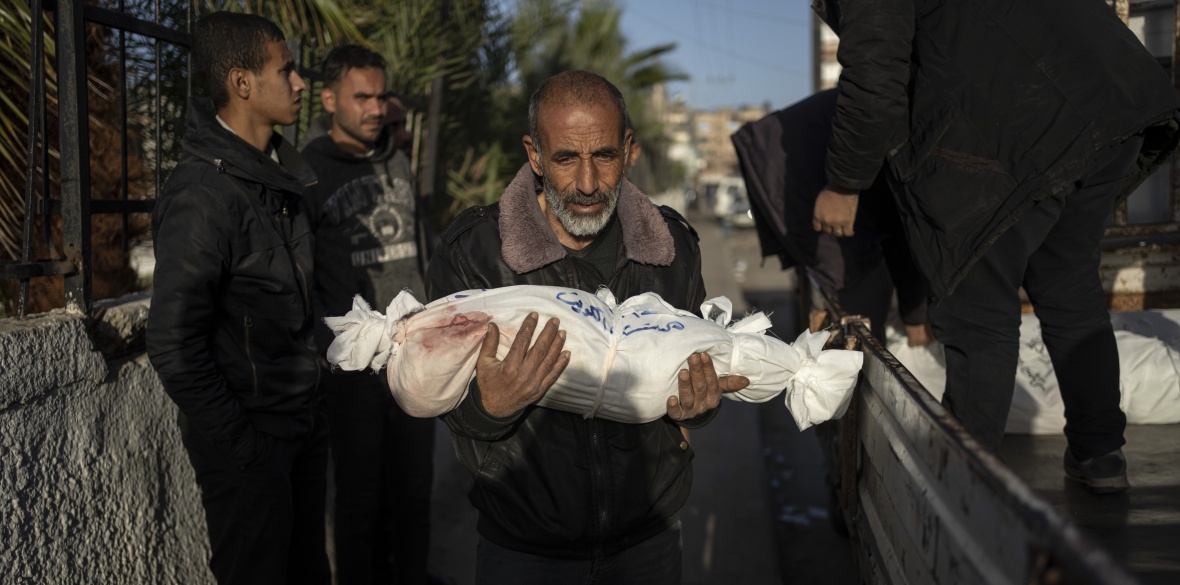
‘This Genocide Must End Now’: Jewish-Led Protests Demand Gaza Cease-Fire

Spread the love

Original article by Jake Johnson at Common Dreams shared under Creative Commons (CC BY-NC-ND 3.0).

Jewish activists and allies hold a protest demanding a cease-fire in Gaza on December 14, 2023 in Atlanta, Georgia. (Photo: Jewish Voice for Peace)

“As the descendant of people who have survived pogroms, I know my ancestors would want me to do everything in my power to stop the U.S.-funded genocide unfolding in Gaza,” said one activist.

On the eighth night of Hanukkah, Jewish activists and allies took to the streets of eight U.S. cities on Thursday to demand an end to the bloodshed in Gaza, blocking traffic on bridges and highways in a show of opposition to the Biden administration’s continued support for the Israeli military’s atrocities.

“It is horrifying to watch the U.S. government fully fund the Israeli government’s relentless bombing campaign and the destruction of the people of Gaza,” said Sara Bollag of the Washington, D.C. chapter of Jewish Voice for Peace (JVP), which helped organize the protests in Seattle; Philadelphia; Los Angeles; Portland, Oregon; Washington, D.C.; Chicago; Minneapolis; and Atlanta.

“I am here, as the great-granddaughter of a victim of the Holocaust, doing everything in my power to stop another genocide unfolding before our eyes,” Bollag added.

In the nation’s capital, demonstrators holding signs that read “Cease-Fire Now” and “Never Again for Anyone” and singing Hanukkah prayers shut down an overpass.

In Chicago, more than a dozen Jewish demonstrators were arrested for obstructing the Washington Street bridge.

“As the descendant of people who have survived pogroms, I know my ancestors would want me to do everything in my power to stop the U.S.-funded genocide unfolding in Gaza,” said Millie Hartenstein of JVP Chicago.

The nationwide demonstrations came amid growing domestic and international outrage over the Biden administration’s decision to keep arming the Israeli government and opposing global efforts to secure a lasting cease-fire as the humanitarian crisis in Gaza spirals out of control, leaving most of the territory’s population without adequate food, clean water, humane living conditions, and sufficient medical treatment.

“Everywhere you look is congested with makeshift shelters. Everywhere you go, people are desperate, hungry, and terrified,” Philippe Lazzarini, commissioner-general of the United Nations Relief and Works Agency for Palestine Refugees in the Near East, said in a speech on Thursday. “People—and this is also something completely new—people are stopping aid trucks, taking the food, and eating it right away. This is how desperate and hungry they are. I witnessed this firsthand.”

President Joe Biden’s national security adviser, Jake Sullivan, met with Israeli leaders on Thursday and reportedly urged them to “switch to more precise tactics in about three weeks” in an attempt to “communicate that American patience with widespread civilian deaths is running out.” According to one human rights monitor, more than 90% of the people killed so far by Israel’s latest aerial and ground assault on Gaza have been civilians.

A U.S. intelligence assessment reported by CNN on Wednesday found that nearly half of the munitions Israel has dropped on Gaza since October 7 have been so-called “dumb bombs,” unguided weapons whose use in densely populated areas could violate international law.

The U.S. has provided Israel with both guided and unguided munitions, as well as artillery shells and other weaponry. Just last Friday, the State Department bypassed a congressional review process to push through the sale of 13,000 rounds of tank ammunition to Israel.

Earlier this week, top humanitarian aid leaders implored the U.S. government to urgently change its approach to halt Gaza’s “apocalyptic free fall” and dozens of Biden administration staffers held a vigil outside the White House demanding an immediate cease-fire, the latest sign of mounting internal dissent.

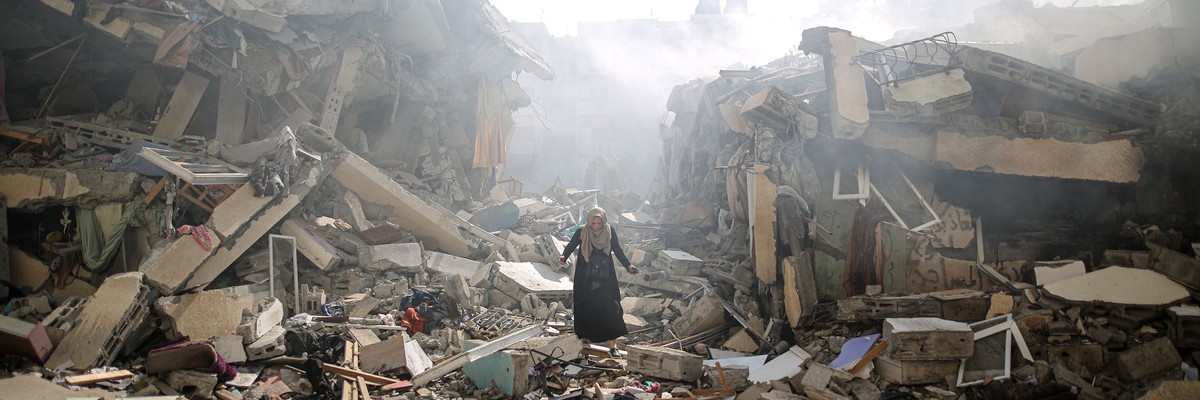
“We have seen refugee camps, hospitals, schools, and entire neighborhoods bombed,” Josh Paul, a former State Department official who resigned in October over the Biden administration’s unconditional arms transfers to Israel, said during Thursday’s vigil. “We have seen dead men, women, and children pulled from the rubble in their pajamas. We have seen harassment, humiliation, and degradation of many kinds. This is unacceptable.”

Original article by Jake Johnson at Common Dreams shared under Creative Commons (CC BY-NC-ND 3.0).

Warren Demands Facebook-Instagram Explain Censorship of Pro-Palestinian Content

Union Leaders Join Progressive Lawmakers in Demanding Gaza Cease-Fire Now

IDF Admits to Firing on and Killing Three Israeli Hostages in Gaza

Continue Reading‘This Genocide Must End Now’: Jewish-Led Protests Demand Gaza Cease-Fire

73% of US Voters Want Emissions Cut in Half by 2030: Poll

Spread the love

Original article by JESSICA CORBETT republished from Common Dreams under Creative Commons (CC BY-NC-ND 3.0). 

Climate protestors march in Washington DC
Climate protestors take part in a march on April 29, 2023 in Washington, D.C.  (Photo: Samuel Corum/Getty Images)

One expert expressed hope that Democrats “realize that strong positions on abortion and climate change are no longer ‘partisan’ or ‘divisive’—religious freedom, bodily privacy, and saving the world are BIG TENT, winning issues.”

Polling results released Friday by CNN show that 73% of U.S. voters across the political spectrum believe the government should design policies to meet its commitment to cut planet-heating emissions in half by the end of this decade.

End Climate Science founding director Genevieve Guenther noted on social media that the overall figure includes 95% of Democrats, 76% of Independents, and even 50% of Republicans.

She expressed hope that the Democratic Party will now “realize that strong positions on abortion and climate change are no longer ‘partisan’ or ‘divisive’—religious freedom, bodily privacy, and saving the world are BIG TENT, winning issues.”

The survey was conducted by SSRS last month and the results were revealed during the United Nations Climate Change Conference (COP28) set to run through Tuesday—which U.S. President Joe Biden has been criticized for blowing off.

As CNN detailed:

Americans give Biden a 43% approval rating for his handling of environmental policy, which is several points above his overall approval rating and well above his numbers for handling the economy. But few Americans, only 2%, see climate change as the most important issue facing the country, giving higher priority to the economy and cost of living.

But climate change and clean energy are increasingly intertwined with the economy. Climate change-fueled disasters don’t just impact commerce, they also strike at the heart of the American dream: homeownership.

The approval and disapproval responses strongly correlate to political party, with far more Democrats backing Biden’s environmental policy.

Most Americans disapprove of President Biden’s handling of environmental policy

(Graphic: Matt Stiles/CNN)

Pollsters found that 58% of voters worry about the effects of extreme weather, 68% worry about the risks of climate change, and 79% think that climate change contributed to extreme weather in their area.

Large majorities of voters from the partisan spectrum agreed that humanity as a whole, the energy and automobile industries, and the U.S. and Chinese governments have some or even a great deal of responsibility to try to reduce climate change. Slightly smaller majorites said that those entities are doing “too little” to address the emergency.

Two-thirds of voters said that “requiring that all electricity in the U.S. be produced using renewable sources like solar and wind by the year 2035” as well as “offering federal tax credits for purchasing and installing home solar panels should be important, or even top priorities.

Even more (71%) noted the importance of “offering federal tax credits for purchasing and installing ultra-efficient home heating and cooling systems” along with “prioritizing investments in clean energy sources over energy from fossil fuels.” A slim majority (54%) prioritized “offering federal tax credits for purchasing an electric vehicle.”

While Biden—who is seeking reelection next year—campaigned on the promise of being a “climate president,” during his first term so far he has faced criticism from campaigners and frontline communities for declining to declare a national climate emergency, supporting the Willow oil project and Mountain Valley Pipeline, backing the expansion of liquefied natural gas exports, and continuing fossil fuel lease sales for public lands and waters.

The president has also had to contend with Republicans and right-wing Democrats in Congress who want to kill or water down climate policies. For example, this week, the House GOP has voted to block a proposed Biden administration rule meant to accelerate the transition to electric vehicles and advance various fossil fuel industry-friendly bills, including one that would saddle taxpayers with the cost of cleaning up oil and gas wells on federal lands.

This article’s headline has been corrected to say 73% of voters want U.S. emissions cut in half by 2030. A previous version stated voters want the emissions slashed by 2023.

Original article by JESSICA CORBETT republished from Common Dreams under Creative Commons (CC BY-NC-ND 3.0). 

Continue Reading73% of US Voters Want Emissions Cut in Half by 2030: Poll

Warren Leads Letter Pressing Biden on Israel’s Use of US Arms

Spread the love

Original article by BRETT WILKINS republished from Common Dreams under Creative Commons (CC BY-NC-ND 3.0). 
An Israeli soldier carries a 155mm artillery shell near a self-propelled howitzer deployed at a position near the border with Lebanon in the upper Galilee region of northern Israel on October 18, 2023. (Photo: Jalaa Marey/AFP via Getty Images)

The senators—who are seeking improved oversight—sounded the alarm on the “staggering number of civilian deaths” caused by Israeli bombing with U.S.-supplied ordnance.

As the number of Gazans killed, maimed, or left missing by Israeli bombs and bullets—many of them manufactured in the United States— tops 60,000, a group of U.S. senators on Tuesday urged President Joe Biden to boost oversight of how American arms are used against Palestinian civilians.

Noting that Israel’s response to the Hamas-led attacks of October 7 “has killed over 15,000 Palestinians in Gaza, the vast majority of whom are civilians,” Sens. Elizabeth Warren (D-Mass.), Jeff Merkley (D-Ore.), Bernie Sanders (I-Vt.), Tim Kaine (D-Va.), and Martin Heinrich (D-N.M.) asked the White House for “information on the accountability and oversight measures that ensure any use of U.S. weapons is in accordance with U.S. policy and international law.”

“U.S. allies and human rights groups have argued many of these deaths were preventable,” the senators wrote in their letter. “In its campaign, Israel has also repeatedly targeted areas it previously designated as ‘safe zones,’ after telling Palestinians to move to these locations for safety.”

“[Israel Defense Forces] airstrikes have also hit the densely populated Jabalia refugee camp multiple times,” the lawmakers noted. “The first strike killed ‘more than 100 people’ and injured ‘hundreds’ more. The second strike left dozens wounded and rescuers said those killed included ‘whole families’… Other strikes and operations have targeted hospitals.”

A growing number of legal, human rights, and other experts have called Israel’s war on Gaza a genocide.

The senators’ letter continues:

While these strikes were aimed at Hamas, we have concerns that strikes on civilian infrastructure have not been proportional, particularly given the predictable harm to civilians. The United Nations Secretary-General António Guterres has said these strikes are ‘clear violations of international humanitarian law.’ Even Israeli Prime Minister Benjamin Netanyahu has admitted that his government’s efforts to minimize civilian casualties to date are ‘not successful.’

The letter singles out 155mm artillery shells, unguided explosive rounds with a “kill radius” of about 50 meters, with shrapnel able to kill and wound people hundreds of meters away.

“The IDF requires its ground forces to stay 250 meters away to protect its own forces,” the letter states. “The IDF has previously used these shells to ‘hit populated areas including neighborhoods, hospitals, schools, shelters, and safe zones,’ causing a staggering number of civilian deaths.”

“Over 30 U.S.-based civil society organizations warned against providing Israel 155mm shells in an open letter to [U.S. Defense Secretary Lloyd] Austin calling the shells ‘inherently indiscriminate’ and ‘a grave risk to civilians,'” the lawmakers added.

Claiming that “civilian harm prevention is a cornerstone of American foreign policy”—a curious assertion given that the United States has killed more foreign civilians by far than any other armed force on the planet since the end of World War II—the senators argued that “we must ensure accountability for the use of U.S. weapons we provided to our ally.”

“As you have acknowledged, Israel’s military campaign has included ‘indiscriminate bombing,'” they wrote. “Your administration must ensure that existing guidance and standards are being used to evaluate the reports of Israel using U.S. weapons in attacks that harm civilians in order to more rigorously protect civilian safety during Israel’s operations in Gaza.”

To that end, the senators ask Biden to answer 13 questions, including:

  • Are U.S. officials aware of the IDF’s current policy on preventing civilian harm?
  • What insights does the U.S. government have into how the Israeli military assesses issues of proportionality?
  • What systems does the Israeli government have in place to investigate allegations of civilian harm?
  • Does the U.S. Defense Department or State Department plan to provide Israel with guidance on how 155mm shells should be
    used when civilians are nearby?
  • Are you aware of any requests for inspector general reviews or audits of U.S. military assistance provided to Israel?

The senators’ letter came ahead of Wednesday’s procedural vote on whether to begin debating a $106 billion “national security” spending package requested by Biden, which includes more than $10 billion in additional U.S. military aid to Israel atop the nearly $4 billion it receives each year from Washington.

On Tuesday, Sanders—who has angered progressives by failing to demand a Gaza cease-fire—said he opposes sending billions of dollars in unconditional U.S. armed aid to the “right-wing, extremist” Israeli government led by Prime Minister Benjamin Netanyahu.

“Israel must dramatically change its approach to minimize civilian harm,” he said, “and lay out a wider political process that can secure lasting peace.”

Original article by BRETT WILKINS republished from Common Dreams under Creative Commons (CC BY-NC-ND 3.0). 

Human Rights Monitor Says 90% Killed by Israel in Gaza Were Civilians

US Official Won’t Call Forced Abandonment of Gaza Newborns a War Crime

‘Apocalyptic’ Horror in Gaza Called ‘Total Failure of Our Shared Humanity’

Continue ReadingWarren Leads Letter Pressing Biden on Israel’s Use of US Arms

UN Chief Invokes Article 99 to Spur Security Council Action on Gaza

Spread the love
United Nations Secretary-General António Guterres discusses climate change at U.N. headquarters in New York City on July 27, 2023.

“Facing a severe risk of collapse of the humanitarian system in Gaza, I urge the council to help avert a humanitarian catastrophe and appeal for a humanitarian cease-fire to be declared.”

With over 16,000 Palestinians dead just two months into Israel’s war on the Gaza Strip, United Nations Secretary-General António Guterres on Wednesday demanded immediate action by the U.N. Security Council.

For the first time since becoming secretary-general nearly seven years ago, Guterres invoked Article 99, a rarely used section of the U.N. Charter empowering him to bring to the attention of the council “any matter which in his opinion may threaten the maintenance of international peace and security.”

U.N. spokesperson Stéphane Dujarric said that Guterres was invoking Article 99 “given the scale of the loss of human life in Gaza and Israel, in such a short amount of time.”

“I think it’s arguably the most important invocation,” Dujarric told reporters at U.N. headquarters, “in my opinion, the most powerful tool that he has.”

“The international community has a responsibility to use all its influence to prevent further escalation and end this crisis.”

Guterres wrote to José Javier De la Gasca Lopez Domínguez, the Ecuadorian president of the Security Council, that “more than eight weeks of hostilities in Gaza and Israel have created appalling human suffering, physical destruction and collective trauma across Israel and the occupied Palestinian territory.”

The U.N. chief reaffirmed his condemnation of the October 7 Hamas-led attack on Israel—in which around 1,200 people were killed and over 200 others were captured—that led to the war. He called accounts of sexual violence “appalling” and stressed that the remaining hostages “must be immediately and unconditionally released.”

He also emphasized that “civilians throughout Gaza face grave danger,” with the Israeli airstrikes and raids damaging more than half of all homes and displacing about 80% of the 2.3 million residents. Over a million of them have sought shelter at U.N. facilities, “creating overcrowded, undignified, and unhygienic conditions,” while others “find themselves on the street.”

“The healthcare system in Gaza is collapsing,” he noted, pointing out that only 14 of 36 hospitals are operating at all. “I expect public order to completely break down soon due to the desperate conditions, rendering even limited humanitarian assistance impossible. An even worse situation could unfold, including epidemic diseases and increased pressure for mass displacement into neighboring countries.”

Already, conditions in Gaza are making “it impossible for meaningful humanitarian operations to be conducted,” Guterres added. “The capacity of the United Nations and its humanitarian partners has been decimated by supply shortages, lack of fuel, interrupted communications, and growing insecurity.”

“The situation is fast deteriorating into a catastrophe with potentially irreversible implications for Palestinians as a whole and for peace and security in the region. Such an outcome must be avoided at all cost,” the U.N. leader warned. “The international community has a responsibility to use all its influence to prevent further escalation and end this crisis.”

“I urge the members of the Security Council to press to avert a humanitarian catastrophe,” he wrote. “I reiterate my appeal for a humanitarian cease-fire to be declared. This is urgent. The civilian population must be spared from greater harm.”

The United States—a supporter of Israel’s war and one of the U.N. Security Council’s five permanent members—vetoed a mid-October resolution condemning violence against civilians in Israel and Gaza and urging “humanitarian pauses” for aid delivery.

Roughly a month later, the Security Council approved a Gaza resolution that calls on all parties to abide by their obligations under international law and advocates for “urgent and extended humanitarian pauses and corridors.”

Dr. Christos Christou, international president of Médecins Sans Frontières, or Doctors Without Borders, said at the time that “the unacceptably jumbled and sluggish process finally led to the adoption of a text that does not come close to reflecting the severity of the humanitarian catastrophe in Gaza.”

Continue ReadingUN Chief Invokes Article 99 to Spur Security Council Action on Gaza

COP28 Loss and Damage Fund Called ‘Drop in the Ocean’

Spread the love

Original article by JULIA CONLEY republished from Common Dreams under Creative Commons (CC BY-NC-ND 3.0). 

Pakistani flood victims wade through floodwaters after monsoon rains in Matiari, Sindh province, Pakistan on August 29, 2022.  (Photo: Shakeel Ahmad/Anadolu Agency via Getty Images)

The United States’ contribution of $17.5 million, in particular, was denounced as “embarrassing” for the wealthiest country in the world.

International campaigners who for years have demanded a global “loss and damage” fund to help developing countries confront the climate emergency were encouraged on Thursday as the 28th United Nations Climate Change Conference began with an agreement to make the fund operational—but said the details of the deal made clear that wealthy countries are still largely abandoning communities that have contributed the least fossil fuel emissions, only to suffer the worst climate injustices.

A recent study from the University of Delaware showed that “the unweighted percentage of global GDP lost” due to climate impacts such as long-lasting drought, catastrophic flooding, and wildfires is estimated at 1.8%, or about $1.5 trillion, and low- and middle-income countries “have experienced $2.1 trillion in produced capital losses due to climate change.”

To meet the need, developing countries have said they already require about $400 billion annually in a loss and damage fund that could help governments rebuild communities, restore crucial wildlife habitats, or relocate people who have been displaced by the climate emergency—so advocates on Thursday were left wondering why the fund agreed upon at COP28 was expected to provide only about $100 billion per year by 2030.

The shortfall threatened to ensure the loss and damage fund will remain “an empty promise,” said Fanny Petitbon, head of advocacy for Care France.

“We hope the agreement will result in rapid delivery of support for communities on the frontlines of the climate crisis,” said Petitbon. “However, it has many shortcomings. It enables historical emitters to evade their responsibility. It also fails to establish the scale of finance needed and ensure that the fund is anchored in human rights principles.”

“We urgently call on all governments who are most responsible for the climate emergency and have the capacity to contribute to announce significant pledges in the form of grants,” she added. “Historical emitters must lead the way.”

The United States, the largest historical contributor of the planet-heating emissions that scientists agree are fueling the climate crisis, has objected to tying loss and damage funding to each wealthy nation’s emissions—perhaps partially explaining why the Biden administration pledged only $17.5 million to the fund.

Such contributions are “a drop in the ocean compared to the scale of the need they are to address,” said Mohamed Adow, director of Power Shift Africa.

“In particular, the amount announced by the U.S. is embarrassing for President [Joe] Biden and [Special Presidential Climate Envoy] John Kerry,” said Adow. “It just shows how this must be just the start.”

Campaigners also objected to the agreement’s stipulation that the World Bank will host the fund for the first four years—a demand that had been made by the U.S. and other wealthy countries—with voluntary payments from powerful governments that will be “invited,” not required, to contribute.

“Although rules have been agreed regarding how the fund will operate there are no hard deadlines, no targets, and countries are not obligated to pay into it, despite the whole point being for rich, high-polluting nations to support vulnerable communities who have suffered from climate impacts,” said Adow.

“The most pressing issue now is to get money flowing into the fund and to the people that need it,” he added. “The pledged funds must not just be repackaged commitments. We need new money, in the form of grants, not loans, otherwise it will just pile more debt onto some of the poorest countries in the world, defeating the point of a fund designed to improve lives.”

The United Arab Emirates, which is hosting COP28, pledged $100 million to the fund, a sum that was matched by Germany. The United Kingdom committed to contributing 60 million British pounds, or about $75 million, while Japan pledged $10 billion. The U.S. also said it would provide $4.5 million to the Pacific Resilience Facility, which will offer loss and damage funding to Pacific Island nations, and $2.5 million for the Santiago Network, which will provide technical support to developing countries.

Izzie McIntosh, climate campaign manager at U.K.-based Global Justice Now, called the creation of the global loss and damage fund was called a “welcome, yet long overdue, step forward for our climate,” and one that “reflects the utter devastation caused by climate change in the global south, and the need for rich countries to pay what they owe for their role in it.”

Rich countries, however, “have weakened the commitment they made to climate justice by insisting on the World Bank as interim host,” added McIntosh. “This decision risks both excluding countries due to its outdated rules and deepening the debt crisis if support is provided through loans, not grants. If loss and damage funding is to be truly impactful, it must be funded and designed adequately, or risk being all talk and no action.”

At COP27 in Egypt one year ago, noted Christian Aid global advocacy lead Mariana Paoli, policymakers did not even place the loss and damage fund on the agenda.

“It’s a testament to the determination of developing country negotiators that we now already have the fund agreed and established,” she said. “It’s now vital we see the fund filled. People who have contributed the least to the climate crisis are already suffering climate losses and damages. The longer they are forced to wait for financial support to cover these costs, the greater the injustice.”

Before COP28 wraps up on December 12, Paoli added, campaigners are hoping they will “see significant new and additional pledges of money to the loss and damage fund, and not just repackaged climate finance that has already been committed.”

A fully funded, impactful loss and damage fund must be paired with a commitment by countries to end fossil fuel expansion, added Romain Ioualalen, global policy manager at Oil Change International, with rich countries “redirecting trillions in fossil industry handouts to triple renewable energy and double energy efficiency.”

“We have had enough delays,” said Ioualalen, “and this must happen now to secure a livable future.”

Original article by JULIA CONLEY republished from Common Dreams under Creative Commons (CC BY-NC-ND 3.0). 

Continue ReadingCOP28 Loss and Damage Fund Called ‘Drop in the Ocean’