The suffocating occupation of Palestine is now a series of war crimes

Spread the love

Original article by Vijay Prashad republished from peoples dispatch under a Creative Commons Attribution-ShareAlike 4.0 (CC BY-SA) license.

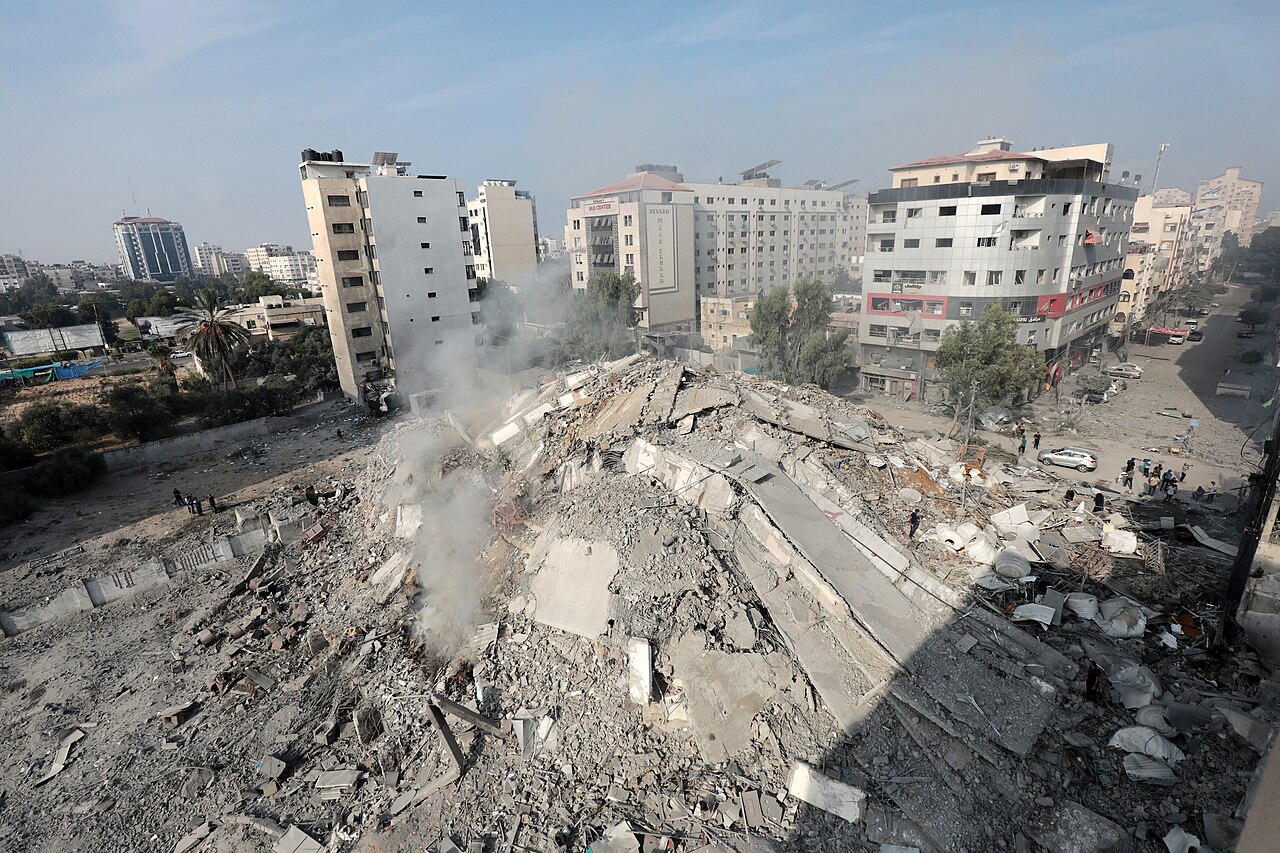
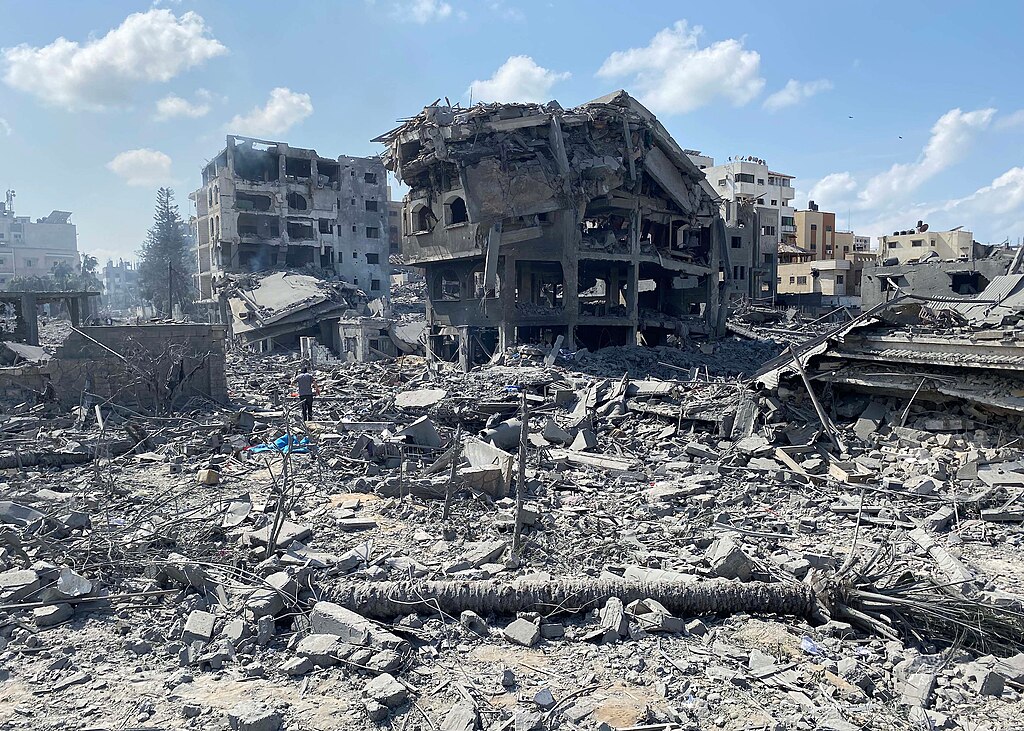
Palestinians inspect the damage following an Israeli airstrike on the El-Remal aera in Gaza City on October 9, 2023. Israel continued to battle Hamas fighters on October 10 and massed tens of thousands of troops and heavy armour around the Gaza Strip after vowing a massive blow over the Palestinian militants' surprise attack. Photo by Naaman Omar apaimages. licensed under the Creative Commons Attribution-Share Alike 3.0 Unported license.
Palestinians inspect the damage following an Israeli airstrike on the El-Remal aera in Gaza City on October 9, 2023. Israel continued to battle Hamas fighters on October 10 and massed tens of thousands of troops and heavy armour around the Gaza Strip after vowing a massive blow over the Palestinian militants’ surprise attack. Photo by Naaman Omar apaimages. licensed under the Creative Commons Attribution-Share Alike 3.0 Unported license.

Israel has grossly violated international humanitarian law in the last 3 weeks of incessant bombing of Gaza, all with the political and financial backing of the US

On October 24, it became clear to the United Nations (UN) that the sustained bombardment of Gaza—which had already killed 6,500 people (including at least 35 UN employees)—had made this part of Palestine unviable for human life. Over two million people live in this slim section of land on the Mediterranean Sea. Since 1948, the refugees who live here have relied on UN assistance, with the United Nations building an entire agency (UNRWA) in 1949 for that purpose. UN Secretary General António Guterres told the UN Security Council that within days the UN would run out of fuel for its trucks, which carry the minimal relief that crosses into Gaza from Egypt and supports the 660,000 Palestinians who have fled their homes to come to UN compounds across Gaza. The trucks carry “a drop of aid in an ocean of need,” Guterres said. “The people of Gaza need continuous aid delivery at a level that corresponds to the enormous needs. That aid must be delivered without restrictions.”

Guterres’s statement, delivered in a calm voice, did however depart from the sentiment of disregard that defines the statements of European and North American leaders—many of whom have rushed to Tel Aviv to stand beside Israeli Prime Minister Benjamin Netanyahu and pledge their full-throated support for Israel. History matters. Guterres said that the problems now befalling the Palestinians of Gaza did not begin on October 7, when Hamas and other Palestinian factions broke through the apartheid security barrier and attacked the settlements that border Gaza. His statement on the situation over the past decades is factual, based as it was on thousands of pages of UN reports and resolutions: “It is important to also recognize the attacks by Hamas did not happen in a vacuum. The Palestinian people have been subjected to 56 years of suffocating occupation. They have seen their land steadily devoured by settlements and plagued by violence; their economy stifled; their people displaced, and their homes demolished. Their hopes for a political solution to their plight have been vanishing.” The image of the “suffocating occupation” is utterly accurate.

After Guterres made these remarks, Israeli authorities—as if on cue—demanded the resignation of the UN Secretary-General. Israel’s permanent representative to the UN Gilad Erdan accused Guterres—absurdly—of “justifying terrorism.” Saying that Guterres “once again distorts and twists reality,” Erdan noted that his government would not permit the UN Humanitarian Aid chief Martin Griffiths from crossing the Rafah border into Gaza to oversee the distribution of relief. “In what world do you live?” asked Israeli Foreign Minister Eli Cohen of Guterres. At the UN Security Council, meanwhile, the United States vetoed resolutions for a ceasefire, while China and Russia vetoed a US resolution that said Israel had a right to defend itself and Iran must stop its export of arms. The United States has deeply politicized the atmosphere in the UN, using its own resolutions to rally support—unsuccessfully—for Israel, while attacking the Palestinians (and bizarrely Iran) in the process.

Nothing neutral about the United States

The United States has never been an unbiased arbiter over the region, given its close linkage to Israel from at least the 1960s. Billions of dollars of weapons sold to Israel, billions of dollars of aid to Israel, and punctual statements in favor of Israel have defined the relationship between Washington and Tel Aviv. During all the negotiations between the Palestinians and Israelis, the United States has played a game of duplicity: pretending to be neutral, but in fact, using its immense power to neuter Palestinians and to strengthen Israel. The Oslo Accords, which led to the creation of a powerless Bantustan run by the Palestinian Authority, was negotiated with the United States with its hands on the pen. Oslo led to the creation of a process that has resulted in the attrition of Palestinian control over East Jerusalem and the West Bank as well as the garrotting of the Palestinians in Gaza—all of this combined being the “suffocating occupation” that Guterres talked about.

Since 2007, when Israeli troops left Gaza and then hemmed it in by land and sea walls that made Gaza the world’s largest open-air prison, Israel has routinely bombed the Palestinians who live there. Each time there is a bombardment, one worse than the next, the United States government has backed Israel fully and re-armed it during the bombardment. Calls for a ceasefire have been blocked by Washington in the UN Security Council since the destructive bombing of Gaza called Operation Cast Lead (2008-09). This time, on cue, the United States has provided Israel with diplomatic support, with US President Joe Biden going to Tel Aviv and with the United States going as far as adopting a flagrant lie that Israel did not bomb al-Ahli Arab Hospital in Gaza City on October 17. Before Biden got to Israel, the United States sent two major naval battle groups into the eastern Mediterranean—two aircraft carriers, the USS Dwight D. Eisenhower and the USS Gerald Ford, with their supporting naval vessels in two strike groups. Since then, the US has moved missile defense systems into the region to strengthen the Israeli armed forces. The movement of these forces comes alongside billions of dollars spent annually by the US to arm Israel, including $15 billion in extra military assistance over this recent period. These wars are not merely Israel’s wars. These are the wars of Israel and the United States, with its Western allies in tow.

Gaza will become Mosul

Meanwhile, the United States has sent senior military officials to work closely with the Israeli generals. One of these officials is a three-star Marine lieutenant general James Glynn, who has been sent to “help the Israelis with the challenges of fighting an urban war.” Glynn and others are in the Israeli military chain of command not to make decisions for Israel but to assist them. Glynn was part of the US Operation Inherent Resolve against the Islamic State of Iraq and Syria (ISIS) in the years following 2014, when the United States bombed Mosul and Raqqa (Iraq) to eject ISIS from those cities. As if to underline Glynn’s Mosul and Raqqa experience, US Defense Secretary Lloyd Austin told Israel’s Defense Minister Yoav Gallant that he had himself been involved in Operation Inherent Resolve in 2016-2017 when Austin headed US Central Command. Austin’s comments and Glynn’s deployment to Israel are in anticipation of the ground war that is expected against Gaza. “The first thing that everyone should know,” Austin told ABC News, “and I think everyone does know, is that urban combat is extremely difficult.”

Indeed, Austin’s comment about the difficulty of urban combat, particularly with the Mosul and Raqqa experiences in mind, is appropriate. In 2017, the Associated Press (AP) reported that the US attack on Mosul had resulted in between 9,000 and 11,000 civilian casualties. Very few people recall the brutality of that war and the numbers of civilian dead are barely noted. If Mosul is the example before the United States and Israel for the ground war to come in Gaza, there are some differences that should be borne in mind. ISIS had only two years to dig in its defenses, while the Palestinian factions have been preparing for such an eventuality since at least 2005 and are therefore better prepared to fight the Israeli army one ruined street after the next. It appears from all reports that the morale of the Palestinian factions is far greater than that of the Israeli army, which means that the Palestinian factions will fight with much more force and with much less to lose than ISIS (whose fighters slipped out of the city and vanished into the countryside).

In both Mosul and Raqqa, when the US aerial bombardment began, tens of thousands of civilians fled the cities for the countryside alongside some ISIS fighters to wait for the destruction to commence and then end. If they had remained in Mosul and Raqqa, the civilian casualties would have been twice the number reported by AP. Mosul’s population was just 1.6 million, smaller than the 2.3 million residents of Gaza—so the numbers of civilian casualties would have to be adjusted upwards. Palestinians in Gaza are trapped and cannot escape to the countryside, unlike the residents of Mosul and Raqqa. They can go nowhere as Israeli tanks enter Gaza, guns blazing. The civilian deaths in Gaza, already outrageously high due to the uncontrolled bombing by Israel, will be unimaginable during this ground war that began on October 27. Gaza, already a ruin, will be left a cemetery.

Vijay Prashad is an Indian historian, editor, and journalist. He is a writing fellow and chief correspondent at Globetrotter. He is an editor of LeftWord Books and the director of Tricontinental: Institute for Social Research. He has written more than 20 books, including The Darker Nations and The Poorer Nations. His latest books are Struggle Makes Us Human: Learning from Movements for Socialism and (with Noam Chomsky) The Withdrawal: Iraq, Libya, Afghanistan, and the Fragility of US Power.

This article was produced by Globetrotter.

Original article by Vijay Prashad republished from peoples dispatch under a Creative Commons Attribution-ShareAlike 4.0 (CC BY-SA) license.

Continue ReadingThe suffocating occupation of Palestine is now a series of war crimes

Julian Assange to be made honorary citizen of Rome

Spread the love
Julian Assange speaks at London's Ecuadorian Embassy
Julian Assange speaks at London’s Ecuadorian Embassy

https://www.reuters.com/world/europe/julian-assange-be-made-honorary-citizen-rome-2023-10-19/?rpc=401&

ROME, Oct 19 (Reuters) – Jailed WikiLeaks founder Julian Assange will become an honorary citizen of Rome by early next year following a vote this week by its local assembly, the city’s former mayor Virginia Raggi said on Thursday.

Assange, 52, has been in London’s high-security Belmarsh prison since 2019 and is wanted in the United States over the release of confidential U.S. military records and diplomatic cables in 2010.

Other Italian cities have taken similar steps. The northern city of Reggio Emilia granted Assange citizenship last month, while Naples is set to follow shortly.

If extradited to the United States, Assange risks a sentence of up to 175 years in a maximum-security prison.

https://www.reuters.com/world/europe/julian-assange-be-made-honorary-citizen-rome-2023-10-19/?rpc=401&

Continue ReadingJulian Assange to be made honorary citizen of Rome

Pope Francis Urges Climate Action as World Nears ‘Breaking Point’

Spread the love

Original article by OLIVIA ROSANE republished from Common Dreams under Creative Commons (CC BY-NC-ND 3.0). 

Pope Francis during the act of appointment of cardinals in the Vatican Basilica of St. Peter, on September 30, 2023, in Rome, Italy.
 (Photo: Stefano Spaziani/Europa Press via Getty Images)

“The necessary transition towards clean energy sources such as wind and solar energy, and the abandonment of fossil fuels, is not progressing at the necessary speed,” he said.

In his second major address on the climate crisis, Pope Francis called for urgent global action ahead of the COP28 United Nations climate conference.

The pontiff’s remarks came in a papal exhortation published Wednesday morning titled “Laudate Deum” or “praise God.”

“We must move beyond the mentality of appearing to be concerned but not having the courage needed to produce substantial changes,” Francis said.

The pope made waves in 2015 when he published an encyclical on climate and the environment titled Laudato Si, shortly before world leaders negotiated the Paris agreement. An exhortation is a shorter, less prestigious document, according to The Washington Post. In Wednesday’s document, the first he has published on the climate crisis in eight years, Francis reflected on how far the world hadn’t come.

“With the passage of time, I have realized that our responses have not been adequate, while the world in which we live is collapsing and may be nearing the breaking point,” he said.

As the world prepares for COP28, he said that international agreements had not so far led to effective action.

“The necessary transition towards clean energy sources such as wind and solar energy, and the abandonment of fossil fuels, is not progressing at the necessary speed,” he said. “Consequently, whatever is being done risks being seen only as a ploy to distract attention.”

“In conferences on the climate, the actions of groups negatively portrayed as ‘radicalized’ tend to attract attention. But in reality they are filling a space left empty by society as a whole.”

He also addressed concerns about the conference being hosted in a major oil-producing country, though he acknowledged that the United Arab Emirates had made significant investments in renewable energy.

“Meanwhile, gas and oil companies are planning new projects there, with the aim of further increasing their production,” he said.

The pope warned about the consequences of inaction:

We know that at this pace in just a few years we will surpass the maximum recommended limit of 1.5° C and shortly thereafter even reach 3° C, with a high risk of arriving at a critical point. Even if we do not reach this point of no return, it is certain that the consequences would be disastrous and precipitous measures would have to be taken, at enormous cost and with grave and intolerable economic and social effects. Although the measures that we can take now are costly, the cost will be all the more burdensome the longer we wait.

Yet he also counseled against abandoning hope, saying it “would be suicidal, for it would mean exposing all humanity, especially the poorest, to the worst impacts of climate change.”

Instead, he argued that hope should be found in structural changes rather than relying entirely on technological fixes like carbon capture.

“We risk remaining trapped in the mindset of pasting and papering over cracks, while beneath the surface there is a continuing deterioration to which we continue to contribute,” he wrote. “To suppose that all problems in the future will be able to be solved by new technical interventions is a form of homicidal pragmatism, like pushing a snowball down a hill.”

Throughout the text, he emphasized climate justice, pointing out that the wealthy world had contributed more to the crisis, while the Global South suffered disproportionately from its impacts. In particular, he called on the United States to alter its energy-intensive lifestyle.

“If we consider that emissions per individual in the United States are about two times greater than those of individuals living in China, and about seven times greater than the average of the poorest countries, we can state that a broad change in the irresponsible lifestyle connected with the Western model would have a significant long-term impact,” he said.

“Global leaders meeting in Dubai for COP28 must heed the pope’s call to agree to a just and equitable phaseout of all fossil fuels and a transition to renewable energy, with adequate financial support for impacted countries.”

He also defended climate activists who have been criticized for disruptive tactics.

“In conferences on the climate, the actions of groups negatively portrayed as ‘radicalized’ tend to attract attention,” he said. “But in reality they are filling a space left empty by society as a whole, which ought to exercise a healthy ‘pressure,’ since every family ought to realize that the future of their children is at stake.”

Several long-time climate advocates welcomed Pope Francis’ remarks.

“The pope’s intervention ahead of the Dubai climate talks is welcome and adds to an increasingly loud chorus of voices demanding that countries tackle the root cause of the climate crisis: fossil fuels,” Mariam Kemple Hardy, global campaigns manager at Oil Change International, said in a statement. “The pope is right to point out the growing gap between the urgent need to phase out all fossil fuels and the fact that countries and the oil and gas industry are doubling down on new production that is incompatible with a livable climate.”

Hardy also echoed the pope’s emphasis climate justice, calling out wealthy nations for continuing to exploit fossil fuels.

“Global leaders meeting in Dubai for COP28 must heed the pope’s call to agree to a just and equitable phaseout of all fossil fuels and a transition to renewable energy, with adequate financial support for impacted countries. Unless it does so, COP28 will be a failure,” Hardy said.

350.org and Third Act co-founder Bill McKibben hoped that the pope’s message might succeed where others had failed.

“The work of spiritual leaders around the world may be our best chance of getting hold of things,” McKibben toldThe Guardian. “Yes, the engineers have done their job. Yes, the scientists have done their job. But it’s high time for the human heart to do its job. That’s what we need this leadership for.”

Original article by OLIVIA ROSANE republished from Common Dreams under Creative Commons (CC BY-NC-ND 3.0). 

Continue ReadingPope Francis Urges Climate Action as World Nears ‘Breaking Point’

‘Gross Denial of Reality’: Biden Infuriates With Approval of More Offshore Drilling

Spread the love

Original article by JULIA CONLEY republished from Common Dreams under Creative Commons (CC BY-NC-ND 3.0). 
While the aftermath of hurricanes continue to affect residents, such as those in Houston, Texas devastated by Hurricane Harvey (see image), research has found that the frequency and intensity of these latest storms have done little to shift public opinion about their connection with global warming. (Photo: Texas Military Department, Flickr CC BY-ND 2.0)
While the aftermath of hurricanes continue to affect residents, such as those in Houston, Texas devastated by Hurricane Harvey (above), research has found that the frequency and intensity of these latest storms have done little to shift public opinion about their connection with global warming. (Photo: Texas Military Department, Flickr CC BY-ND 2.0)

“End Fossil Fuels is pretty clear,” said one advocate. “Not ‘hold slightly fewer lease sales,’ not ‘talk about climate action’—End. Fossil. Fuels.”

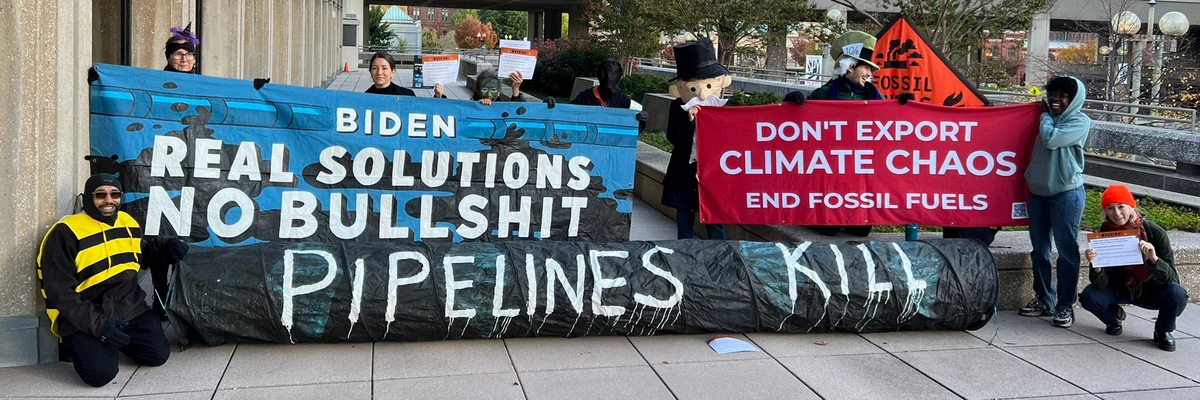
Rejecting the corporate media’s narrative that U.S. President Joe Biden’s newly-released offshore drilling plan includes the “fewest-ever” drilling leases, dozens of climate action and marine conservation groups on Friday said the president had “missed an easy opportunity to do the right thing” and follow through on his campaign promise to end all lease sales for oil and gas extraction in the nation’s waters.

The U.S. Interior Department announced Friday its five-year plan for the National Outer Continental Shelf Oil and Gas Leasing Program, including three new areas in the Gulf of Mexico where fossil fuel companies will be permitted to drill.Biden promised “no new drilling, period” as a presidential candidate, and the plan was announced six months after climate advocates were incensed by the administration’s approval of the Willow oil drilling project in Alaska.The new leases will be added to more than 9,000 drilling leases that have already been sold, and is “incompatible with reaching President Biden’s goal of cutting emissions by 50-52% by 2030,” said the Protect All Our Coasts Coalition, citing the findings of Biden’s own Environmental Protection Agency (EPA) and its Office of Atmospheric Protection earlier this year.

While the final plan scales back from the eleven sales that were originally proposed, said the coalition, “the plan is a step backwards from the climate goals the administration has set and for environmental justice communities across the Gulf South, who are already experiencing the disproportionate impact of fossil fuel extraction across the region.”

The coalition includes the Port Arthur Community Action Network, which has called attention to the risks posed to public health in the Gulf region by continued fossil fuel extraction.

“Folks in Port Arthur, Texas die daily from cancer, respiratory, heart, and kidney disease from the very pollution that would come from more leases and drilling,” said John Beard, the founder, president, and executive director of the group. “If Biden is to truly be the environmental president, he should stop any further leasing and all forms of the petrochemical build-out, call for a climate emergency, and jumpstart the transition to clean green, renewable energy, and lift the toxic pollution from overburdened communities.”

Kendall Dix, national policy director of Taproot Earth, dismissed political think tanks that applauded the “historically few lease sales” on Friday.

“The earth does not recognize political ‘victories,'” said Dix, pointing to an intrusion of saltwater in South Louisiana’s drinking water in recent weeks, which has been exacerbated by the fossil fuel-driven climate crisis.

“As the head of the United Nations and has said, continued fossils fuel development is incompatible with human survival,” he added. “We need to transition to justly sourced renewable energy that’s democratically managed and accountable to frontline communities as quickly as possible.”

Along with groups in the Gulf region, national organizations on Friday condemned a plan that they said blatantly ignores the repeated warnings of international energy experts and the world’s top climate scientists who say no new fossil fuel expansion is compatible with a pathway to limiting planetary heating to 1.5°C.

“Sacrificing millions of acres in the Gulf of Mexico for oil and gas extraction when scientists are clear that we must end fossil fuel expansion immediately is a gross denial of reality by Joe Biden in the face of climate catastrophe,” said Collin Rees, United States program manager at Oil Change International. “Doubling down on drilling is a direct violation of President Biden’s prior commitments and continues a concerning trend.”

Rees noted that 75,000 people marched in New York City last week to demand that Biden declare a climate emergency and end support for any new fossil fuel extraction projects.

“End Fossil Fuels is pretty clear,” said Rees, referring to campaigners’ rallying cry. “Not ‘hold slightly fewer lease sales,’ not ‘talk about climate action’—End. Fossil. Fuels.”

Despite Biden’s campaign promises, Rees noted, the U.S. is currently “on track to expand fossil fuel production more than any other country by 2050.”

“I feel disgusted and incredibly let down by Biden’s offshore drilling plan. It piles more harm on already-struggling ecosystems, endangered species and the global climate,” said Brady Bradshaw, senior oceans campaigner at the Center for Biological Diversity, another member of the Protect All Our Coasts Coalition. “We need Biden to commit to a fossil fuel phaseout, but actions like this condemn us to oil spills, climate disasters, and decades of toxic harm to communities and wildlife.”

The lease sales, said Sarah Winter Whelan of the Healthy Ocean Coalition, also represent a missed opportunity by the administration to treat the world’s oceans “as a climate solution, not a source for further climate disaster.”

Under the Inflation Reduction Act, negotiated by the White House last year, the government is required to offer at least 60 million acres of offshore gas and oil leases before developing new wind power projects of similar scope.

“A single new lease sale for offshore oil and gas exploration is one too many,” said Whelan. “Communities around the country are already dealing with exacerbating impacts from climate disruption caused by our reliance on fossil fuels. Any increase in our dependence on fossil fuels just bakes in greater impacts to humanity.”

Gulf communities, added Beard, “refuse to be sacrificed” for fossil fuel profits.

“We say enough is enough,” he said.

Original article by JULIA CONLEY republished from Common Dreams under Creative Commons (CC BY-NC-ND 3.0). 
Continue Reading‘Gross Denial of Reality’: Biden Infuriates With Approval of More Offshore Drilling

AOC Says Climate Movement Must Become ‘Too Big and Too Radical to Ignore’

Spread the love
Rep. Alexandria Ocasio-Cortez (D-NY) speaks in front of the U.S. Capitol on July 28th, 2022. (Photo by Nathan Posner/Anadolu Agency via Getty Images)

Original article by JON QUEALLY republished from Common Dreams under Creative Commons (CC BY-NC-ND 3.0). 

“We have to send the message that some of us are going to be living on this planet 30, 40, 50 years from now and we will not take no for an answer.”

Congresswoman Alexandria Ocasio-Cortez issued a fiery speech to the tens of thousands of climate marchers who took to the streets of New York City on Sunday, telling the crowd that “it means something” when people show up in force because now is the time for elected leaders in the United States and around the world to finally show “urgency” on the issue of soaring global temperatures that are driven by the burning of fossil fuels.

“The way that we create urgency on the issue of climate,” declared Ocasio-Cortez, “is when we have people all across the world in the streets—in the streets!—showing up, demanding change, and demanding a cessation of what is killing us. We have to send the message that some of us are going to be living on this planet 30, 40, 50 years from now and we will not take no for an answer.”

Over 75,000 are estimated to have marched Sunday ahead of the rally that capped off days of organized action in New York and elsewhere in the country and around the world. All of the coordinated activities came ahead of this week’s United Nation’s General Assembly, including a Climate Ambition Summit initiated by U.N. Secretary-General António Guterres slated for Wednesday.

Calling the climate crisis “the biggest issue of our time,” the New York Democrat said the organized movement demanding bold change “must be too big and too radical to ignore.”

Ocasio-Cortez touted her 2019 Green New Deal legislation that called for a 10-year time period for rapid decarbonization alongside a shift to renewable energy that also includes a just transition for workers impacted by the shift away from good-paying and reliable jobs in the oil, gas, and coal industries.

“We are demanding a change,” she said, “so that working people get better jobs and lower bills under a renewable energy economy—that is what we are here to make sure we achieve!”

Further, Ocasio-Cortez slammed the U.S. government under the Biden administration for approving a record number of oil and gas drilling leases and told the crowd “that has got to end today” as she applauded the climate movement for starting to “crack the grip” which the fossil fuel industry holds on the nation’s political economy.

“That’s because of you,” she said to those in the crowd. “Don’t let the cynics win. The cynics want us to think that this isn’t worth it. The cynics want us to believe that we can’t win. The cynics want us to believe that organizing doesn’t matter; that our political system doesn’t matter; that our economy doesn’t matter. But we’re here to say that we organize out of hope! We organize out of commitment! We organize out of love! We organize out of the beauty of our future! And we will not give up. We will not let go! We will not let cynicism to prevail!”

Original article by JON QUEALLY republished from Common Dreams under Creative Commons (CC BY-NC-ND 3.0). 
Continue ReadingAOC Says Climate Movement Must Become ‘Too Big and Too Radical to Ignore’