Tag: UNRWA

  • ICJ expands urgent measures in genocide case against Israel as famine “sets in” in Gaza

    Spread the love

    Original article by Tanupriya Singh republished from peoples dispatch under a Creative Commons Attribution-ShareAlike 4.0 (CC BY-SA) license.

    Photo: WHO via UN NEWS

    The Court has issued orders for Israel to “ensure” the “unhindered provision” of humanitarian aid, as 31 people have been killed due to deliberate starvation in Gaza

    Noting that the “catastrophic living conditions of the Palestinians in the Gaza Strip have deteriorated further,” the International Court of Justice (ICJ) has ordered Israel to take additional measures, including “unhindered provision” of basic necessities and humanitarian assistance, as the Occupation continues its genocidal war for the sixth month. 

    The ruling was issued on March 28 in response to a request by South Africa calling on the Court to take further action “in light of the new facts and changes in the situation in Gaza— particularly the situation of widespread starvation”. 

    According to the latest Integrated Food Security Phase Classification (IPC) analysis, both North Gaza and Gaza Governorates are “classified in IPC Phase 5 (Famine) with reasonable evidence, with 70% of the population in IPC Phase 5 (Catastrophe).”

    On March 24, the head of the UN Relief and Works Agency (UNRWA) stated that Israel had informed the UN that it would no longer approve the agency’s food convoys to north Gaza. Only 11 aid convoys of the World Food Programme have reached the area since the start of 2024. 

    In January, Israel accused UNRWA, without any concrete evidence, of employing over 450 “military operatives”. Israel’s allies in the west immediately began suspending funding for the agency, even as it has been revealed that Israel had tortured and coerced UNRWA staffers into giving false confessions. 

    Meanwhile, the US Congress has now voted to defund UNRWA as part of a USD 1.2 trillion spending bill. The legislation, which simultaneously provides the annual USD 3.8 billion in funding to Israel, will also limit aid to the Palestinian Authority (PA) in the occupied West Bank if the Palestinians initiate or support an investigation by the International Criminal Court (ICC) into Israel’s crimes. 

    South Africa’s request was part of the case it brought against Israel in December, accusing it of violating its obligations under the 1948 Convention on the Prevention and Punishment of the Crime of Genocide. Ahead of a full hearing of the case, South Africa had called on the Court to issue interim measures to prevent “severe and irreparable harm” to the Palestinians as Israel continued and escalated its attacks.

    On January 26, the Court found that it was plausible that Israel was committing genocide in Gaza and ordered six measures, including for Israel to “take all measures within its powers to prevent the commission of all acts within the scope of the [Genocide] Convention.” 

    These acts include killing, causing serious bodily or mental harm, “deliberately inflicting conditions of life calculated to bring about its physical destruction in whole or in part,” and imposing measures intended to prevent births.

    As it became immediately clear that Israel had no intentions of obeying these legally binding measures, South Africa approached the ICJ for additional measures in February. However, the Court declined to expand on its order. 

    Starvation and massacres escalate 

    In a second attempt on March 6, South Africa stated that Gazans are no longer at “immediate risk of death by starvation,” noting that at least 15 children had died of starvation in the week leading up to its submission. 

    “These deaths are “man-made, predictable and entirely preventable. It is predicted that they will increase exponentially and not linearly in the absence of a cessation of military activities and a lifting of the blockade,” it had said, adding that Israel had repeatedly used humanitarian aid as a “bargaining chip in negotiations” by creating a “hostile, inoperable environment for aid agencies.” 

    The application was submitted days after the “Flour Massacre”—neither the first nor the last atrocity of its kind. The massacre “forms part of an escalating pattern of fatal attacks by Israel on the Palestinian people it is deliberately starving, as they seek access to aid,” South Africa stated. 

    In its ruling on Thursday, the ICJ observed that “Palestinians in Gaza are no longer facing only a risk of famine… but that famine is setting in, with at least 31 people, including 27 children, having already died of malnutrition and dehydration.” 

    Also cited it a statement made by UN human rights chief Volker Türk that the “situation of hunger, starvation and famine is a result of Israel’s extensive restrictions on the entry and distribution of humanitarian aid and commercial goods, displacement of most of the population, as well as he destruction of crucial civilian infrastructure.”

    The Court held that “there is no substitute for land routes and entry points from Israel into Gaza to ensure the effective and efficient delivery of food, water, medical and humanitarian assistance; there is an urgent need to increase the capacity and number of open land crossing points into Gaza and to maintain them open…”

    The ruling took “note” of “certain declarations of representatives of the UN and the various organizations… according to which the catastrophic humanitarian situation can only be addressed if the military operations in the Gaza Strip are suspended [emphasis added].” 

    Also acknowledged is the UN Security Council resolution 2728, which “[d]emand[ed] an immediate ceasefire for the month of Ramadan respected by all parties leading to a lasting sustainable ceasefire.” 

    Not only was the Resolution’s text amended to call for a “lasting” instead of a “permanent” ceasefire under US’ threat of veto, the US ultimately went on to absurdly claim that the resolution was non-binding—statements also rejected by the UN and other SC member states. 

    It is important to note that the month of Ramadan, and by extension the proposed ceasefire period, is set to end in less than two weeks. 

    The Court also noted that since its ruling on January 26, Israel had killed over 6,600 additional people in Gaza and injured another 11,000. Given that the original provisional measures did not address the changes in the situation in Gaza—including the “unprecedented levels of food insecurity” and the increasing risks of epidemics—the ICJ concluded that its original decision had to be modified. 

    The ICJ “reaffirmed” its previous provisional measures and has ordered three further measures: a) that Israel must take all measures to ensure “without delay, in full cooperation with the UN, the unhindered provision at scale…of urgently needed basic services and humanitarian assistance” and b) ensure “with immediate effect” that its military does not commit acts that violate the rights of the Palestinian people under the Genocide Convention. 

    Israel has been given one month to submit a report to the Court on all measures taken to implement the order. 

    In its original application to the Court, South Africa had demanded an order calling on Israel to immediately cease its military operations in and around Gaza. While this measure was not explicitly granted, a ceasefire could be inferred, as South Africa’s foreign minister Naledi Pandor argued, because “without it, the Order would not work,” including the delivery of humanitarian aid. 

    Nevertheless, while the ICJ ruling did not order cessation of Israel’s military actions on Thursday, seven judges from the Court’s bench issued separate statements stating that the Court should have explicitly ordered a suspension of Israel’s operations, “including its planned military operation in Rafah,” or at least acknowledging that a ceasefire was necessary for its orders to take effect. 

    “It is indeed the very right of existence of the Palestinian population of Gaza that is currently at risk of irreparable prejudice,” said Judge Abdulqawi Ahmed Yusuf. 

    Importantly, he stated, “The argument that a State party to the Convention that is involved in a conflict with a non-State actor is not under an obligation to suspend its military operations to prevent genocide or should not be ordered to do so, unless the non-State actor is disarmed, makes no sense whatsoever. It is contrary to the very idea of prevention of genocide and to the objectives of the Convention…”

    “All the indicators of genocidal activities are flashing red in Gaza… The provisional measures indicated by the Court are binding. They are not something that a State party to the Convention is free to respect or to ignore according to its own pleasure. They must be implemented,” ICJ Judge Yusuf had said. 

    “In the same way that a State party to the Convention has a duty to prevent genocide in its territory whatever may be the nature of the forces or actors opposing it, it has also the obligation to prevent genocide in any territory which such party invades or occupies. This is the case with respect to the situation in Gaza.” 

    This was reiterated in the joint opinion of Judges Xue Hanqin, Leonardo Nemer Caldeira Brant, Juan Manuel Gómez Robledo, and Dire Tladi—“Israel’s dominant control over Gaza explains why Israel has the primary responsibility to ensure unhindered and unimpeded access, in particular the land cross access for the delivery of humanitarian assistance… For that purpose, suspension of military operations… appears indispensable.” 

    Israel’s “humanitarian camouflage” 

    During the hearings on the provisional measures in January, Israel had deployed two key arguments to deny that it was committing genocide in Gaza. One being its supposed facilitation of humanitarian assistance to Gaza, even though it had already been reported at the time that the entire population of Gaza was suffering from “crisis or worse” levels of food insecurity; and it’s supposed adherence to international humanitarian law as a way to justify its mass killings and bombings of critical infrastructure. 

    This second tactic was examined in a report published by the UN Special Rapporteur on the occupied Palestinian territories (OPt), Francesca Albanese, on March 25, titled “Anatomy of a Genocide” which concluded that there were “reasonable grounds to believe that the threshold indicating Israel’s commission of genocide is met.”

    The report documents three acts of genocide being committed by Israel—killing members of the group, causing serious bodily or mental harm to members of the group, and deliberately inflicting on the group conditions of life calculated to bring about its physical destruction in whole or in part. 

    “More broadly, [the context, facts and analysis] indicate that Israel’s actions have been driven by a genocidal logic integral to its settler-colonial project in Palestine.” 

    “Punishing their indigeneity and rejection of colonization, Israel construed Palestinians as a ‘security threat’ to justify their oppression and “de-civilianization,” namely the denial of their status as protected civilians.” 

    This “de-civilianization,” Albanese argues, has intensified since October 7 through Israel’s use of International Humanitarian Law (IHL) terminology such as human shields, collateral damage, safe zones, and evacuations, which has “transformed an entire national group and its inhabited space into a destroyable target, revealing an eliminationist conduct of hostilities.” 

    The report notes that Israel has repeatedly accused Palestinian resistance groups of “deliberately using civilians as human shields” in its wars of aggression on Gaza and the 2018 Great March of Return protests—even as it was later proved that the evidence had been fabricated—to “justify widespread and systematic killing” of Palestinians. 

    “Israel [has] transformed Gaza into a “world without civilians” in which “everything from taking shelter in hospitals to fleeing for safety is declared a form of human shielding.”

    This strategy has been extended to the infrastructure required to sustain life in Gaza—including hospitals—with Israel systematically attacking medical workers and facilities for being Hamas “command centers” or “headquarters,” “legitimizing the destruction of Gaza’s entire healthcare sector.”

    The report also connects this policy of shielding with Israel’s evacuation orders, particularly the one issued on October 13 forcing people to move to south Gaza—“Israel illegally categorized the inhabitants of northern Gaza who had remained (including the sick and wounded) as “human shields” and “accomplices” of terrorism.”

    “This policy points to the intention by Israel to ‘transform’ hundreds of thousands of civilians into ‘legitimate’ military targets or collateral casualties through impossible-to-follow evacuation orders.” Not only that, Israel targeted evacuees and residents of designated safe zones—“safe areas were deliberately turned into areas of mass killing.” 

    “Israel considers any object that has allegedly been or might be used militarily as a legitimate target, so that entire neighborhoods can be razed or demolished under fictions of legality… Rationalizing patterns of attacks on civilian objects, knowingly killing civilians en masse, has become military strategy premised upon probable war crimes,” Albanese notes. 

    Importantly, she also addresses Israel’s use of the notion of “proportionate collateral damage to knowingly shell large numbers of members of the protected group”. The way Israel has gone about this, is by “defining military advantage, in each attack, in relation to the destruction of the whole Hamas organization both politically and militarily.” 

    “It is manifestly illegal to declare as a war aim the destruction of the other side’s political capacity (particularly in the context of a 56-year military occupation which deprives the occupied population of its right to self-determination.”

    Meanwhile, Ireland has announced that it will intervene in the case, as has the State of Palestine, which stated that despite the Court’s orders, “Israel’s relentless aggression persists… violating Palestinian rights under the Genocide Convention.”

    “Equally, many states have failed to honor their erga omnes obligations [obligations owed to the international community as a whole] to adhere to and implement the ICJ’s order, thereby entrenching complicity in these grave acts, including the political and military aiding and abetting of the perpetrators of the genocide.”

    Original article by Tanupriya Singh republished from peoples dispatch under a Creative Commons Attribution-ShareAlike 4.0 (CC BY-SA) license.

  • Foreign Office faces legal challenge over pause in UNRWA funding for Gaza  

    Spread the love

    https://leftfootforward.org/2024/03/foreign-office-faces-legal-challenge-over-pause-in-unrwa-funding-for-gaza/

    UK could be sued over decision to stop funding a key UN agency delivering aid to Gaza

    A legal challenge is to be launched against the Foreign Office over its decision to pause funding for the UN’s Palestinian refugee agency. 

    On behalf of a British-Palestinian man with family in Gaza, Bindmans LLP has issued a pre-action letter to the government department warning, if funding is not reinstated by Tuesday 2, April, the client will issue judicial review proceedings in the High Court. 

    The legal challenge claims that the government’s decision to withdraw funds from the United Nations Relief and Works Agency for Palestine Refugees in the Near East (UNRWA) on 27, January was decided, “illogically and without due consideration of evidence, of international obligations, or of FCDO decision-making frameworks”.

    Funding was paused by 10 governments including Australia, the United States and Canada following allegations by the Israeli authorities that several UNRWA staff were involved in the October 7 Hamas attacks. 

    …

    https://leftfootforward.org/2024/03/foreign-office-faces-legal-challenge-over-pause-in-unrwa-funding-for-gaza/

    ‘Death Sentence for Thousands’: Israel Bars UNRWA Food Aid to Northern Gaza

  • UN Security Council’s Gaza Cease-Fire Resolution Is Not Enough—But It’s a Start

    Spread the love

    Original article by PHYLLIS BENNIS republished from Common Dreams under Creative Commons (CC BY-NC-ND 3.0). 

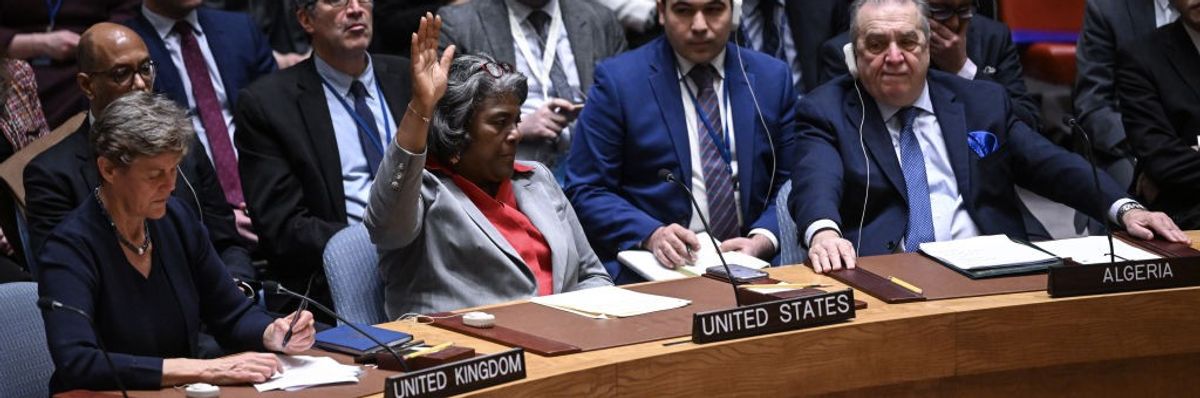
    US Ambassador to the United Nations Linda Thomas-Greenfield raises her hand during the UN Security Council meeting which adopted a resolution demanding an immediate cease-fire in Gaza Strip for the month of Ramada on March 25, 2024. As many as 14 countries voted in favor of the resolution, presented by 10 elected members of the Council, while the US abstained from voting.  (Photo by Fatih Aktas/Anadolu via Getty Images

    Despite weaknesses and false U.S. claims that the resolution is nonbinding, it demands an end to the bombing and a massive influx of humanitarian aid. And that means the possibility of saving lives.

    Five and half months into Israel’s genocidal assault on Gaza with more than 32,000 Palestinians already killed, six weeks after the International Court of Justice found Israel plausibly committing genocide and ordered it to stop, and after four earlier tries, the UN Security Council on Monday finally passed a resolution submitted by all ten elected members aiming to stop the slaughter. The resolution has lots of weaknesses and shows the effects of U.S. pressure—but it demands an end to the bombing and a massive influx of food and medicine. And that means the possibility of saving lives.

    The resolution demanded an immediate ceasefire leading to a lasting and sustainable ceasefire, the release of all hostages, and compliance with international law in treatment of all those detained. The Council also demanded “the lifting of all barriers to the provision of humanitarian assistance at scale,” reminding the world of the need for massive expansion of that aid and for protection of Palestinian civilians across the entire Gaza Strip.

    The resolution’s passage was uncertain until the very last moment. An hour before the vote, U.S. diplomats won a final concession—replacing the original demand for a “permanent” ceasefire” to the squishier, less clear “lasting.” And there are significant other weaknesses in the resolution.

    When U.S. Ambassador Linda Thomas-Greenfield claimed that the Council vote was “nonbinding,” she was setting the stage for the U.S. government to violate the UN Charter by refusing to be bound by the resolution’s terms.

    The most important flaw in the Council’s text is that it calls for a ceasefire only “for the month of Ramadan.” This most important of Muslim holidays began on March 11, so the demand for a ceasefire is only for about two weeks. And while it does demand that the immediate halt lead to a lasting ceasefire, two weeks is still a much too-short time.

    Other problems reflect deliberate obfuscation of language. The demand that all parties treat “all persons they detain” in compliance with international law clearly refers to the thousands of Palestinian detainees Israel is holding, many in administration detention without even the pretense of legitimate legal procedures, whom international law requires to be immediately released. Their detention violates a host of those laws, but by not naming them directly, diplomatic wrangling always threatens to deny them their rights.

    And in the paragraph focusing on the catastrophic humanitarian situation across Gaza, the Council’s demand for “lifting all barriers to provision of humanitarian aid at scale” should be a clear and straightforward message to Israel that it must open the gates, end its rejection of goods on the spurious grounds of potential “dual use,” replace its deliberately complex and time-consuming inspection processes and more. But that reference to “lifting all barriers” is hidden in a long sentence within a reference to an earlier resolution. The first part of the sentence merely “emphasizes” the need for more humanitarian aid and protection for Palestinian civilians. And in UN diplo-speak, especially in the Security Council that actually has the right to enforce its resolutions, “emphasizing” something ain’t even close to “demanding” that it happen.

    Israel was still not pleased, of course. Prime Minister Benjamin Netanyahu immediately announced his delegation, expected in Washington tomorrow to discuss Tel Aviv’s planned escalation against Rafah, will stay home instead.

    But even if the resolution is not all it should be, its passage (14 in favor, the U.S. abstained) still represents a powerful global rejection of the U.S.-backed Israeli assault against Palestinians in Gaza, and an important expression of support for the South African-led intervention at the International Court of Justice designed to prevent or stop Israeli genocide and to hold Israel accountable for its crimes. Importantly, and despite U.S. Ambassador Linda Thomas-Greenfield’s false claim following the vote, all decisions of the Council, as stated in Article 25 of the UN Charter, are binding on Member States.

    That puts a big obligation on the U.S. and global movements for ceasefire, massive escalation of humanitarian aid, and resumption of funding UNRWA. Left to its own devices, the Council will almost never move to enforce its own decisions. That responsibility, that obligation, lies with our movements—and, in the UN context, with the General Assembly. The legacy of the South Africa anti-apartheid movement, especially through the 1970s and 80s, and into the early 1990s, shows that model. The U.S. and Britain over and over again vetoed resolutions in the Security Council for sanctions against apartheid South Africa. Over and over again the General Assembly passed the resolutions—for banking, trade, and other sanctions, for arms embargoes and much more. Eventually, public pressure against Washington and London forced a pull-back, and eventually, reluctantly and grudgingly, those governments gave in, stopped vetoing the Council resolutions and started abiding by the calls of the Assembly. It all played a huge role in ending South African apartheid.

    Left to its own devices, the Council will almost never move to enforce its own decisions. That responsibility, that obligation, lies with our movements—and, in the UN context, with the General Assembly.

    When U.S. Ambassador Linda Thomas-Greenfield claimed that the Council vote was “nonbinding,” she was setting the stage for the U.S. government to violate the UN Charter by refusing to be bound by the resolution’s terms. But enforcement of Council decisions can take shape in many forms—protest movements around the world can demand their governments move to pressure Israel to abide by the Council’s demands. The General Assembly can urge Member States to impose some of those same sanctions it used so successfully against apartheid South Africa. Maybe the Assembly and global movements together can escalate the call urging boycotts of Israeli products, divestment from companies profiting from Israel’s occupation or apartheid, and sanctions on banking transactions or trade, and the imposition of arms embargoes.

    First things, of course, an immediate ceasefire, release of hostages and Palestinian detainees, and a flood of emergency humanitarian aid. Then maybe, just maybe, we’ll see this Security Council resolution lead to the United Nations joining the global BDS movement. It’s never too late.


    Phyllis Bennis

    Phyllis Bennis is a fellow of the Institute for Policy Studies and serves on the national board of Jewish Voice for Peace. Her most recent book is the 7th updated edition of “Understanding the Palestinian-Israeli Conflict: A Primer” (2018). Her other books include: “Understanding the US-Iran Crisis: A Primer” (2008) and “Challenging Empire: How People, Governments, and the UN Defy US Power” (2005).

    Original article by PHYLLIS BENNIS republished from Common Dreams under Creative Commons (CC BY-NC-ND 3.0). 

  • Draft UN Report Finds Israel Has Met Threshold for Genocide

    Spread the love

    Original article by BRETT WILKINS republished from Common Dreams under Creative Commons (CC BY-NC-ND 3.0).

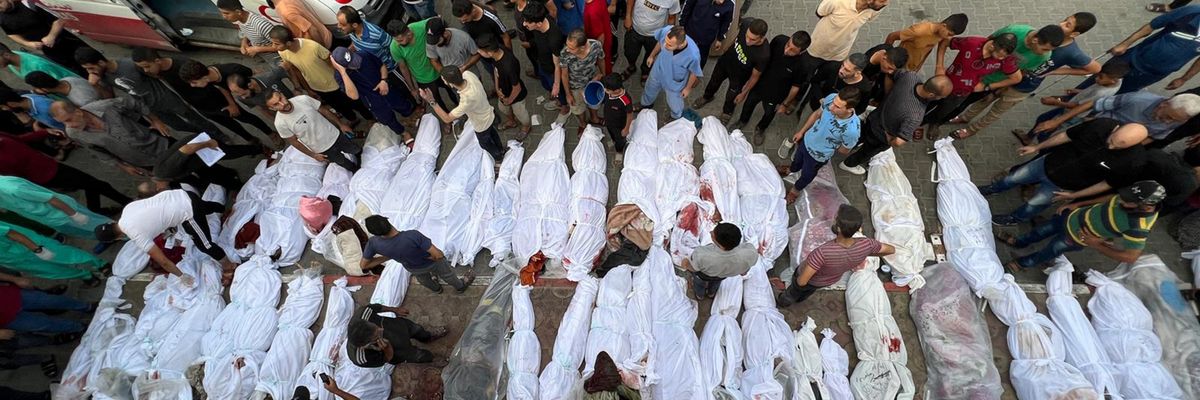
    The bodies of victims of the October 31, 2023 Israeli bombing of the Jabalia refugee camp in the Gaza Strip are lined up outside the Indonesian Hospital in Gaza City.  (Photo: Fadi Alwhidi/Anadolu via Getty Images)

    “Israel’s genocide on the Palestinians in Gaza is an escalatory stage of a long-standing settler colonial process of erasure.”

    The United Nations Human Rights Council on Monday published a draft report that found “reasonable grounds to believe” that Israel is committing genocide in Gaza, a move that came on the same day as the U.N. Security Council passed a resolution demanding an immediate cease-fire in the ongoing war.

    The advance unedited version of the report—entitled Anatomy of a Genocide—concludes that Israel’s far-right government and military “have intentionally distorted jus in bello principles, subverting their protective functions, in an attempt to legitimize genocidal violence against the Palestinian people.”

    “The overwhelming nature and scale of Israel’s assault on Gaza and the destructive conditions of life it has inflicted reveal an intent to physically destroy Palestinians as a group,” the draft report states, enumerating Israeli actions that violate Article II of the Convention on the Prevention and Punishment of the Crime of Genocide: “Killing members of the group; causing serious bodily or mental harm to group members; and deliberately inflicting on the group conditions of life calculated to bring about its physical destruction in whole or in part.”

    “Israel has de facto treated an entire protected group and its life-sustaining infrastructure as ‘terrorist’ or ‘terrorist-supporting,’ thus transforming everything and everyone into either a target or collateral damage, hence killable or destroyable,” the paper continues. “In this way, no Palestinian in Gaza is safe by definition. This has had devastating, intentional effects, costing the lives of tens of thousands of Palestinians, destroying the fabric of life in Gaza, and causing irreparable harm to its entire population.”

    Israel rejected the report as “an obscene inversion of reality.”

    According to Palestinian and international humanitarian officials, Israel’s 171-day Gaza onslaught has killed at least 32,333 Palestinians, most of them women and children, while wounding nearly 75,000 others and displacing around 90% of Gaza’s 2.3 million people. Thousands more Palestinians are missing and believed to be dead and buried beneath the rubble of bombed buildings. Disease and deadly starvation caused and exacerbated by Israel’s siege and blockade of Gaza are spreading rapidly.

    “Israel’s genocide on the Palestinians in Gaza is an escalatory stage of a long-standing settler-colonial process of erasure,” the draft report asserts. “For over seven decades this process has suffocated the Palestinian people as a group—demographically, culturally, economically, and politically—seeking to displace it and expropriate and control its land and resources.”

    Referring to the flight and ethnic cleansing of more than 750,000 Arabs from Palestine during the foundation of the modern state of Israel in 1948, the paper contends that “the ongoing Nakba must be stopped and remedied once and for all. This is an imperative owed to the victims of this highly preventable tragedy, and to future generations in that land.”

    “The ongoing Nakba must be stopped and remedied once and for all.”

    The draft report urges U.N. member states to “enforce the prohibition of genocide in accordance with their… obligations” under international law. In January, the U.N.’s International Court of Justice (ICJ) found that Israel was “plausibly” perpetrating genocide in Gaza and ordered the country’s government to “take all measures within its power” to prevent genocidal acts. Human rights defenders say Israel has ignored the order.

    “Israel and those states that have been complicit in what can be reasonably concluded to constitute genocide must be held accountable and deliver reparations commensurate with the destruction, death, and harm inflicted on the Palestinian people,” the publication argues.

    The draft report recommends measures including:

    • Immediate implementation of an arms embargo on Israel, as it appears to have failed to comply with the binding measures ordered by the ICJ;
    • Immediate referral of the situation in Palestine to the International Criminal Court in support of its ongoing investigation;
    • Ensuring that Israel, as well as states who have been complicit in the Gaza genocide, acknowledge the colossal harm done, commit to nonrepetition, with measures for prevention and full reparations, including the full cost of the reconstruction of Gaza;
    • Deploying an international protective presence to constrain the violence routinely used against Palestinians in the occupied territories; and
    • Ensuring that the United Nations Relief and Works Agency for Palestine Refugees in the Near East (UNRWA) is properly funded to enable it to meet the increased needs of Palestinians in Gaza.

    Israel on Monday informed the U.N. that it will no longer allow UNRWA convoys carrying food aid into northern Gaza, even as the Palestinians are starving to death, a move that one humanitarian campaigner called a “death sentence.”

    Original article by BRETT WILKINS republished from Common Dreams under Creative Commons (CC BY-NC-ND 3.0).

  • Israel is starving Palestinians to death while the world watches

    Spread the love

    Original article by Abdul Rahman republished from peoples dispatch under a Creative Commons Attribution-ShareAlike 4.0 (CC BY-SA) license.
    Children waiting for food in Gaza. Photo: UNRWA

    Israel has deliberately slowed the flow of aid to Gaza with hundreds of trucks stranded on the Egyptian side of the Rafah border at a time when over two dozen Palestinian children have died of malnutrition

    UN agencies have repeatedly condemned Israel’s refusal to expedite the process of aid delivery to Gaza which has been under siege by Israel for nearly six months. This is despite repeated calls for urgency in the context of critical humanitarian conditions which are becoming worse with each passing day.

    According to the latest alerts issued by the Integrated Food Security Phase Classification (IPC) on March 18, most of northern Gaza would move into the category five indicating the highest stage of food insecurity or catastrophic levels of hunger. The IPC explains that this would mean that Palestinian households would face “an extreme lack of food and extremely critical levels of acute malnutrition.”

    The IPC has assessed that the region which continues to face Israeli bombing and ground offensive already faces category four levels of malnutrition with huge gaps between need and actual availability of food.


    UNRWA has already confirmed that one in three children in northern Gaza are malnourished. In the last few weeks over 25 children have died due to the same. The situation in other parts of Gaza is approaching similar levels at an alarming speed.

    The same day that the IPC released its findings, Philippe Lazzarini, the head of UNRWA, was denied entry to Gaza by Israeli authorities. In a post on X, Lazzarini wrote, “UNRWA has by far the largest presence among all humanitarian organizations in Gaza. My visit today was supposed to coordinate & improve the humanitarian response.”

    He added, “This man-made starvation under our watch is a stain on our collective humanity. Too much time was wasted, all land crossings must open now. Famine can be averted with political will.”

    The UNRWA head also noted that over 1.1 million people in Gaza facing phase five levels of starvation “is the highest number of people ever recorded as facing catastrophic hunger and is double the number of just three months ago.”

    Beth Bechdol, deputy director general of the UN Food and Agricultural Organization (FAO) told Al-Jazeera on Tuesday that, almost half of the total population of Gaza is at the acute level of malnutrition and at the risk of ultimately death.

    The United Nations Children Fund (UNICEF) stated on Sunday that thousands of Palestinian children in Gaza are so malnourished that they do not have enough “energy to cry.”

    Over 13,000 Palestinian children have been killed in the Israeli war on Gaza which began on October 7. According to different UN agencies, as many children have been injured and now hundreds of thousands are being forced into starvation by Israel.

    UNICEF’s Executive Director Catherine Russell had earlier made similar assertions saying that there are “very great bureaucratic challenges” which prevent the humanitarian aid to reach two million Palestinians in Gaza.

    Israel has restricted the entry of the aid through land borders using different kinds of excuses, for example presence of scissors in the aid boxes or alleged overcrowding of Palestinians at aid distribution centers among others.

    James Elder, UNICEF spokesperson, called the blocking of aid supplies to Gaza “outrageous.” He posted on X showing hundreds of trucks with humanitarian aid stranded at the Rafah border as Israel has not allowed them to enter Gaza.

    Adele Khodr, UNICEF’s regional director for the Middle East and North Africa called for the opening of all crossings. “The world’s inaction is shocking as more children succumb to slow death. All border crossing must open now to allow unfettered access to humanitarian aid” Khodr said in the tweet on Tuesday.

    Original article by Abdul Rahman republished from peoples dispatch under a Creative Commons Attribution-ShareAlike 4.0 (CC BY-SA) license.