Trump Says Ground Attack on Venezuela Imminent—Plus Colombia, Mexico Also in US Crosshairs

Spread the love

Original article by Brett Wilkins republished from Common Dreams under Creative Commons (CC BY-NC-ND 3.0).
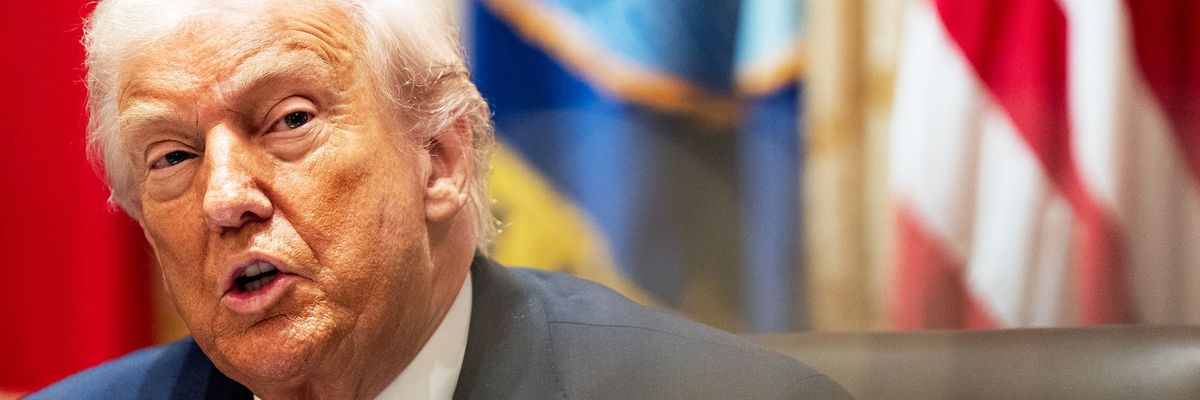
US President Donald Trump speaks to reporters in the White House in Washington, DC on December 8, 2025. (Photo by Demetrius Freeman/The Washington Post via Getty Images)

“It’s now taken as a given… that Trump is mulling a ground invasion of Venezuela and a dramatic expansion in his bombing campaign with no congressional authorization,” said one critic.

President Donald Trump said in an interview published Tuesday that a US land attack on Venezuela is coming and signaled that he is open to launching similar military action against Colombia and Mexico.

“We’re gonna hit ‘em on land very soon, too,” Trump told Politico‘s Dasha Burns, citing the pretext of stopping fentanyl from entering the United States.

RECOMMENDED…
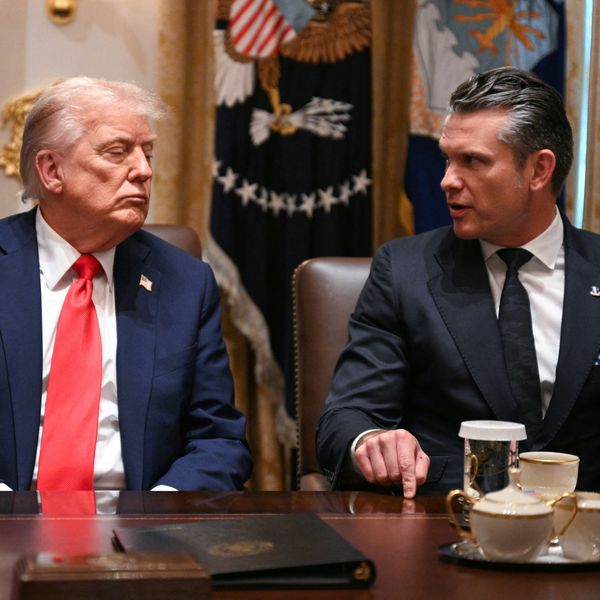
Donald Trump and Pete Hegseth

Trump Briefed On Venezuela Military Strike Options That Could Occur in ‘Coming Days’: Report
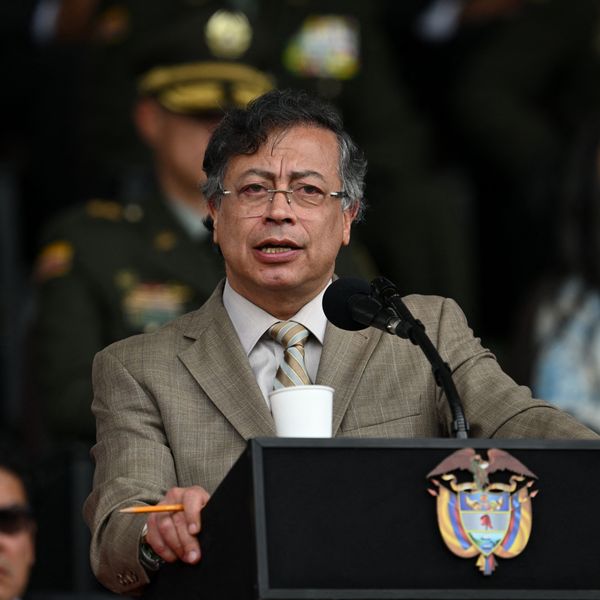
COLOMBIA-POLICE-ANNIVERSARY-PROMOTION

As Trump Issues New Threats to Mexico and Colombia, Democrats Push to End Unauthorized Aggression

Trump repeated his baseless claim that during the administration of his predecessor, the “very stupid” former President Joe Biden, Venezuelan President Nicolás Maduro “sent us millions of people, many from prisons, many drug dealers, drug lords,” and “people in mental institutions.”

Burns then noted that most of the illicit fentanyl sold in the United States “is actually produced in Mexico,” which along with Colombia is “even more responsible” for trafficking the potent synthetic opioid into the US. She asked Trump if he would “consider doing something similar” to those countries.

“I would,” Trump replied. “Sure, I would.”

Pressed on his contradictory pardon of convicted narco-trafficking former Honduran President Juan Orlando Hernández while threatening war against Venezuela, Trump feigned ignorance, claiming that “I don’t know him” and asserting that “he was set up.”

Trump’s latest threat against Venezuela comes amid his deployment of warships and thousands of troops off the coast of the oil-rich South American nation, his approval of covert CIA action against Maduro’s government, and more than 20 airstrikes on boats his administration claims without evidence were smuggling drugs in the southern Caribbean Sea and eastern Pacific Ocean.

The Trump administration’s targeting of Venezuela evokes the long history of US “gunboat diplomacy” in Latin America and continues more than a century of Washington’s meddling in Venezuelan affairs. It also marks a historic escalation of aggression, as the US has never attacked Venezuelan territory.

Officials in Venezuela and Colombia, as well as relatives of men killed in the boat bombings, contend that at least some of the victims were fishermen who were not involved in drug trafficking.

The strikes have killed at least 87 people since early September, according to administration figures—including shipwrecked survivors slain in a so-called double-tap bombing. Legal experts and some former US military officials contend that the strikes are a violation of international law, murders, war crimes, or all of these.

Critics also assert that the boat strikes violate the War Powers Act, which requires the president to report any military action to Congress within 48 hours and mandates that lawmakers must approve troop deployments after 60 days. The Trump administration argues that it is not bound by the War Powers Resolution, citing as precedent the Obama administration’s highly questionable claim of immunity from the law when the US attacked Libya in 2011.

A bipartisan bid to block the boat bombings on the grounds that they run afoul of the War Powers Act failed to muster enough votes in the Senate in October.

“Note that it’s now taken as a given—as an unremarkable and baked-in fact about our politics—that Trump is mulling a ground invasion of Venezuela and a dramatic expansion in his bombing campaign with no congressional authorization,” New Republic staff writer Greg Sargent observed Tuesday in response to the president’s remarks to Politico.

“What emerges from this interview,” he added, “is that Trump is pulling all of this—the substantive case for these bombings, the legal justification for them, the rationale for mulling a massive military escalation in the Western Hemisphere—out of his rear end.”

Original article by Brett Wilkins republished from Common Dreams under Creative Commons (CC BY-NC-ND 3.0).

Donald Fuhrump says that Amerikkka doesn't bother with crimes or charges anymore, not being 100% Amerikkkan and opposing his real estate intentions is enough.
Donald Fuhrump says that Amerikkka doesn’t bother with crimes or charges anymore, not being 100% Amerikkkan and opposing his real estate intentions is enough.
Continue ReadingTrump Says Ground Attack on Venezuela Imminent—Plus Colombia, Mexico Also in US Crosshairs

US maintains “Christian genocide” narrative at UN special event

Spread the love

Original article by Nicholas Mwangi republished from peoples dispatch under a Creative Commons Attribution-ShareAlike 4.0 (CC BY-SA) license.

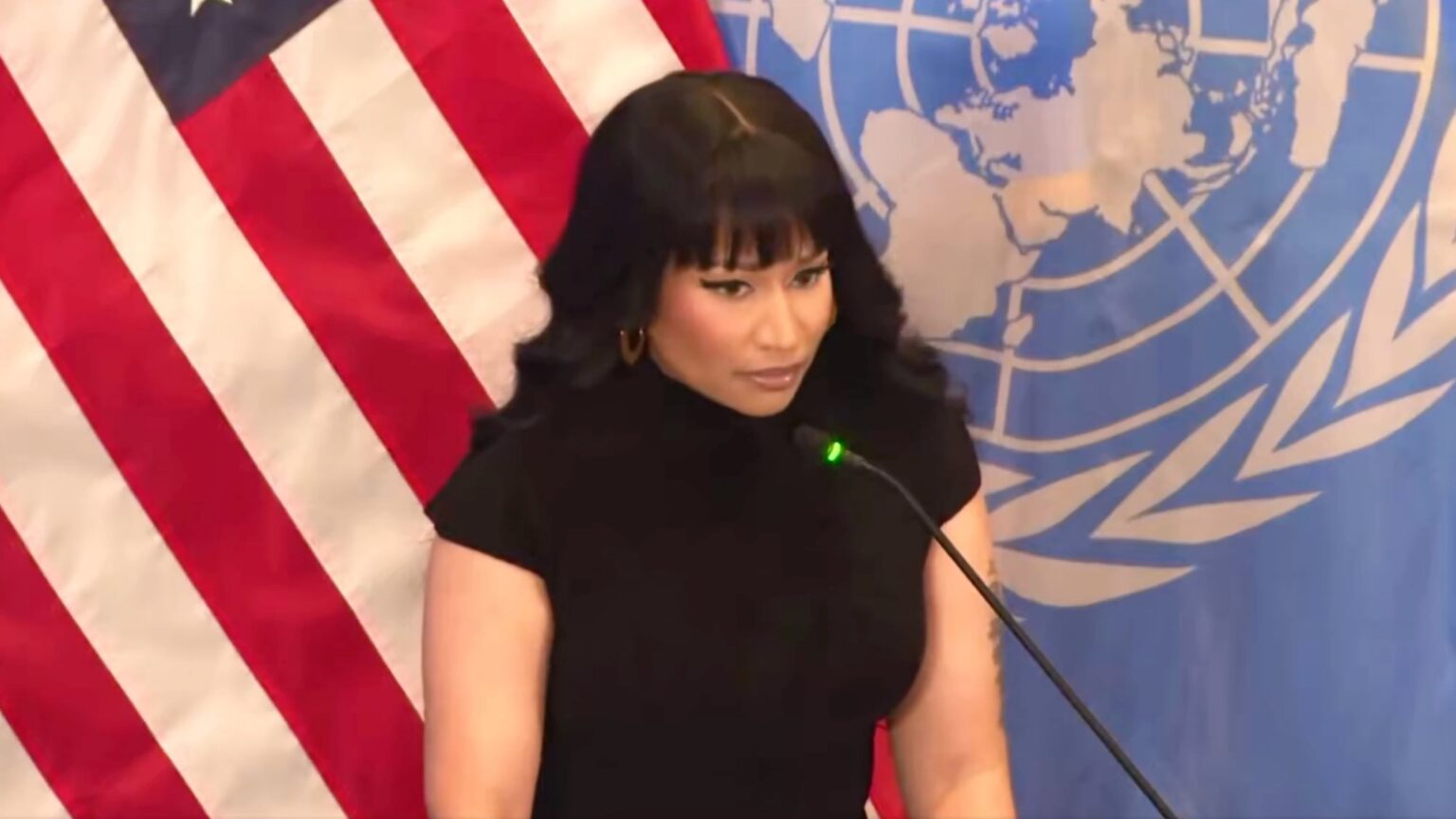
Nicki Minaj repeats US media narrative of Christian genocide in Nigeria at UN event in NY. Photo: screenshot

Analysts argue that framing the conflict as religious persecution masks a deeper geopolitical struggle over Nigeria’s enormous mineral wealth.

The United States intensified its claims that Nigeria is facing a “genocide against Christians” during a special event at the United Nations held in November called “Combating Christian Violence and the Killing of Christians in Nigeria”. The session, led by US Ambassador Mike Waltz, featured American rapper Nicki Minaj as one of the keynote speakers, and further amplified a narrative that Nigerian officials and regional analysts have repeatedly dismissed as misleading and politically motivated.

The UN event follows a recent wave of rhetoric by US President Donald Trump, who alleged widespread, systematic killings of Christians in the West African nation. Nigeria has rejected the accusations, insisting they are based on distorted reports and selective data that ignore the complex security realities in the country. Officials acknowledge the ongoing threat of Boko Haram and other armed groups but argue that the situation cannot be reduced to a one-sided religious persecution narrative.

Media organizations, including the BBC, have also noted that several of the claims circulating in US political circles cannot be independently verified.

Nicki Minaj repeats Trump’s narrative at UN stage

Nicki Minaj, whose earlier social media statements echoed Trump’s message, reiterated her comments at the UN event. She stated:

“In Nigeria, Christians are being targeted, driven from their homes and killed. Churches have been burned, families torn apart, and entire communities live in fear constantly, simply because of how they pray.”

Her remarks closely mirrored the religious persecution framing popularized in US conservative media, which African analysts argue oversimplifies a multidimensional conflict involving poverty, state fragility, armed groups, climate pressures, and competition over land and mineral resources.

African analysts push back

Journalist David Hundeyin, speaking to BreakThrough News, challenged the US framing, saying the violence in northern and central Nigeria cannot be understood simply as a religious conflict. He stressed that:

Boko Haram and affiliated groups have killed between 50,000 and 150,000 people, though the exact numbers remain unclear. The majority of victims have been Muslims, not Christians, since most violence occurs in predominantly Muslim regions of the north and middle belt.

Armed groups attack both Christians and Muslims, and “everyone is dying in numbers … they’re all poor people and powerless.”

According to Hundeyin, framing the conflict as religious persecution masks a deeper geopolitical struggle over Nigeria’s enormous mineral wealth, including rare earth elements crucial for global technology industries. He argues: Presenting the conflict as “Islamists killing Christians” provides a moral pretext for deeper US involvement in a region with strategic resources.

A key part of Hundeyin’s critique is the near-total absence of Muslim deaths in Western coverage. Although Muslims make up the majority of victims, their deaths rarely appear in narratives circulated in US conservative politics, which instead portray Nigeria as the world’s “epicenter of Christian persecution”.

Read more: Trump threatens war on Africa’s most populous country to “save” “our CHERISHED Christians”

As Pavan Kulkarni wrote in a Peoples Dispatch report last month, “The majority of people killed by the Boko Haram and Islamic State West Africa Province are Muslims, simply because they make up the majority in the northern region these Islamist insurgencies are ravaging. For the same demographic reasons, Muslims are also the majority victims of bandits who kill, loot, and kidnap in the northwest region, where the state is struggling to enforce the rule of law. In the central region, Christian victims of violence are in the majority, not because of their religious identity but because of their occupation: farming. Amid intensifying competition over depleting land and water due to climate change, raids on farmlands by mobile herders, groups of whom are armed, are a serious problem in several African countries suffering desertification.”

The Nigerian government maintains that while terrorism remains a serious challenge, portraying the crisis as a Christian genocide is inaccurate and dangerous. Officials argue that such language obscures the socio-economic drivers of violence, including state collapse in rural areas, the proliferation of weapons, land-use conflicts, and climate-related displacement across the Sahel.

Read More: World Bank acknowledges poverty increase in Nigeria, but doubles down on the reforms causing it

African Union issues statement

The African Union Commission (AUC), released a statement,  reaffirming its commitment to sovereignty, non-interference, religious freedom, and the rule of law as outlined in the AU Constitutive Act, and expressed concern over US allegations accusing Nigeria of targeting Christians and threatening military action, emphasizing that Nigeria is a longstanding and vital AU Member State whose sovereign right to manage its internal affairs, particularly regarding security, human rights, and religious freedom, must be fully respected by all external partners.

Nigeria’s struggles with insecurity demand nuanced understanding rather than a blanket accusation of Christians being targeted in the country.

Original article by Nicholas Mwangi republished from peoples dispatch under a Creative Commons Attribution-ShareAlike 4.0 (CC BY-SA) license.

Continue ReadingUS maintains “Christian genocide” narrative at UN special event

Cop30: five reasons the UN climate conference failed to deliver on its ‘people’s summit’ promise

Spread the love
Andre Borges / EPA

Simon Chin-Yee, UCL; Mark Maslin, UCL, and Priti Parikh, UCL

As the sun set on the Amazon, the promise of a “people’s Cop” faded with it. The latest UN climate summit – known as Cop30, hosted in the Brazilian city of Belém – came with the usual geopolitics and the added excitement of a flood and a fire.

The summit saw Indigenous protests on an unprecedented scale, but the final negotiations were once again dominated by fossil fuel interests and delaying tactics. After ten years of climate (in)action since the Paris agreement, Brazil promised Cop30 would be an “implementation Cop”. But the summit failed to deliver, even as the world recorded a devastating 1.6˚C of global warming last year.

Here are our five key observations:

1. Indigenous groups were present – but not involved

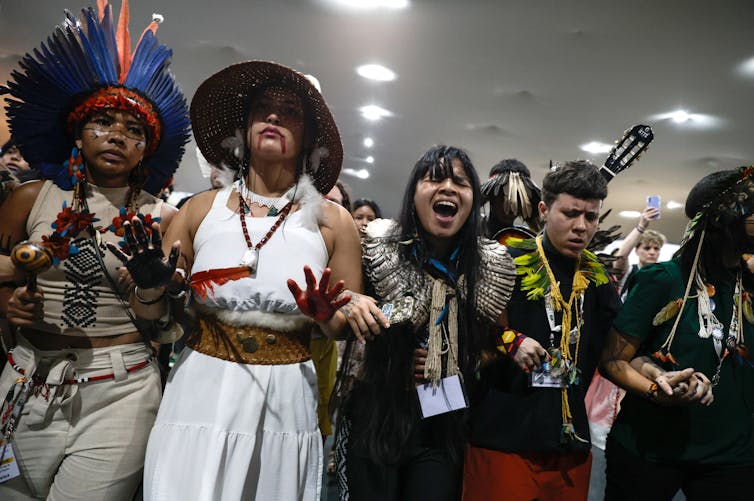
Located in Amazonia, this was branded the summit for those on the frontlines of climate change. Over 5,000 Indigenous people were there, and they certainly made their voices heard.

However, only 360 secured passes to the main negotiating “blue zone”, compared to 1,600 delegates linked to the fossil fuel industry. Inside the negotiating rooms it was business as usual, with Indigenous groups remaining as observers, unable to vote or attend closed-door meetings.

The choice of location was nicely symbolic but logistically tough. Hosting the conference in the Amazon cost hundreds of millions of dollars in a region where many still lack basic amenities.

A stark image of this inequality: with hotel rooms full, the Brazilian government even docked two cruise ships for delegates, which per head can have eight times the emissions of a five star hotel.

2. The power of protests

But this was the second largest UN climate summit ever, and the first since Glasgow Cop26 in 2021 to take place in a country that permits real public protest. That mattered. Protests of various sizes happened every day during the two-week conference, most notably an Indigenous-led “great people’s march” on the middle Saturday.

Indigenous protesters scored some small wins – but weren’t involved in the main talks. Fraga Alves / EPA

The visible pressure helped obtain recognition of four new Indigenous territories in Brazil. It showed that when civil society has a voice it can secure wins, even outside of the main emissions negotiations.

3. US absence creates a vacuum – and an opportunity

In Donald Trump’s first turn as president, the US sent at least a skeletal group of negotiators. This time, in a historic first, America did not send an official delegation at all.

Trump recently described climate change as “the greatest con job ever perpetrated on the world”, and since returning to power the US has slowed renewables and expanded oil and gas. It even helped scuttle plans for a net zero framework for global shipping last month.

As the US is rolling back its ambition, it is allowing other oil producing countries like Saudi Arabia to ignore their own climate pledges and to try and undermine others.

China has stepped into the void and become one of the loudest voices in the room. As the world’s largest supplier of green technology, Beijing used Cop30 to promote its solar, wind and electric vehicle industries and court countries looking to invest.

But for many delegates, the absence of America came as a relief. Without the distraction of the US attempting to “burn the house down” as it did at the shipping negotiations, the conference was able to get on with the business at hand: negotiating texts and agreements that will limit global warming.

4. ‘Implementation’ through side deals – not the main stage

So what was actually implemented? This year, the main action happened through voluntary pledges, not the binding global agreement.

The Belém pledge, backed by countries including Japan, India and Brazil, committed signatories to quadruple sustainable fuels production and use by 2035.

Brazil also launched a major trust fund for forests, with around US$6 billion (£4.6 billion) already pledged for communities working to protect rainforests. The EU followed by pledging new funds for the Congo Basin, the world’s second largest rainforest.

These are useful steps, but they highlight how the biggest advances at UN climate summits now often happen in the margins, rather than in the main talks.

The outcome of those main talks at Cop30 – the Belém package – is weak, and will get us nowhere near the Paris agreement’s target of limiting global warming to 1.5˚C. Most striking is the absence of the words “fossil fuels” from the final text even though they were central to the Glasgow climate pact (2021) and the UAE consensus (2023) – and of course they represent the main cause of climate change.

5. The Global Mutirão text: a missed opportunity

One potential breakthrough did emerge in negotiating rooms: the Global Mutirão text, a proposed roadmap to “transition away” from fossil fuels. More than 80 countries signed it, from EU members to climate-vulnerable Pacific island states.

Tina Stege, climate envoy for one of those vulnerable states, the Marshall Islands, urged delegates: “Let’s get behind the idea of a fossil fuel roadmap, let’s work together and make it a plan.”

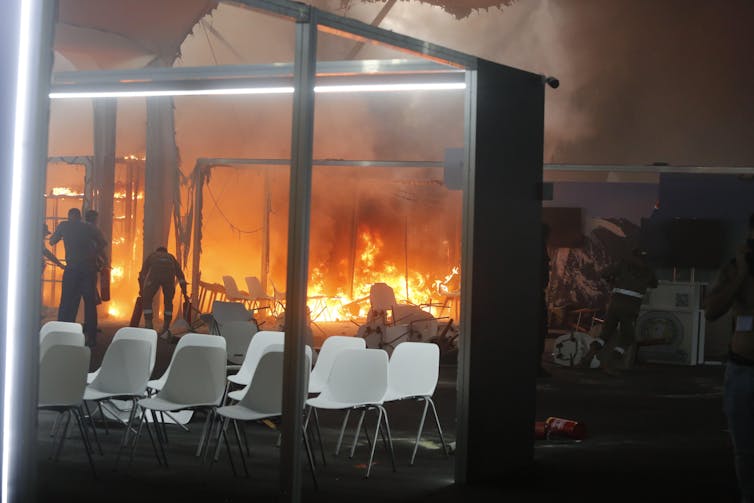
On the final Thursday, a small fire broke out in the pavilion area of the summit. Brazil Photo Press / Alamy

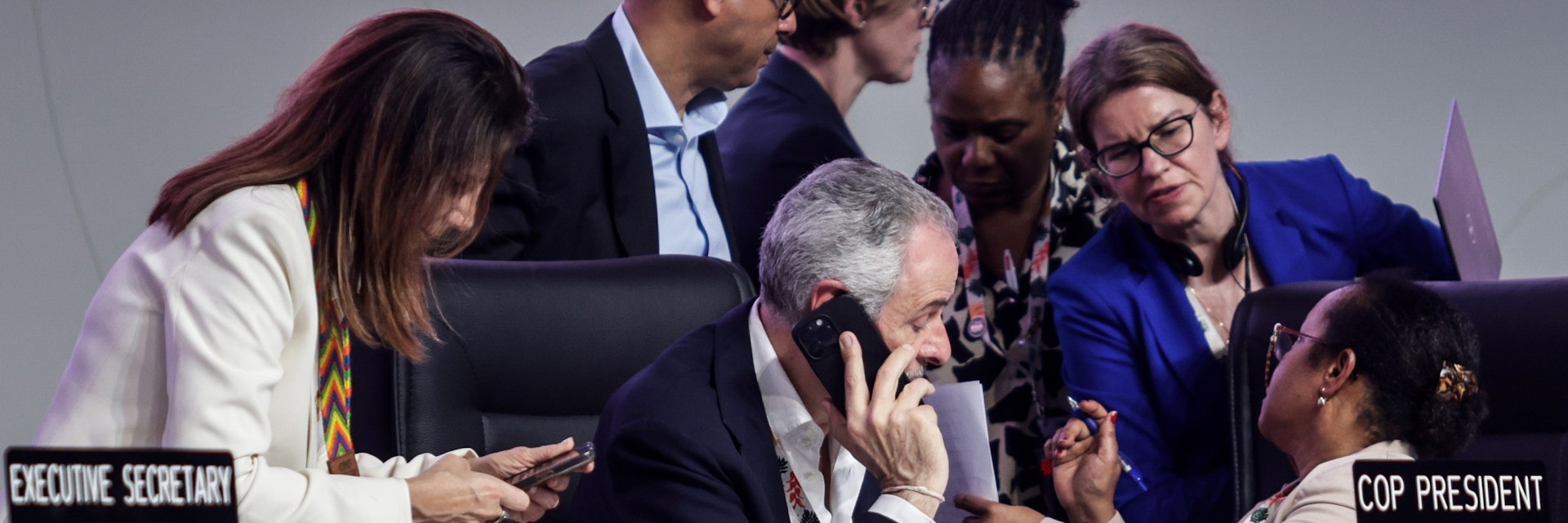
But opposition from Saudi Arabia, India and other major fossil fuel producers watered it down. Negotiations stretched into overtime, not helped by a fire that postponed discussions for a day.

When the final deal was agreed, key references to a fossil fuel phase-out were missing. There was a backlash from Colombia, due to the lack of inclusion of transition away from fossil fuels, which forced the Cop presidency to offer a six-month review as an olive branch.

This was hugely disappointing, as earlier in the summit there seemed to be huge momentum.

A widening gulf

So this was another divisive climate summit. The gulf between oil-producing countries (in particular in the Middle East) and the rest of the world has never been wider.

One positive to come out of the summit was the power of organised people: Indigenous groups and civil society made their voices heard, even if they weren’t translated into the final text.

With next year’s summit to be held in Turkey, these annual climate summits are increasingly migrating to nations with authoritarian leanings where protests are not welcome or completely banned. Our leaders keep stating that time is running out, yet negotiations themselves remain stuck in never ending circles of delays.

Simon Chin-Yee, Lecturer in International Development, UCL; Mark Maslin, UCL Professor of Earth System Science and UNU Lead for Climate, Health and Security, UCL, and Priti Parikh, Professor of Infrastructure Engineering and International Development, UCL

This article is republished from The Conversation under a Creative Commons license. Read the original article.

Donald Trump urges you to be a Climate Science denier like him. He says that he makes millions and millions for destroying the planet, Burn, Baby, Burn and Flood, Baby, Flood.
Nigel Farage urges you to ignore facts and reality and be a climate science denier like him and his Deputy Richard Tice. He says that Reform UK has received £Millions and £Millions from the fossil fuel industry to promote climate denial and destroy the planet.
Orcas comment on killer apes destroying the planet by continuing to burn fossil fuels.

Continue ReadingCop30: five reasons the UN climate conference failed to deliver on its ‘people’s summit’ promise

‘Time for Them to Leave’: Charlotte Communities Rise Up Against ICE Invasion

Spread the love

Original article by Brett Wilkins republished from Common Dreams under Creative Commons (CC BY-NC-ND 3.0). 

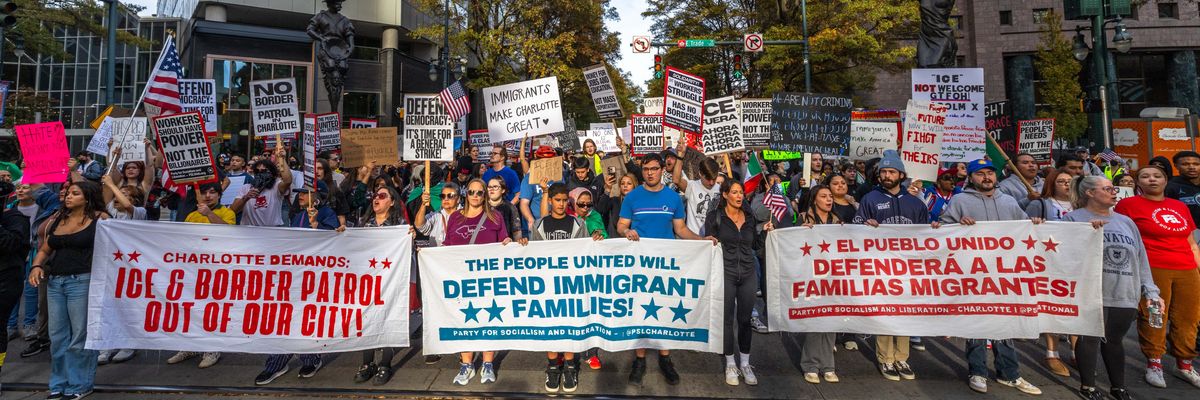
Protesters march through uptown after gathering at First Ward Park for the “No Border Patrol In Charlotte” rally on November 15, 2025 in North Carolina’s largest city. (Photo by Grant Baldwin/Getty Images)

“I want to keep my neighbors protected because they deserve protection and they deserve to live in a world where they’re not scared,” said one woman patrolling the streets of Charlotte with a whistle.

Backlash against the Trump administration’s assault on immigrant communities—in which some US citizens are also getting caught up—is growing in Charlotte, North Carolina this week, as over 30,000 students staged walkouts to protest the federal invasion, people rallied to condemn the arrest of day laborers, and communities mobilized to protect their friends and neighbors targeted by federal agents.

Hundreds of people gathered outside the Home Depot on North Wendover Road Wednesday morning, lining both sides of the street, holding signs supporting immigrants and denouncing US Immigration and Customs Enforcement (ICE) and Border Patrol agents, and cheering as motorists honked in support.

The protest came on the fifth—and reportedly penultimate—day of Operation Charlotte’s Web, which the Department of Homeland Security claimed targeted the “worst of the worst criminal illegal aliens.” The Mecklenburg County Sheriff’s Office said Thursday that it has been informed by federal officials that Operation Charlotte’s Web has wrapped up.

The administration’s “worst of the worst” claim does not seem supported in the vast majority of the hundreds of arrests made in the Charlotte area, as ICE and US Customs and Border Protection (CBP) agents have targeted locations including a church, grocery stores, construction sites, homes, and hardware store parking lots where day laborers gather every morning in search of work.

“From guns being drawn on pedestrians, windows broken at restaurants and US citizens being detained and later released, it is clear that CBP’s main mission is to disrupt public safety and everyday life in Charlotte,” Zamara Saldivar of the Carolina Migrant Network told WFAE at the Home Depot protest.

Protester Norm Perreault told the Charlotte Observer that “they say they’re deporting the worst of the worst, but day laborers are the best of the best.”

Former Charlotte Mayor Jennifer Roberts, a Democrat, was also at the Home Depot demonstration, where she declared: “We are here to support the immigrant community. We know they’re an integral part of our economy, education, culture, and growth.”

“It’s time for them to leave,” Roberts said of the federal invaders. “We need business to get back to normal. We need our schools to be able to educate our children.”

On Monday, an estimated 30,000 Charlotte-Mecklenburg Schools students walked out of their classrooms in protest of the crackdown. Students marched, held signs, and chanted messages including, “No borders, no nations, stop the deportations!”

“It’s stressful seeing my mom ‘cuz, like, she struggled with bills already going to work. I mean, even without her going to work, she’s struggling even more.” said one unidentified student protester from East Mecklenburg High School told WCNC, discussing his family’s fear of being targeted during the crackdown.

Another unidentified East Mecklenburg High student lamented “little kids losing their parents by ICE and getting taken, seeing them cry, and that, like, it breaks my heart seeing them like that.”

East Mecklenburg High multilingual teacher David Gillespie told WJBF that “a school should be a safe place for a child to come. They should be able to come here to get their education, they should be able to come here and spend time with their friends, socialize, they should feel secure.”

“I’m not sure which of my students I’m going to see again,” Gillespie said in a separate interview with WCNC. “Whether because their parents were involved in detainments or because their parents have to make that unfortunate safety calculus—Is it worth it to send my kids to school and put myself at risk?”

Parent Portia James told WBTV that she supports the walkout as an avenue for “students to be able to say something and voice their opinion in a positive way.”

“This is not the kind of behavior that we want in Charlotte going forward,” James said of the federal crackdown.

This week’s demonstrations followed Saturday’s “No Border Patrol in Charlotte” rally and march, which drew thousands of protesters to First Ward Park and the city’s streets.

Concern is also growing over federal agents arresting and terrorizing US citizens who legally follow, monitor, and record their activities. Vigilant residents have been confronting federal agents, shouting, blowing whistles, and recording them. Federal agents have also seized US citizens who’ve shown proof of their citizenship.

“Our country is facing a constant constitutional assault unlike we’ve experienced in many decades,” David Bier, director of immigration studies at the libertarian Cato Institute, said on X Wednesday. “Don’t give an inch of your freedom.”

Undaunted, some democracy defenders have taken to mocking the invaders:

Others are mobilizing to resist the invasion and protect their immigrant relatives, friends, and neighbors. Residents have formed volunteer patrols, parents and educators have monitored schools and surrounding areas for agents, and church parishioners armed with whistles are alerting community members when “la migra esta aquí”—the immigration agents are here.

On Saturday, Manolo’s Latin Bakery, which has operated in Charlotte for 28 years, was rocked as federal agents in tactical gear chased, tackled, and arrested people outside the business.

“I have seen these people in SUVs, cars that are not marked with their faces covered… throwing immigrants to the floor and taking them away,” owner Manolo Betancur told Queen City News on Saturday, saying he would temporarily shut down his business.

“I’m going to close the door right now,” he said. “Yeah, I’m not going to risk my customers… I don’t want to risk myself even though I am an American citizen. Because the way they look, because they’re way that my accent, because the way that I talk, they’re just going to throw me down to the floor.”

Local resident Beth Clements told CNN Thursday that she’s been outside the bakery for three days wearing a yellow vest and whistle.

“I’m going to walk the streets with my whistle,” she said, “and I want to keep my neighbors protected because they deserve protection and they deserve to live in a world where they’re not scared.”

Original article by Brett Wilkins republished from Common Dreams under Creative Commons (CC BY-NC-ND 3.0). 

Orcas discuss Donald Trump and the killer apes' concept of democracy. Front Orca warns that Trump is crashing his country's economy and that everything he does he does for the fantastically wealthy.
Orcas discuss Donald Trump and the killer apes’ concept of democracy. Front Orca warns that Trump is crashing his country’s economy and that everything he does he does for the fantastically wealthy.
Donald Fuhrump says that Amerikkka doesn't bother with crimes or charges anymore, not being 100% Amerikkkan and opposing his real estate intentions is enough.
Donald Fuhrump says that Amerikkka doesn’t bother with crimes or charges anymore, not being 100% Amerikkkan and opposing his real estate intentions is enough.

Continue Reading‘Time for Them to Leave’: Charlotte Communities Rise Up Against ICE Invasion

European left urges solidarity with Venezuela amid growing US aggression

Spread the love

Original article by Ana Vračar republished from peoples dispatch under a Creative Commons Attribution-ShareAlike 4.0 (CC BY-SA) license.

Protest against US and UK sanctions on Venezuela. Photo: Venezuela Solidarity Campaign

Left parties and organizations across Europe are calling for respect for Venezuela’s sovereignty and action against escalating US aggression in the Caribbean.

European leaders continue to subordinate themselves to the Trump administration, including on the United States’ escalating military threats against Venezuela. Shortly before this month’s CELAC–EU summit in Colombia, several high-ranking figures, including European Commission President Ursula von der Leyen, German Chancellor Friedrich Merz, and French President Emmanuel Macron, suddenly announced they would not attend the meeting. Their move has widely been understood as an attempt to avoid displeasing US President Donald Trump at a moment of mounting US aggression in Latin America.

Read more: A brief overview of US military interventions in the Americas

In contrast, left parties in the region warn against this approach. Instead of supporting US militarism, they insist, Europe should uphold international law, respect the sovereignty of Latin American states, and push for diplomacy over war.

“We are witnessing an unprecedented military escalation in 20 years, a multifaceted aggression that threatens not only Venezuela, but any project of sovereignty and social justice in Latin America,” the Workers’ Party of Belgium (PTB-PVDA) wrote in response to the situation. Italy’s Potere al Popolo echoed this concern, noting that US interests in Latin America have remained unchanged for decades. “On the one hand, it’s about securing access to the immense oil, water, and raw materials reserves, but also to the food production capacities of the Latin American continent (an economic and trade war),” the party wrote. “On the other hand, they want to stifle the efforts of progressive and socialist governments (an ideology war).”

For left organizations from Greece to Britain, there is little doubt that the current US threats against Venezuela amount to a push for regime change. Most see this as yet another step that could trap Latin America and the rest of the world into an even deeper cycle of violence. Despite such concerns, most European governments have not shown any sign of questioning US plans or proposing alternatives. Just the opposite: in addition to skipping multilateral discussions with Latin American counterparts, some have even chosen to reduce diplomatic representation in the region.

Belgium recently announced it would close several diplomatic missions, including those in Havana and Rio de Janeiro. The PTB-PVDA warned against this decision, emphasizing that it is both dangerous and short-sighted. “This is a very bad idea,” said party General Secretary Peter Mertens. “At a time when international law and international relations are already under heavy pressure, and US President Donald Trump is announcing new military aggressions in the Caribbean region, we need more diplomacy.”

Read more: US deploys aircraft carrier and threatens invasion of Venezuela

Peace networks and organizations are similarly calling for a change of approach. Belgian associations Vrede and Intal appealed to parliamentary bodies to take action in light of recent US announcements regarding the launch of its new military initiative, Operation Southern Spear. “Venezuela is risking being plunged into chaos similar to the most devastating conflicts of recent decades, and a prolonged instability could arise across the region,” the groups wrote.

They also warned that Belgium has legal and political obligations to uphold international law and therefore support peaceful solutions. Similar calls have appeared in Britain, where several MPs and peace networks have criticized Prime Minister Keir Starmer for failing to oppose the US militarization drive. “There are deep fears that US military intervention in Venezuela would be the first step in a wider military escalation by Trump in Latin America,” their appeal warns. “The US has a long history of interference in the continent, where so-called ‘regime change’ has caused widespread suffering and lasting harm.”

The Venezuela Solidarity Campaign in Britain also urged action, saying: “The task now is to maximize support for solidarity with Venezuela on the basis of respect for Venezuela’s sovereignty, a recall of the US fleet, and end to US military aggression in Latin America and the Caribbean.”

Read more: From Palestine to Venezuela: The US is behind the door

Those calling for solidarity with Venezuela are well aware that their initiatives stand in stark contrast to the interests of powerful actors poised to benefit from the escalation. “War is beneficial for some, not least those who are well aware that Venezuela sits on the world’s largest oil reserves,” Jeremy Corbyn noted for the Stop the War Coalition.

Despite anticipating a response from conservative and right-wing forces, left parties and progressive networks insist that now is the time to intensify solidarity. “Trump is responding to the crisis of US hegemony with greater militarization of the world. Europe – including Giorgia Meloni’s government – is following suit by increasing military spending and attacking the rights of the working class,” Potere al Popolo stated. “Today, more than ever, we have a duty to stop this expanding war economy, as the dockworkers demonstrated with their recent general strikes and as millions around the world showed by marching for peace.”

Original article by Ana Vračar republished from peoples dispatch under a Creative Commons Attribution-ShareAlike 4.0 (CC BY-SA) license.

Orcas discuss how Trump was re-elected and him being an obviously insane, xenophobic Fascist.
Continue ReadingEuropean left urges solidarity with Venezuela amid growing US aggression