Tag: US

  • Greenland is rich in natural resources – a geologist explains why

    Spread the love
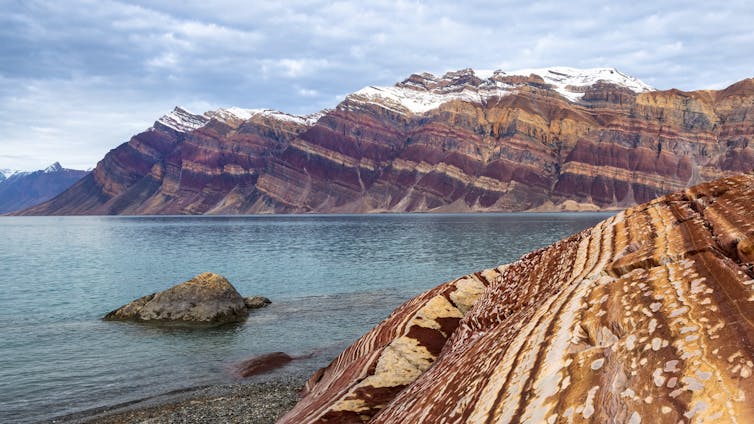
    Greenland’s concentration of natural resource wealth is tied to its hugely varied geological history over the past 4 billion years. Jane Rix/Shutterstock

    Jonathan Paul, Royal Holloway, University of London

    Greenland, the largest island on Earth, possesses some of the richest stores of natural resources anywhere in the world.

    These include critical raw materials – resources such as lithium and rare earth elements (REEs) that are essential for green technologies, but whose production and sustainability are highly sensitive – plus other valuable minerals and metals, and a huge volume of hydrocarbons including oil and gas.

    Three of Greenland’s REE-bearing deposits, deep under the ice, may be among the world’s largest by volume, holding great potential for the manufacture of batteries and electrical components essential to the global energy transition.

    The scale of Greenland’s hydrocarbon potential and mineral wealth has stimulated extensive research by Denmark and the US into the commercial and environmental viability of new activities like mining. The US Geological Survey estimates that onshore northeast Greenland (including ice-covered areas) contains around 31 billion barrels of oil-equivalent in hydrocarbons – similar to the US’s entire volume of proven crude oil reserves.

    But Greenland’s ice-free area, which is nearly double the size of the UK, forms less than a fifth of the island’s total surface area – raising the possibility that huge stores of unexplored natural resources are present beneath the ice.

    Greenland’s concentration of natural resource wealth is tied to its hugely varied geological history over the past 4 billion years. Some of the oldest rocks on Earth can be found here, as well as truck-sized lumps of native (not meteorite-derived) iron. Diamond-bearing kimberlite “pipes” were discovered in the 1970s but have yet to be exploited, largely due to the logistical challenges of mining them.

    Geologically speaking, it is highly unusual (and exciting for geologists like me) for one area to have experienced all three key ways that natural resources – from oil and gas to REEs and gems – are generated. These processes relate to episodes of mountain building, rifting (crustal relaxation and extension), and volcanic activity.

    Greenland was shaped by many prolonged periods of mountain building. These compressive forces broke up its crust, allowing gold, gems such as rubies, and graphite to be deposited in the faults and fractures. Graphite is crucial for the production of lithium batteries but remains “underexplored”, according to the Geological Survey of Denmark and Greenland, relative to major producers such as China and South Korea.

    But the greatest proportion of Greenland’s natural resources originates from its periods of rifting – including, most recently, the formation of the Atlantic Ocean from the beginning of the Jurassic Period just over 200 million years ago.

    Map of Greenland's major geologic provinces with their rock types.
    Greenland’s major geologic provinces with rock types and ages. Geophysical Research Letters, CC BY-NC-SA

    Greenland’s onshore sedimentary basins such as the Jameson Land Basin appear to hold the greatest potential of oil and gas reserves, analogous to Norway’s hydrocarbon-rich continental shelf. However, prohibitively high costs have limited commercial exploration. There is also a growing body of research suggesting potentially extensive petroleum systems ringing the entirety of offshore Greenland.

    Metals such as lead, copper, iron and zinc are also present in the onshore (mostly ice-free) sedimentary basins, and have been worked locally, on a small scale, since 1780.

    Difficult-to-source rare earth elements

    While not as intimately related to volcanic activity as nearby Iceland – which, uniquely, sits at the intersection of a mid-ocean ridge and a mantle plume – many of Greenland’s critical raw materials owe their existence to its volcanic history.

    REEs such as niobium, tantalum and ytterbium have been discovered in igneous rock layers – similar to the discovery (and subsequent mining) of silver and zinc reserves in south-west England, which were deposited by warm hydrothermal waters circulating at the tip of large volcanic intrusions.

    Critically among REEs, Greenland is also predicted to hold sufficient sub-ice reserves of dysprosium and neodymium to satisfy more than a quarter of predicted future global demand – a combined total of nearly 40 million tonnes.

    These elements are increasingly seen as the most economically important yet difficult to source REEs because of their indispensable role in wind power, electric motors for clean road transport, and magnets in high-temperature settings like nuclear reactors.

    The development of known deposits such as Kvanefield in southern Greenland – not to mention those not yet discovered in the island’s central rocky core – could easily affect the global REE market, owing to their relative global scarcity.

    An unfortunate dilemma

    The global energy transition came about due to increasing public recognition of the manifold threats of burning fossil fuels. But climate change has major implications for the availability of many of Greenland’s natural resources that are currently blanketed by kilometres of ice – and which are a key part of that energy transition.

    An area the size of Albania has melted since 1995, and this trend is likely to accelerate unless global carbon emissions fall sharply in the near future.

    Recent advances in survey techniques, such as the use of ground-penetrating radar, allow us to peer with increasing certainty beneath the ice. We are now able to obtain an accurate picture of bedrock topography below up to 2 km of ice cover, providing clues as to the potential mineral resources in Greenland’s subsurface.

    However, progress is slow in prospecting under the ice – and sustainable extraction is likely to prove even harder.

    Soon, an unfortunate dilemma may need to be addressed. Should Greenland’s increasingly available resource wealth be extracted with gusto, in order to sustain and enhance the energy transition? But doing so will add to the effects of climate change on Greenland and beyond, including despoiling much of its pristine landscape and contributing to rising sea levels that could swamp its coastal settlements.

    Currently, all mining and resource extraction activities are heavily regulated by the government of Greenland through comprehensive legal frameworks dating from the 1970s. However, pressures to loosen these controls, and to grant new licences for exploration and exploitation, may increase amid the US’s strong interest in Greenland’s future.

    Jonathan Paul, Associate Professor in Earth Science, Royal Holloway, University of London

    This article is republished from The Conversation under a Creative Commons license. Read the original article.

  • Venezuela complains to maritime body over US Caribbean piracy

    Spread the love

    https://morningstaronline.co.uk/article/venezuela-complains-maritime-body-over-us-caribbean-piracy

     This image from video posted on Attorney General Pam Bondi’s X account, and partially redacted by the source, shows an oil tanker being seized by U.S. forces off the coast of Venezuela, December 10, 2025. Photo: U.S. Attorney General’s Office/X via AP

    VENEZUELA has lodged a complaint to the International Maritime Organisation (IMO) about the US seizure of an oil tanker in the Caribbean.

    The Venezuelans filed the complaint on Thursday to the London-based IMO over what many observers have labelled an act of piracy by the US on Wednesday. 

    The country’s Vice-President Delcy Rodriguez said she had communicated with IMO executive secretary Arsenio Dominguez, with the aim of “formally and legally addressing this serious situation.”

    VP Rodriguez described the incident as a blatant robbery and said the action “exposed the true interests of the US in its ongoing aggression against Venezuela.”

    …

    Article continues at https://morningstaronline.co.uk/article/venezuela-complains-maritime-body-over-us-caribbean-piracy

    Donald Fuhrump says that Amerikkka doesn't bother with crimes or charges anymore, not being 100% Amerikkkan and opposing his real estate intentions is enough.
    Donald Fuhrump says that Amerikkka doesn’t bother with crimes or charges anymore, not being 100% Amerikkkan and opposing his real estate intentions is enough.
  • Trump’s national security strategy is a blueprint for world domination – even if it denies it

    Spread the love

    Original article by Cameron Harrison and C.J. Atkins republished from People’s World under Attribution-NonCommercial-NoDerivs 3.0 United States licence.

    The Trump administration’s new National Security Strategy claims to be rooted in ‘America First’ principles, but it is really ‘Imperialism First.’ | AP

    Imperialism has a new mission statement. With the release of the Trump administration’s updated National Security Strategy (NSS), the campaign to keep U.S. capitalism in the global driver’s seat is signaling that those at the helm are ready to pick up the gun.

    Since he returned to office, the president’s effort to shore up American corporations’ slumping economic dominance has largely focused on roping in trading partners with tariff threats or shutting out market competitors via sanctions and export restrictions.

    As aggressive as those moves have been, they may end up looking like the proverbial carrot compared to the stick which the capitalist state now appears prepared to wield for the sake of ruling class profits.

    Over a century ago, Marxist political economist Rosa Luxemburg observed that militarism is not just aggression for aggression’s sake but rather the “pre-eminent means for the realization of surplus value.” The new NSS proves her point.

    Whose “security”?

    The NSS is not a plan for “national security,” as the White House is marketing it, but rather a ruthless strategy for securing the global dominance of U.S. monopoly capital. Its main push is to crush rival powers, slow China’s growing international influence, and maintain U.S. global hegemony.

    When the document trumpets “America First,” it really means “Imperialism First,” defining the “national interest” solely as the interest of the ruling class.

    This imperial blueprint arrives amid a dangerous U.S. military build-up in the Caribbean and brazen extrajudicial strikes, signaling a violent escalation in Washington’s regime-change campaign against Venezuela. The NSS leaves little doubt that this aggression is part of a broader design.

    The document’s top priority, it declares, is to “reassert and enforce the Monroe Doctrine to restore American pre-eminence in the western hemisphere.” This so-called “Trump Corollary,” announced on the doctrine’s 202nd anniversary, is a prescription for renewed U.S. domination, disguised as protecting the region from outside actors, primarily China.

    It vows to “deny non-hemispheric competitors the ability…to own or control strategically vital assets,” using coded language for a determination to block Latin American cooperation with China on infrastructure and development. It boasts, for instance, of restoring U.S. “privileged access” to the Panama Canal.

    Dispensing with (everyone else’s) sovereignty

    What this will mean in practice is escalated hostility toward geopolitical alliances that the U.S. sees as rivals, like BRICS, and regime-change operations against the peoples of any country asserting their own sovereignty.

    Thus, the NSS’s fraudulent rhetoric of “Sovereignty and Respect” is laid bare in the document. In it, U.S. imperialism asserts its own sovereignty as absolute while explicitly planning to violate that of nations in its declared “sphere of influence.” Venezuela is clearly first in line, but the independence of every state in the region is under threat.

    The NSS’s imperial vision extends further around the world, too. Its supposed “Predisposition to Non-Interventionism” is a complete farce. The entire document outlines a strategy for aggressive economic, political, and military intervention.

    The document stresses preventing Chinese reunification with Taiwan due to the island’s significance to U.S. naval domination and calls on Indo-Pacific countries to grant the U.S. military greater access. It dwells extensively on maintaining an edge over China, the “near peer” rival.

    Anti-communism, the go-to of capitalist ideologues, also shines through in the document’s call for “disciplined economic action” to hem in China and its socialist-oriented economic policies—which are derisively dismissed as “predatory, state-directed subsidies and industrial strategies.”

    The NSS demand that NATO states spend 5% of their GDP on militarization and directly confront China and Russia is a reaffirmation of the military alliance’s function to serve as an imperialist spearhead for aggression.

    In Europe, U.S. imperialism’s goal is to “cultivate resistance” to EU independence by bolstering far-right, pro-U.S. nationalist parties in order to ensure Europe remains a subservient tool for Washington. This aim pitched in terms of “helping Europe correct its current trajectory.”

    The “healthy nations of Central, Eastern, and Southern Europe”—i.e. those with right-wing governments friendly to the Trump administration—are to be built up “through commercial ties, weapons sales, political collaboration, and cultural and educational exchanges.”

    Meanwhile, in a nod toward Moscow, the document says the Trump administration will work toward “ending the perception, and preventing the reality, of NATO as a perpetually expanding alliance.” This is a rhetorical tactic in the White House’s strategy of prying Russia loose from its ties with China—an effort to prevent cooperation between two countries seen as rivals.

    The NSS aims for “energy dominance” and rejects the concept of “net zero” when it comes to fighting climate change. This of course signals a full, state-backed mobilization of U.S. fossil fuel capital to intensify extraction and sabotage global climate efforts.

    Furthermore, the shift in Africa from “aid to investment” is explicitly about seizing the continent’s “critical minerals” for imperialist accumulation and plunder. The NSS favors partnerships with what it calls “capable, reliable states committed to opening their markets to U.S. goods and services.” Any countries who attempt to chart an independent path—like South Africa—earn themselves a place on Trump’s hit list.

    Building a MAGA world

    The document also reflects the administration’s domestic far-right politics, which of course serve its overall imperialist aims.

    The call for “strong, traditional families,” pride in “past glories,” and rejection of “woke lunacy” is a right-wing cultural reaction designed to further split the working class along racial, gender, and national lines. It fosters the chauvinistic nationalism necessary to drum up support for impending imperialist wars.

    The terroristic deportation campaign by ICE against immigrant workers is part and parcel of this project. It has its transatlantic reflection in the NSS’s declared goal of “restoring Europe’s civilizational self-confidence and Western identity.” Adapting the white supremacist ideology long deployed by the far-right at home, Trump says Europe must also unite to defend against “civilizational erasure”—racist code for immigration.

    Similarly, the NSS’s critique of “misguided bets on globalism” that hollowed out industry acknowledges the devastation wrought by neoliberalism but instead of pinpointing this as the result of unleashing free market capitalism, it frames de-industrialization as a mere “strategic error.” Of course, the real cause is the logic of capitalism, in its imperialist stage, which seeks maximum profit through outsourcing, financialization, and wage depression.

    Thus, Trump’s turn toward protectionism and trade wars is not a rejection of this logic but an attempt to reconfigure it under conditions of systemic crisis and heightened global economic competition.

    Therefore, the claim to be “pro-American worker” is a cynical ploy. Policies like Trump’s tariffs and “re-shoring” are designed to wed a section of the U.S. working class to “national” capital against other countries and immigrant workers. Their weaponized concept of “competence and merit” attacks affirmative action by presenting inequality as “natural” to mask the brutal antagonisms of capitalist society.

    Partitioning the globe

    The NSS presents U.S. assets—the world’s largest economy, financial system, and military—as “natural” blessings. These comparative advantages were not born “naturally,” however; they were built on centuries of domestic class exploitation, slavery, colonial plunder, and global extraction. The “world’s most dynamic economy” is dynamic precisely because of its ruthless exploitation of labor and nature both at home and abroad.

    This imperial blueprint arrives amid a dangerous U.S. military build-up in the Caribbean and brazen extrajudicial strikes, signaling a violent escalation in Washington’s regime-change campaign against Venezuela. The nuclear-powered aircraft carrier USS Gerald R. Ford heads up a military strike force currently being assembled off the coast of Venezuela. | AP

    Beyond the U.S.’ largest immediate trading partners, Canada and Mexico, the nations of Latin America will be the first to find themselves in the crosshairs of this new strategy. Dominating this region is seen by the ruling class as the key in building a solid U.S. sphere of influence—a step toward holding onto global supremacy.

    Building maximum resistance to U.S. aggression requires strengthening international solidarity campaigns with Venezuela, Cuba, Nicaragua, Colombia, and all countries facing the brunt of this offensive. It requires exposing the class essence of “America First” and uniting workers, and all forces for peace, against the common enemy: an imperialist system in crisis that is hurtling toward war and deeper exploitation in its desperate bid to maintain hegemony.

    The document states quite clearly that the U.S. government’s objective must be “maintaining economic preeminence and consolidating our alliance system into an economic group.” On behalf of which sectors is this campaign to be waged? “AI, biotech, quantum computing,” “finance,” and “oil, gas, coal, and nuclear” are among the patron industries for whom the NSS was crafted.

    So, it doesn’t take much reading between the lines when it comes to mapping the connections between Trump’s new NSS and the long-term decline of U.S. capitalism’s competitive advantage. Despite claims throughout of being “pro-worker,” the goal of this document—and the trade war that’s preceded its unveiling—is halting and reversing the erosion of U.S. monopoly corporate power via the construction of a U.S.-dominated bloc.

    It has nothing to do with the real interests of the American people.

    Original article by Cameron Harrison and C.J. Atkins republished from People’s World under Attribution-NonCommercial-NoDerivs 3.0 United States licence.

    Orcas discuss Donald Trump and the killer apes' concept of democracy. Front Orca warns that Trump is crashing his country's economy and that everything he does he does for the fantastically wealthy.
    Orcas discuss Donald Trump and the killer apes’ concept of democracy. Front Orca warns that Trump is crashing his country’s economy and that everything he does he does for the fantastically wealthy.
  • UN Report Estimates Bold Climate Action Would Deliver $100 Trillion in Benefits by 2100

    Spread the love

    Original article by Brad Reed republished from Common Dreams under Creative Commons (CC BY-NC-ND 3.0).

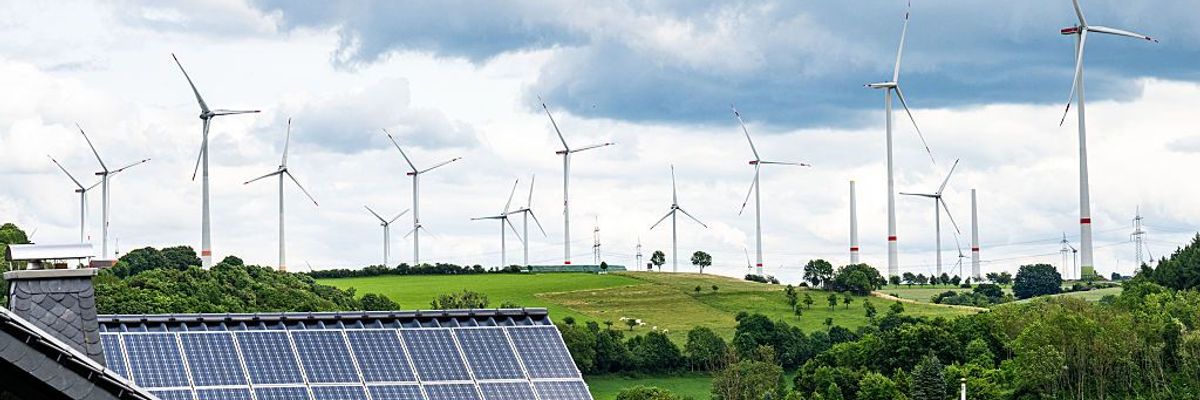
    Houses in the so-called ‘smart city’ of Etteln, Germany, are seen equipped with solar panels on the roofs on June 6, 2025. (Photo by David Inderlied/picture alliance via Getty Image

    “If we choose to stay on the current path—powering our economies with fossil fuels, extracting virgin resources, destroying nature, polluting the environment—the damages would stack up.”

    A new report from the United Nations Environment Program has found that addressing the global climate emergency would deliver major economic benefits, in addition to creating a cleaner and more habitable planet.

    The seventh edition of the Global Environmental Outlook (GEO), released on Tuesday, estimates that making up-front investments in climate action now would begin to yield global macroeconomic benefits starting in 2050, potentially growing to $20 trillion per year by 2070 and $100 trillion by 2100.

    RECOMMENDED…

    Natural Gas is Burned During Oil Production in North Dakota's Bakken Shale

    ‘Little to No Measurable Progress’ on Climate as World on Track for 2.6°C: Report

    Roundup Weed And Grass Killer At Costco Wholesale

    Trump DOJ Sides With Roundup Manufacturer Over Cancer Victims in Supreme Court Case

    The report, which was the product of nearly 300 multi-disciplinary scientists across more than 80 countries, argues that a total of $8 trillion in annual investment from this year until 2050 would be needed to achieve its climate goals. But, the report stresses, the cost of inaction would be far greater.

    “If we choose to stay on the current path—powering our economies with fossil fuels, extracting virgin resources, destroying nature, polluting the environment—the damages would stack up,” the report warns. “Climate change would cut 4% off annual global GDP by 2050, claim many lives, and increase forced migration.”

    Other likely consequences of inaction, warns the report, include “Amazon forest dieback and ice-sheet collapse,” along with the loss of “hundreds of millions more hectares of natural lands.” The report also projects that global food availability will fall if the climate crisis is not addressed, and that increased air pollution will cause an additional 4 million premature deaths per year.

    The report recommends a rapid move away from fossil fuels, as well as a drastic rethinking of agricultural subsidies so that they no longer “directly favor activities that have significant harmful effects on the environment, including on biodiversity.”

    Robert Watson, a co-chair of the GEO assessment, said in an interview with the Guardian that the climate crisis cannot simply be seen as an environmental issue given that it is now “undermining our economy, food security, water security, human health,” and also creating national security problems by increasing “conflict in many parts of the world.”

    In an interview with BBC, Watson also accused US President Donald Trump’s administration of sabotaging the report by refusing to even accept its conclusions about the damage being done by human-induced climate change.

    “The US decided not to attend the meeting at all,” he explained. “At the very end they joined by teleconference and basically made a statement that they could not agree with most of the report, which means they didn’t agree with anything we said on climate change, biodiversity, fossil fuels, plastics, and subsidies.”

    Original article by Brad Reed republished from Common Dreams under Creative Commons (CC BY-NC-ND 3.0).

    Donald Trump urges you to be a Climate Science denier like him. He says that he makes millions and millions for destroying the planet, Burn, Baby, Burn and Flood, Baby, Flood.
    Donald Trump urges you to be a Climate Science denier like him. He says that he makes millions and millions for destroying the planet, Burn, Baby, Burn and Flood, Baby, Flood.
    Nigel Farage urges you to ignore facts and reality and be a climate science denier like him and his Deputy Richard Tice. He says that Reform UK has received £Millions and £Millions from the fossil fuel industry to promote climate denial and destroy the planet.
    Nigel Farage urges you to ignore facts and reality and be a climate science denier like him and his Deputy Richard Tice. He says that Reform UK has received £Millions and £Millions from the fossil fuel industry to promote climate denial and destroy the planet.
    Elon Musk urges you to be a Fascist like him, says that you can ignore facts and reality then.
    Elon Musk urges you to be a Fascist like him, says that you can ignore facts and reality then.

  • Trump Says Ground Attack on Venezuela Imminent—Plus Colombia, Mexico Also in US Crosshairs

    Spread the love

    Original article by Brett Wilkins republished from Common Dreams under Creative Commons (CC BY-NC-ND 3.0).

    US President Donald Trump speaks to reporters in the White House in Washington, DC on December 8, 2025. (Photo by Demetrius Freeman/The Washington Post via Getty Images)

    “It’s now taken as a given… that Trump is mulling a ground invasion of Venezuela and a dramatic expansion in his bombing campaign with no congressional authorization,” said one critic.

    President Donald Trump said in an interview published Tuesday that a US land attack on Venezuela is coming and signaled that he is open to launching similar military action against Colombia and Mexico.

    “We’re gonna hit ‘em on land very soon, too,” Trump told Politico‘s Dasha Burns, citing the pretext of stopping fentanyl from entering the United States.

    RECOMMENDED…

    Donald Trump and Pete Hegseth

    Trump Briefed On Venezuela Military Strike Options That Could Occur in ‘Coming Days’: Report

    COLOMBIA-POLICE-ANNIVERSARY-PROMOTION

    As Trump Issues New Threats to Mexico and Colombia, Democrats Push to End Unauthorized Aggression

    Trump repeated his baseless claim that during the administration of his predecessor, the “very stupid” former President Joe Biden, Venezuelan President Nicolás Maduro “sent us millions of people, many from prisons, many drug dealers, drug lords,” and “people in mental institutions.”

    Burns then noted that most of the illicit fentanyl sold in the United States “is actually produced in Mexico,” which along with Colombia is “even more responsible” for trafficking the potent synthetic opioid into the US. She asked Trump if he would “consider doing something similar” to those countries.

    “I would,” Trump replied. “Sure, I would.”

    Pressed on his contradictory pardon of convicted narco-trafficking former Honduran President Juan Orlando Hernández while threatening war against Venezuela, Trump feigned ignorance, claiming that “I don’t know him” and asserting that “he was set up.”

    Trump’s latest threat against Venezuela comes amid his deployment of warships and thousands of troops off the coast of the oil-rich South American nation, his approval of covert CIA action against Maduro’s government, and more than 20 airstrikes on boats his administration claims without evidence were smuggling drugs in the southern Caribbean Sea and eastern Pacific Ocean.

    The Trump administration’s targeting of Venezuela evokes the long history of US “gunboat diplomacy” in Latin America and continues more than a century of Washington’s meddling in Venezuelan affairs. It also marks a historic escalation of aggression, as the US has never attacked Venezuelan territory.

    Officials in Venezuela and Colombia, as well as relatives of men killed in the boat bombings, contend that at least some of the victims were fishermen who were not involved in drug trafficking.

    The strikes have killed at least 87 people since early September, according to administration figures—including shipwrecked survivors slain in a so-called double-tap bombing. Legal experts and some former US military officials contend that the strikes are a violation of international law, murders, war crimes, or all of these.

    Critics also assert that the boat strikes violate the War Powers Act, which requires the president to report any military action to Congress within 48 hours and mandates that lawmakers must approve troop deployments after 60 days. The Trump administration argues that it is not bound by the War Powers Resolution, citing as precedent the Obama administration’s highly questionable claim of immunity from the law when the US attacked Libya in 2011.

    A bipartisan bid to block the boat bombings on the grounds that they run afoul of the War Powers Act failed to muster enough votes in the Senate in October.

    “Note that it’s now taken as a given—as an unremarkable and baked-in fact about our politics—that Trump is mulling a ground invasion of Venezuela and a dramatic expansion in his bombing campaign with no congressional authorization,” New Republic staff writer Greg Sargent observed Tuesday in response to the president’s remarks to Politico.

    “What emerges from this interview,” he added, “is that Trump is pulling all of this—the substantive case for these bombings, the legal justification for them, the rationale for mulling a massive military escalation in the Western Hemisphere—out of his rear end.”

    Original article by Brett Wilkins republished from Common Dreams under Creative Commons (CC BY-NC-ND 3.0).

    Donald Fuhrump says that Amerikkka doesn't bother with crimes or charges anymore, not being 100% Amerikkkan and opposing his real estate intentions is enough.
    Donald Fuhrump says that Amerikkka doesn’t bother with crimes or charges anymore, not being 100% Amerikkkan and opposing his real estate intentions is enough.