Syrians wave the country’s new flag as they gather for Friday prayers at the Umayyad mosque in Damascus, Syria, December 13, 2024
THOUSANDS of Syrians gathered in the capital Damascus today in rallies called by its new rulers to celebrate the fall of Bashar al-Assad, as the United States and Turkey “broadly agreed” on their plans for the country.
US Secretary of State Anthony Blinken met allies in Jordan, Turkey and Iraq to shape the transition of Syria’s leadership, calling for an “inclusive and non-sectarian” interim government.
After talks with Turkey’s Foreign Minister Hakan Fidan, Mr Blinken said there was “broad agreement” between Turkey and the US on what they would like to see in Syria.
Mr Fidan said the priority was “establishing stability in Syria as soon as possible, preventing terrorism from gaining ground, and ensuring that Islamic State and the Kurdistan Workers Party aren’t dominant.”
Hayat Tahrir al-Sham (HTS), which has ruled Idlib since 2017 under Turkish protection and swept to power last weekend, claims it has broken ties with its extremist past linked to al-Qaida and its leader, Ahmad al-Sharaa (also known as Abu Mohammed al-Julani), invited the public to “show their happiness” at Damascus’s squares.
Huge crowds, including some insurgent fighters, packed the capital’s historic Umayyad Mosque in the old city for Friday prayers.
Pro-Palestinian demonstrators with their hands painted the colour of blood hold a demonstration to call for a ceasefire in Gaza as US Secretary of State Antony Blinken testifies before the House Foreign Affairs Committee on the U.S. Withdrawal from Afghanistan on Capitol Hill in Washington DC, United States on December 11, 2024 [Celal Güneş/Anadolu Agency]
A group of pro-Palestinian protestors repeatedly disrupted Secretary of State Antony Blinken’s testimony, Wednesday, before a House of Representatives panel on the chaotic US withdrawal from Afghanistan, Anadolu Agency reports.
One protester shouted: “Bloody Blinken” and “Butcher of Gaza” as Blinken began his remarks.
A second demonstrator, holding a sign that read: “Stop Bombing Kids”, yelled: “Stop killing kids in Gaza” and “I don’t know how you can sleep at night when you’re killing so many kids in tents.” The protester was arrested and removed from the chamber.
Blinken continued his testimony, despite the disruptions.
The US, Israel’s primary supporter, provides nearly 70 per cent of its weapons, along with significant diplomatic backing. The support has drawn growing criticism amid the escalating civilian death toll in the Gaza Strip from Israel’s ongoing military onslaught.
Israel’s offensive has killed more than 44,800 people, mostly women and children, since a 7 October, 2023 attack by the Palestinian Resistance group, Hamas.
The International Criminal Court issued arrest warrants last month for Israeli Prime Minister, Benjamin Netanyahu, and his former Defence chief, Yoav Gallant, for war crimes and crimes against humanity in Gaza.
Israel also faces a genocide case at the International Court of Justice for its war on Gaza.
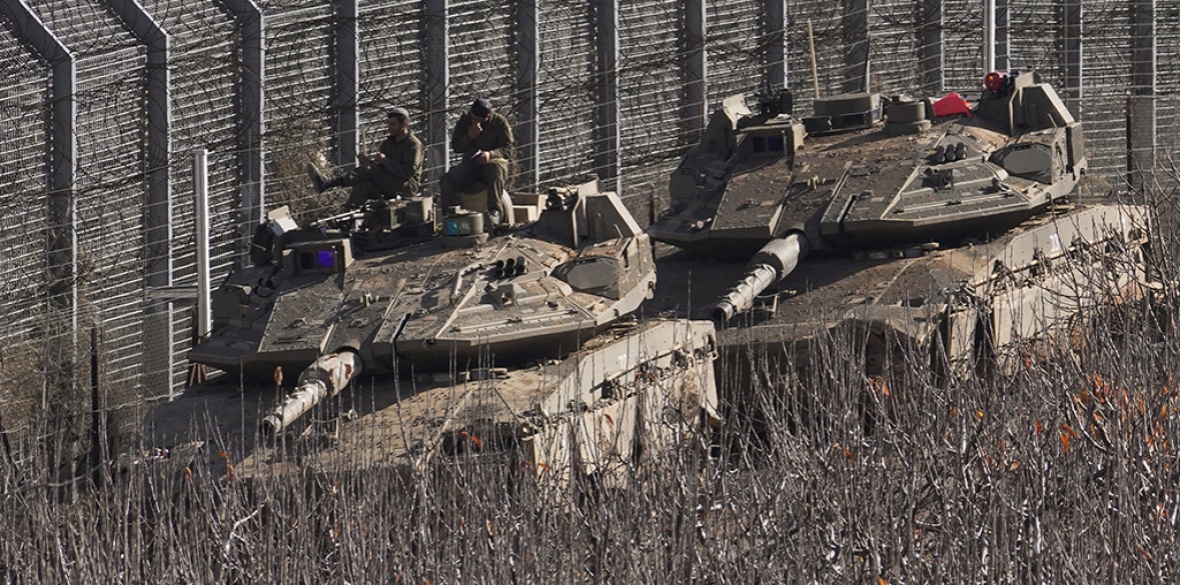
The Israeli army reinforces its air and ground forces in the Golan Heights in response to ongoing situation in Syria on December 06, 2024, in Israel [Israel Defense Forces (IDF) – Anadolu Agency]
Israel has launched an extensive military campaign in Syria, conducting over 350 air strikes and seizing territory beyond the illegally occupied Golan Heights, in what Defence Minister Israel Katz describes as an effort to create a “sterile defensive area” along the border.
The occupation forces reported that their fighter jets have carried out hundreds of strikes across Syria over the past 48 hours, targeting what they claim are strategic weapons stockpiles in major cities including Damascus, Homs, Tartus, Latakia and Palmyra. The offensive has included attacks on Syria’s naval bases, with Katz boasting about destroying Syria’s modest navy “with great success”.
The Israeli army told journalists yesterday that it had completed the main part of its aggressive military campaign against Syria since the fall of the Bashar Al-Assad regime, targeting the military capabilities of the Syrian state. The occupation regime claimed that it had destroyed between 70 and 80 per cent of these capabilities.
The military escalation marks Israel’s most significant incursion into Syrian territory since the 1973 Arab-Israeli war. According to diplomatic sources, Israeli forces have moved “men and material” into the demilitarised buffer zone since 7 December, positioning troops and armoured vehicles near seven abandoned Syrian military posts.
The expansion has drawn sharp international criticism. Turkey’s foreign ministry condemned the attacks, stating that, “Israel is again displaying its occupier mentality.” The UN, through its spokesperson Stephane Dujarric, expressed firm opposition to any violation of Syria’s territorial integrity, emphasising that, “This is a turning point for Syria. It should not be used by its neighbours to encroach on the territory of Syria.”
UN Syria envoy Geir Pedersen warned that Israel’s actions could undermine prospects for peaceful transition in the already fragile state. “We need to see a stop to the Israeli attacks,” insisted Pedersen. “It’s extremely important that we don’t see any action from any international actor that destroys the possibility for this transformation in Syria to take place.”
Critics have pointed out the apparent contradiction in Israel’s strategy of protecting a buffer zone by creating another buffer zone, particularly given that Israel’s occupation of the Golan Heights since 1967 remains unrecognised by the international community. Despite this, Israeli Prime Minister Benjamin Netanyahu has declared that, “The Golan Heights will be an inseparable part of the state of Israel forever.”
The US stressed its support for Israeli military operations despite growing opposition. There has been a significant shift in American public opinion, with an increasing number of voters expressing concern about US power being employed primarily to serve Israeli interests rather than America’s. This “America First” sentiment has gained particular traction with those who question why US diplomatic, military and financial resources are being committed extensively to support Israel’s regional ambitions.
This debate has intensified following former General Wesley Clark’s 2001 revelation that the US had planned to topple seven regimes in the region to secure Israeli hegemony, including Syria. The admission has fuelled criticism that US foreign policy in the Middle East has prioritised Israel’s strategic objectives over America’s national interests, leading to calls for a fundamental reassessment of the US-Israel relationship.
This work by Middle East Monitor is licensed under a Creative Commons Attribution-NonCommercial-ShareAlike 4.0 International License.
Israeli soldiers sit on top of a tank along the so-called Alpha Line that separates the Israeli-annexed Golan Heights from Syria, in the town of Majdal Shams
ISRAEL was condemned today for its invasion of Syria in the wake of the fall of its president, Bashar al-Assad, as the United States joined Tel Aviv in widespread bombing of targets within the country.
Israeli Prime Minister Benjamin Netanyahu said yesterday that Israeli forces have seized a buffer zone in the Golan Heights, established by a 1974 ceasefire agreement with Syria.
…
Stop the War vice-chairman Chris Nineham told the Morning Star: “We condemn the bombing of various sites in Syria.
“Not content with conducting genocide in Gaza, Israel, the US’s main ally in the Middle East, is contributing to the growing chaos and instability in the region.”
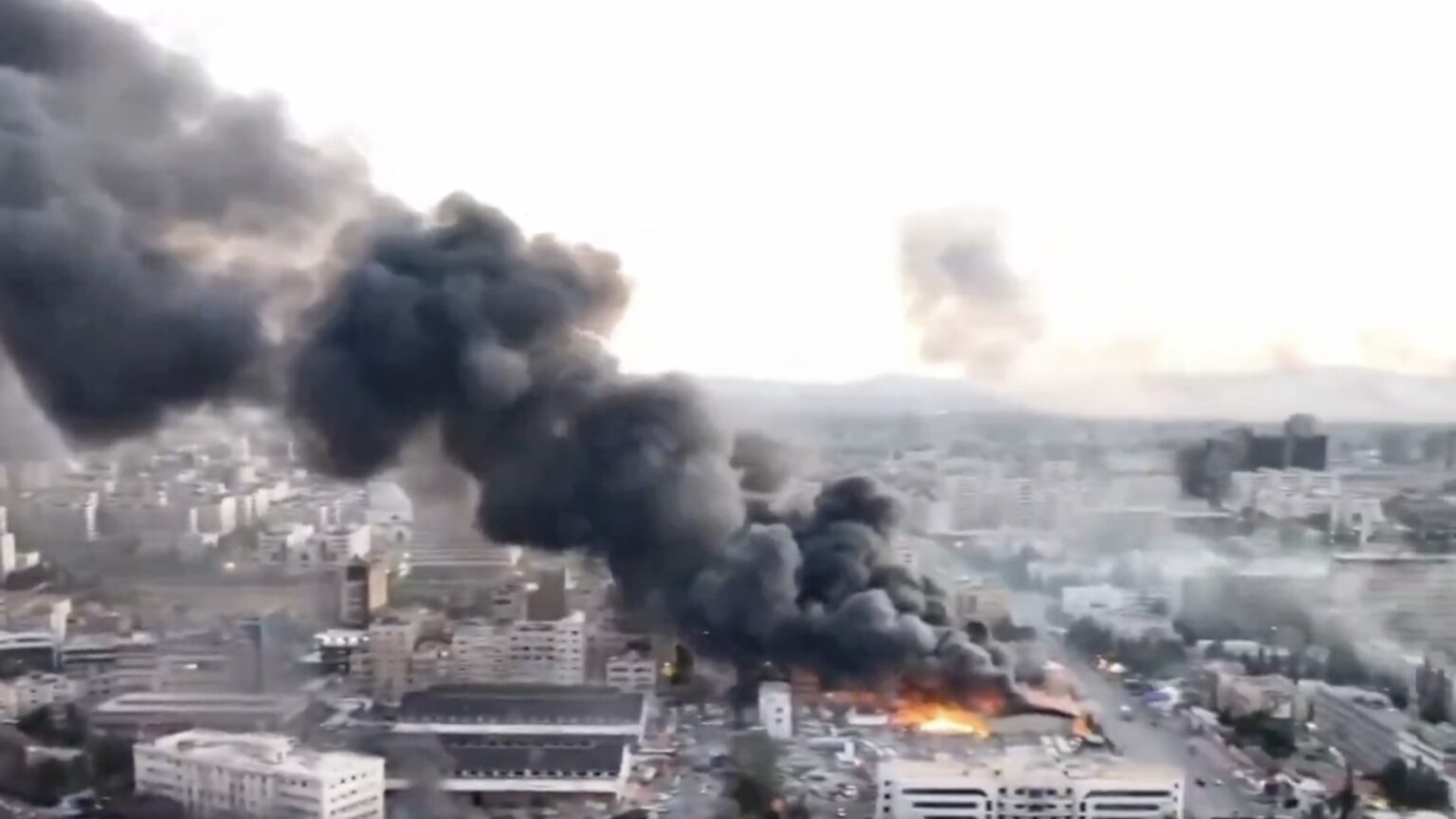
Israel carried out multiple airstrikes against the Syrian capital of Damascus on Sunday, December 8, after the fall of President Bashar al-Assad. Photo: Screenshot
The resignation and fleeing of Bashar al-Assad inaugurates a new chapter in the region that has been facing constant US and Israeli aggression for decades.
As Israeli forces advanced into the Golan buffer zone and initiated airstrikes on targets in the Syrian capital of Damascus, Israeli Prime Minister Benjamin Netanyahu declared in a video published on X that the collapse of Assad’s government on Sunday, December 8, “is a direct result of our forceful action against Hezbollah and Iran, Assad’s main supporters.” Meanwhile, images circulated across social media of members of the armed opposition groups led by Hay’at Tahrir al-Sham (HTS) taking control over Damascus, invading the Iranian embassy in the capital and tearing down posters of late Hezbollah leader Sayyed Hassan Nasrallah and Iranian General Qassem Soleimani.
The dramatic events took place after groups led by HTS launched a surprise offensive on November 27, against Syrian government forces in the Aleppo governorate. HTS is led by Abu Mohammad al-Julani, the former leader of Al-Qaeda’s Syrian branch Al-Nusra front which rebranded as HTS. In the following 12 days, the groups, some of which are backed by the United States, Turkey, and covertly Israel, quickly advanced and gained control of key Syrian cities with little resistance until reaching the capital Damascus on December 8.
The fall of Assad’s government has sent a shock wave across the region and the world. The Syrian government had been engaged in a protracted civil war since 2011, which eventually saw armed opposition groups, including ISIS and Al-Qaeda affiliates, take control over large swathes of territory. The United States officially intervened in the conflict in 2014, carrying out extensive airstrikes as well as territorial deployment alongside Kurdish forces in the north, which continues to this day. Syria’s allies including Russia, Iran, and Lebanese resistance group Hezbollah, played a central role in the military campaign to regain control over the majority of Syrian territory and defeat the Islamic State and other terrorist groups. Importantly, the coalition of armed opposition groups retained control over the Idlib governorate, from where they evidently regrouped to launch their latest offensive.
Analysts, and even Netanyahu himself, have pointed out that the timing of this offensive was no coincidence. The HTS-led offensive began on the same day that a ceasefire deal was reached between a significantly-weakened Hezbollah and Israel. The critical support Syria received in its fight against opposition groups in the last decade, was significantly reduced as its partners and allies have been engaged in their own arduous wars and conflicts.
Lebanese American journalist Rania Khalek wrote on December 5, “There is a feeling that all the forces against Syria – Turkey, the US, Israel, etc – have joined forces to attack the resistance axis at one of its weakest moments, taking advantage of the last year plus of genocide in Gaza, destruction in Lebanon and Russia being bogged down in Ukraine. All this while US sanctions and bad governance hollowed out what was left of the Syrian state and its remaining institutions. Everyone fears even darker days ahead.”
Additionally, with Israel’s advance on the Golan buffer zone, many now fear that it will seek to advance its annexation goals for the Golan Heights.
In a 2018 article written by Nour Samaha for The Intercept, she warned that, taking advantage of the war, Israel at the time was “expanding its influence and control deeper into opposition-held southern Syria.” Samaha argued that this advance through NGOs and backing opposition groups was partially in response to Israel’s anxiety about “increasing Iranian influence in Syria and Hezbollah’s presence close to its northern border”, but also ultimately part of its “aim of cementing Israel’s hold on the Golan Heights.” She reported at the time that there was an increase in Israeli settlement activity within the Occupied Golan Heights.
Israeli forces stated the deployment to the buffer zone was “to ensure the safety of the communities of the Golan Heights and the citizens of Israel. We emphasize that the IDF is not interfering with the internal events in Syria.”
Meanwhile, Israel continues to carry out airstrikes on Syria’s capital targeting strategic sites such as ammunition and weapons depots and the Mezzeh airbase, reportedly to prevent the sites from falling into the hands of the new government.
Iran, the foremost ally of the Assad government, responded to the developments in Syria during a cabinet session on Sunday, December 8. Iranian President Masoud Pezeshkian stated, “We stress the importance of preserving Syria’s unity and sovereignty, with its people deciding the country’s future and political system. We emphasize the importance of dialogue among all segments of Syrian society to reach an understanding, and we hope for an end to military confrontations.” The head of state added that Iran condemns Israel’s “violation of Syrian territory and calls on all parties and countries in the region to be vigilant against its aims.”
The country also condemned the incursion into its embassy in Damascus.
US President Joe Biden speaking in a press conference held at the White House, praised the government takeover by HTS as a “fundamental act of justice” but also that “the fall of the Assad regime in Syria is also a moment of risk and uncertainty.”
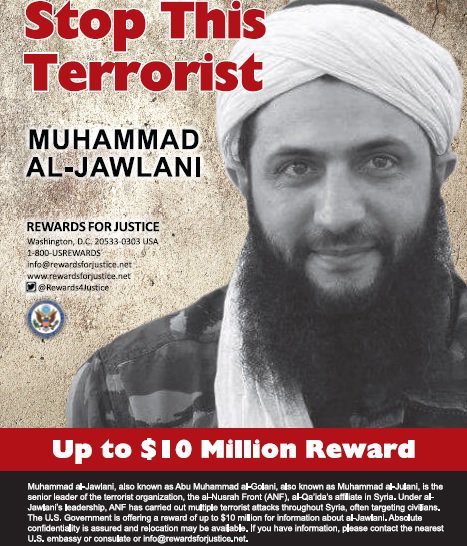
In 2017, the US had declared that it considers HTS a “designated terrorist org”. The US Embassy in Syria posted an image of HTS leader al-Julani, who himself had been declared a global terrorist as early as 2013, and stated “we remain committed to bringing leading AQS figures in HTS to justice”, offering a USD 10 million reward for his capture.