

Original article by Nandini Naira Archer republished from Open Democracy under a Creative Commons Attribution-NonCommercial 4.0 International licence.

A year on from the outset of Israel’s war on Gaza, Israeli forces have killed more than 42,000 Palestinians – and this is just the confirmed death toll. A recent study by the Lancet medical journal projected that the death toll could exceed 186,000 when counting indirect deaths – from starvation and diseases due to the Israeli blockade on humanitarian aid, food, water and medicines.
To take stock of where we’re at and whether this nightmare is likely to end any time soon, openDemocracy spoke to Tariq Kenney-Shawa, a foreign policy analyst based in New York and US Policy Fellow at Al-Shabaka: The Palestinian Policy Network.
openDemocracy: It’s been a year since this latest iteration of Israel’s war on Gaza commenced. Is the end in sight? What’s Israel’s end game?
Tariq: Unfortunately, I don’t see any light at the end of the tunnel here. There is no end in sight to Israel’s genocide in Gaza. And that’s mainly because Israel hasn’t faced an ounce of accountability or pressure to de-escalate from the international community (the US and other western benefactors) to end this.
I’ve tended to be doubtful when people insist that Israel doesn’t have a plan in Gaza and is just destroying and killing for the sake of it. Israel does have a plan and it has been acting on it. It truly sees this moment in history, as well as the blank check from the US, as a golden strategic opportunity to take leaps towards its ultimate goal of ‘maximum land with minimum Palestinians’ and wider regional domination through brute force.
Israel’s end game in Gaza is erasure, and for the last 12 months, they’ve been laying the foundation for a new reality in Gaza for us all to see. In addition to “thinning out the population,” as Netanyahu said, through genocide, collective punishment, and ethnic cleansing, Israel has been effectively chopping up the Strip into smaller, more controllable enclaves that will come to represent the new “facts on the ground.”
openDemocracy: Has anything about the conflict surprised you?
Tariq: I think one of the most surprising aspects about both the genocide in Gaza and now Israel’s escalation across the region is that it has gone on uninterrupted and without international intervention for so long, despite the fact that just about every massacre has been broadcast for the world to see on social media.
As someone who is part of a generation that grew up being taught that the phrase “never again” really meant something, this is what I have found most jarring. Of course, Gaza is not the first time the international “rules-based” order has been exposed as a crutch for Western hegemony. From Vietnam to Iraq, the West’s selective application of international law has long been exposed for what it is. But Gaza is the first postwar genocide both entirely perpetrated by a Western ally and funded, facilitated, and justified by the West itself, not to mention the first to be so thoroughly recorded for the world to see.
openDemocracy: Now with recent escalations including Iran, do you think realistically we’re on the verge of all-out war in the region?
Tariq: I think we are already seeing an all-out regional war by every definition of the term. Israeli fighter jets are bombing Gaza, the West Bank, Lebanon, Syria, Yemen, and Iran. This is not to mention the strikes the US, UK, and other Israeli benefactors have carried out on Israel’s behalf.
It boils down to this: Israel will continue to escalate across the region in hopes of achieving its extremist, expansionist goals as long as the US taxpayer continues to foot the bill and US assets and personnel are off the coast of Haifa to come to Israel’s defence if need be.
openDemocracy: It seems that the Biden administration actually gave Israel the green light to mount large-scale attacks on Lebanon. Has the US ever really been interested in stabilising the region? Does the US want an all-out war?
Tariq: The Biden Administration has either explicitly or implicitly (through uninterrupted weapons transfers and diplomatic shielding) given Israel the green light for a year of genocide and regional escalation.
I believe it is clear that the US ultimately shares the same strategic objectives as Israel, which range from silencing Palestinians once and for all to destroying groups like Hezbollah to causing significant damage to Iran. These are all outcomes that the US would celebrate (just take the public statement the US made following Israel’s assassination of Hassan Nasrallah as one example).
Does the Biden Administration wish Israel could go about some of their operations differently? Perhaps. But at the end of the day, the costs of Israel’s unparalleled violence, the mass death of Arabs and the destruction of their lands, is a price the US is willing to accept. If the US didn’t want an all-out war, they would stop giving Israel all the weapons and diplomatic space to keep escalating at will. Because while every US administration has been pro-Israel, other US presidents have stood up to Israel when they felt US interests were at risk.
openDemocracy: Do you think things will change after the US elections on November 5?
Tariq: Nothing will fundamentally change, regardless of who wins the elections on November 5. For Palestinians, the genocide will continue because neither candidate has exhibited any indication that they intend to hold Israel accountable for war crimes and genocide or use any of the ample leverage that the US has to influence Israel’s conduct.
In fact, it’s the opposite. Donald Trump insists he would let Israel “finish the job” in Gaza, while Kamala Harris promises that she will continue the Biden Administration’s policy of giving Israel “everything it needs” and continues to make it clear that she intends to be a carbon copy of the Biden Administration. The truth is, both Harris and Trump spell continued disaster for both Palestinians and the wider region, and there is no “lesser evil” here.
The truth is, the Biden administration’s resume on Israel-Palestine, even long before October 7, has in many ways mirrored that of Trump’s.
If Biden wanted to make good on his commitment to a “two-state solution,” he would have at least started by reversing the norm shattering pro-Israel policies of his predecessor. The Biden Administration has actually given Israel more military and diplomatic assistance than any previous administration.
The only substantial difference between Trump and Biden has been their rhetoric. But one could argue that Biden’s lofty, yet empty words actually does more harm than good by distracting us from the fact that he has given Israel everything it needed to get away with genocide right in front of our eyes. If Harris wins in November, it will be more of the same, and you don’t need to take my word for it, she has made it abundantly clear herself.
Original article by Nandini Naira Archer republished from Open Democracy under a Creative Commons Attribution-NonCommercial 4.0 International licence.
Original article by Brett Wilkins republished from Common Dreams under Creative Commons (CC BY-NC-ND 3.0).

U.S. armed aid to Israel and related spending on American militarism in the Middle East cost taxpayers at least $22.76 billion over the past year, according to new research published Monday.
The Costs of War Project at Brown University’s Watson Institute for International & Public Affairs—which has long been the premier source for statistics on the human and economic costs of ongoing U.S.-led post-9/11 wars and militarism in the Middle East and beyond—called the $22.76 billion estimate “conservative.”
“This figure includes the $17.9 billion the U.S. government has approved in security assistance for Israeli military operations in Gaza and elsewhere since October 7—substantially more than in any other year since the U.S. began granting military aid to Israel in 1959,” report authors Linda Bilmes, William Hartung, and Stephen Semler wrote. “Yet the report describes how this is only a partial amount of the U.S. financial support provided during this war.”
In addition to the repeated multibillion-dollar rounds of military aid to Israel, related U.S. operations in the region, particularly bombing and shipping defense in and near Yemen—where Houthi rebels have attacked maritime commerce and launched missiles at Israel—have cost over $2 billion since last October.
“It has been difficult for the U.S. public, journalists, and members of Congress to get an accurate understanding of the amount of military equipment and financial assistance that the U.S. government has provided to Israel’s military during the past year of war,” the report states. “There is likewise little U.S. public awareness of the costs of the United States military’s own related operations in the region, particularly in and around Yemen.”
The analysis adds that regional hostilities “have escalated to become the most sustained military campaign by U.S. forces since the 2016-19 air war” against the so-called Islamic State in Iraq and Syria.
“The Costs of War project has an obligation to look at the consequences of the U.S. backing of Israel’s military operations after October 7, especially as it reverberates throughout the region,” Costs of War director Stephanie Savell said in a statement. “Our project examines the human and budgetary costs of U.S. militarism at home and abroad, and for the last year, people in Gaza have suffered the highest consequences imaginable.”
According to the Gaza Health Ministry and international agencies, Israel’s yearlong assault on Gaza has left at least 149,000 Palestinians dead, maimed, or missing, and millions more forcibly displaced, starved, or sickened. U.S. military aid to Israel has continued in successive waves, even as the country stands trial for genocide at the International Court of Justice.
The Hamas-led October 7 attack on resulted in more than 1,100 Israeli and other deaths—at least some of which were caused by so-called “friendly fire” and intentional targeting under the Hannibal Directive—with more than 240 people kidnapped.
Although the Costs of War Project report mainly covers U.S. aid to Israel since last October, it also notes that since 1948—the year the modern state of Israel was founded, largely through the ethnic cleansing of Palestine’s Arabs—American taxpayers have contributed over a quarter trillion inflation-adjusted dollars to the key Mideast ally.
A second report published Monday by the Costs of War Project found that around 90% of Gaza’s population has been forcibly displaced by the Israeli onslaught and 96% of Gazans face “acute levels of food insecurity.” The publication cites a letter sent last week by a group of U.S. physicians to President Joe Biden—who has repeatedly declared his “unwavering” support for Israel—stating that “it is likely that the death toll from this conflict is already greater than 118,908, an astonishing 5.4% of Gaza’s population.” That figure includes 62,000 deaths due to starvation.
“In addition to killing people directly through traumatic injuries, wars cause ‘indirect deaths’ by destroying, damaging, or causing deterioration of economic, social, psychological and health conditions,” report author Sophia Stamatopoulou-Robbins wrote. “These deaths result from diseases and other population-level health effects that stem from war’s destruction of public infrastructure and livelihood sources, reduced access to water and sanitation, environmental damage, and other such factors.”
The new report comes less than two weeks after Israel secured yet another U.S. armed aid package, this one worth $8.7 billion. Meanwhile, the Federal Emergency Management Agency said it faced a nearly $9 billion shortfall for Hurricane Helene relief efforts.
Original article by Brett Wilkins republished from Common Dreams under Creative Commons (CC BY-NC-ND 3.0).
Original article by Jake Johnson republished from Common Dreams under Creative Commons (CC BY-NC-ND 3.0).

The United Nations General Assembly on Wednesday passed a resolution demanding that the Israeli government end its occupation of Palestinian territories within 12 months, affirming a recent International Court of Justice opinion that deemed the decadeslong occupation unlawful.
The Palestine-led resolution, co-sponsored by dozens of nations, calls on Israel to swiftly withdraw “all its military forces” from Gaza and the West Bank, including East Jerusalem. The final vote tally was 124 member states in favor and 14 against, with 43 nations abstaining.
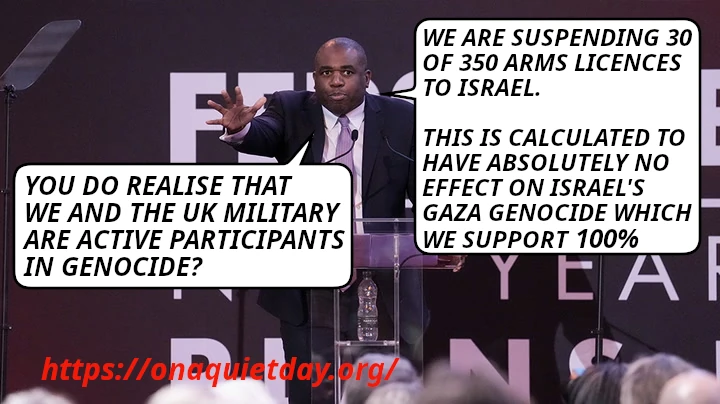
Unsurprisingly, Israel and the United States—Israel’s top ally and arms supplier—were among the 14 countries that opposed the resolution, which is not legally binding. The United Kingdom, which recently suspended some arms export licenses for Israel, abstained from Wednesday’s vote, a decision that the advocacy group Global Justice Now (GJN) said shows “complete disregard for the ongoing suffering of Palestinians forced to live under military-enforced racial discrimination.”
“The vast majority of countries have made it clear: Israel’s occupation of Palestine must end, and all countries have a definite duty not to aid or assist its continuation,” said GJN’s Tim Bierley. “To stay on the right side of international law, the U.K.’s dealings with Israel must drastically change, including closing all loopholes in its partial arms ban and revoking any trade or investment relations that might assist the occupation.”
The Palestinian-led Boycott, Divestment, and Sanctions (BDS) Movement welcomed passage of the resolution, noting that the U.N. General Assembly voted “for the first time in 42 years” in favor of “imposing sanctions on Israel.”
The resolution specifically calls on all U.N. member states to “implement sanctions, including travel bans and asset freezes, against natural and legal persons engaged in the maintenance of Israel’s unlawful presence in the occupied Palestinian territory, including in relation to settler violence.”
The resolution’s passage came nearly two months after the International Court of Justice (ICJ), the U.N.’s highest legal body, handed down an advisory opinion concluding that Israel’s occupation of Palestinian territories is illegal and must end “as rapidly as possible.”
The newly approved resolution states that “respect for the International Court of Justice and its functions… is essential to international law and justice and to an international order based on the rule of law.”
The Biden administration, which is heavily arming the Israeli military as it assails Gaza and the West Bank, criticized the ICJ’s opinion as overly broad.
Nihad Awad, national executive director of the Council on American-Islamic Relations (CAIR), said in a statement Wednesday that “the Biden administration should join the overwhelming majority of nations around the world in condemning these crimes against the Palestinian people, demanding an end to the occupation, and exerting serious pressure on the Israeli government to comply.”
“We welcome this U.N. resolution demanding an end to one of the worst and ongoing crimes against humanity of the past century,” said Awad.
Ahead of Wednesday’s vote, a group of U.N. experts said in a statement that many countries “appear unwilling or unable to take the necessary steps to meet their obligations” in the wake of the ICJ’s opinion.
“Devastating attacks on Palestinians across the occupied Palestinian territory show that by continuing to turn a blind eye to the horrific plight of the Palestinian people, the international community is furthering genocidal violence,” the experts said. “States must act now. They must listen to voices calling on them to take action to stop Israel’s attacks against the Palestinians and end its unlawful occupation. All states have a legal obligation to comply with the ICJ’s ruling and must promote adherence to norms that protect civilians.”
Original article by Jake Johnson republished from Common Dreams under Creative Commons (CC BY-NC-ND 3.0).
Original article by Jake Johnson republished from Common Dreams under Creative Commons (CC BY-NC-ND 3.0).

A report out Thursday shows that the United States’ for-profit healthcare system still ranks dead last among peer nations on key metrics, including access to care and health outcomes such as life expectancy at birth.
The new analysis from the Commonwealth Fund is the latest indictment of a corporate-dominated system that leaves tens of millions of people uninsured or underinsured and unable to afford life-saving medications without rationing doses or going into debt.
“Despite spending a lot on healthcare, the United States is not meeting one of the principal obligations of a nation: to protect the health and welfare of its residents,” the report states. “Most of the countries we compared are providing this protection, even though each can learn a good deal from its peers. The U.S., in failing this ultimate test of a successful nation, remains an outlier.”
People in the U.S., which spends roughly twice as much per capita on healthcare as other rich nations, “live the shortest lives and have the most avoidable deaths,” Commonwealth noted, pointing to frequent “denials of services by insurance companies” and other systematic defects of the American system, including massive administrative costs.
Meanwhile, insurance giants and pharmaceutical companies are raking in huge profits, benefiting in particular from the growing privatization of Medicare. More than half of the Medicare-eligible population in the U.S. is currently on a privately run Medicare Advantage plan.
“Our private, profit-driven system means that we are paying more for less,” progressive activist Jonathan Cohn wrote in response to the Commonwealth report.

Note: To normalize performance scores across countries, each score is the calculated standard deviation from a nine-country average that excludes the US. See “How We Conducted This Study” for more detail.
Data: Commonwealth Fund analysis.
Source: David Blumenthal et al., Mirror, Mirror 2024: A Portrait of the Failing U.S. Health System — Comparing Performance in 10 Nations (Commonwealth Fund, Sept. 2024). https://doi.org/10.26099/ta0g-zp66
The Commonwealth Fund’s findings bolster progressives’ case for transitioning to a Medicare for All system that would provide comprehensive coverage to everyone in the country for free at the point of service. Studies have repeatedly shown that such a program would cost less than the immensely wasteful for-profit system—which is set to drive national healthcare spending to $7.7 trillion per year by 2032—while saving lives.
Commonwealth observed Thursday that while affordability “is a pervasive problem” in the U.S., Australia “offers free care in all public hospitals, and the nation’s universal Medicare system provides all Australians with coverage for all or part of the cost of [general practitioners] and specialist consultations and diagnostic tests, with additional subsidies available for private hospital care.”
“The U.S. continues to be in a class by itself in the underperformance of its healthcare sector,” the report continues. “While the other nine countries differ in the details of their systems and in their performance on domains, unlike the U.S., they all have found a way to meet their residents’ most basic health care needs, including universal coverage.”
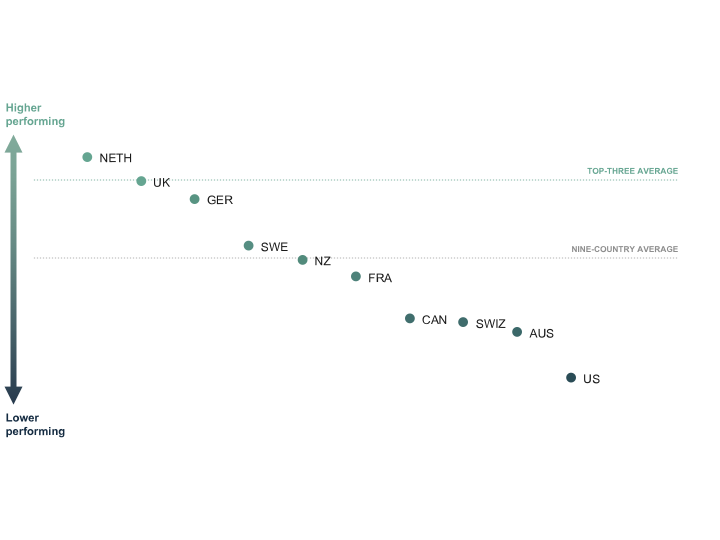
Note: To normalize performance scores across countries, each score is the calculated standard deviation from a nine-country average that excludes the US. See “How We Conducted This Study” for more detail.
Data: Commonwealth Fund analysis.
Source: David Blumenthal et al., Mirror, Mirror 2024: A Portrait of the Failing U.S. Health System — Comparing Performance in 10 Nations (Commonwealth Fund, Sept. 2024). https://doi.org/10.26099/ta0g-zp66
With the U.S. presidential election less than two months away, neither 2024 candidate for the two major parties has outlined a detailed healthcare proposal thus far.
Former President Donald Trump, the Republican nominee, said during last week’s debate in Philadelphia that he merely has “the concepts of a plan,” while Harris—who once co-sponsored Medicare for All legislation in the Senate—said she “absolutely” supports “private healthcare options” and wants to “maintain and grow the Affordable Care Act.”
Just days after the debate, Sen. JD Vance (R-Ohio)—Trump’s running mate—said the Republican nominee prefers a system in which “a young American” and a “65-year-old American with a chronic condition” are not placed in “the same risk pools,” suggesting a rollback of the ACA’s protections for people with preexisting conditions.
“You can’t really say people with preexisting conditions are protected if they are in a separate insurance risk pool and can be charged exorbitant premiums,” Larry Levitt, executive vice president for health policy at the research group KFF, wrote in response to Vance’s comments.
Original article by Jake Johnson republished from Common Dreams under Creative Commons (CC BY-NC-ND 3.0).