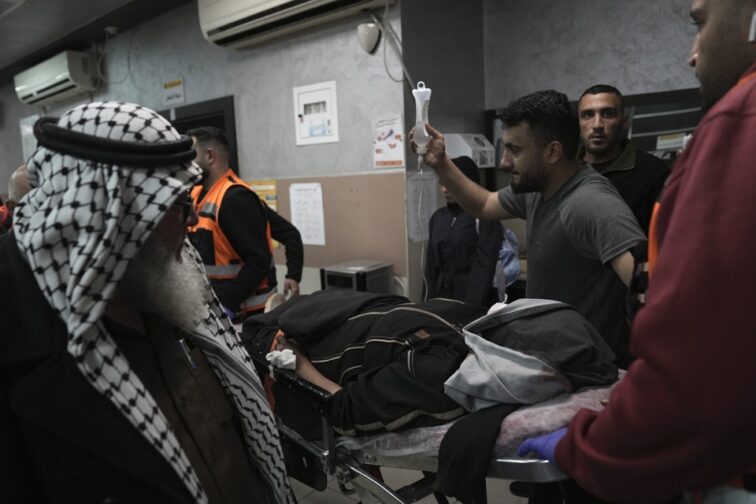
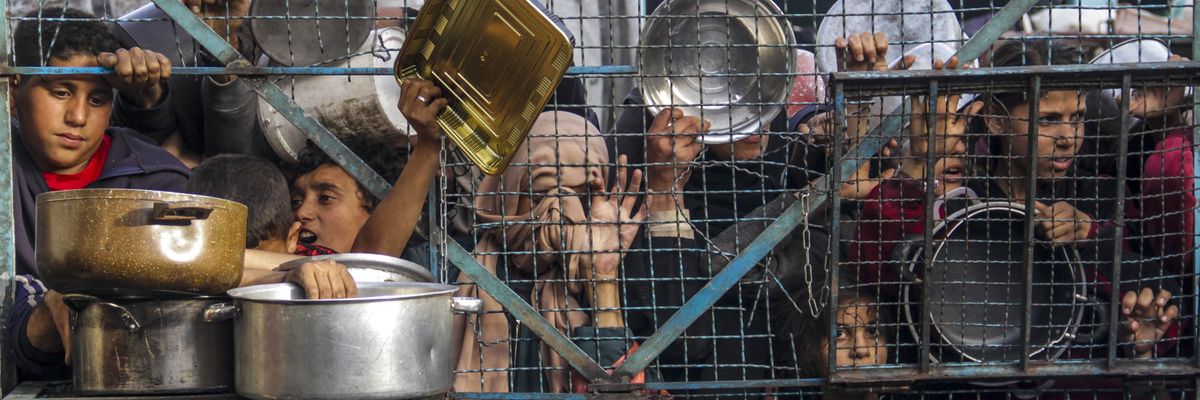
A crowd of starving Palestinians, including children, waits to receive food distributed by charity organizations amid Israel’s blockade at the Jabalia refugee camp in Gaza on March 27, 2024. (Photo by Mahmoud Issa/Anadolu via Getty Images)
“The Israeli government’s use of starvation as a weapon of war has proven deadly for children in Gaza.”
The Israeli government is starving children to death in the Gaza Strip with its deliberate and systematic obstruction of food aid, Human Rights Watch said in a report released Tuesday, citing firsthand accounts from doctors and families in the besieged enclave.
At least 32 people, including 28 children, have died of malnutrition and dehydration so far in northern Gaza, which is facing famine conditions due to Israel’s illegal blockade.
HRW’s new report builds on its December assessment that Israel was “using starvation of civilians as a method of warfare” in Gaza, with disastrous consequences for the territory’s civilian population.
“The Israeli government’s use of starvation as a weapon of war has proven deadly for children in Gaza,” said Omar Shakir, HRW’s Israel and Palestine director. “Israel needs to end this war crime, stop this suffering, and allow humanitarian aid to reach all of Gaza unhindered.”
For its new report, HRW interviewed doctors who have treated malnourished patients and family members of children who have starved to death in recent weeks. The group also reviewed photographs and video footage showing emaciated children who have died of malnutrition.
Dr. Hussam Abu Safiya, the head of the pediatrics unit of a northern Gaza hospital targeted by Israeli forces, said that 26 children in his facility alone have died from starvation-related health complications. Safiya told HRW that at least 16 of the children were under five months old, and one of them was just two days old.
The mother, he said, “had no milk to give him.”
“Israel’s allies like the U.S., U.K., France, and Germany need to press for full-throttle aid delivery by immediately suspending their arms transfers.”
Already badly hindered by Israel’s siege, aid deliveries to Gaza have been further disrupted by Israeli attacks on humanitarian workers and convoys. Israeli forces’ killing of seven World Central Kitchen workers last week led several aid groups to suspend their operations in Gaza.
While Israel agreed in the wake of the deadly attack—and in the face of massive international pressure—to reopen a key border crossing in northern Gaza, aid groups say far more is needed to prevent mass starvation.
“Governments outraged by the Israeli government starving civilians in Gaza should not be looking for band-aid solutions to this humanitarian crisis,” Shakir said Tuesday. “Israel’s announcement that it will increase aid shows that outside pressure works. Israel’s allies like the U.S., U.K., France, and Germany need to press for full-throttle aid delivery by immediately suspending their arms transfers.”
Israel’s six-month war on Gaza has been catastrophic for the territory’s children. According to one recent analysis, over 2% of Gaza’s child population—nearly 26,000 kids—has been killed or wounded during the assault, with at least 1,000 children losing one or both of their legs.
The war has also taken a devastating psychological toll on Gaza’s kids, many of whom have been displaced repeatedly and seen family members maimed or killed by Israeli bombs.
“The emotional distress of dodging bombs and bullets, losing loved ones, being forced to flee through streets littered with debris and corpses, and waking up every morning not knowing if they will be able to eat has also left parents and caregivers increasingly unable to cope,” Save the Children said last month.
Speaking to HRW, the father of newborn twin girls said that one of his babies died of malnutrition at northern Gaza’s Kamal Adwan Hospital eight days after she was born.
“He said that he struggled to feed his family prior to the girls’ birth, but that they only had bread to eat, without meat or protein,” the human rights organization noted in its new report. “He said that after the twins’ birth, his wife could not produce milk to breastfeed the girls and that store-bought milk was scarce.”
One mother of a 6-year-old boy with cystic fibrosis told HRW that “because of the Israeli blockade, she struggled to obtain the necessary medication and provide adequate nourishment.”
“By mid-January, Fadi’s health had deteriorated to the point where he could no longer walk, prompting his hospitalization,” HRW said. Late last month, the boy was evacuated from Kamal Adwan Hospital to receive treatment at a facility in Cairo.
Lama Fakih, HRW’s Middle East and North Africa director, said Tuesday that Israeli officials upholding the blockade that is starving children in Gaza “are committing war crimes.”
“Governments should impose targeted sanctions, including travel bans and asset freezes, against responsible officials,” said Fakih.
But the U.S., Israel’s top ally and arms supplier, is refusing to take concrete action even as damning evidence of Israeli war crimes mounts.
Asked during a Monday press briefing “how many Palestinian citizens should be killed, whether by fire or starvation, so you can seriously intervene,” U.S. State Department spokesperson Matthew Miller said that “we do not want to see a single Palestinian killed.”
“And that is why we have made clear that Israel needs to do more to improve its deconfliction and coordination measures,” Miller said, brushing off the idea of imposing strict conditions on U.S. military aid. The Biden administration is currently pressing Congress to sign off on an $18 billion sale of F-15 fighter jets to Israel.
Earlier in Monday’s briefing, Miller said the U.S. has “not yet at this time concluded that Israel has violated international humanitarian law.”
The editorial boards of the nation’s major media organizations must have been frantic last week.
Used to reporting on US foreign policy, wars and arms exports so as to portray the United States as a benevolent, law-abiding and democracy-defending nation, they were confronted on March 25 with a real challenge dealing with Israel and Gaza. No sooner did the Biden administration, for the first time, abstain and thus allow passage of a United Nations Security Council resolution that was not just critical of Israel, but demanded a ceasefire in Gaza, than US officials began declaring that the resolution that they allowed to pass was really meaningless.
It was “nonbinding,” they said.
The New York Times (3/25/24) reported that US’s UN Ambassdor “Thomas-Greenfield called the resolution ‘nonbinding’”—and let no one contradict her.
That was enough for the New York Times (3/25/24), which produced the most one-sided report on the decision. That article focused initially on how Resolution 2728 (which followed three resolutions that the US had vetoed, and a fourth that was so watered down that China and Russia vetoed it instead) had led to a diplomatic dust-up with the Israeli government: Prime Minister Benjamin Netanyahu canceled a planned visit to Washington by a high-level Israeli delegation to discuss Israel’s planned invasion of Rafah and the future of Gaza and the West Bank.
The Times quoted Richard Gowan, a UN expert at the International Crisis Group: “The abstention is a not-too-coded hint to Netanyahu to rein in operations, above all over Rafah.”
Noting that “Security Council resolutions are considered to be international law,” Times reporters Farnaz Fassihi, Aaron Boxerman and Thomas Fuller wrote, “While the Council has no means of enforcing the resolution, it could impose punitive measures, such as sanctions, on Israel, so long as member states agreed.”
This was nevertheless followed by a quote from Washington’s UN Ambassador Linda Thomas-Greenfield, who abstained from the otherwise unanimous 14–0 vote of the rest of the Security Council, characterizing the resolution as “nonbinding.”
The Times offered no comment from any international law scholars, foreign or US, to rebut or even discuss that claim. Such an expert might have pointed to the unequivocal language of Article 25 of the UN Charter: “The members of the United Nations agree to accept and carry out the decisions of the Security Council in accordance with the present Charter.”
If the US offered its claim that this language only applies to resolutions explicitly referencing the UN Charter’s Chapter VII, dealing with “threats to the peace,” an international law expert (EJIL: Talk!, 1/9/17) might note that the International Court of Justice stated in 1971, “It is not possible to find in the Charter any support for this view.”
‘Creates obligations’
The Washington Post (3/26/24) quoted an international law expert to note that the resolution “creates obligations for Israel and Hamas.”
The Washington Post (3/26/24), though like the Times a firm defender of Washington’s foreign policy consensus, did marginally better. While the Times didn’t mention Britain or France, both major US NATO allies, in its piece on the Security Council vote, the Post noted that the four other veto powers—Britain and France, as well as China and Russia—had all voted in favor of the resolution, along with all 10 elected temporary members of the Council.
The Post also cited one international law legal expert, Donald Rothwell, of the Australian National University, who said the “even-handed” resolution “creates obligations for Israel and Hamas.”
While that quote sounds like the resolution is binding, the Post went on to cite Gowan as saying, “I think it’s pretty clear that if Israel does not comply with the resolution, the Biden administration is not going to allow the Security Council members to impose sanctions or other penalties on Israel.”
The Post (3/25/24) actually ran a stronger, more straightforward piece a day earlier, when it covered the initial vote using an AP story. AP did a fairer job discussing the fraught issue of whether or not the resolution was binding on the warring parties, Israel and Hamas (as well as the nations arming them).
That earlier AP piece, by journalist Edith M. Lederer, quoted US National Security spokesperson John Kirby as explaining that they decided not to veto the resolution because it “does fairly reflect our view that a ceasefire and the release of hostages come together.”
Because of the cutbacks to in-house reporting on national and international news in most of the nation’s major news organizations, most Americans who get their news from television and their local papers end up getting dispatches—often edited for space—from the New York Times, Washington Post or AP wire stories. (The Wall Street Journal, for example, ran the same AP report as the Post.)
‘A demand is a decision’
CNN (3/27/24) quoted US officials claiming the resolution was nonbinding—and noted that “international legal scholars” disagree.
In TV news, CNN (3/27/24) had some of the strongest reporting on the debate over whether the resolution was binding. The news channel said straight out, “While the UN says the latest resolution is nonbinding, experts differ on whether that is the case.”
It went on to say:
After the resolution passed, US officials went to great lengths to say that the resolution isn’t binding. State Department spokesperson Matthew Miller repeatedly said during a news conference that the resolution is nonbinding, before conceding that the technical details of are for international lawyers to determine. Similarly, White House National Security Council spokesman John Kirby and US ambassador to the UN Linda Thomas-Greenfield separately insisted that the resolution is nonbinding.
Those US positions were challenged by China’s UN Ambassador Zhang Jun, who “countered that such resolutions are indeed binding,” and by UN spokesperson Farhan Haq, who said Security Council resolutions are international law, and “so to that extent they are as binding as international law is.”
CNN quoted Maya Ungar, another International Crisis Group analyst:
The US—ascribing to a legal tradition that takes a narrower interpretation—argues that without the use of the word “decides” or evocation of Chapter VII within the text, the resolution is nonbinding…. Other member states and international legal scholars are arguing that there is legal precedence to the idea that a demand is implicitly a decision of the Council.
‘A rhetorical feint’
According to the Guardian (3/26/24), the US’s “nonbinding” interpretation “put the US at odds with other member states, international legal scholars and the UN itself.”
To get a sense of how one-sided or at best cautious the US domestic coverage of this critically urgent story is, consider how it was covered in Britain or Spain, two US allies in NATO.
The British Guardian (3/26/24), which also publishes a US edition, ran with the headline: “Biden Administration’s Gaza Strategy Panned as ‘Mess’ Amid Clashing Goals.” The story began:
The Biden administration’s policy on Gaza has been widely criticized as being in disarray as the defense secretary described the situation as a “humanitarian catastrophe” the day after the State Department declared Israel to be in compliance with international humanitarian law.
But the real contrast is with the Spanish newspaper El País (3/29/24), which bluntly headlined its story “US Sparks Controversy at the UN With Claim That Gaza Ceasefire Resolution Is ‘Nonbinding.’” Not mincing words, the reporters wrote:
By abstaining in the vote on the UN Security Council resolution demanding an immediate ceasefire in Gaza, the United States on Monday sparked not only the anger of Israel, which had asked it to veto the text, but also a sweeping legal and diplomatic controversy due to its claims that the resolution—the first to be passed since the start of the Gaza war—was “nonbinding.” For Washington, it was a rhetorical feint aimed at making the public blow to its great ally in the Middle East less obvious.
El País (3/29/24) quoted the relevant language from the UN Charter: “The members of the United Nations agree to accept and carry out the decisions of the Security Council in accordance with the present Charter.”
After quoting Thompson-Greenfield saying it was a “nonbinding resolution,” and Kirby saying dismissively, “There is no impact at all on Israel,” they wrote,
These claims hit the UN Security Council—the highest executive body of the UN in charge of ensuring world peace and security—like a torpedo. Were the Council’s resolutions binding or not? Our was it that some resolutions were binding and others were not?
The reporters answered their own rhetorical question:
Diplomatic representatives and legal experts came out in force to refute Washington’s claim. UN Secretary-General António Guterres made his opinion clear: the resolutions are binding. Indeed, this is stated in Article 25 of the UN Charter: “The members of the United Nations agree to accept and carry out the decisions of the Security Council in accordance with the present Charter.” Several representatives of the Security Council, led by Mozambique and Sierra Leone, pointed to case law to support this argument. The two African diplomats, both with legal training, said that the Gaza ceasefire resolution is binding, regardless of whether one of the five permanent members of the Council abstains from the vote, as was the case of the US. The diplomats highlighted that in 1971, the advisory opinion of the International Court of Justice (ICJ) established that all resolutions of the UN Security Council are legally binding. The Algerian ambassador to the UN summed it up even more categorically: “Security Council resolutions are binding. Not almost, not partly, not maybe.”
Unlike most most US news organizations, El País went to an expert, in this instance seeking out Adil Haque, a professor of international law at Rutgers University, where he is a professor, and also executive editor of the law journal Just Security. Haque, they wrote, “has no doubts that the resolution is binding.” He explains in the article:
According to the UN Charter, all decisions of the Security Council are binding on all member states. The International Court of Justice has ruled that a resolution need not mention Chapter VII of the Charter [action in case of threats to the peace, breaches of the peace or acts of aggression], refer to international peace and security, or use the word “decides” to make it binding. Any resolution that uses “mandatory language” creates obligations, and that includes the term “demands” used in the resolution on Gaza.” He adds, “For now, it does not seem that the US has a coherent legal argument.”
It should be noted that the New York Times, when there is a dispute regarding a document, typically runs a copy of the document in question—or, if it is too long, the relevant portion of it. In the case of Resolution 2728, which even counting its headline only runs 263 words, that would have not been a hard call. Despite the disagreement between the US and most of the Council over the wording of the ceasefire resolution, the Times chose not to run or even excerpt it.
Far from ‘standing alone’ Israel is fully supplied with military hardware from various Western and non-Western countries, writes RAMZY BAROUD
…
Though many of Israel’s traditional allies in the West are openly disowning its behaviour in Gaza, weapons from various Western and non-Western countries continue to flow, feeding the war machine as it, in turn, continues to harvest more Palestinian lives.
This compels the question: does Israel truly stand alone when its airports and seaports are busier than ever receiving massive shipments of weapons coming from all directions? Not in the least.
Almost every time a Western country announces that it has suspended arms exports to Israel, a news headline appears shortly afterwards, indicating the opposite. Indeed, this has happened repeatedly.
Last year, Rome had declared that it was blocking all arms sales to Israel, giving false hope that some Western countries were finally experiencing some kind of moral awakening.
Alas, on March 14, Reuters quoted the Italian Defence Minister Guido Crosetto as saying that shipments of weapons to Israel are continuing, based on the flimsy logic that previously signed deals would have to be “honoured.”
Another country that is also “honouring” its previous commitments is Canada, which announced on May 19, following a parliamentary motion, that it had suspended arms exports.
The celebration among those advocating an end to the genocide in Gaza were just getting started when, a day later, Ottawa practically reversed the decision by announcing that it, too, will honour previous commitments.
This illustrates that some Western countries, which continue to impart their unsolicited wisdom about human rights, women’s rights and democracy on the rest of the world, have no genuine respect for any of these values.
Canada and Italy are not the largest military supporters of Israel. The US and Germany are.
As Israel prepares for a ground invasion of Rafah, the US-authored resolution presented to the UN Security Council merely noted an “imperative” for an immediate ceasefire in Gaza. Algeria, Russia, and China rejected the resolution, stating that it had failed to deliver on the core demand for a ceasefire.
Russia and China vetoed a US-authored resolution in the United Nations Security Council (UNSC) on March 22 on the situation in Gaza. The text “determines the imperative for an immediate and sustained ceasefire” stopping short of an explicit call for a halt to Israel’s six-month long attack on besieged Gaza that has killed almost 32,000 Palestinians.
The US authored the resolution after vetoing three successive UNSC resolutions on Gaza, including a February 20 resolution presented by Algeria that had called for an immediate ceasefire.
Absent an explicit call for a ceasefire, the text presented by the US mentioned allowing for the delivery of essential humanitarian assistance, “alleviate humanitarian suffering and towards that end unequivocally supports ongoing international diplomatic efforts to secure such a cease-fire in connection [emphasis added] with the release of all remaining hostages,” according to a draft circulated in the news media on Thursday.
This unilateral demand for the release of Israeli hostages—without a mention of a reciprocal release of the thousands of Palestinians Israel has imprisoned and tortured— has been inserted by the US in UNSC discussions of a ceasefire. This is all while Israel has continued to bomb Gaza and rejected comprehensive ceasefire proposals presented by the Palestinian resistance. Friday’s vote in the Security Council was held amid ongoing negotiations in Qatar.
The US continued to make this link perhaps not “as firmly”, during the Council on Friday, with Ambassador Linda Thomas-Greenfield speaking of an “immediate and sustained ceasefire as part of a deal that leads to the release of all hostages being held by Hamas and other groups that will help us address the dire humanitarian crisis in Gaza”. She added that adopting the resolution would “put pressure on Hamas to accept the deal on the table”.
The US resolution received 11 votes in favor, and three votes against, with Algeria joining Russia and China who cast the deciding vetoes. Guyana was the sole abstention, reiterating the lack of a call for an immediate ceasefire.
US resolution a “hypocritical spectacle”
Addressing the Council ahead of the vote, Russian Ambassador Vassily Nebenzia accused the US of presenting a “hypocritical spectacle” wrapped up in a ceasefire, that the US had been trying to “sell a product” to the international community. He added that the language of an “imperative” was not enough to save the lives of the Palestinians and was not stipulated in the mandate of the UNSC, which is vested with a mechanism to “demand a ceasefire and where necessary, to compel compliance”.
“The American product is exceedingly politicized, the sole purpose of which is to help to play to the voters, to throw them a bone in the form of some kind of a mention of a ceasefire in Gaza” and would make the UNSC “instrument in the advancement of Washington’s destructive policy in the Middle East”, and “to ensure the impunity of Israel whose crimes in the draft are not even assessed.”
“The US draft contains an effective green light for Israel to mount a military operation in Rafah”, adding that the text’s authors had tried to make it that “nothing would prevent” Israel from “continuing their brutal cleansing of the south of the Gaza Strip”.
Algerian Ambassador Amar Bendjama stated that the adoption of the February ceasefire resolution could have saved thousands of lives, adding that the present resolution had fallen short “due to the absence of a clear demand for a ceasefire those who believe that the Israeli occupying power will choose to uphold its international legal obligation are mistaken, they must abandon this fiction”.
He stated that the US draft resolution had been circulated a month ago following which Algeria had made proposed edits to “achieve a more balanced and acceptable text”, however, finally, the draft fell short as “core concerns remained unaddressed”.
Addressing the Council on Friday, China’s Ambassador Zhang Jun explained the country’s veto, stating that despite the urgent need and demand for an immediate, unconditional, and sustained ceasefire, “the Council had dragged its feet and wasted too much time”.
He added that the US-authored draft had “always evaded and dodged the most central issue- that of a ceasefire. The final text remains ambiguous and does not call for an immediate ceasefire, nor does it even provide an answer to the question of realizing a ceasefire in the short-term”.
Zhang further stated that an immediate ceasefire was a “fundamental prerequisite” for “saving lives, expanding humanitarian access and preventing greater conflicts. The US draft on the contrary sets up preconditions for a ceasefire which is no different from giving a green light to continued killings which is unacceptable.”
He noted that the draft was “very imbalanced” particularly in regard to Israel’s plans to invade Rafah. “The draft does not clearly and unequivocally state its opposition which would send an utterly wrong signal and lead to severe consequences.”
His Algerian counterpart, Bendjama, had similarly stated that the text “does not convey a clear message of peace. It tacitly allows continuing civilian casualties and lacks clear safeguards to prevent further escalation. It is a laissez-passer to continue killing the Palestinian civilians. The emphasis on ‘measures to reduce civilian harm from ongoing and future operations’ implies a license for continuing bloodshed,” Bendjama added, highlighting Israel’s looming invasion of Rafah.
Rafah invasion still on the table despite international outcry
Israeli Prime Minister Benjamin Netanyahu has reiterated the Occupation’s plan to launch a ground invasion of Rafah in southern Gaza, where 1.5 million people forcibly displaced by Israeli attacks on other parts of Gaza are currently trapped.
While the US continues to make a display of its supposed efforts to halt the looming invasion, Netanyahu has declared that Israel is “rejecting” growing international pressure “in order to achieve the goals of the war”. Following a phone call with President Joe Biden, Netanyahu stated that he “made it as clear as possible” that there was no way around a ground incursion.
“We see no way to eliminate Hamas militarily without destroying these remaining battalions. We are determined to do this”, he said. Netanyahu reiterated this in a meeting with US Secretary of State Antony Blinken, saying on Friday, “I told him that I hope we will do it with the support of the US, but if we have to— we will do it alone”.
“A major military ground operation is not the way to do it”, Blinken told reporters, then going on to say, “We’re determined that Israel succeed in defending itself and becomes integrated into the region with its security.”
Meanwhile, the ten elected, non-permanent members (E-10) of the Security Council have drafted a separate resolution calling for an immediate humanitarian ceasefire for the Muslim holy month of Ramadan, “leading to a permanent sustainable ceasefire”.
It also demands “the immediate and unconditional release of all hostages”, without linking it to the ceasefire, and stresses the need to protect civilians in Gaza and provide humanitarian assistance. France has also stated that it will be drafting a separate resolution.
A vote on the E-10 text is reportedly expected to take place later on Friday or Saturday morning.
People during a pro-Palestine march in central London, organised by the Palestine Solidarity Campaign, February 3, 2024
THOUSANDS of Palestine supporters will gather across Britain this weekend against world leaders’ continued failure to call for a ceasefire in Gaza.
Russia, China and Algeria vetoed a US-sponsored resolution at the UN today which said that “an immediate and sustained ceasefire” in Gaza is “imperative” to protect civilians and enable humanitarian aid to stave off widespread famine.
They did so because the resolution did not actually call for a ceasefire.
Guyana abstained in the vote, with just 11 of the 15 security council members accepting it.
Russia’s UN ambassador Vassily Nebenzia said that while Moscow supports an immediate ceasefire, he questioned the resolution’s language. He accused US Secretary of State Antony Blinken and US ambassador Linda Thomas-Greenfield of “misleading the international community” for “politicised” reasons.
“This was some kind of an empty rhetorical exercise,” Mr Nebenzia said.