Tag: US

  • Russia and China veto US resolution on Gaza over failure to explicitly demand ceasefire

    Spread the love

    Original article by Tanupriya Singh republished from peoples dispatch under a Creative Commons Attribution-ShareAlike 4.0 (CC BY-SA) license.
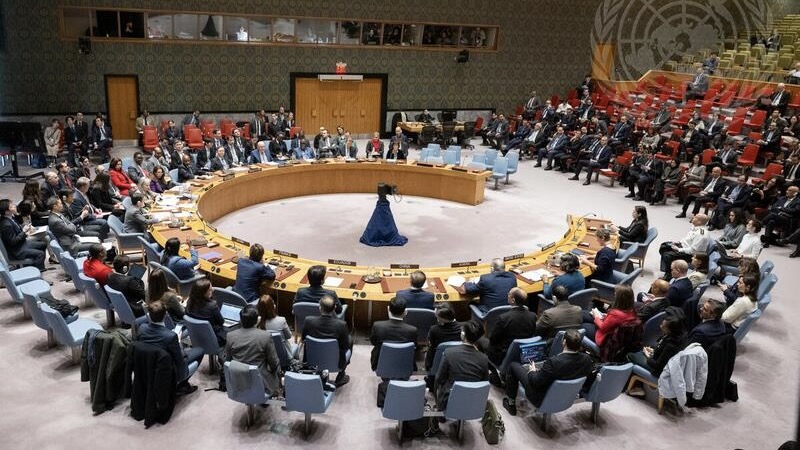
    UNSC. Photo: UN Photo/Eskinder Debebe

    As Israel prepares for a ground invasion of Rafah, the US-authored resolution presented to the UN Security Council merely noted an “imperative” for an immediate ceasefire in Gaza. Algeria, Russia, and China rejected the resolution, stating that it had failed to deliver on the core demand for a ceasefire.

    Russia and China vetoed a US-authored resolution in the United Nations Security Council (UNSC) on March 22 on the situation in Gaza. The text “determines the imperative for an immediate and sustained ceasefire” stopping short of an explicit call for a halt to Israel’s six-month long attack on besieged Gaza that has killed almost 32,000 Palestinians.

    The US authored the resolution after vetoing three successive UNSC resolutions on Gaza, including a February 20 resolution presented by Algeria that had called for an immediate ceasefire.

    Absent an explicit call for a ceasefire, the text presented by the US mentioned allowing for the delivery of essential humanitarian assistance, “alleviate humanitarian suffering and towards that end unequivocally supports ongoing international diplomatic efforts to secure such a cease-fire in connection [emphasis added] with the release of all remaining hostages,” according to a draft circulated in the news media on Thursday.

    This unilateral demand for the release of Israeli hostages—without a mention of a reciprocal release of the thousands of Palestinians Israel has imprisoned and tortured— has been inserted by the US in UNSC discussions of a ceasefire. This is all while Israel has continued to bomb Gaza and rejected comprehensive ceasefire proposals presented by the Palestinian resistance. Friday’s vote in the Security Council was held amid ongoing negotiations in Qatar.

    The US continued to make this link perhaps not “as firmly”, during the Council on Friday, with Ambassador Linda Thomas-Greenfield speaking of an “immediate and sustained ceasefire as part of a deal that leads to the release of all hostages being held by Hamas and other groups that will help us address the dire humanitarian crisis in Gaza”. She added that adopting the resolution would “put pressure on Hamas to accept the deal on the table”. 

    The US resolution received 11 votes in favor, and three votes against, with Algeria joining Russia and China who cast the deciding vetoes. Guyana was the sole abstention, reiterating the lack of a call for an immediate ceasefire.

    US resolution a “hypocritical spectacle”

    Addressing the Council ahead of the vote, Russian Ambassador Vassily Nebenzia accused the US of presenting a “hypocritical spectacle” wrapped up in a ceasefire, that the US had been trying to “sell a product” to the international community. He added that the language of an “imperative” was not enough to save the lives of the Palestinians and was not stipulated in the mandate of the UNSC, which is vested with a mechanism to “demand a ceasefire and where necessary, to compel compliance”.

    “The American product is exceedingly politicized, the sole purpose of which is to help to play to the voters, to throw them a bone in the form of some kind of a mention of a ceasefire in Gaza” and would make the UNSC “instrument in the advancement of Washington’s destructive policy in the Middle East”, and “to ensure the impunity of Israel whose crimes in the draft are not even assessed.”

    “The US draft contains an effective green light for Israel to mount a military operation in Rafah”, adding that the text’s authors had tried to make it that “nothing would prevent” Israel from “continuing their brutal cleansing of the south of the Gaza Strip”.

    Algerian Ambassador Amar Bendjama stated that the adoption of the February ceasefire resolution could have saved thousands of lives, adding that the present resolution had fallen short “due to the absence of a clear demand for a ceasefire those who believe that the Israeli occupying power will choose to uphold its international legal obligation are mistaken, they must abandon this fiction”.

    He stated that the US draft resolution had been circulated a month ago following which Algeria had made proposed edits to “achieve a more balanced and acceptable text”, however, finally, the draft fell short as “core concerns remained unaddressed”.

    Addressing the Council on Friday, China’s Ambassador Zhang Jun explained the country’s veto, stating that despite the urgent need and demand for an immediate, unconditional, and sustained ceasefire, “the Council had dragged its feet and wasted too much time”.

    He added that the US-authored draft had “always evaded and dodged the most central issue- that of a ceasefire. The final text remains ambiguous and does not call for an immediate ceasefire, nor does it even provide an answer to the question of realizing a ceasefire in the short-term”.

    Zhang further stated that an immediate ceasefire was a “fundamental prerequisite” for “saving lives, expanding humanitarian access and preventing greater conflicts. The US draft on the contrary sets up preconditions for a ceasefire which is no different from giving a green light to continued killings which is unacceptable.”

    He noted that the draft was “very imbalanced” particularly in regard to Israel’s plans to invade Rafah. “The draft does not clearly and unequivocally state its opposition which would send an utterly wrong signal and lead to severe consequences.”

    His Algerian counterpart, Bendjama, had similarly stated that the text “does not convey a clear message of peace. It tacitly allows continuing civilian casualties and lacks clear safeguards to prevent further escalation. It is a laissez-passer to continue killing the Palestinian civilians. The emphasis on ‘measures to reduce civilian harm from ongoing and future operations’ implies a license for continuing bloodshed,” Bendjama added, highlighting Israel’s looming invasion of Rafah.

    Rafah invasion still on the table despite international outcry

    Israeli Prime Minister Benjamin Netanyahu has reiterated the Occupation’s plan to launch a ground invasion of Rafah in southern Gaza, where 1.5 million people forcibly displaced by Israeli attacks on other parts of Gaza are currently trapped.

    While the US continues to make a display of its supposed efforts to halt the looming invasion, Netanyahu has declared that Israel is “rejecting” growing international pressure “in order to achieve the goals of the war”. Following a phone call with President Joe Biden, Netanyahu stated that he “made it as clear as possible” that there was no way around a ground incursion.

    “We see no way to eliminate Hamas militarily without destroying these remaining battalions. We are determined to do this”, he said. Netanyahu reiterated this in a meeting with US Secretary of State Antony Blinken, saying on Friday, “I told him that I hope we will do it with the support of the US, but if we have to— we will do it alone”.

    “A major military ground operation is not the way to do it”, Blinken told reporters, then going on to say, “We’re determined that Israel succeed in defending itself and becomes integrated into the region with its security.”

    Meanwhile, the ten elected, non-permanent members (E-10) of the Security Council have drafted a separate resolution calling for an immediate humanitarian ceasefire for the Muslim holy month of Ramadan, “leading to a permanent sustainable ceasefire”.

    It also demands “the immediate and unconditional release of all hostages”, without linking it to the ceasefire, and stresses the need to protect civilians in Gaza and provide humanitarian assistance. France has also stated that it will be drafting a separate resolution.

    A vote on the E-10 text is reportedly expected to take place later on Friday or Saturday morning.

    Original article by Tanupriya Singh republished from peoples dispatch under a Creative Commons Attribution-ShareAlike 4.0 (CC BY-SA) license.

  • Thousands gather this weekend to demand a ceasefire in Gaza

    Spread the love

    https://morningstaronline.co.uk/article/thousands-gather-this-weekend-to-demand-a-ceasefire-in-gaza

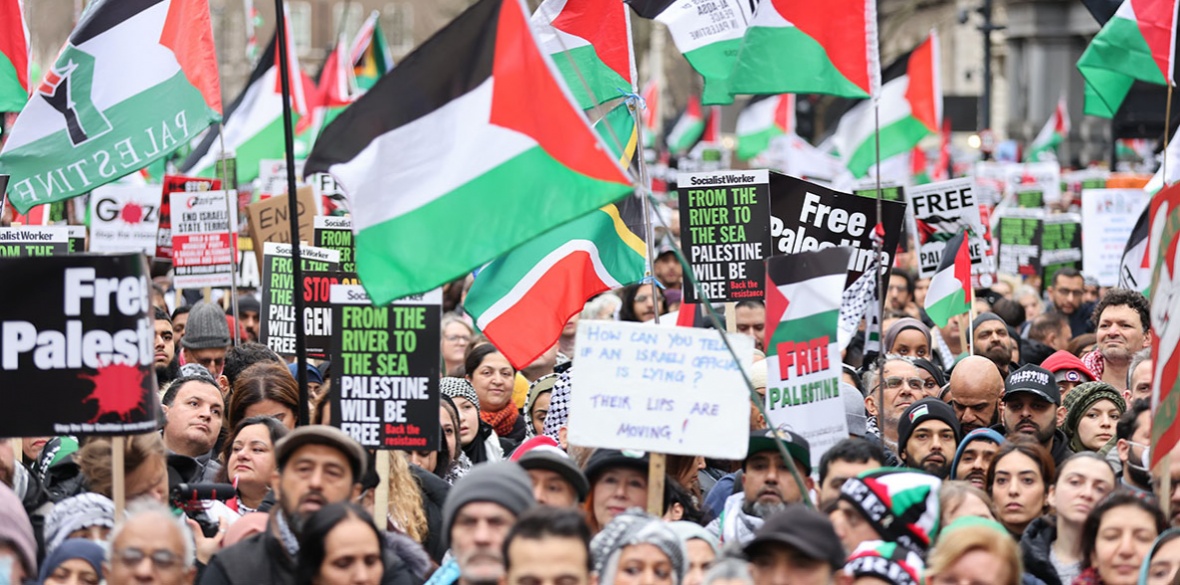
    People during a pro-Palestine march in central London, organised by the Palestine Solidarity Campaign, February 3, 2024

    THOUSANDS of Palestine supporters will gather across Britain this weekend against world leaders’ continued failure to call for a ceasefire in Gaza.

    Russia, China and Algeria vetoed a US-sponsored resolution at the UN today which said that “an immediate and sustained ceasefire” in Gaza is “imperative” to protect civilians and enable humanitarian aid to stave off widespread famine.

    They did so because the resolution did not actually call for a ceasefire.

    Guyana abstained in the vote, with just 11 of the 15 security council members accepting it.

    Russia’s UN ambassador Vassily Nebenzia said that while Moscow supports an immediate ceasefire, he questioned the resolution’s language. He accused US Secretary of State Antony Blinken and US ambassador Linda Thomas-Greenfield of “misleading the international community” for “politicised” reasons.

    “This was some kind of an empty rhetorical exercise,” Mr Nebenzia said.

    …

    https://morningstaronline.co.uk/article/thousands-gather-this-weekend-to-demand-a-ceasefire-in-gaza

  • ‘Finish the Problem’: Presumptive GOP Nominee Trump Endorses Gaza Genocide

    Spread the love

    Original article by JAKE JOHNSON republished from Common Dreams under Creative Commons (CC BY-NC-ND 3.0). 

    Former U.S. President Donald Trump attends a Super Tuesday election night watch party in Palm Beach, Florida on March 5, 2024.  (Photo: Chandan Khanna/AFP via Getty Images)

    One commentator argued that while President Joe Biden has “bent over backward to support Israel,” Donald Trump would “be even worse.”

    Shortly before winning nearly every GOP primary on Super Tuesday and all but locking up the 2024 Republican nomination, former President Donald Trump said in a Fox News interview that he wants Israel to “finish the problem” in Gaza—a clear endorsement of a military campaign that has killed more than 30,000 people in less than five months and sparked one of the worst humanitarian catastrophes in recent history.

    Fox host Brian Kilmeade told Trump that voters who have marked “uncommitted” on their primary ballots to register their opposition to President Joe Biden’s support for Israel’s war are “not gonna like you either because you are firmly in Israel’s camp.”

    “Yeah,” Trump responded.

    Asked whether he is “on board with the way the [Israel Defense Forces] is taking the fight to Gaza,” Trump said, “You’ve gotta finish the problem.”

    “You had a horrible invasion. It took place. It would have never happened if I was president, by the way,” said Trump, who went on to claim that Hamas militants attacked Israel because they “have no respect for Biden” and because Israel “got soft.”

    Trump dodged when asked whether he would support a cease-fire in Gaza.

    Watch:

    Until Tuesday, Trump had largely been quiet about Israel’s large-scale attack on the Gaza Strip, but as president he was a staunch supporter of the Israeli government.

    Trump’s administration recognized Jerusalem as Israel’s capital, moved the American embassy to Jerusalem, and reversed longstanding U.S. policy that deemed Israeli settlements in occupied Palestinian territory “inconsistent with international law”—a shift that the Biden administration rolled back last month.

    Following Trump’s Fox interview Tuesday morning, the former president’s national press secretary Karoline Leavitt toldNBC News that Trump “did more for Israel than any American president in history.”

    “When President Trump is back in the Oval Office, Israel will once again be protected, Iran will go back to being broke, terrorists will be hunted down, and the bloodshed will end,” Leavitt added.

    With former South Carolina Gov. Nikki Haley officially dropping out of the GOP presidential primary race on Wednesday, a rematch between Biden and Trump is now essentially set for November.

    As Democratic voters have used state party primaries in recent weeks to voice their objections to Biden’s unconditional support for Israel, The New York Times reported Friday how the Trump campaign and its allies “plan to exploit that division to their advantage” during the general election.

    “One idea under discussion among Trump allies as a way to drive the Palestinian wedge deeper into the Democratic Party,” the Times reports, “is to run advertisements in heavily Muslim areas of Michigan that would thank Mr. Biden for ‘standing with Israel.’”

    In a column on Monday, The Intercept‘s James Risen argued that Trump and “his MAGA Republicans” would “be even worse” on Israel than the Biden administration, which has supported Israel’s Gaza assault militarily and diplomatically while also issuing mild calls for the protection of civilians, delivery of humanitarian aid, and a temporary cease-fire.

    “Trump is a big fan of war crimes, especially against Muslims,” wrote Risen, The Intercept‘s senior national security correspondent. “During his first term, he intervened on behalf of Special Operations Chief Eddie Gallagher, a Navy SEAL platoon leader convicted of posing for a photo with the body of a dead Iraqi; another SEAL team member told investigators that Gallagher was ‘freaking evil,’ but Trump said at a political rally that he was one of ‘our great fighters.’ Trump also pardoned Blackwater contractors convicted of killing Iraqi civilians in a wild shooting spree in Baghdad’s Nisour Square. There is no chance that he would try to stop Israel from indiscriminately killing Palestinians.”

    “Although the Biden administration has bent over backward to support Israel, the president has said repeatedly in recent weeks that an independent Palestinian state is still possible. What’s more, political unrest within the Democratic Party is starting to have an impact on Biden, forcing changes in the White House’s approach to Israel,” Risen continued. “Trump would never face such pro-Palestinian pressure from within the Republican Party. He and his MAGA cult of Christian nationalists would never force Israel to accept a cease-fire—or a Palestinian state.”

    A previous version of this story misidentified Nikki Haley as the former governor of North Carolina.

    Original article by JAKE JOHNSON republished from Common Dreams under Creative Commons (CC BY-NC-ND 3.0). 

    ‘Unconscionable’: Biden Has Approved 100+ Arms Sales to Israel in Just Five Months

    What a Leaked US Cable Says About Israel’s Looming Assault on Rafah

  • ‘Make Argentina Great Again’: Far-Right Trump and Milei Embrace at CPAC

    Spread the love

    Original article republished from Common Dreams under Creative Commons (CC BY-NC-ND 3.0). 

    US-POLITICS-CONSERVATIVES 
    Argentine President Javier Milei speaks during the annual Conservative Political Action Conference (CPAC) meeting on February 24, 2024, in National Harbor, Maryland. (Photo by MANDEL NGAN / AFP) (Photo by MANDEL NGAN/AFP via Getty Images)

    “This is an unholy alliance,” said one critic of the pair, “mark my words.”

    Disgraced former President Donald Trump of the United States and Argentina’s recently-elected libertarian President Javier Milei met and shared a warm embrace backstage at the annual CPAC gathering on Saturday.

    Milei, the libertarian firebrand who vowed to “chainsaw” his nation’s social programs and usher in a new era of neoliberal austerity in the Latin American nation, was in town to speak at the Conservative Political Action Conference where Trump also spoke on Saturday afternoon.

    “It’s a very big honor for me,” Milei said to Trump as they met, with the Argentinian seeming to thank him for political support during his campaign.

    Trump responded by saying, “MAGA! Make Argentina Great Again.” As they posed for photos together, Trump said, “You look fantastic” and told Milei he was doing a great job.

    “I won’t forget you, I can promise you that,” Trump said.

    “I’ll see you again,” said Milei. “And next time I hope you will be president.”

    “I hope so too,” said Trump.

    Critics of the pair, like researcher Ana M. Fuentes, suggested the meeting was an ominous one.

    “Oh man. I was hoping the Milei meets Trump clip was a parody…but it’s not,” Fuentes said on social media. “This is an unholy alliance, born at CPAC, mark my words.”

    Original article republished from Common Dreams under Creative Commons (CC BY-NC-ND 3.0). 

  • The US Must Stop Arming Israel’s Assault on Hospitals

    Spread the love

    Original article by KATHY KELLY republished from Common Dreams under Creative Commons (CC BY-NC-ND 3.0).

    Injured Palestinians, including children, are brought to Nasser Hospital to receive medical treatment following Israeli attacks in Khan Younis, Gaza, on January 22, 2024.  (Photo: Belal Khaled/Anadolu via Getty Images)

    If we can’t find the morality to stop, we may find we have created a world in which no one can count on upholding basic human rights.

    Many decades ago in Chicago, my favorite of several part-time student jobs was operating the “old-style” telephone switchboard at a small hospital called Forkosh Memorial. The console of coils and plugs included a mirror so operators could keep an eye on the hospital entrance, which on weekends and evenings was also monitored by an elderly, unarmed security guard named Frank. He sat at a classroom style desk near the entrance with a ledger book.

    Over the course of four years, on weekends and evenings, “security” at the hospital generally consisted solely of Frank and me. Fortunately, nothing much ever happened. The possibility of an attack, invasion, or raid never occurred to us. The notion of an aerial bombardment was unimaginable, like something out of War of the Worlds or some other sci-fi fantasy.

    Now, tragically, hospitals in Gaza and the West Bank have been attacked, invaded, bombed, and destroyed. News of additional Israeli attacks is being reported on a daily basis. Last week, Democracy Now! interviewed Dr. Yasser Khan, a Canadian ophthalmologist and eye surgeon who recently returned from a humanitarian surgical mission at the European Hospital in Khan Younis in Gaza. Dr. Khan spoke of bombings taking place every few hours resulting in a constant influx of mass casualties. The majority of patients he treated were children from age 2 to 17. He saw horrific eye injuries, shattered faces, shrapnel wounds, abdominal injuries, limbs severed above the bone, and traumas caused by drone-launched laser-guided missiles. Amid the overcrowding and chaos, healthcare workers tended to patients while lacking basic equipment, including anesthesia. Patients lay on the ground in unsterile conditions, vulnerable to infection and disease. Most of them also suffered from severe hunger.

    At Forkosh Hospital in the 1970s, I had a mirror to see what was happening behind my back, but everyone on Earth can see, directly, the horror of U.S. support for a genocidal event happening on our watch.

    Normally, a child who undergoes an amputation faces as many as 12 additional surgeries. Khan wondered who would do the follow-up care for these children, some of whom have no surviving relatives.

    He also noted sniper fire prevented doctors from going to work. “They’ve killed healthcare workers, nurses, paramedics; ambulances have been bombed. This has all been systematic,” Khan explained. “Now there are 10,000 to 15,000 bodies decomposing. It’s the rainy season right now in Gaza, so all the rainwater mixes with the decomposing bodies and that bacteria mixes with the drinking water supply and you get further disease.”

    According to Khan, Israeli forces have kidnapped 40 to 45 doctors, specifically targeting specialists and hospital administrators. Three healthcare professional organizations have issued a statement expressing deep concern that the Israeli military has abducted and unlawfully detained Dr. Khaled al-Serr, a surgeon at the Nasser Hospital in Gaza.

    On February 19, WHO Director-General Dr. Tedros Adhanom Ghebreyesus described conditions in the Nasser hospital after Israel ordered evacuation of Palestinians from the complex. “There are still more than 180 patients and 15 doctors and nurses inside Nasser,” he said. “The hospital is still experiencing an acute shortage of food, basic medical supplies, and oxygen. There is no tap water and no electricity, except a backup generator maintaining some lifesaving machines.”

    Eight years ago, in October of 2015, the United States military destroyed Afghanistan’s Kunduz hospital, run by Médecins sans Frontières (Doctors Without Borders). For more than an hour, a C-130 transport plane repeatedly fired incendiary devices at the hospital’s emergency room and intensive care unit, killing 42 people. Thirty-seven additional people were injured. “Our patients burned in their beds,” read the MSF’s in-depth report. “Our medical staff were decapitated or lost limbs. Others were shot from the air while they fled the burning building.”

    The horrific attack outraged war resisters and human rights groups. I remember joining a group of activists in upstate New York who assembled outside a hospital emergency room with a banner proclaiming, “To bomb this site would be a war crime.”

    In 2009, on a smaller, yet still horrific scale, I witnessed an Israeli onslaught in Gaza called “Operation Cast Lead.” In the emergency room of the Al Shifa hospital, Dr. Saeed Abuhassan, an orthopedic surgeon, described experiences similar to Khan’s. This surgeon grew up in Chicago, very close to the neighborhood where I lived. I asked him what he would want me to tell our neighbors back home. He listed a litany of horrors, and then he stopped. “No,” he said. “First, you must tell them that U.S. taxpayer money paid for all of these weapons.”

    Taxpayer money feeds the bloated, swollen Pentagon budget. U.S. Senators, last week, cowed by AIPAC, decided to send Israel an additional $14.1 billion to boost military spending. Only three Senators voted against the bill.

    From Palestine, Huwaida Arraf, a Palestinian-American human rights attorney, wrote on X: “The scary part is not that Israel is planning the forcible transfer of the Palestinians it hasn’t slaughtered, but that the so-called ‘civilized world’ is allowing it to happen. The ramifications of this coordinated evil will haunt its collaborators for generations to come.”

    At Forkosh Hospital in the 1970s, I had a mirror to see what was happening behind my back, but everyone on Earth can see, directly, the horror of U.S. support for a genocidal event happening on our watch. Gravely distorted versions of what occurred on October 7, cannot—even if believed—justify the scale of the horrors being reported in Gaza and the West Bank each day.

    The U.S. government continues enthusiastically to bankroll Israel’s systemic and inhumane destruction of Gaza. U.S. advisers make feeble attempts to suggest Israel should pause or at least try to be more precise in their attacks. In its quest for hegemonic superiority, the United States tears into ever tinier shreds whatever remains of a commitment to human rights, equality, and human dignity.

    What kept Forkosh Hospital secure, decades ago, was a social contract that presumed safety for a small hospital serving the local population.

    If we can’t find the morality to stop supplying weapons for ongoing Israeli onslaughts against Gaza and its places of healing, we may find we have created a world in which no one can count on upholding basic human rights. We may be creating intergenerational wounds of hatred and sorrow from which there will never, ever be any safe place to heal.

    A version of this article first appeared on The Progressive website.

    Original article by KATHY KELLY republished from Common Dreams under Creative Commons (CC BY-NC-ND 3.0).