States face challenges getting federal aid amid dwindling Fema funds and laws that don’t consider heat a climate disaster
The spiraling costs of extreme weather in the US are hitting hard as more than 60 million Americans are under heat alerts this week, experts say, even though federal law does not explicitly consider heatwaves to be climate disasters.
Temperatures on Tuesday climbed toward record highs across the north-east, upper midwest and mid-Atlantic, with the south also bracing for soaring temperatures later in the week.
“It’s just an extraordinary, harrowing summer when it comes to extreme events, many of which bear the fingerprints of climate change,” said Rachel Cleetus, the climate and energy policy director with the Union of Concerned Scientists.
The country is stretched paying those costs, due to dwindling funds from the Federal Emergency Management Agency (Fema) and laws that don’t consider heat to be a climate disaster.
This year’s heatwaves have been a huge challenge – and scientists predict 2024 will likely break records again
It’s been a record-breaking summer of heatwaves across large parts of the US and the world, and trying to stay cool and safe has been an unprecedented challenge.
There has been a rise in heat-related fatalities; companies and organizations have been under greater pressures to protect workers; and officials from small towns to the White House have been scrambling to respond.
All of this could be the start of the “new normal”.
Climate scientists say the heat and other extreme weather is in line with three decades of scientific prediction amid humanity’s relentless carbon emissions. It might, in fact, be the tip of the iceberg compared with what is to come.
…
Next year will probably not only see record or near-record heat, it will also likely see a surge in flooding events. The influence of El Niño will cause the US to experience three times the number of “nuisance” flooding events next year than it did in 2000, according to the National Oceanic and Atmospheric Administration. Oliver Milman
Analysts estimate the category 3 storm has already racked up a preliminary cost of $9.36bn, straining the insurance industry
Hurricane Idalia could become the costliest climate disaster to hit the US this year, analysts say, with massive implications for insurance and risk management industries.
The category 3 storm that barreled into Florida’s west coast from the Gulf of Mexico on Wednesday, then carved a path of destruction and flooding through Georgia and the Carolinas, has a preliminary price tag of $9.36bn, based on early estimates, according to risk analysts at UBS.
It follows 15 previous “individual weather and climate disasters” recorded in the US already this year by the National Oceanic and Atmospheric Administration (Noaa) as unprecedented heat, wildfires, storms and floods escalate.
In effect, he has become the chief annihilator of democracy.
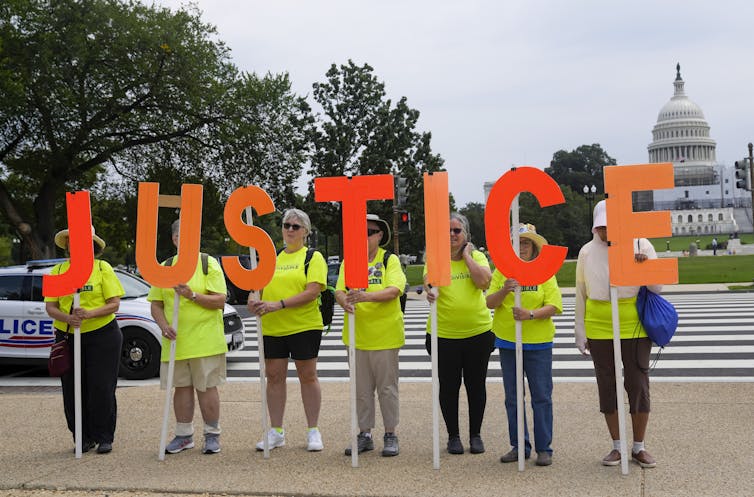
Anti-Donald Trump protesters hold letters that spell out ‘justice’ in Washington, D.C., on Aug. 3 as former president Donald Trump was set to appear in federal court on charges that he sought to overturn the results of the 2020 presidential election. (AP Photo/Jess Rapfogel)
“He has trafficked in racism and xenophobia. He has incited violence. He has kowtowed to dictators and trashed our alliances. He has welcomed Russian attacks on our elections. He has locked children in cages. He has called for his opponents to be locked up.”
Put differently, Trump has criminalized both social problems and politics itself.
Trump and his allies have long created a culture of lies, illusions, cruelty and misrepresentation. He has waged an incessant attack on reason, critical thinking, informed judgment and social responsibility. His distaste for Black people, migrants and others he considers disposable is matched by his support for the financial and corporate elite.
Yet, despite the damage Trump has done to democracy, he has almost complete support of the Republican Party and a majority of Republican voters — slightly more than 58 per cent say they still plan to vote for him in the 2024 presidential election if he wins the Republican nomination. He appears poised to clinch that nomination.
Even more troubling are recent polls indicating he’s in a dead heat with U.S. President Joe Biden if they’re the presidential nominees in 2024.
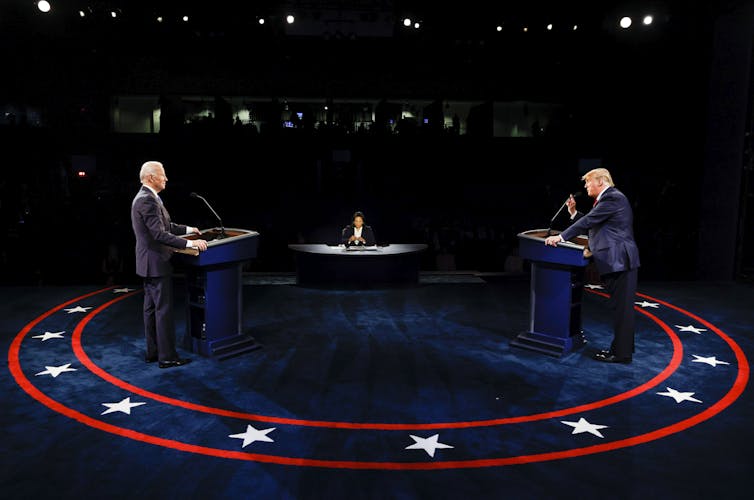
Donald Trump and Joe Biden participate in a presidential debate in Nashville, Tenn., in October 2020. (Jim Bourg/Pool via AP)
What explains Trump’s appeal?
Most of media is focused on Trump’s legal troubles. But too little has been written about the conditions that have given rise to his authoritarian politics or why Trump is a national disgrace still backed by millions of Americans.
Trump’s grip on power is a collective nightmare that can only be understood in terms of the historical, economic, political and cultural conditions of which he is the endpoint.
“Odious as he may be, Trump is less the cause of America’s decline than a product of its descent.”
Trump embodies a society that has been in crisis for decades, but especially since the 1980s. This was a period when the right-wing counter-revolution emerged with the election of Ronald Reagan.
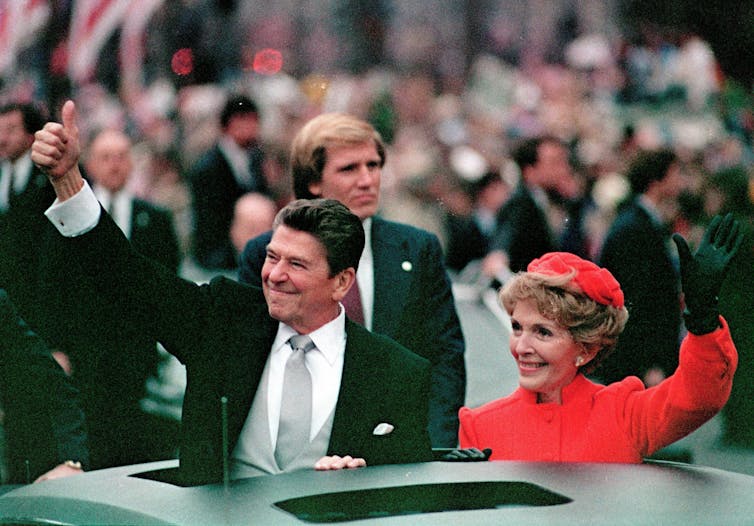
Ronald Reagan gives a thumbs up to the crowd while his wife, first lady Nancy Reagan, waves from a limousine during the inaugural parade in Washington following Reagan’s swearing in as the 40th president of the United States in January 1981. (AP Photo/File)
Since that time, the democratic values that informed the social contract and common good have been increasingly displaced by market values that stress self-interest, privatization, commodification, deregulation and the accumulation of profit and celebration of greed. Civic culture came under attack along with the erosion of the values of shared citizenship.
The market became a template for controlling not just the economy, but all of society. The language of rabid individualism replaced the notion of the common good and gave way to a disdain for community.
Government was discredited as a force for good, its public infrastructure was eroded and replaced by a culture of cruelty in which matters of compassion, care, and ethical responsibility began to disappear.
What emerged was society marked by precarity, loneliness and mass anxiety. The rising cult of individualism made it difficult for the public to translate private troubles into systemic considerations, weakening the public imagination. The rise of a media environment where politics becomes a form of entertainment helped silence any resistance to a growing culture of lies and greed.
Staggering levels of economic inequality also emerged, setting the ground for dark money shaping politics. This neoliberal poison helped to create a society of political monsters, immune to the virtues and conditions of democracy.
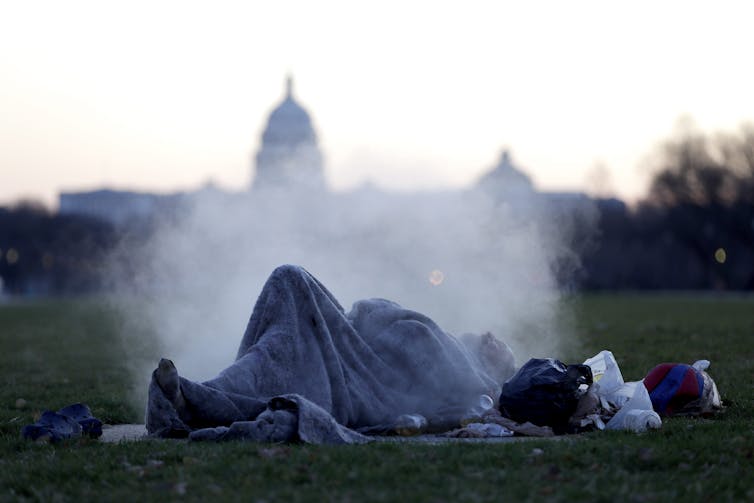
A homeless man resting on a steam vent on the National Mall in 2019 in Washington. (AP Photo/Julio Cortez)
Harnessed to exclusion and bigotry, the language of freedom was invoked eventually by Trump and other Republican Party politicians to produce policies that have banned books, crushed dissent, limited classroom and workplace discussions about race, whitewashed African American history and justified a virulent anti-democratic politics that echo the ghosts of a fascist past.
America at a crossroads
The most important issues Americans face today are not solely about Trump’s corruption, lawlessness or open authoritarianism — it’s about learning from history.
We must rethink the lies that neoliberal capitalism have told us about how American society defines itself while rethinking what it will take to challenge and overcome the anti-democratic forces that gave rise to Trump.
The 2024 election should be about more than Trump’s ongoing legal travails. It should be a directive for what kind of society Americans want and what kind of future they desire for their children. They should regard the election as a choice between democracy and the further criminalization of American politics.
Henry Giroux, Chaired professor for Scholarship in the Public Interest in the Department of English and Cultural Studies, McMaster University
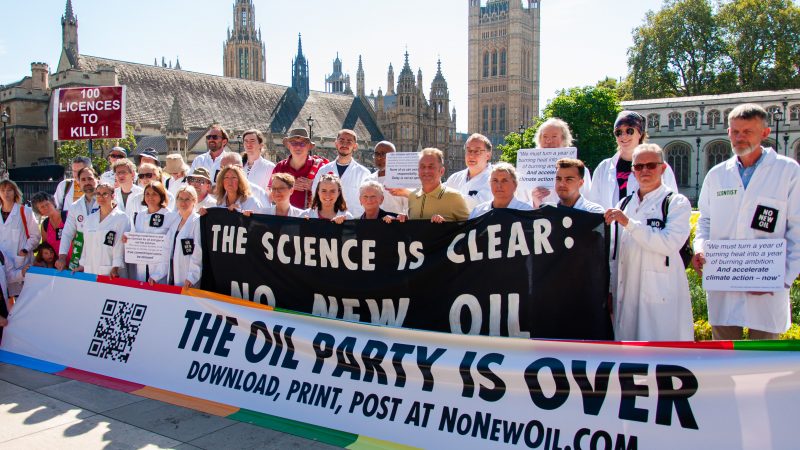
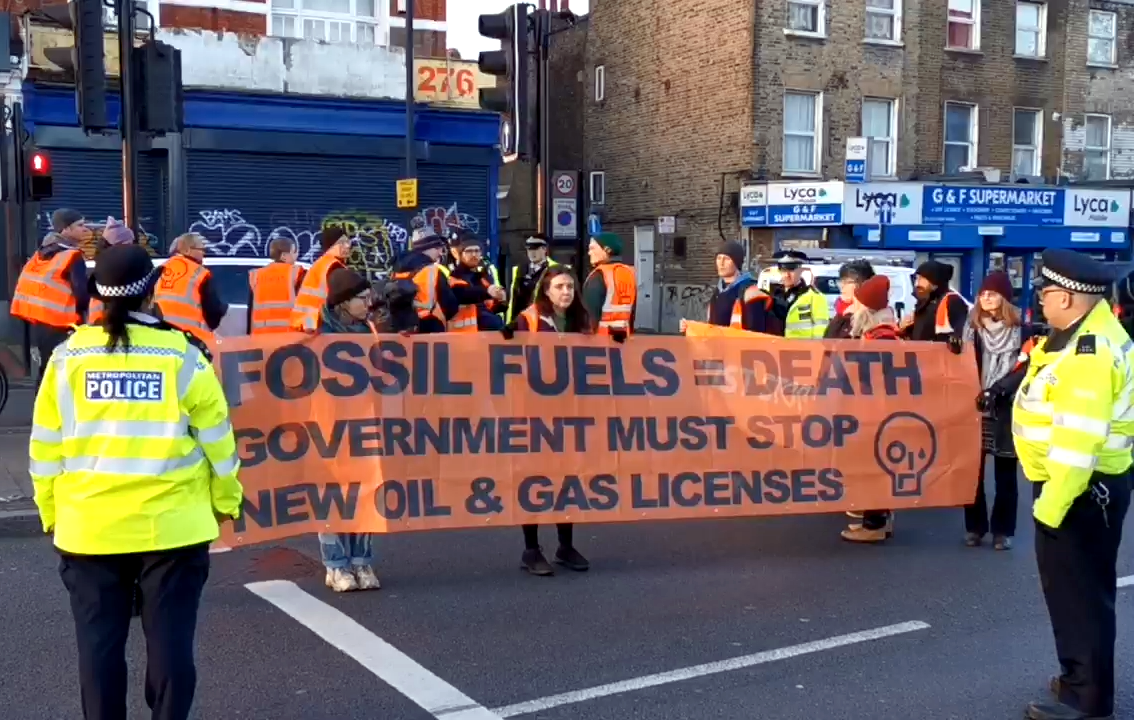
Just Stop Oil protesting in London 6 December 2022.
Despite floods and fires, both left and right in the US act like environmental disaster isn’t happening
There’s a lot of hot air from the American right around education at the moment, with hate groups inciting moral panics that have resulted in the banning of books related to race, sex and gender. But there seems to be surprisingly little emphasis on another right-wing bugbear: environmentalism.
Don’t get me wrong – it’s not that US conservatives don’t consider bashing Greta Thunberg on the internet a national pastime. It’s just that Greta and the cause she represents don’t seem to come up when right-wing activists go to school-board meetings to scream about ‘transgenderism’ or ‘critical race theory’.
On one level, it is, of course, good that they’re not calling for literature addressing our environmental crises to be banned in schools. Growing up, I learned a lot from Ranger Rick magazine, a product of the National Wildlife Federation that teaches children about nature and supports conservation. But on another level, the lack of interest on this issue from the right may actually signal a problem for the US and therefore – because my country is such an outsized contributor to global climate change – the entire planet.
Authoritarians are bullies who paint themselves as victims. If you want to see what I mean, just type ‘Donald Trump’ and the phrase ‘treated very unfairly’ into Google. They whine and scream the loudest when they feel their privilege and power to be most immediately threatened. And if Republicans do not feel especially threatened on behalf of their precious fossil fuels industry, that’s probably because the US is highly unlikely to pass any serious environmental regulations any time soon.