Tag: US

  • UN Puts Out ‘Truly Damning Report Card’ for Climate Action Before Global Summits

    Spread the love
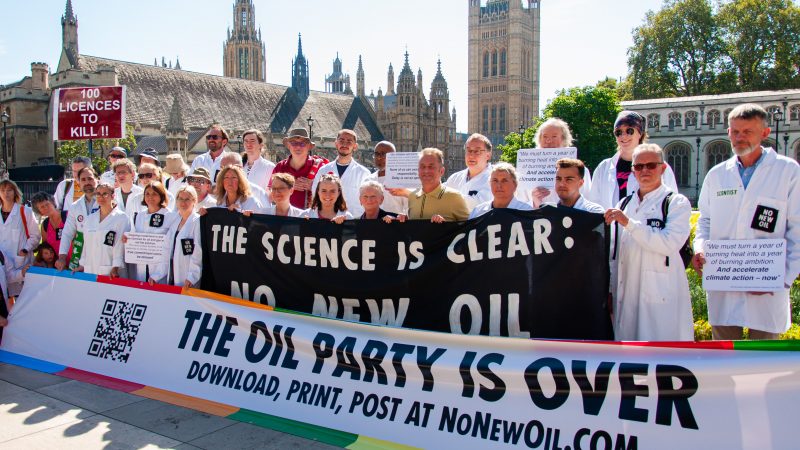
    Scientists protest at UK Parliament 5 September 2023.
    Scientists protest at UK Parliament 5 September 2023.

    Original article by JESSICA CORBETT republished from Common Dreams under Creative Commons (CC BY-NC-ND 3.0). 

    “This report is a wake-up call to the injustice of the climate crisis and a pivotal opportunity to correct course,” said one expert.

    “The United Nations’ polite prose glosses over what is a truly damning report card for global climate efforts. Carbon emissions? Still climbing. Rich countries’ finance commitments? Delinquent. Adaptation support? Lagging woefully behind.”

    That’s how Ani Dasgupta, president and CEO of the World Resources Institute, began his response to a “global stocktake” report released Friday by the U.N. Framework Convention on Climate Change (UNFCCC) ahead of two global summits.

    “This report is a wake-up call to the injustice of the climate crisis and a pivotal opportunity to correct course,” Dasgupta continued. “We already knew the world is failing to meet its climate goals, but leaders now have a concrete blueprint underpinned by a mountain of evidence for how to get the job done.”

    “There are a few bright spots worth celebrating,” he noted. “But overall, the report finds there are more gaps than progress—gaps that can only be erased by transformational change across systems like energy, food, land, and transport. The future of our planet depends on whether national leaders use this stark assessment as a catalyst for bold systems transformation.”

    “This report makes clear that President Biden is squandering precious time every second he fails to take bold action on fossil fuels.”

    The UNFCCC report comes nearly eight years after countries finalized the Paris climate agreement, which aims to keep global temperature rise this century below 2°C, relative to preindustrial levels, with a more ambitious target of 1.5°C.

    “The global stocktake was designed under the Paris agreement to assess our global response to the climate crisis and chart a better way forward,” the UNFCCC explained Friday. “The global stocktake is held every five years and is intended to inform the next round of nationally determined contributions to be put forward by 2025.”

    Data collection began in 2021, ultimately resulting in more than 170,000 pages of written submissions and over 252 hours of meetings and discussions. The new synthesis report summarizes 17 key technical findings from the discussions.

    “I urge governments to carefully study the findings of the report and ultimately understand what it means for them and the ambitious action they must take next,” said U.N. Climate Change Executive Secretary Simon Stiell. “It’s the same for businesses, communities, and other key stakeholders. While the catalytic role of the Paris agreement and the multilateral process will remain vital in the coming years, the global stocktake is a critical moment for greater ambition and accelerating action.”

    As University College London professor of climatology Mark Maslin explained, the report “makes it clear that the Paris agreement was a game-changer” but also countries’ greenhouse gas (GHG) emission reduction pledges are not in line with the 1.5°C target.

    “The U.N. estimates that… we need to reduce global GHG emissions by 43% by 2030 and further by 60% by 2035 compared to 2019 levels and reach net-zero [carbon dioxide] emissions by 2050 globally,” Maslin summarized. “This is a huge ask given that greenhouse gas emissions were at their highest level ever in 2022.”

    “All the technology exists to undergo the net-zero transformation but the huge increases in renewables, [electric vehicles], and batteries [have] to be even more rapid to make the huge cuts suggested by the U.N.—estimates are we need everything to happen five times faster,” he added.

    The UNFCCC publication was released in preparation for the U.N. Climate Change Conference (COP28)—scheduled for November and December in Dubai, United Arab Emirates—where the first global stocktake will conclude.

    “This global stocktake report provides clear direction on how we can meet the expectations of the Paris agreement by taking decisive action in this critical decade,” said COP28 President-Designate Sultan Al Jaber—whose selection for the summit post is controversial because he also heads the UAE’s Abu Dhabi National Oil Company. “We must urgently disrupt business as usual and unite like never before to move from ambition to action and from rhetoric to real results.”

    The report also comes just ahead of U.N. Secretary-General António Guterres’ Climate Ambition Summit scheduled to begin on September 20 in New York City. In response, activists have planned the March to End Fossil Fuels on September 17.

    Organizers of the NYC march are calling on U.S. President Joe Biden to stop federal approvals for new fossil fuel projects and repeal permits for “climate bombs” like the Willow project and the Mountain Valley Pipeline; phase out oil and gas drilling on public lands and waters; declare a climate emergency; and provide a just transition.

    Advocacy groups supporting the march issued fresh demands for action on Friday in response to the UNFCCC publication.

    “This report makes clear that President Biden is squandering precious time every second he fails to take bold action on fossil fuels,” said the Center for Biological Diversity’s Jean Su, who previously authored a document detailing how an emergency declaration would empower the administration to tackle the climate crisis. “Every day we’re seeing and feeling the harms of fossil-fueled climate change from extreme heat to deadly wildfires and devastating floods.”

    “As leader of the world’s largest oil and gas producer, Biden has more power than anyone to stop expanding the fossil fuels driving this deadly crisis,” Su added. “Ahead of the U.N.’s Climate Ambition Summit, thousands of people will be in the streets of New York on September 17 for the March to End Fossil Fuels. This is the perfect opportunity for Biden to declare a climate emergency, use all his executive powers to phase out fossil fuels, and finally secure a legacy as a climate leader.”

    “We need the biggest players to use their power to avert climate chaos, and to flex their muscle to protect human life rather than protecting corporate polluters.”

    Greenpeace International policy coordinator Kaisa Kosonen on Friday called out governments across the globe, declaring that “our house is burning down and the people with the power to save us are still sipping coffee pretending it’s not happening.”

    “No government can claim they didn’t know how to fix the climate problem,” she said. “They’ve been thrown a lifesaver again and again by scientists, and now we have this report. What the world is waiting for is action; leadership. We need the biggest players to use their power to avert climate chaos, and to flex their muscle to protect human life rather than protecting corporate polluters.”

    Looking toward COP28, Kosonen argued that “at this year’s U.N. climate summit, governments must agree to end the use of oil, gas, and coal in a fast and fair way and make the polluters pay. Leaders can no longer smile and claim they support the Paris agreement and its 1.5°C warming limit, if they fail to give fossil fuels an end date and continue their expansion.”

    “The solutions are ready—renewables are now the cheapest power source—but we’ve got to push the fossil fuel industry out of the way,” she stressed. “Fossil fuel corporations are holding us hostage, but their time’s up.”

    The UNFCCC report and resulting calls for action follow a series of scientific findings throughout the week that also generated demands for a swift end to fossil fuels, including that Antarctica is warming more quickly than models project, this summer is the hottest on record, and last year greenhouse gas concentrations, global sea level, and ocean heat content all hit record highs.

    Original article by JESSICA CORBETT republished from Common Dreams under Creative Commons (CC BY-NC-ND 3.0). 
  • ‘A harrowing summer’: extreme weather costs hit US as 60m under heat alerts

    Spread the love
    Scientists protest at UK Parliament 5 September 2023.
    Scientists protest at UK Parliament 5 September 2023.

    https://www.theguardian.com/environment/2023/sep/06/a-relatively-new-challenge-why-us-heatwaves-dont-receive-disaster-funds

    States face challenges getting federal aid amid dwindling Fema funds and laws that don’t consider heat a climate disaster

    The spiraling costs of extreme weather in the US are hitting hard as more than 60 million Americans are under heat alerts this week, experts say, even though federal law does not explicitly consider heatwaves to be climate disasters.

    Temperatures on Tuesday climbed toward record highs across the north-east, upper midwest and mid-Atlantic, with the south also bracing for soaring temperatures later in the week.

    “It’s just an extraordinary, harrowing summer when it comes to extreme events, many of which bear the fingerprints of climate change,” said Rachel Cleetus, the climate and energy policy director with the Union of Concerned Scientists.

    The country is stretched paying those costs, due to dwindling funds from the Federal Emergency Management Agency (Fema) and laws that don’t consider heat to be a climate disaster.

    …

    https://www.theguardian.com/environment/2023/sep/06/a-relatively-new-challenge-why-us-heatwaves-dont-receive-disaster-funds

  • How will the US cope next summer when it could be even hotter?

    Spread the love
    A Texas Longhorn bull.

    https://www.theguardian.com/us-news/2023/sep/04/us-climate-crisis-heat-temperature-heatwave

    This year’s heatwaves have been a huge challenge – and scientists predict 2024 will likely break records again

    It’s been a record-breaking summer of heatwaves across large parts of the US and the world, and trying to stay cool and safe has been an unprecedented challenge.

    There has been a rise in heat-related fatalities; companies and organizations have been under greater pressures to protect workers; and officials from small towns to the White House have been scrambling to respond.

    All of this could be the start of the “new normal”.

    Climate scientists say the heat and other extreme weather is in line with three decades of scientific prediction amid humanity’s relentless carbon emissions. It might, in fact, be the tip of the iceberg compared with what is to come.

    …

    Next year will probably not only see record or near-record heat, it will also likely see a surge in flooding events. The influence of El Niño will cause the US to experience three times the number of “nuisance” flooding events next year than it did in 2000, according to the National Oceanic and Atmospheric Administration. Oliver Milman

    …

    https://www.theguardian.com/us-news/2023/sep/04/us-climate-crisis-heat-temperature-heatwave

  • Hurricane Idalia could become 2023’s costliest climate disaster for the US

    Spread the love

    https://www.theguardian.com/us-news/2023/aug/31/hurricane-idalia-cost-update-category-3-florida-georgia

    Analysts estimate the category 3 storm has already racked up a preliminary cost of $9.36bn, straining the insurance industry

    Hurricane Idalia could become the costliest climate disaster to hit the US this year, analysts say, with massive implications for insurance and risk management industries.

    The category 3 storm that barreled into Florida’s west coast from the Gulf of Mexico on Wednesday, then carved a path of destruction and flooding through Georgia and the Carolinas, has a preliminary price tag of $9.36bn, based on early estimates, according to risk analysts at UBS.

    It follows 15 previous “individual weather and climate disasters” recorded in the US already this year by the National Oceanic and Atmospheric Administration (Noaa) as unprecedented heat, wildfires, storms and floods escalate.

    Cumulatively, Noaa said that by the end of July, which Nasa said was Earth’s hottest month on record, the total estimated cost of the damage caused by the disasters was $39.7bn. That figure does not include the estimated $5.5bn cost to rebuild the town of Lahaina following devastating wildfires that razed the Hawaii island of Maui this month.

    …

    https://www.theguardian.com/us-news/2023/aug/31/hurricane-idalia-cost-update-category-3-florida-georgia

  • The U.S. at a crossroads: How Donald Trump is criminalizing American politics

    Spread the love

    Henry Giroux, McMaster University

    Donald Trump has made history again. He is the first president of the United States charged with attempting to overturn a presidential election, violating the rights of citizens to have their votes counted, tampering with a witness and obstructing an official proceeding, among other criminal offences.

    He’s also the first president to be indicted. And this is his third indictment in four months — and all of this is playing out amid his campaign for re-election in 2024.

    None of the charges brought against Trump are surprising. His legacy as an accused serial liar, self-serving crook, sexual predator and white nationalist
    — coupled with his assaults on the courts and supporter of authoritarians globally — are well known.

    In effect, he has become the chief annihilator of democracy.

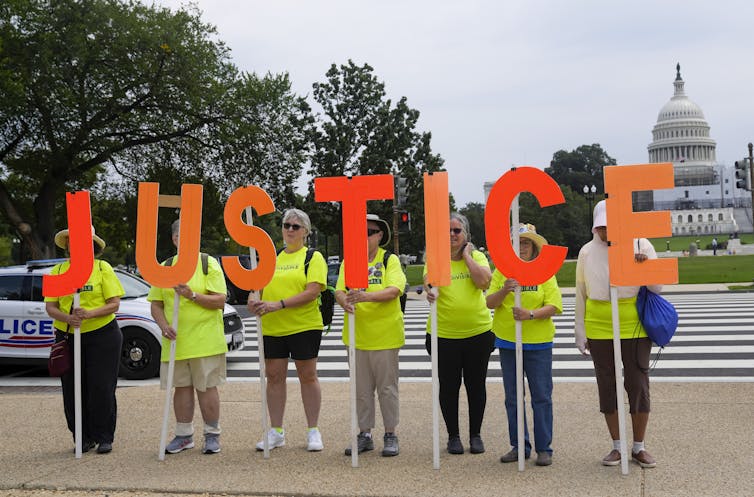
    Seven protesters in neon yellow T-shirts hold orange letters that spell out 'justice.'
    Anti-Donald Trump protesters hold letters that spell out ‘justice’ in Washington, D.C., on Aug. 3 as former president Donald Trump was set to appear in federal court on charges that he sought to overturn the results of the 2020 presidential election.
    (AP Photo/Jess Rapfogel)

    Racism, xenophobia

    As Washington Post political columnist Max Boot has observed, Trump has made a mockery out of political leadership, embraced widespread corruption and provided a model for being one of the worst presidents in American history. Boot writes:

    “He has trafficked in racism and xenophobia. He has incited violence. He has kowtowed to dictators and trashed our alliances. He has welcomed Russian attacks on our elections. He has locked children in cages. He has called for his opponents to be locked up.”

    Put differently, Trump has criminalized both social problems and politics itself.

    Trump and his allies have long created a culture of lies, illusions, cruelty and misrepresentation. He has waged an incessant attack on reason, critical thinking, informed judgment and social responsibility. His distaste for Black people, migrants and others he considers disposable is matched by his support for the financial and corporate elite.

    His populist pose is not only at odds with his policies, such as reducing taxes for the rich and hollowing out the social safety net, but has also pushed American society closer to an upgraded form of white supremacy and fascism.

    Yet, despite the damage Trump has done to democracy, he has almost complete support of the Republican Party and a majority of Republican voters — slightly more than 58 per cent say they still plan to vote for him in the 2024 presidential election if he wins the Republican nomination. He appears poised to clinch that nomination.

    Even more troubling are recent polls indicating he’s in a dead heat with U.S. President Joe Biden if they’re the presidential nominees in 2024.

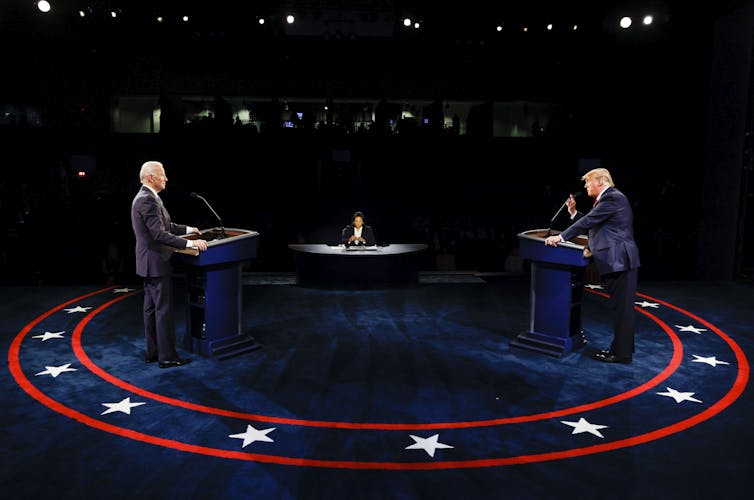
    Two men are seen arguing on a large stage from behind their respective podiums.
    Donald Trump and Joe Biden participate in a presidential debate in Nashville, Tenn., in October 2020.
    (Jim Bourg/Pool via AP)

    What explains Trump’s appeal?

    Most of media is focused on Trump’s legal troubles. But too little has been written about the conditions that have given rise to his authoritarian politics or why Trump is a national disgrace still backed by millions of Americans.

    Trump’s grip on power is a collective nightmare that can only be understood in terms of the historical, economic, political and cultural conditions of which he is the endpoint.

    As American anthropologist Wade Davis has observed:

    “Odious as he may be, Trump is less the cause of America’s decline than a product of its descent.”

    Trump embodies a society that has been in crisis for decades, but especially since the 1980s. This was a period when the right-wing counter-revolution emerged with the election of Ronald Reagan.

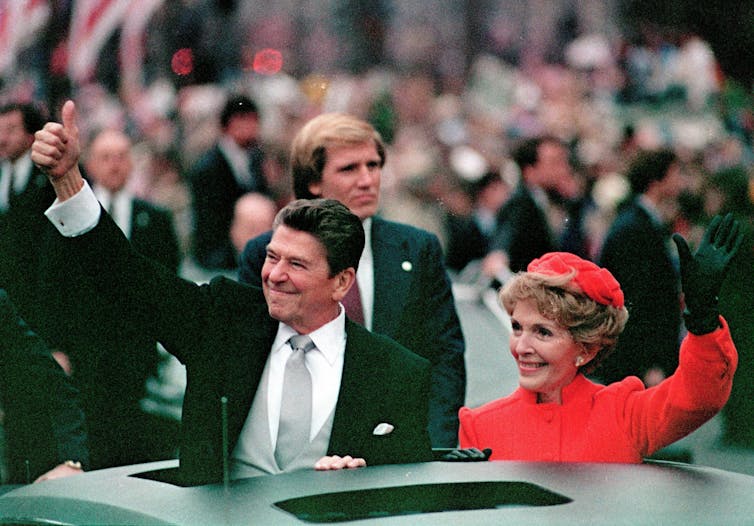
    A dark-haired man gives a thumbs up while a woman dressed in red waves from a limousine.
    Ronald Reagan gives a thumbs up to the crowd while his wife, first lady Nancy Reagan, waves from a limousine during the inaugural parade in Washington following Reagan’s swearing in as the 40th president of the United States in January 1981.
    (AP Photo/File)

    Since that time, the democratic values that informed the social contract and common good have been increasingly displaced by market values that stress self-interest, privatization, commodification, deregulation and the accumulation of profit and celebration of greed. Civic culture came under attack along with the erosion of the values of shared citizenship.

    The market became a template for controlling not just the economy, but all of society. The language of rabid individualism replaced the notion of the common good and gave way to a disdain for community.

    Snubbing social responsibility

    Under the regime of neoliberalism, social responsibility is now viewed as a liability.

    Government was discredited as a force for good, its public infrastructure was eroded and replaced by a culture of cruelty in which matters of compassion, care, and ethical responsibility began to disappear.

    What emerged was society marked by precarity, loneliness and mass anxiety. The rising cult of individualism made it difficult for the public to translate private troubles into systemic considerations, weakening the public imagination. The rise of a media environment where politics becomes a form of entertainment helped silence any resistance to a growing culture of lies and greed.

    Staggering levels of economic inequality also emerged, setting the ground for dark money shaping politics. This neoliberal poison helped to create a society of political monsters, immune to the virtues and conditions of democracy.

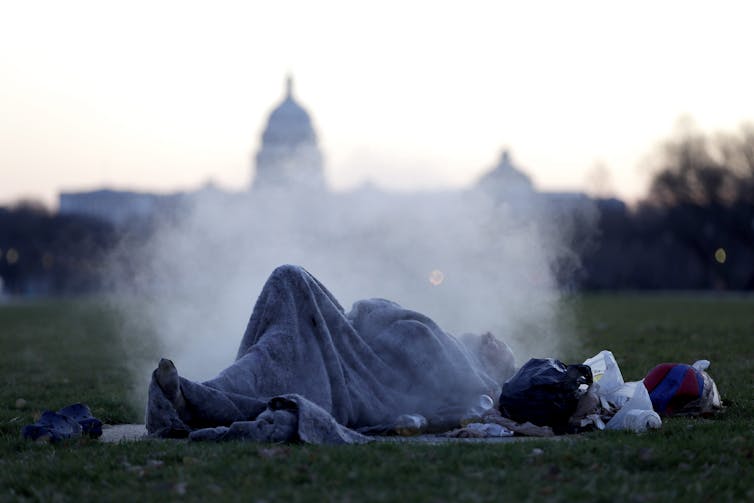
    An ornate domed building is seen behind a homeless person lying on a steam vent in a grassy area.
    A homeless man resting on a steam vent on the National Mall in 2019 in Washington.
    (AP Photo/Julio Cortez)

    Democratic freedoms rooted in equality, freedom from fear, poverty and precarity gave way to what are known as ugly freedoms used to mine depths of hatred and selfishness, and redefine citizenship as the exclusive privilege of white Christian nationalists and radical evangelicals.

    Harnessed to exclusion and bigotry, the language of freedom was invoked eventually by Trump and other Republican Party politicians to produce policies that have banned books, crushed dissent, limited classroom and workplace discussions about race, whitewashed African American history and justified a virulent anti-democratic politics that echo the ghosts of a fascist past.

    America at a crossroads

    The most important issues Americans face today are not solely about Trump’s corruption, lawlessness or open authoritarianism — it’s about learning from history.

    We must rethink the lies that neoliberal capitalism have told us about how American society defines itself while rethinking what it will take to challenge and overcome the anti-democratic forces that gave rise to Trump.

    The 2024 election should be about more than Trump’s ongoing legal travails. It should be a directive for what kind of society Americans want and what kind of future they desire for their children. They should regard the election as a choice between democracy and the further criminalization of American politics. The Conversation

    Henry Giroux, Chaired professor for Scholarship in the Public Interest in the Department of English and Cultural Studies, McMaster University

    This article is republished from The Conversation under a Creative Commons license. Read the original article.