News review

Spread the love
  • ConDem Conservative and Liberal-Democrat Conservative coalition government protects Tony Blair by refusing to release pre-Iraq war cabinet minutes
  • The corporate press promotes Tony Blair

Tony Blair’s Iraq meetings to remain secret after government veto

The government has vetoed an order by the independent freedom of information watchdog to release the minutes of cabinet meetings held immediately before the invasion of Iraq in March 2003.

The decision was announced on Tuesday by Dominic Grieve, the attorney general, the only minister to have access to papers of a previous administration, in this case Tony Blair’s Labour government.

Grieve said he issued a certificate under the Freedom of Information Act vetoing disclosure after consulting former Labour ministers, his cabinet colleagues, and the leader of the opposition, Ed Miliband.

He described the case as “exceptional” and one where, in his view, the public interest demanded the papers should be kept secret. He says he took into account “serious potential prejudice to the maintenance of effective cabinet government”.

The attorney said he also considered the fact that “the issue discussed was exceptionally serious, being a decision to commit British service personnel to an armed conflict situation”, that the issue “remains the focus of both domestic and international interest”, and that “Iraq remains very much a live political issue in its own right” with links to the “overall security situation in the Middle East and the perceived link between the terror threat to the UK and military action in Iraq”.

Grieve noted that most of those present at the cabinet meetings in March 2003 were still MPs or “otherwise active in public life”.

Christopher Graham, the information commissioner, had argued that the “exceptional gravity and controversy” of the matters discussed meant that minutes of the cabinet meetings on 13 and 17 March 2003, days before the invasion, should be disclosed.

One of the reasons Grieve gave for vetoing disclosure was that the Chilcot inquiry meant the invasion of Iraq was still a “live” issue. Yet the panel chaired by Sir John Chilcot is being prevented by Whitehall mandarins from disclosing key documents relating to the decision to invade Iraq.

The March 2003 cabinet minutes are believed to be among them. The continuing dispute between Chilcot and Whitehall officials over disclosure is a main reason why his report has been delayed.

In a separate move last week, the Foreign Office appealed against a judge’s ruling that extracts of a conversation between Blair and George Bush days before the invasion of Iraq must be disclosed. It argued that revealing Blair’s comments to Bush on the telephone on 12 March 2003 would present a “significant danger” to UK-US relations.

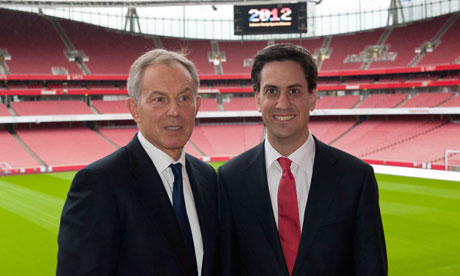
Tony Blair and Ed Miliband


The Return Of The King – Tony Blair And The Magically Disappearing Blood

By David Cromwell

How many war crimes does a western leader have to commit before he is deemed persona non grata by the corporate media and the establishment? Apparently there is no limit, if we are to judge by the prevailing reaction to Tony Blair’s return to the political stage.

On July 11, it was announced that Blair would be ‘contributing ideas and experience’ to Labour leader Ed Miliband’s policy review. He will apparently provide advice on how to ‘maximise’ the economic and sporting legacies of the 2012 London Olympics.

The Guardian described the announcement mildly as a ‘controversial move’; not necessarily in the country at large, the paper claimed, but ‘perhaps especially within the Labour party’. One Guardian headline declared ‘Return of the king’.

The ‘left-wing’ John Harris did his bit in the Guardian to smooth Blair’s path:

‘He’s only 59, the picture of perma-tanned vitality and keen to “make a difference”. Could a fourth stint in No 10 even be on the cards? We shouldn’t rule it out.’

Harris declared ‘that for all his mistakes, transgressions and howling misjudgments, there remains something magnetic about his talents.’
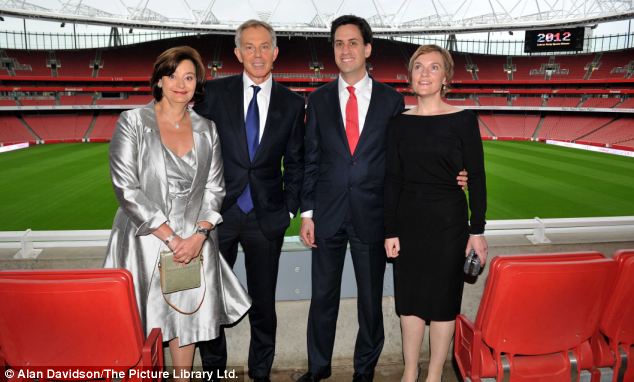
Blairs and Milibands

When Blair appeared at a Labour fundraising dinner at Arsenal’s Emirates stadium, Harris noted that:

‘He was greeted by the obligatory crowd of protesters, still furious about his role in the Iraq war.’

That’s the curious thing about peace protesters; endlessly ‘furious’ about the country being dragged into an illegal war that led to the deaths of around one million people, created four million Iraqi refugees, devastated Iraq’s infrastructure, generated untold suffering and burned obscenely huge sums of public money in times of ‘austerity’. Perhaps we Brits should simply display that famed stiff upper lip and move on. Certainly that’s what Richard Beeston, foreign editor of The Times, suggested in 2009:

‘All this happened six years ago. Get over it.’ (‘The war went wrong. Not the build-up. Stop obsessing about the legality of invading Iraq. The campaign itself was the real disaster’, The Times, February 26, 2009.)

A recent Times editorial welcomed Blair’s return:

‘Labour is coming together, drawing on its best available talent and starting to get serious again. (Editorial, ‘A year in politics’, The Times, July 14, 2012)

The second coming of Blair was launched by a friendly chat on the BBC’s Andrew Marr show. Marr, of course, is well-known as a totally impartial political analyst and a ‘congenial and knowlegable [sic] interviewer’ (to quote a cable from the US embassy in London to Hillary Clinton).

The PR onslaught continued when London’s Evening Standard published an interview with the former PM on the day he ‘guest-edited’ the paper. Would he like to be prime minister again one day? ‘Sure’, he replied. A supportive Financial Times interview with editor Lionel Barber proclaimed:

‘Five years after leaving power, Tony Blair wants back in. He is ready for a big new role. But what exactly is driving him? And can he persuade the world to listen?’

Unnamed ‘friends’ and ‘allies’ were quoted, no doubt passing on the Blair-approved message:

‘Friends say he is desperate to play a bigger role, not because he has any ambition to run for high office but because he wants to be part of the argument. “He would really like to be the centre of attention again,” says one long-time ally.’

A Guardian editorial did its bit to help:

‘he seems to have mellowed a touch since his book [‘A Journey’, published in 2011]; maybe he’s even learnt a little respect for international law.’ (‘Unthinkable? Tony Blair for PM again.’)

The paper continued:

‘Besides, this is no time to fret about the policy details – there is the showbiz to consider. In 2007 John Major likened Mr Blair’s long goodbye to Nellie Melba; the coming comeback must demonstrate he is more like Sinatra and Elvis. There can only be one true heir to Tony Blair, and that is Tony Blair II.’

Could the vanguard of British liberal journalism really be making an editorial call for the return of Blair? It shouldn’t be a total surprise. Recall that even in the wake of the supreme international crime of invading Iraq, the Guardian still called for its readership to re-elect Blair at the 2005 general election.


Continue ReadingNews review

News review

Spread the love
  • Tony Blair a liability to the Labour Party
  • Ed Miliband calls Nick Clegg a Tory accomplice – also true of Tony Blair
  • Since we’re discussing Tory Blair, he was involved in this mass deception and contempt for democracy

Tony Blair’s return as prime minister would not get Britain’s backing

He has been reported as saying that experience could make him a better prime minister the next time around, but the voters beg to differ with Tony Blair. According to a Guardian/ICM poll, if Blair were to return as leader, a prospect he acknowledges is “not likely to happen“, the party’s standing would sink by three points, from the 39% vote share under Ed Miliband, down to just 36%.

Labour coalition government with Lib Dems would be difficult with Nick Clegg as leader – Ed Miliband

ED Milliband has revealed striking a coalition deal with the Liberal Democrats, after the next general election, would be “difficult” if Nick Clegg is still leader.

Mr Clegg has admitted that he would be “open” to a partnership with Labour in the event of a hung parliament.

• Ed Miliband has said that a coalition deal with Lib Dems would be “difficult” with Nick Clegg as leader

• Miliband calls Lib Dem leader a Tory “accomplice”

But Mr Miliband poured cold water on the idea by suggesting Mr Clegg was an an “accomplice” of the Conservatives.

“Clegg’s biggest problem is that he will say he is a brake on the Tories, but he is an accomplice,” he said.

“He chose not to kill the Health and Social Care Bill – a really bad bill doing damage to the NHS – and to pursue House of Lords reform.”

Asked if he could work with the Liberal Democrat leader, Mr Miliband replied: “I would find it difficult to work with him.”


Penta-lawn 2000

On September 11, 2001, a bunch of mean nasty Arab terrorists — who hated our freedoms — hijacked American Airlines Flight 77, a Boeing 757 fully loaded with fuel, and crashed it through the first floor of the west side wall of the Pentagon.

Continue ReadingNews review

The war of austerity is bogus

Spread the love

It needed to be said and well done to Michael Meacher MP for saying it: the war of austerity is bogus, fake, manufactured. The solution is simple says Meacher: the filthy rich are getting filthier rich, tax them. Of course – if you’re filthy rich, you will not ever even notice being slightly less filthy rich.

Meacher’s article is well presented and appears very well researched. Meacher consistently shows competence and capablity and is willing to address the big, important issues – often even against his own party’s policies. We need far more politicians like Meacher.


How to kickstart the UK economy – at zero cost to 99% of us

By imposing a capital gains tax charge at 28% on the seriously rich 0.003% we could create 1.5m jobs over the next two years

Michael Meacher

According to the annual Sunday Times Rich List, the richest 1,000 persons now sit atop of £414bn, a sum more than three times the size of the entire UK budget deficit. The richest 1% of the population, about 300,000 persons with an income of more than £3,000 a week, are estimated to possess wealth of about £1tn. The richest 10% control wealth of about £4tn. To put these figures in perspective, Britain’s total GDP is £1.45tn.

Consider first that minuscule group in the stratosphere at the top, Britain’s thousand richest. In 1997 they held assets of £99bn, but they took full advantage of New Labour’s being “intensely relaxed about people becoming filthy rich” to nearly quadruple this to £336bn by 2010. That process of gargantuan enrichment now means that in order to get access to this exclusive club, one needs personally to command assets of at least £450m to get into the top 200, £750m to get into the richest 100, and no less than £1.4bn to break into the top 50.

It’s not only that the very rich have colossal wealth, they also overwhelmingly monopolise it. The richest 1% of the population own a quarter of total UK wealth, and the richest half control no less than 94% of total wealth. Ownership of land is even more skewed: 69% of it is owned by 0.3% of the population.

What, then, should be done? In the short term, the most feasible approach is to impose a capital gains tax charge at the current rate of 28% on the topmost layers of wealth, the £155bn gains amassed by the 0.003% over the last three years. That would yield £43bn, more than enough to generate the public investment to create 1.5 million jobs over the next two years. This could then steadily be extended to the remainder of the top 1%, which would provide the funds to widen and deepen the early recovery.

A wealth tax and land value tax, the details of which would have to be carefully drafted, should then follow in the medium term, and would achieve several purposes. They would resuscitate a public sector ravaged by the Tory ideological assault, curtail the grossest excesses of inequality that have disfigured the last three decades, and lay the foundations for an industrial and technological revival without which British living standards cannot be sustained. And all this without burdening the remaining 99% of the population.

Michael Meacher’s blog

Continue ReadingThe war of austerity is bogus

Bank of England gives yet another £50B to bankers

Spread the love

“…quantitative easing – printing money by another name – is the last resort of desperate governments when all other policies have failed.”

George Osborne, speech January 9 2009

The Bank of England announced today that it intends to do a further £50billion round of Quantitative Easing. Quantitative Easing involves pumping money into the economy in an apparently futile – it hasn’t yet been shown to work – attempt to stimulate the economy. There is a problem that there is very little to show for so many billions after billions that have already been squandered on Q.E.

It appears that it’s austerity for the vast majority and rolling in lolly for the rich elite. No money for the NHS for the plebs, plenty of billions to stimulate the markets for rich multi-millionaire traders and bankers to get yet richer.

There is an argument that the poor would stimulate the economy far more – since they would have to spend the money.


 10/2/12:

Quantitative Easing is stimulating commodity trading, not the real economy

As the economy slides towards recession, the Bank of England today announced today it was creating a further £50bn worth of ‘quantitative easing’ (QE).

If you read articles on the topic in the media, you will see statements like “the Bank is ‘printing’ money” or the Bank  will “pump a further £50 billion in to the economy”.  Both these statements are misleading.

QE actually involves the Bank of England buying financial assets – usually government bonds – belonging to institutional investors and sitting in Banks. The Bank buys these assets with newly created central bank reserves.  These reserves can only be held by banks – they do not and cannot go to businesses the real economy.

As explained in nef’s Where Does Money Come From?, central bank reserves are used by commercial banks to settle payments with each other.

By ‘pumping’ more reserves in to the intra-bank clearing system the idea is that banks will feel more confident about making loans to the real economy because they will know that other banks are in a stronger position to settle with them.

In addition, by buying up ultra-safe government bonds in vast quantities and thus pushing down the yield (the interest received on holding) on these assets, the central bank hopes to encourage investors to buy higher yielding corporate bonds – which again provides money for real businesses.

QE may reduce long-term interest rates, but there is little evidence it has stimulated commercial banks to start lending more to businesses, in particular small businesses, or soften the conditions banks are attaching to loans.

In fact the most recent figures published by the Bank show that net lending – the amount of loans minus the amount repaid – to small businesses has contracted by six per cent in the year to November 2011. And this despite the banks being given small business lending targets by the government through ‘Project Merlin’.  Not much wizardry there then.

The hard truth is that commercial banks are still in a process of ‘de-leveraging’, more keen on getting their loans repaid and building up their capital base than making new loans to productive businesses in what is perceived to be a risky real economy.

Evidence suggests the additional funds provided by QE are more likely to be used by banks to create more speculative credit, not least commodity speculation,  that provides shorter term returns.  As a result, the money supply in the real economy is contracting just at the point where new investment is most needed.


Continue ReadingBank of England gives yet another £50B to bankers

Reflecting on: Beautiful

Spread the love

There is a tradition of denoting something by it’s opposite. Marilyn Manson’s ‘Beautiful People’ for all those that died on 7 July 2005 from many different religions and belief systems ~ indeed actually more than that ~ the day after Dubya’s bicycle accident on his birthday. Robin Cooke wrote about 7/7 shortly before he died on Ben Stack.

Then there’s kaleidoscope.  the word “kaleidoscope” is derived from the Ancient Greek καλ(ός) (beauty, beautiful), είδο(ς) (form, shape) and -σκόπιο (tool for examination)—hence “observer of beautiful forms.” Who was it that mentioned “kaleidoscope” (and “tea and biscuits”)?

Continue ReadingReflecting on: Beautiful