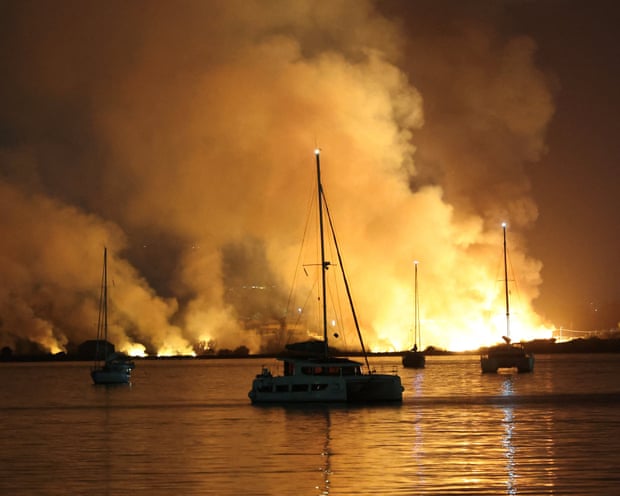
A wildfire burning near the coast of Syracuse in Sicily, Italy, toward the end of last month. Photograph: Stéphane Mahé/Reuters
WMO report details extreme weather events causing climatic feedback loop with serious health consequences
Big increases in wildfires and heatwaves supercharged by the climate crisis are hindering improvements to air quality around the world, UN experts have said.
Regions that had recorded a fall in pollution emitted by cars and industrial sites are facing new threats to air quality because of exposure to smoke from wildfires, according to a new report, while rising temperatures caused by intense heatwaves are causing a surge in ground-level ozone.
In turn, the pollution generated by these climate-linked events is itself contributing to climate breakdown, creating a feedback loop that risks dragging the world deeper into environmental catastrophe.
“Air quality and climate cannot be treated as separate subjects; they are deeply intertwined and have to be treated together,” said Lorenzo Labrador, a scientific officer of the World Meteorological Organization (WMO), which issued the report.
Elon Musk urges you to be a Fascist like him, says that you can ignore facts and reality then.Donald Trump urges you to be a Climate Science denier like him. He says that he makes millions and millions for destroying the planet, Burn, Baby, Burn and Flood, Baby, Flood.Nigel Farage urges you to ignore facts and reality and be a climate science denier like him and his Deputy Richard Tice. He says that Reform UK has received £Millions and £Millions from the fossil fuel industry to promote climate denial and destroy the planet.
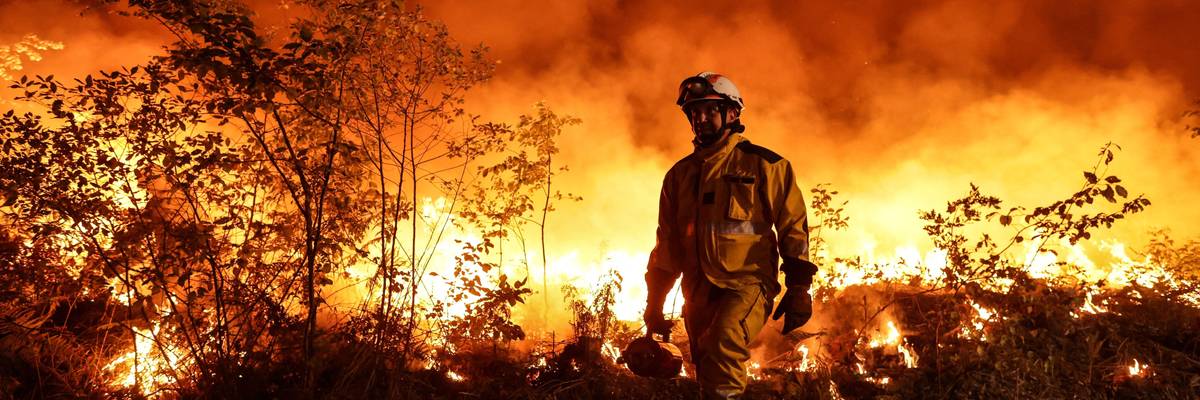
Tactical firefighters set a backfire to a plot of land to prevent the wildfire from spreading as the winds change in Louchats, France, on July 17, 2022. (Photo by Thibaud Moritz/AFP via Getty Images)
“Overshoot doesn’t have to mean surrender,” said one campaigner. “The size and length of that overshoot is still being written by the decisions governments make this year.”
The world has officially moved past the point where preventing a temperature rise above 1.5°C will be possible, scientists said in a United Nations report released Wednesday, which made clear that communities can expect sea levels to continue rising, heatwaves to intensify, and hurricanes, wildfires, and flooding to become more frequent and dangerous—all climate impacts that experts have long warned about as policymakers have failed to rapidly draw down greenhouse gas emissions.
But the authors of the report, published by the UN Environment Program (UNEP) and titled “Limiting Overshoot,” emphasized that the inevitable temperature rise must not be viewed as a point of no return, and that steps can and must be taken to ensure the overshoot of the 1.5°C goal is only temporary.
The best-case scenario is now a peak global temperature of 1.8°C, said the report’s dozens of authors, with an “overshoot, peak, and decline” pathway still possible before the end of this century if policymakers ensure that planet-heating fossil fuel emissions are drastically reduced—starting immediately.
The report is the first ever to establish the inevitability of overshooting the 1.5°C goal that countries were tasked with working toward when the Paris climate agreement was signed in 2015, and to chart a path toward ensuring the planet can ultimately make its way back down to 1.5°C—hopefully limiting the time above the threshold to a few decades.
We can't avoid exceeding 1.5°C—but we can still limit the damage.
The new UNEP Limiting Overshoot report is a powerful reminder that the climate crisis is already reshaping our world. Coral reefs are bleaching, glaciers are disappearing, and biodiversity is under growing… pic.twitter.com/hbfLvedqIx
If the world remains above 1.5°C over preindustrial temperatures long-term, said UNEP Executive Director Inger Andersen, “there are no good outcomes.”
Last year, global temperatures were already about 1.3°C to 1.4°C above the preindustrial average, The Washington Postreported, and the effects on the Earth have been made clear as wildfires have engulfed parts of Canada and South America; a glacial collapse led to flooding that killed more than 1,000 people in Nepal last week; and extreme heatkilled more than 1,000 people across Europe this summer.
“Across the globe, extreme heatwaves are already proving that climate impacts will strike faster, hit harder, and last longer—costing more lives and causing deeper disruption,” said Andersen. “Now is the time we must double down on climate action. We can—and must—get on the right path. By cutting greenhouse gas emissions, strengthening resilience and adaptation, and ensuring exceedance of 1.5°C is as small and short as possible.”
The scientists said planet-heating fossil fuel emissions must be slashed by 55% by 2035 and almost entirely eliminated by the middle of the century to limit the global temperature rise to 1.8°C above preindustrial levels.
Climate scientist Joeri Rogeli of Imperial College London, a lead author of the report, told the Post that swift action is crucial, as “for every five years that humanity delays reducing emissions… the peak temperature the world will ultimately face rises by at least a 10th of a degree.”
The scientists emphasized that avoiding the 1.5°C limit would have been a less daunting goal than reversing the temperature rise. Policies that continue allowing oil, gas, and coal companies to extract fossil fuels will make both goals difficult to achieve.
The report was released weeks after President Donald Trumpterminated offshore wind energy projects in the US—the latest of several renewable energy projects he’s killed—and moved to take ownership of Venezuelan oil fields. Recent global climate summits have been attended by an outsized number of corporate lobbyists for fossil fuel industries, weakening the climate commitments that have come out of the meetings.
Fenton Lutunatabua of 350.org Pacific noted that the report was also released as Pacific countries meet at the 55th Pacific Islands Forum Leaders Meeting.
“All eyes are on one of the world’s largest fossil fuel exporters, Australia, and how they act on this urgent warning,” said Lutunatabua. “The climate crisis is here and any delay in mitigation, in phasing out coal, oil, and gas, will only make our adaptation pressures harder and more expensive to bear.”
The report emphasizes that even if the world is able to reduce planetary heating once global temperatures shoot above 1.5°C, some impacts of continued fossil fuel extraction will be irreversible, including the melting of glaciers and the extinction of some species.
But UN Secretary-General António Guterres was among those who said “an overshoot of ambition” is now required to mitigate the damage as much as possible.
“This summer’s scorching heat, raging wildfires, and deadly floods are a warning of what lies ahead. We must make the overshoot above 1.5 degrees as small and short as possible,” said Guterres.
Along with rapidly cutting emissions, the report calls “carefully governed carbon dioxide removal (CDR)—the process of removing carbon from the air and storing it through afforestation or other means—an essential part of the mix.”
CDR methods—from planting forests to act as carbon sinks to technological fixes—come with limitations and are potentially reversible. Forests that are planted could be destroyed by wildfires, while CDR technology is largely unproven and can be energy-intensive—negating many of the benefits.
“Overall, even optimistic CDR scaling is unlikely to deliver a temperature reversal beyond a few tenths of a degree this century,” reads the report. “This emphasizes the importance of focusing on reducing greenhouse gas emissions.”
Richard Betts, a climate scientist at the University of Exeter and another report author, told the Post that CDR cannot be relied upon as a “get-out-of-jail-free card.”
At 350.org, head of campaigns and networks Savio Carvalho said that “there is no version of ‘limiting overshoot’ that doesn’t start with ending new coal, oil, and gas expansion today.”
“This report confirms what communities on the frontlines of the climate crisis have been telling us for years: that delay is not a neutral act, it is a decision,” said Carvalho. “We’ve just watched a glacier collapse bury Himalayan communities under mud and water, and we’re watching Pacific nations lose land to the sea in real time. UNEP is right that overshoot doesn’t have to mean surrender: The size and length of that overshoot is still being written by the decisions governments make this year, on fossil fuel phase-out, technology transfer, and on finance for the countries least responsible and most exposed.”
Murat Kurum, Türkiye’s minister of environment, urbanization, and climate change and the president-designate of the 31st UN Climate Change Conference (COP31), said the upcoming summit scheduled for November “must turn this urgency into concrete action.”
“Every fraction of a degree matters, and every year spent in overshoot increases climate risks and the potential for irreversible losses,” said Kurum. “The Overshoot Report makes clear that exceeding 1.5°C should not be seen as a new destination, but as a pathway we must urgently work to minimize and reverse. This requires rapid and sustained emissions reductions, alongside ambitious adaptation to protect people, communities, and ecosystems.”
“We need to accelerate global electrification, reduce methane emissions from waste, strengthen the climate resilience of cities, and enhance the resilience of marine and coastal ecosystems,” he added. “The choices we make today will determine how high temperatures peak, how long they remain there, and how safely we can return to 1.5°C.”
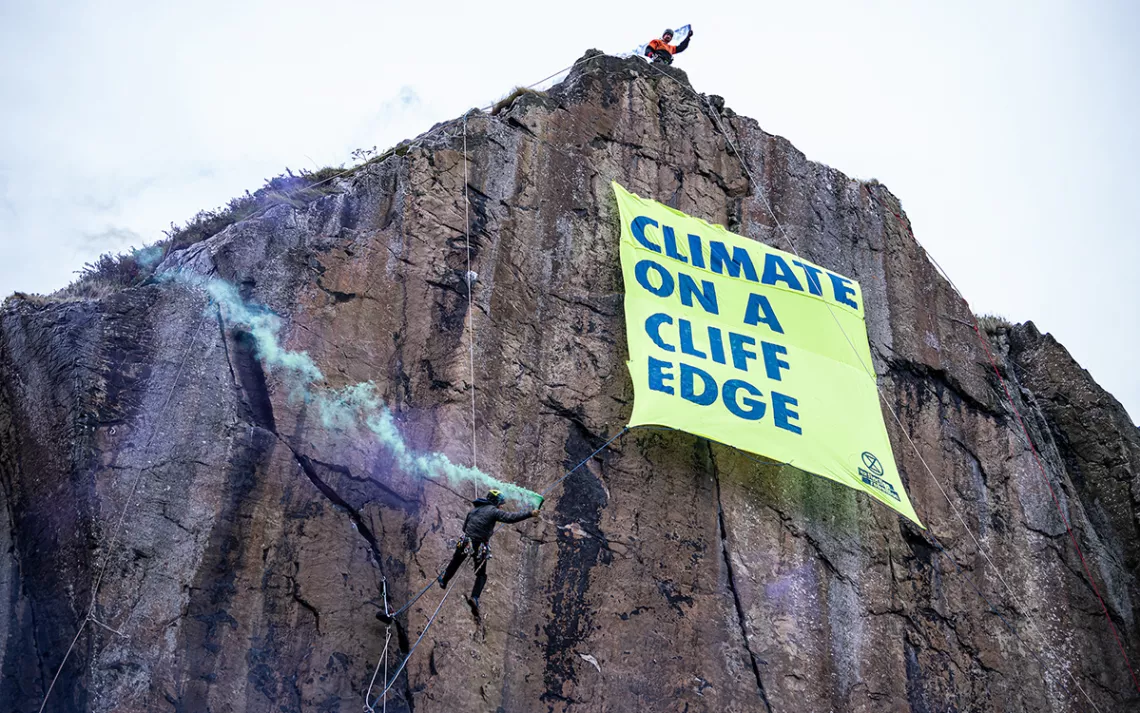
Donald Trump urges you to be a Climate Science denier like him. He says that he makes millions and millions for destroying the planet, Burn, Baby, Burn and Flood, Baby, Flood.Nigel Farage urges you to ignore facts and reality and be a climate science denier like him and his Deputy Richard Tice. He says that Reform UK has received £Millions and £Millions from the fossil fuel industry to promote climate denial and destroy the planet.Experienced climbers scale a rock face near the historic Dumbarton castle in Glasgow, releasing a banner that reads “Climate on a Cliff Edge.” One activist, dressed as a globe, symbolically looms near the edge, while another plays the bagpipes on the shores below. | Photo courtesy of Extinction Rebellion and Mark Richards
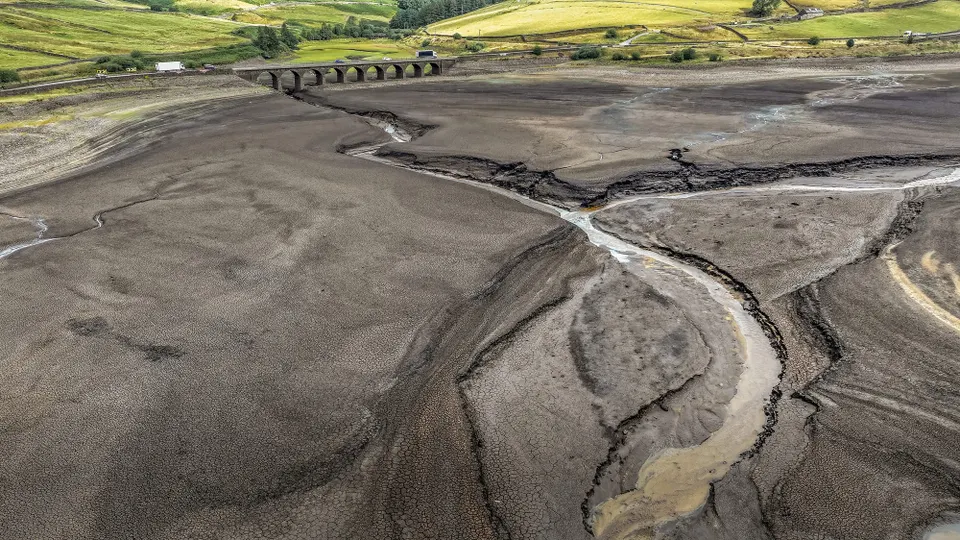
Last month was the driest July ever recorded in the country since records began in 1836 | Christopher Furlong/Getty Images
Adapting to an over-heated planet means very little unless it is accompanied by addressing the root causes of climate breakdown.
Will the succession of heatwaves across Europe and the UK compel governments of all complexions to take climate breakdown more seriously? While much of the news and public conversation this summer has focused on the tragic deaths of people caught in wildfires, floods, and storms, less attention has been paid to how heat waves kill people directly.
When the temperature rises to the point where the body can no longer cool itself, this is termed “uncompensable heat stress”, or UHS, and has long been known to have a disproportionate risk for the over sixties: The older you are, the less you can sweat; your heart works harder and your blood vessels are less able to widen, all adding to the risk of heat stress and early death. In an ageing and warming world, people older than sixty will increase in numbers to 2.1 billion by 2050 and are more likely to succumb to UHS.
Last year, one of the hottest ever on record in Britain, analysis from the UK Health Security Agency put excess deaths due to heat-related factors at 1,504. As of June this year, most of the country had already experienced four heatwaves, causing 2,877 excess deaths. Since then, there have been more heat waves with early indications of another in September, meaning a huge increase in heat-related deaths as compared to the previous year.
This rapid escalation in heat-related deaths is worth considering in a context where previous forecasts on the rate of climate change have proved to be too optimistic: Heavily populated Europe appears to be heating up much faster than the average, and research on the ability of forests to soak up greenhouse gases and help prevent climate breakdown has turned out to be less than expected.
Meanwhile, the naturally occurring El Niño/La Niña climate cycle is entering a “heating phase”, which is likely to further increase global heating and disruptive weather in the coming months. On Friday, the Met Office warned that this year’s El Nino is likely to be the most intense in recent memory. “We should be clear that this is an unprecedented event,” Prof Adam Scaife, head of long-range forecasting at the UK Met Office, told the BBC. “I have never seen an El Niño signal this intense in our forecasts.”
Sleep-walking towards disaster
Why are we sleepwalking towards disaster in this way when it simply does not make sense? Of the many reasons, three stand out; each requiring concerted governmental effort and leadership.
First, what needs to be done is a mammoth task. Not only will we have to radically decarbonise our economies, but we will need major changes in behaviour including a much less meat-based diet, far less use of air travel and far greater use of electricity generated from renewable resources, and a far more circular economy.
Second, the current economic system where neoliberal economics in its various forms is simply not fit for purpose. Crucially, when it comes to climate breakdown the need to act a decade or more ahead of impact is incompatible with free market ideology that believes that the market works best when it has the minimum of regulation. The kind of economic planning and management that the risk of climate breakdown requires is anathema to the very idea of a free market.
Moreover, this is in addition to the runaway wealth that the current free market system favours. So endemic to the system is the accumulation of wealth and political power in the hands of an elite few, that any attempt at an environmentally sustainable economy “for the many, not the few” will be strongly resisted by the few.
Finally, there are the well-resourced right-wing think tanks and lobbies determined to maintain the status quo. The Atlas Foundation alone “provides training, networking, and grants for libertarian, free-market and conservative groups around the world” working with nearly 800 groups in over a hundred countries.
There is already support in the UK and many other countries for adapting to a warmer world, including much better funded emergency services, improved housing and better ventilation, but a core problem remains.
Adaption currently envisaged means very little unless it is accompanied by addressing the root causes of climate breakdown, especially the burning of fossil carbon in the form of coal, oil or gas. All that adaptation does is give us a few extra years before we are overwhelmed by even higher temperatures and wilder weather, and that goes on, and on, with far more of the world becoming uninhabitable.
The heat excesses of the past year will have killed many tens of thousands of people across the world, especially among the poorest. It is vital to shift the political mood enough to truly accelerate the necessary changes. There is a small chance that further devastation caused by El Nino might focus minds on the reality of climate breakdown, but the likes of Trump and most of the global oligarchy will do all they can to prevent that.
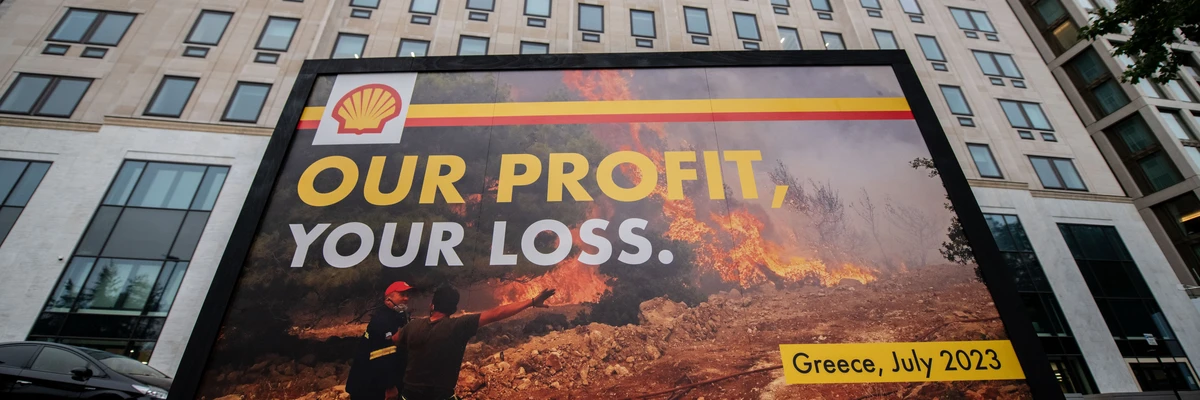
Donald Trump urges you to be a Climate Science denier like him. He says that he makes millions and millions for destroying the planet, Burn, Baby, Burn and Flood, Baby, Flood.Experienced climbers scale a rock face near the historic Dumbarton castle in Glasgow, releasing a banner that reads “Climate on a Cliff Edge.” One activist, dressed as a globe, symbolically looms near the edge, while another plays the bagpipes on the shores below. | Photo courtesy of Extinction Rebellion and Mark RichardsGreenpeace activists display a billboard during a protest outside Shell headquarters on July 27, 2023 in London. (Photo: Handout/Chris J. Ratcliffe for Greenpeace via Getty Images)
dizzy: UK government’s inaction and support of climate-destroying datacentres suggests that Burnham & Co are likely to permit the Rosebank and Jackdaw North Sea oil and gas fields further destroying the planet.
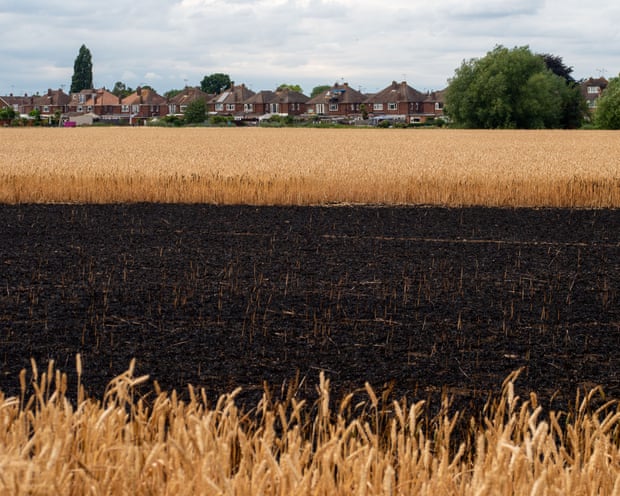
A burned field of wheat in Eton Wick, Windsor, in July. Experts say the UK should regenerative agriculture approaches to increase food resilience. Photograph: Maureen McLean/REX/Shutterstock
Rejecting North Sea drilling licences and protecting nature are just some measures Andy Burnham must implement to ready country
From record-smashing temperatures, wildfires, hosepipe bans and thousands of premature deaths, the climate crisis has left its mark across the summer of 2026.
Tackling the root cause – the burning of fossil fuels – and ending the crisis will take years. So will fixing the UK government’s calamitousfailure to protect lives and livelihoods against the long-predicted affects of global heating.
But the climate emergency is right here, right now, and here are 10 policies that Andy Burnham’s government should consider announcing urgently.
1. Reject drilling licences for the Jackdaw and Rosebank oil and gasfields
This would be a vital and confidence-boosting sign that the UK is committed to putting a rocket-booster under the clean, green and very fast-growing economy of the 21st century, not the fossil-fuelled one of the last. It would also give diplomatic weight to the UK as it works internationally to cut emissions and end the climate crisis.
The supposed benefits of approving the North Sea oil and gasfields are mostly fantasy. They will have no impact on UK energy prices – oil and gas are commodities whose price is set by international markets. As the UK Energy Research Council says: “Assertions that drilling the North Sea will provide energy resilience and affordability in the face of current fuel price shocks are a delusion.”
As for jobs, the licences would support very few – again, unlike the growing green economy. Some also argue North Sea production is less carbon intensive than imports, but that ignores the far cleaner record of our main gas importer, Norway, as well as the methane emissions from LNG, and in any case the differences are small compared with CO2 savings of using renewable energy and storage instead of gas.
2. Increase windfall tax on fossil fuel giants to pay for adaptation measures
…
3. Make grey water reuse mandatory in new buildings and incentivise rainwater harvesting
…
4. Bring the water industry under national control
…
5. Invest in proper equipment for firefighters
…
6. Implement a maximum workplace temperature
…
7. Fund cool spaces in every community
…
8. Launch a national retrofit programme
Homes in the UK are among the draughtiest and least energy-efficient in Europe. This means they are often too hot in summer and too cold in winter, leading to high bills and spiralling carbon emissions.
Efforts to persuade the private sector to take on the challenge of making homes fit for the changing climate have failed. But a report earlier this year suggested councils could take the lead on a retrofitting programme backed by national government. Under the plan, councils would train and employ their own retrofitting workforce and, starting with key public services such as hospitals and care homes, then work through council and social housing before moving on to privately owned homes. The report said it would not only make the country’s homes and public services more climate resilient, but it would also tackle the cost of living, create secure jobs and stimulate growth. They added it would also be a more efficient way of spending the public funds already allocated for insulation.
9. Plant more trees and protect existing nature
…
10. Encourage regenerative agriculture approaches to increase food resilience
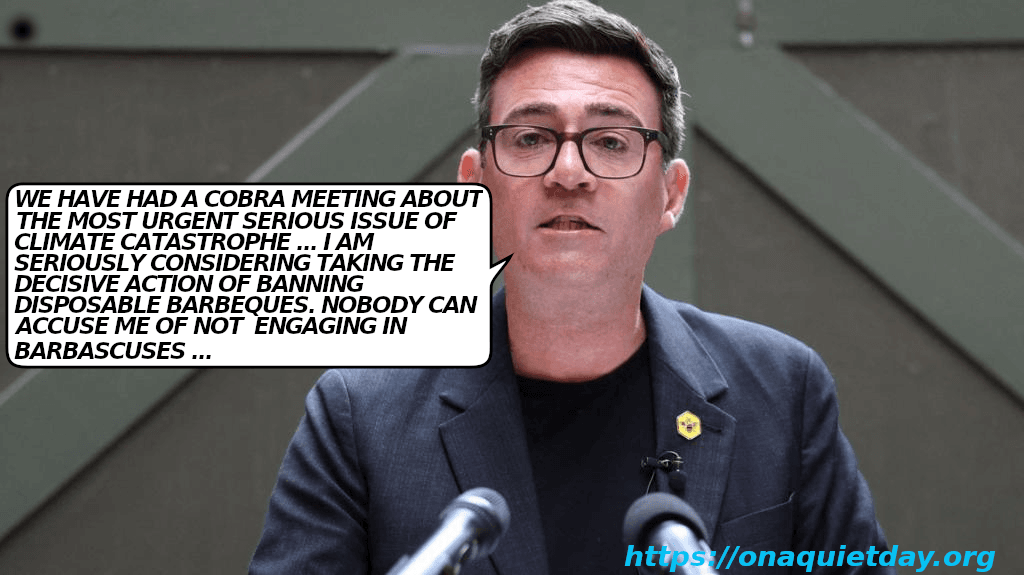
Andy Burnham addresses the climate crisis by considering banning disposable barbecues.Nigel Farage urges you to ignore facts and reality and be a climate science denier like him and his Deputy Richard Tice. He says that Reform UK has received £Millions and £Millions from the fossil fuel industry to promote climate denial and destroy the planet.Orcas comment on killer apes destroying the planet by continuing to burn fossil fuels.
dizzy:
11. Make private jets and superyachts history
…
12. Tax the rich so much that they’re not able to destroy the planet
The rich hugely drive climate breakdown. Tax them out of existence.
13. Recognise Carbon Capture and Storage as a false solution and abandon it
…
14. End all fossil fuel subsidies
…
15/8/26 9.50pm
15. Abandon nuclear power
Nuclear is far too expensive, too centralised and takes far too long. Renewables is the way to go and will create far more employment for more people.
Shrivelled sunflowers near the village of Kovilj, Serbia. Photograph: Andrej Isaković/AFP/Getty Image.
Slovakia reaches new high of 42C as authorities in Poland forced to shut down Kozienice and Połaniec power plants
Temperature records have been broken in several countries across central and eastern Europe as the extreme weather that has caused wildfires and droughts across the continent continues.
Countries including Slovakia, Austria and Hungary registered record temperatures. On Thursday, the Slovakian hydrometeorological agency said a new high of 42C (108F) had been reached in Dolné Plachtince.
Authorities in Poland were forced to shut down the Kozienice and Połaniec coal-fired power plants after critically low water levels in the Vistula River limited cooling water supplies. The disruption removed about 1.3GW of capacity from Poland’s power system.
In Germany, climate activists demanding an end to the use of fossil fuels demonstrated outside the chancellery against the lack of government action to keep people safe from extreme heat. An estimated 11,900 people across the country have died from heat this summer, according to new estimates from the Robert Koch Institute.
Nigel Farage urges you to ignore facts and reality and be a climate science denier like him and his Deputy Richard Tice. He says that Reform UK has received £Millions and £Millions from the fossil fuel industry to promote climate denial and destroy the planet.Donald Trump urges you to be a Climate Science denier like him. He says that he makes millions and millions for destroying the planet, Burn, Baby, Burn and Flood, Baby, Flood.Power-mad orange gasbag Donald Trump says Burn, Baby, Burn.