No Kings, no exceptions: How Trump’s Iran war exposes the death of American democracy

Spread the love

This work by Middle East Monitor is licensed under a Creative Commons Attribution-NonCommercial-ShareAlike 4.0 International License.

by Greg Pence

Demonstrators hold a protest against the war on Iran next to Recruting Station in Times Square, New York City, United States, on Sunday, March 22, 2026. [Selçuk Acar – Anadolu Agency]

On 28th February 2026, the United States went to war. No congressional debate. No public deliberation. No formal declaration. Just a midnight operation, with top lawmakers notified only minutes before the bombs fell, announcing that American aircraft were already striking Tehran. This is not how a republic wages war. This is how a king does.

The strikes on Iran — codenamed Operation Epic Fury— killed Iranian Supreme Leader Ali Khamenei and multiple senior officials, put American lives in harm’s way without a single vote of the people’s representatives, and shook global energy markets to their foundations.

Article I of the Constitution gives Congress, not the president, the power to declare war. Trump did it anyway. And in doing so, he did not merely break a rule — he broke the foundational compact of American self-governance.

The White House’s legal rationale was collective self-defence under the UN Charter. But the United States was not under attack. Iran had not struck American soil. Administration officials released conflicting statements about the aims of the operation, ranging from ending Iran’s nuclear program to outright regime change — language that has no grounding in any congressional mandate or democratic debate. As Senator Andy Kim told TIME, lawmakers and the American public were being asked to accept military escalation without understanding the endgame: “The President has really boxed us in and put us on the hook for things that we haven’t discussed as a country.” When senators demanded classified briefings, they largely received stonewalling. What followed was not strategic clarity but performative chaos: on the same day his administration surged forces to the region, Trump posted on social media about winding down. He threatened to bomb Iranian power plants if the Strait of Hormuz was not opened on his timetable.

And when asked about rising gas prices, he shrugged: *”If they rise, they rise.”* These are not the words of a commander-in-chief accountable to a republic. They are the words of a man who believes he answers to no one.

Dissent has come from across the political spectrum, which is precisely what makes the administration’s contempt for Congress so damning. [Senator Chris Van Hollen]() called it plainly: “Trump is lying to the American people as he launches an illegal, regime-change war against Iran. This is endangering American lives and has already resulted in mass civilian casualties.” Kentucky Republican Thomas Massie declared: “This is not ‘America First.’ The Constitution conferred the power to declare or initiate war to Congress for a reason — to make war less likely.” Army veteran and Ohio Republican Warren Davidson said simply: “War requires Congressional authorization.” These are conservatives honouring their oath, not partisans playing politics. And yet the war powers resolutions they championed failed to override a presidential veto, as most Republicans fell in line. Senator Tim Kaine’s warning now hangs over every future presidency: “Don’t hide under your desk and just let the president do it on his own. Because if you do, you’re opening the door for presidents of either party into the future just to wage war willy-nilly.”

The U.S.–Israeli War on Iran: Gains and Losses

The human cost is already devastating — over 1,400 Iranians killed, thirteen American soldiers dead — and the economic cost is being borne by the entire world. Brent crude surpassed $126 per barrel at its peak, its highest level in years. The Strait of Hormuz — through which 20 percent of global oil supplies flow — was effectively closed, and QatarEnergy, responsible for 20 percent of the world’s LNG supply, declared force majeure on all exports. Global stocks fell 5.5 percent in the war’s opening days. Inflation is forecast to rise across the eurozone, the United States, and Asia simultaneously, presenting central banks with the spectre of stagflation — while the president who lit the fuse demands that the Federal Reserve cut interest rates.

Families in Chicago and Chennai, in Lagos and London, are absorbing the price of a decision made by one man without asking anyone’s permission.

The World Economic Forum put the deeper betrayal into words: the United States “has imposed enormous costs on many of the same economies it relies on as trading and strategic partners.” Allies were not consulted. The democratic world was not asked. And yet it is paying, country by country, household by household, for a war it did not vote for and cannot stop. This matters far beyond economics. The United States built the post-war international order on the premise that even the most powerful nation would operate within rules and seek legitimacy before using force. When that premise collapses, the argument for democratic governance in an age of strongmen collapses with it. A world with kings — whether in Moscow, Beijing, or Washington — is a more dangerous world for everyone.

The phrase “No Kings” is not a slogan invented by the left. It is the founding premise of the American republic, inscribed in the separation of powers and in a Constitution written by men who had lived under a monarchy and refused to recreate one. This war is the most dramatic breach of that premise yet — but not the first. Trump launched strikes on Iranian nuclear facilities last year without a congressional vote. He ordered the capture of Venezuela’s president without one.

Each unchallenged act of unilateral power makes the next easier. This is how republics die — not in a single dramatic moment, but in the slow accumulation of precedents no one stopped in time.

On March 28, over 3,000 No Kings protests are scheduled across every state in this country. Join them. Bring your neighbors. Bring your children, so they can see what democracy looks like when citizens defend it. This is not a partisan call — it is a constitutional one, and it belongs to everyone who believes that in America, the people decide. Not one man. Not a king.

We have tried kings before. We know how it ends.

When presidents lie, diplomacy dies: The global cost of post-truth under Trump

The views expressed in this article belong to the author and do not necessarily reflect the editorial policy of Middle East Monitor.

Keir Starmer explains that UK is participating defensively in Trump and Israel's criminal war for Israel's genocidal expansion in Iran and states that he supports Zionism "without qualification". Keir Starmer said "I said it loud and clear – and meant it – that I support Zionism without qualification.” here: https://www.jewishnews.co.uk/keir-starmer-interview-i-will-work-to-eradicate-antisemitism-from-day-one/
Keir Starmer explains that UK is participating defensively in Trump and Israel’s criminal war for Israel’s genocidal expansion in Iran and states that he supports Zionism “without qualification”. Keir Starmer said “I said it loud and clear – and meant it – that I support Zionism without qualification.” here: https://www.jewishnews.co.uk/keir-starmer-interview-i-will-work-to-eradicate-antisemitism-from-day-one/
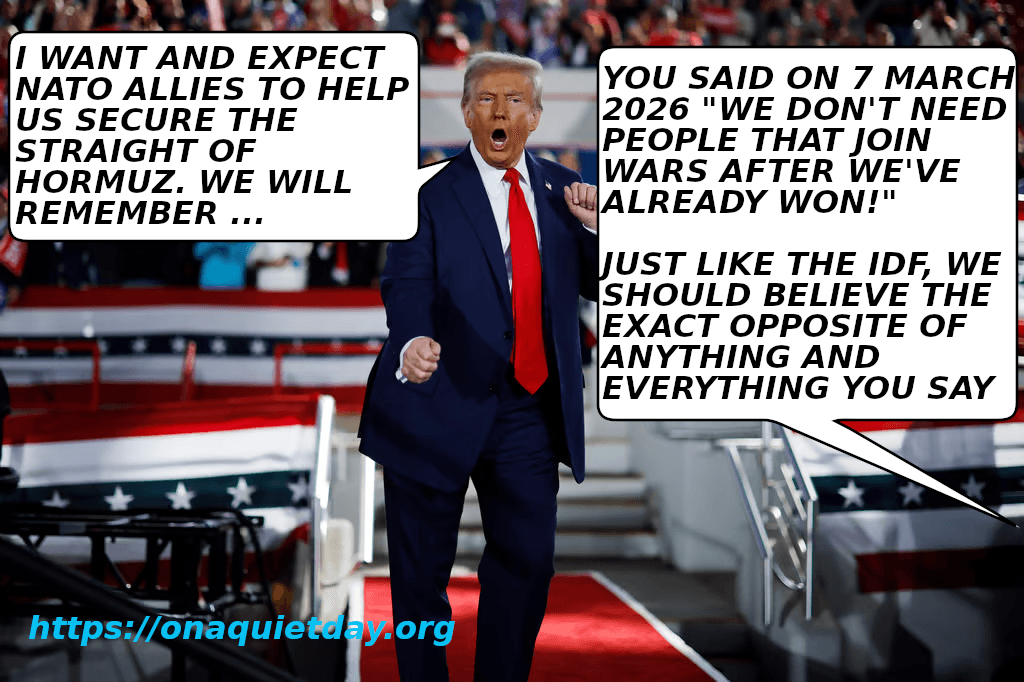
Donald Trump calls for help from NATO allies in securing the Straight of Hormuz despite saying on 7 March 2026 that they don't need people to join wars after they've already won.
Donald Trump calls for help from NATO allies in securing the Straight of Hormuz despite saying on 7 March 2026 that they don’t need people to join wars after they’ve already won.
Climate science denier Donald Trump confirms that he knows nothing about democracy and that more liquid gold is being secured according to his policy of global privateering.

Continue ReadingNo Kings, no exceptions: How Trump’s Iran war exposes the death of American democracy

‘Sometimes You Need a Dictator,’ Trump Says Following Threats to Cancel Election

Spread the love

Original article by Stephen Prager republished from Common Dreams under Creative Commons (CC BY-NC-ND 3.0).

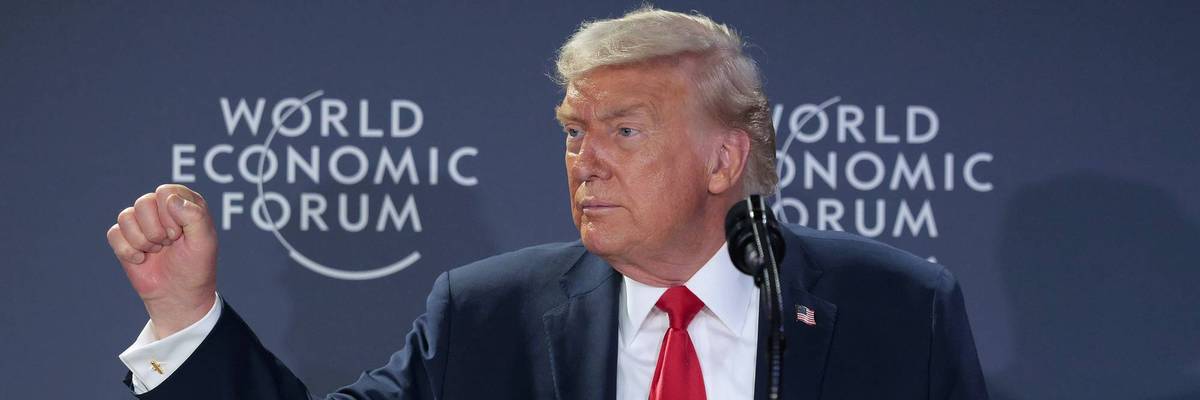
US President Donald Trump speaks during a reception for business leaders at the World Economic Forum annual meeting on January 21, 2026, in Davos, Switzerland.  (Photo by Chip Somodevilla/Getty Images)

Trump previously said he wished he could cancel elections, but feared being called a “dictator” by his detractors. Now he’s calling himself one in front of the whole world.

After weeks of authoritarian threats to crush protests with the military, cancel electionsconquer foreign countries, and send masked agents door-to-door to round up anyone who can’t prove their citizenship, Trump on Wednesday told an already uneasy room full of world leaders that “sometimes you need a dictator.”

The offhanded comment came in the middle of a rambling speech at the reception dinner for the annual meeting of the World Economic Forum in DavosSwitzerland, on Wednesday, in which Trump congratulated himself on a different rambling speech he’d given earlier that day at the summit.

RECOMMENDED…

US-POLITICS-TRUMP-RETURN

Fearing Midterm Loss, Trump Once Again Says ‘We Shouldn’t Even Have an Election’

US-POLITICS-TRUMP-GOP

‘I Don’t Need International Law,’ Trump Says, Adding That His ‘Power’ Is Limited Only By His ‘Morality’

“We had a good speech, we got great reviews. I can’t believe it, we got good reviews on that speech,” Trump said of the widely mocked address in which he continued to demand the US take over Greenland (which he repeatedly referred to as “Iceland”) and made new tariff threats against Canada and Europe if they resist the annexation.

“Usually they say ‘he’s a horrible dictator-type person,’ I’m a dictator,” Trump continued. “But sometimes you need a dictator! But they didn’t say that in this case… It’s all based on common sense, it’s not conservative or liberal, or anything else.”

At least twice over the past month, Trump has suggested that the 2026 midterm elections should be canceled, since his party is likely to lose.

The first time he brought up the idea, on the five-year anniversary of the January 6, 2021, Capitol insurrection, he seemed to back off the idea for fear of being called a dictator by his detractors: “I won’t say cancel the election; they should cancel the election, because the fake news would say: ‘He wants the elections canceled. He’s a dictator.’ They always call me a dictator.”

But if being called a dictator was the only thing holding him back from attempting to suspend democracy, he no longer appears to care.

As political commentator Charlotte Clymer wrote on social media, “Trump is now openly referring to himself as a dictator” in front of the whole world.

Original article by Stephen Prager republished from Common Dreams under Creative Commons (CC BY-NC-ND 3.0).

Elon Musk urges you to be a Fascist like him, says that you can ignore facts and reality then.
Donald Fuhrump says that Amerikkka doesn't bother with crimes or charges anymore, not being 100% Amerikkkan and opposing his real estate intentions is enough.
Donald Fuhrump says that Amerikkka doesn’t bother with crimes or charges anymore, not being 100% Amerikkkan and opposing his real estate intentions is enough.
Orcas discuss how Trump was re-elected and him being an obviously insane, xenophobic Fascist.

Continue Reading‘Sometimes You Need a Dictator,’ Trump Says Following Threats to Cancel Election

How global inequality hinders climate action

Spread the love
Leaders from around the globe are meeting in Davos. Michael Derrer Fuchs/Shutterstock

Susan Ann Samuel, University of Leeds

World leaders have gathered for the World Economic Forum annual meeting in Davos, Switzerland. One of their main goals is to align their responses to geopolitical shocks such as floods and wildfires that hamper trade, investment and more.

The meeting also supposedly aims to find ways to stimulate economic growth to improve living standards, foster a just and inclusive energy transition, achieve security and cooperation amidst conflicts, and accelerate the economic response to an “intelligent age” of AI.

But, a new report from Oxfam International, published on the first day of the meeting in Davos, highlights how global inequality is more rampant than ever. The report, written by a team of policy campaigners and inequality research advisers outlines how billionaire wealth rose sharply in 2024 worldwide, with the pace of the increase three times faster than in 2023.

The World Economic Forum lists extreme weather as one of the top global risks. But, as world leaders convene in Davos, the high-profile anti-climate stances of some of them stand in stark opposition to any meaningful progress for climate action.

The Oxfam report highlights the exploitation involved in creating and sustaining wealth and outlines how, as inequalities deepen, vulnerable communities are disproportionately affected. The most vulnerable – overwhelmingly women, people of colour, Indigenous groups and low-wage workers – are caught in a cycle of insufficient wages, limited services and minimal political influence.

The report also highlights how wealth inequality is often intertwined with historical processes of extraction — both within countries (for example, through weak labour protections that lowers wages) and between countries (through trade, finance, and resource exploitation).

The climate connection

Other research has also shown how inequality is deeply interwoven with climate breakdown. Each crisis exacerbates the other. Historically, the richest nations – and within them, the wealthiest people – have contributed the most to greenhouse gas emissions.

Meanwhile, lower-income countries that bear little responsibility for global heating suffer the most. These countries, already burdened by debt and systemic inequality, have fewer resources to protect communities from extreme weather, crop failures and infrastructure damage. This makes day-to-day survival a struggle for billions.

When climate change exacerbates existing inequalities, marginalised communities are denied basic human rights. For instance, droughts reduce crop yields and deplete water sources, so more people — often women and children — have to ration supplies or go without. This directly infringes on their rights to food, safe drinking water and sanitation.

In these ways, without climate action, the warming planet threatens to widen inequalities by affecting the poorest people most severely. A 2020 World Bank report estimated that an additional 68 to 135 million people could be pushed into poverty by 2030 because of climate change. French researchers identified that climate change also slows down the economic catch-up of poorer countries.

The reality on the ground is bleak. Floods in Pakistan displaced thousands and affected more than 33 million people in 2023. That’s ten times more than the total population of Los Angeles where, when the recent wildfires struck, 170,000 people had to be evacuated.

Around the world, climate movements continue. Law suits that demand climate action are transforming governance. High-level negotiations like the UN’s annual climate summit carry on seeking progress, although the processes could be improved to accelerate change.

What can Davos do? World leaders need to look at how wealth and power can be redistributed (reparations for climate damages is one way to do this) and low-income, climate-vulnerable nations can be better represented in global decision-making.

Without this kind of change, there’s a risk climate action will perpetuate the same structural imbalances that first enabled environmental exploitation. Only by tackling both climate injustice and economic inequality together can the world prevent further climate disasters and ensure a more equitable future.


Don’t have time to read about climate change as much as you’d like?
Get a weekly roundup in your inbox instead. Every Wednesday, The Conversation’s environment editor writes Imagine, a short email that goes a little deeper into just one climate issue. Join the 40,000+ readers who’ve subscribed so far.


Susan Ann Samuel, PhD Candidate, School of Politics and International Studies, University of Leeds

This article is republished from The Conversation under a Creative Commons license. Read the original article.

Continue ReadingHow global inequality hinders climate action

Humanity’s Chance to Reverse Amazon’s Slide Toward Tipping Point Is ‘Shrinking’

Spread the love

Original article by Eloise Goldsmith republished from Common Dreams under Creative Commons (CC BY-NC-ND 3.0).

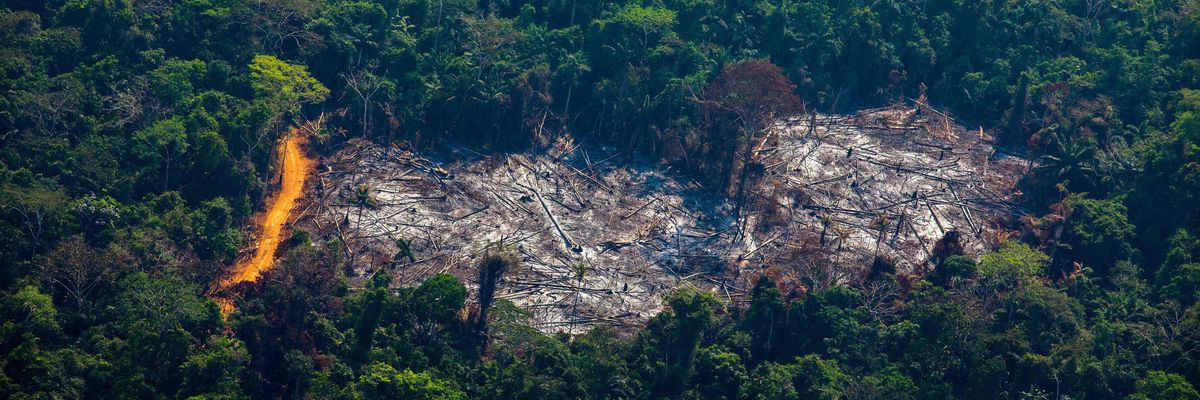
This aerial view shows Amazon forest degradation in the Menkragnoti Indigenous Territory in Altamira, Pará state, Brazil, on August 28, 2019. (Photo: Joao Laet/AFP/Getty Images)

The world’s largest rainforest showed “ominous indicators,” including wildfires and extreme drought, in 2024.

The Amazon, sometimes called the “lungs of the planet,” this year showed signs of further inching toward a much-feared tipping point, threatening the very existence of the world’s largest rainforest.

Rampant wildfires and extreme drought ravaged large parts of the Amazon in 2024. The fires and dry conditions were fueled by deforestation and the El Niño weather pattern, and also made worse by climate change, according to the World Economic Forum. “The number of fires reached its highest level in 14 years this September,” the group reported in October.

Drought has also impacted the Amazon River, causing one of the river’s main tributaries to drop to its lowest level ever recorded, according to October reporting from The Associated Press. The drop in the river has negatively impacted local economies and food supplies.

Andrew Miller, advocacy director at Amazon Watch, told the AP last week that the fires and droughts experienced across the Amazon in 2024 “could be ominous indicators that we are reaching the long-feared ecological tipping point.”

“Humanity’s window of opportunity to reverse this trend is shrinking, but still open,” he said.

The Amazon plays a vital role in keeping the planet healthy. 150-200 billion tons of carbon are stored in the Amazon, and it also carries 20% of the earth’s fresh water to sea.

According to the World Economic Forum, if the Amazon tipping point is reached, “it will release billions of tonnes of CO2 into the atmosphere through fires and plants dying off. This would further exacerbate climate change and make the 1.5°C goal impossible to achieve. It would also alter weather patterns, which would impact agricultural productivity and global food supplies.”

A paper published in the journal Nature in February indicates that up to half of the rainforest could hit a tipping point by the middle of the century. “We estimate that by 2050, 10% to 47% of Amazonian forests will be exposed to compounding disturbances that may trigger unexpected ecosystem transitions and potentially exacerbate regional climate change,” explained the researchers behind the paper.

However, it wasn’t all bad news out of the Amazon in 2024. According to the AP, the amount of deforestation in Brazil and Colombia declined in this year. In Brazil, which houses the largest chunk of the Amazon, forest loss dropped 30.6% compared to the year prior, bringing it to the lowest level of destruction in nearly a decade.

The improvement is an about-face from a couple of years ago, when the country registered 15-year high of deforestation during the leadership of former far-right President Jair Bolsonaro. Brazil is now led by the left-wing President Luiz Inácio Lula da Silva, who—despite presiding over this drop in deforestation—has also come under scrutiny, as AP noted, by environmentalist for backing projects that they argue could harm the environment.

Original article by Eloise Goldsmith republished from Common Dreams under Creative Commons (CC BY-NC-ND 3.0).

Continue ReadingHumanity’s Chance to Reverse Amazon’s Slide Toward Tipping Point Is ‘Shrinking’

The dishonesty of Rachel Reeves

Spread the love

The video shows that Rachel Reeves intended to means test winter fuel payments in 2014. Her claims that she was forced to take this action because of the economic position inherited from the Tories is – therefore – very suspect. Labour weren’t forced to do it as she repeatedly claims – she and they intended to do it 10 years ago.

Keir Starmer says pensioners can freeze to death and poor children can starve and be condemned to failure and misery all their lives.
Continue ReadingThe dishonesty of Rachel Reeves