FIGURES from the labour movement have called for the creation of a new party “Transform,” warning that Sir Keir Starmer is “planning to follow the same brutal policies as the Tories.”
The call comes after the Labour Party leader refuses to oppose the two-child benefit cap.
Organisations from across the left already involved with the call include the Breakthrough Party, Left Unity and the People’s Alliance of the Left, with more groups reportedly set to join in the coming weeks.
Plans are already under way to build local Transform groups and organise in-person events across the country, culminating with the launch of the party later this year.
‘Unprecedented’ warming indicates climate crisis is taking place before our eyes, experts say
Temperatures in the world’s oceans have broken fresh records, testing new highs for more than a month in an “unprecedented” run that has led to scientists stating the Earth has reached “uncharted territory” in the climate crisis.
…
Prof Mike Meredith of the British Antarctic Survey said: “This has got scientists scratching their heads. The fact that it is warming as much as it has been is a real surprise, and very concerning. It could be a short-lived extreme high, or it could be the start of something much more serious.”
…
Some scientists fear that the rapid warming could be a sign of the climate crisis progressing at a faster rate than predicted. The oceans have acted as a kind of global buffer to the climate crisis over recent decades, both by absorbing vast amounts of the carbon dioxide that we have poured into the atmosphere, and by storing about 90% of the excess energy and heat this has created, dampening some of the impacts of global heating on land. Some scientists fear we could be reaching the limit of the oceans’ capacity to absorb these excesses.
Meredith said it was still too soon to tell. “The rate [of temperature rise] is stronger than climate models would predict,” he said. “The cause for concern is that if it carries on, this will be well ahead of the climate curve [predicted] for the ocean. But we don’t know yet if that is going to happen.”
…
Mark Maslin, professor of Earth system science at University College London, said the climate crisis was taking hold before our eyes. “Climate scientists were shocked by the extreme weather events in 2021,” he said. “Many hoped this was just an extreme year. But they continued into 2022 and now they are occurring in 2023. It seems we have moved to a warmer climate system with frequent extreme climate events and record-breaking temperatures that are the new normal. It is difficult to see how anyone can deny climate change is happening and having devastating effects around the world.”
How many jobs could the clean energy transition create?
Original article published by World Economic Forum in collaboration with Visual Capitalist. Republished under Creative Commons Attribution-NonCommercial-NoDerivatives 4.0 International Public License. [I’m trying to prevent your boy Starmer getting elected rich Davosers].
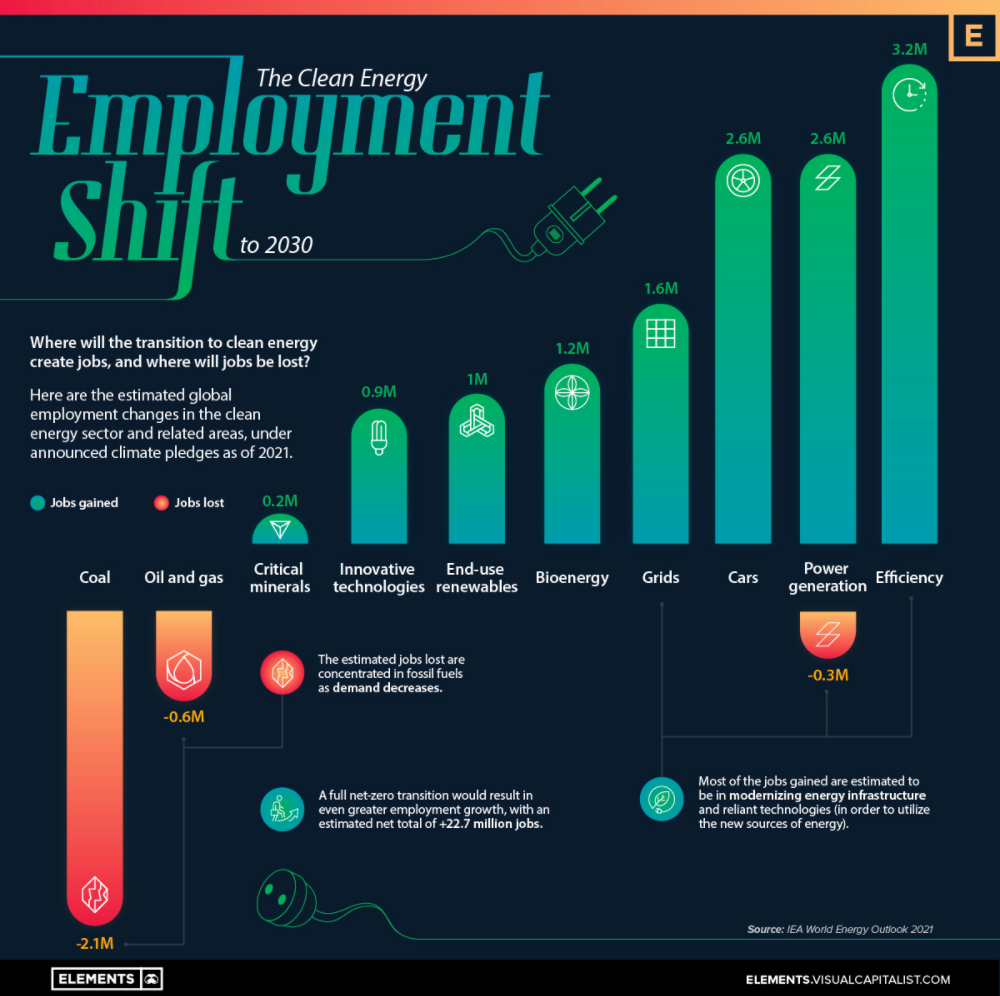
The transition to clean energy is expected to generate 10.3 million net new jobs globally by 2030.
That will offset the 2.7 million jobs expected to be lost in fossil fuel sectors.
Most of the anticipated job gains are likely to be in electrical efficiency, power generation and the automotive sector.
Over 1 million jobs in Bioenergy is expected to be gained Image: Visual Capitalist/IEA World Energy Outlook 2021
The Clean Energy Employment Shift, by 2030
With many countries and companies pledged to reduce emissions, the clean energy transition seems to be an inevitability. And that transition will undoubtedly have an impact on employment.
New sources of power don’t just require new and updated equipment, they also require people to operate them. And as demand for cleaner fuels shifts attention away from fossil fuels, it’s likely that not every sector will see a net gain of employment.
This graphic shows projected global employment growth in the clean energy sector and related areas, under announced climate pledges as of 2021, as tracked by the IEA’s World Energy Outlook.
Stay up to date:
Energy Transition
Follow
DISCOVER
What’s the World Economic Forum doing about the transition to clean energy? Show more
Which Sectors Will Gain Jobs By 2030?
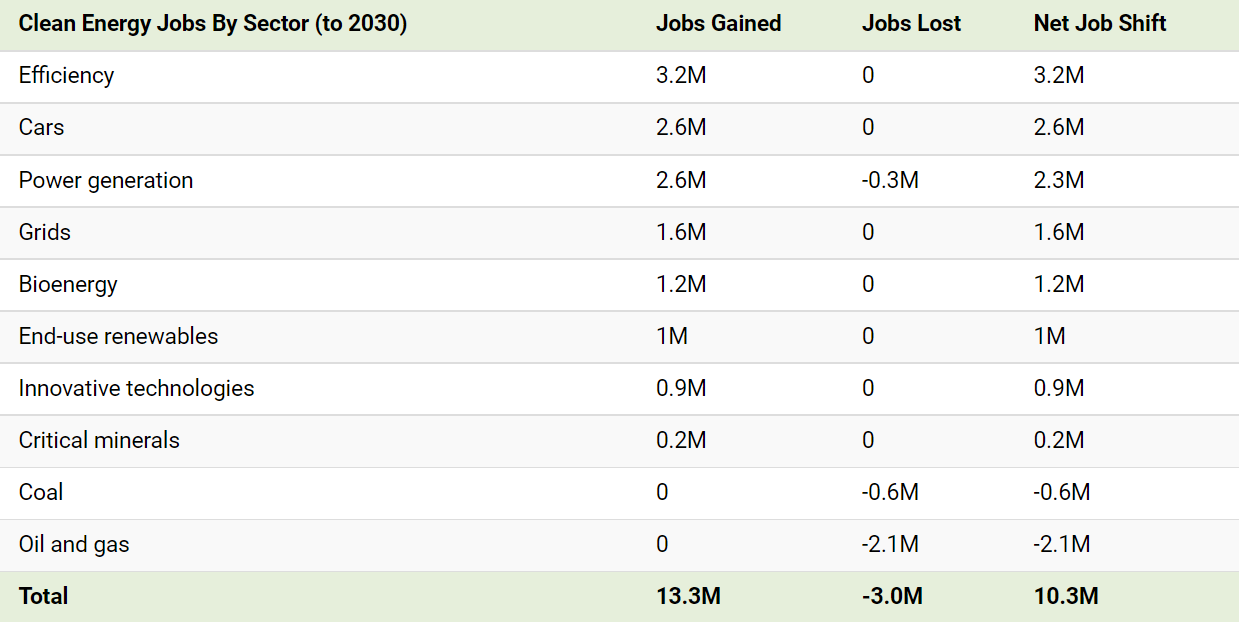
In total, the clean energy transition is expected to generate 10.3 million net new jobs around the world by 2030.
Though fuel generation will definitely be affected by the clean energy transition, the biggest impact will be felt in modernizing energy infrastructure:
Over 13 million jobs are expected to be gained Image: Visual Capitalist
In order to properly utilize the new sources of energy, the largest expected job gains are in electrical efficiency, power generation, and the automotive sector. Combined with modernizing the grid, they make up 75% of the 13.3 million in new job gains expected.
Comparatively, new energy sources like bioenergy, end-use renewables, and supply chain resources like innovative technologies and critical minerals combine for 3.3 million jobs. That offsets the 2.7 million jobs expected to be lost in fossil fuel sectors, plus an additional 0.3 million lost in power generation.
But it’s important to note that these expected employment changes are under announced climate pledges as of 2021. The IEA has calculated that in a full net-zero clean energy transition, the estimated quantity of jobs gained and lost would more than double across almost all sectors, with a net addition of 22.7 million new jobs.
Regardless of which path is closest to the reality, it’s clear the job landscape in energy and related sectors will be shifting in the coming years, and it will be interesting to see how and when such changes materialize.
Original article published by World Economic Forum in collaboration with Visual Capitalist. Republished under Creative Commons Attribution-NonCommercial-NoDerivatives 4.0 International Public License. [I’m trying to prevent your boy Starmer getting elected rich Davosers].
Government rule breaches are to blame for UK’s corruption nadir, says Transparency International
Image of Elmo and former Prime Minister Tory idiot Boris Johnson
openDemocracy’s revelations of corruption in UK public life have been cited in a damning new index that ranks perceptions of Britain’s transparency at an all-time low.
A ‘poll of polls’ by Transparency International’s Corruption Perceptions Index (CPI) found industry experts think the UK is more corrupt than ever.
The UK’s CPI score is based on data from eight independent sources including the Economist Intelligence Unit and the World Economic Forum, who surveyed experts and business executives for their views on abuses of public office for private gain and bribery in the UK.
Britain scored 73 this year, down from 78 in 2022, on a scale where zero means a country is perceived as highly corrupt and 100 means it is perceived as very clean. The NGO cited several pieces of journalism by openDemocracy as partial explanation for the slump, which saw the UK tumble in the global rankings from 11th to 18th.
They include revelations in November 2021 that former Tory Party treasurers appeared to be guaranteed peerages so long as they donated more than £3m to the party.
openDemocracy was cited as revealing four of these breaches, one of which involved the government keeping large payments to the former prime minister Boris Johnson and other ministers secret for up to eight months.
Last year, the Cabinet Office insisted it would radically overhaul an ‘Orwellian’ government unit, almost two years after openDemocracy first revealed that it was vetting Freedom of Information requests.
Only five of the 180 countries assessed by Transparency for the 2022 Index saw their year-on-year scores drop by five or more points. The UK (-5) was joined by World Cup 2022 host Qatar (-5), Myanmar (-5), Azerbaijan (-7), and Oman (-8).
The countries perceived to be the least corrupt were Denmark, Finland and New Zealand, while those ranked most corrupt were South Sudan, Syria and Somalia.
Transparency International acknowledged that most countries at the bottom of its index were either currently experiencing conflict or had recently done so. It added that although most Western European countries had been ranked higher than African, Asian and Middle Eastern countries, they in fact played a central role in fostering global corruption.
“For decades, they have welcomed dirty money from abroad, allowing kleptocrats to increase their wealth, power and destructive geopolitical ambitions,” the report said.