Repression of climate and environmental protest is intensifying across the world

Spread the love
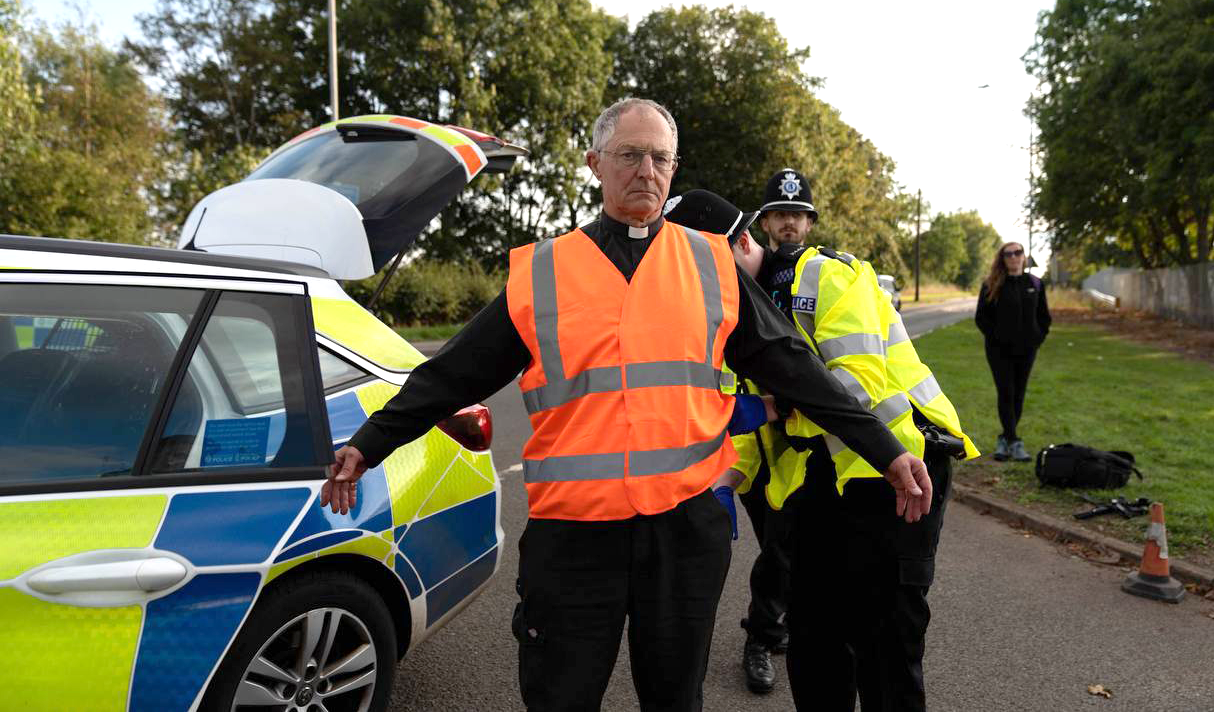
Image of a Just Stop Oil participant getting arrested at Kingsbury oil terminal.
A Just Stop Oil participant getting arrested at Kingsbury oil terminal. A JSO / Vladamir Morozov image.

Oscar Berglund, University of Bristol and Tie Franco Brotto, University of Bristol

Climate and environmental protest is being criminalised and repressed around the world. The criminalisation of such protest has received a lot of attention in certain countries, including the UK and Australia. But there have not been any attempts to capture the global trend – until now.

We recently published a report, with three University of Bristol colleagues, which shows this repression is indeed a global trend – and that it is becoming more difficult around the world to stand up for climate justice.

This criminalisation and repression spans the global north and south, and includes more and less democratic countries. It does, however, take different forms.

Our report distinguishes between climate and environmental protest. The latter are campaigns against specific environmentally destructive projects – most commonly oil and gas extraction and pipelines, deforestation, dam building and mining. They take place all around the world.

Climate protests are aimed at mitigating climate change by decreasing carbon emissions, and tend to make bigger policy or political demands (“cut global emissions now” rather than “don’t build this power plant”). They often take place in urban areas and are more common in the global north.
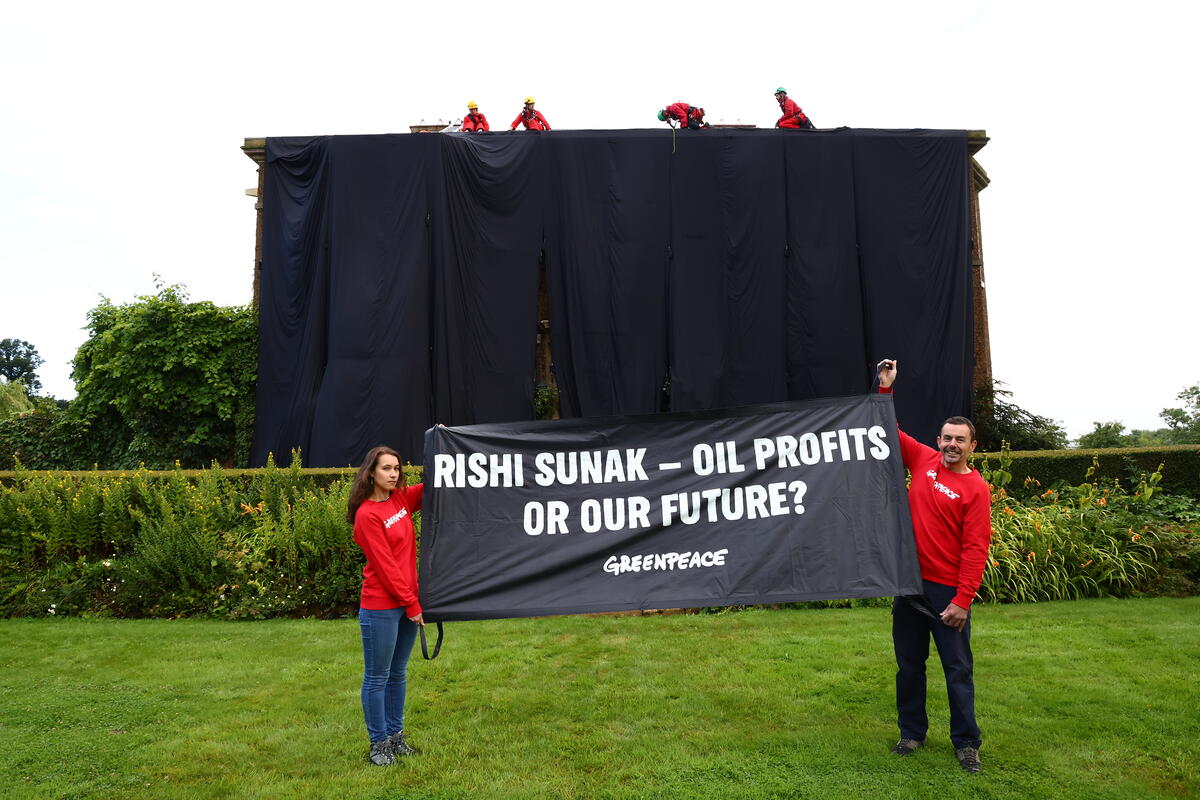
Greenpeace cover Rishi Sunak's home in black oily fabric in protests at Sunak's intended huge expansion of North Sea fossil fuel exploration.
Greenpeace cover Rishi Sunak’s home in black oily fabric in protests at Sunak’s intended huge expansion of North Sea fossil fuel exploration. Image © Greenpeace.

Four ways to repress activism

The intensifying criminalisation and repression is taking four main forms.

1. Anti-protest laws are introduced

Anti-protest laws may give the police more powers to stop protest, introduce new criminal offences, increase sentence lengths for existing offences, or give policy impunity when harming protesters. In the 14 countries we looked at, we found 22 such pieces of legislation introduced since 2019.

2. Protest is criminalised through prosecution and courts

This can mean using laws against climate and environmental activists that were designed to be used against terrorism or organised crime. In Germany, members of Letzte Generation (Last Generation), a direct action group in the mould of Just Stop Oil, were charged in May 2024 with “forming a criminal organisation”. This section of the law is typically used against mafia organisations and had never been applied to a non-violent group.

In the Philippines, anti-terrorism laws have been used against environmentalists who have found themselves unable to return to their home islands.

Criminalising protest can also mean lowering the threshold for prosecution, preventing climate activists from mentioning climate change in court, and changing other court processes to make guilty verdicts more likely. Another example is injunctions that can be taken out by corporations against activists who protest against them.

3. Harsher policing

This stretches from stopping and searching to surveillance, arrests, violence, infiltration and threatening activists. The policing of activists is carried out not just by state actors like police and armed forces, but also private actors including private security, organised crime and corporations.

In Germany, regional police have been accused of collaborating with an energy giant (and its private fire brigade) to evict coal mine protesters, while private security was used extensively in policing anti-mining activists in Peru.

4. Killings and disappearances

Lastly, in the most extreme cases, environmental activists are murdered. This is an extension of the trend for harsher policing, as it typically follows threats by the same range of actors. We used data from the NGO Global Witness to show this is increasingly common in countries including Brazil, Philippines, Peru and India. In Brazil, most murders are carried out by organised crime groups while in Peru, it is the police force.

Protests are increasing

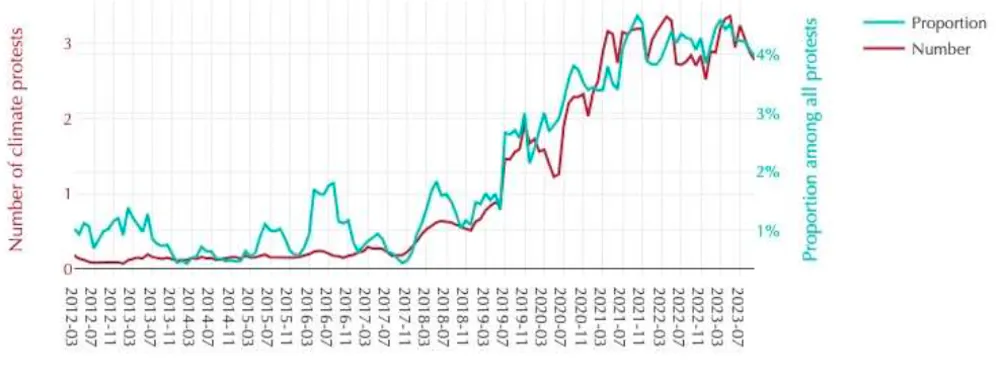
To look more closely at the global picture of climate and environmental protest – and the repression of it – we used the Armed Conflicts Location Event database. This showed us that climate protests increased dramatically in 2018-2019 and have not declined since. They make up on average about 4% of all protest in the 81 countries that had more than 1,000 protests recorded in the 2012-2023 period:
Graph
Climate protests increased sharply in the late 2010s in the 14 countries studied. (Data is smoothed over five months; number of protests is per country per month.) Berglund et al; Data: ACLED, CC BY-SA

This second graph shows that environmental protest has increased more gradually:

Graph
Environmental protests in the same 14 countries. Data: ACLED, CC BY-SA

We used this data to see what kind of repression activists face. By looking for keywords in the reporting of protest events, we found that on average 3% of climate and environmental protests face police violence, and 6.3% involve arrests. But behind these averages are large differences in the nature of protest and its policing.

A combination of the presence of protest groups like Extinction Rebellion, who often actively seek arrests, and police forces that are more likely to make arrests, mean countries such as Australia and the UK have very high levels of arrest. Some 20% of Australian climate and environmental protests involve arrests, against 17% in the UK – with the highest in the world being Canada on 27%.

Meanwhile, police violence is high in countries such as Peru (6.5%) and Uganda (4.4%). France stands out as a European country with relatively high levels of police violence (3.2%) and low levels of arrests (also 3.2%).

In summary, while criminalisation and repression does not look the same across the world, there are remarkable similarities. It is increasing in a lot of countries, it involves both state and corporate actors, and it takes many forms.

This repression is taking place in a context where states are not taking adequate action on climate change. By criminalising activists, states depoliticise them. This conceals the fact these activists are ultimately right about the state of the climate and environment – and the lack of positive government action in these areas.

Oscar Berglund, Senior Lecturer in International Public and Social Policy, University of Bristol and Tie Franco Brotto, PhD Candidate, School for Policy Studies, University of Bristol

This article is republished from The Conversation under a Creative Commons license. Read the original article. [Accompanying images are selected by dizzy deep of https://onaquietday.org.]

Youth Demand shit in Rishi Sunak's private lake 25/6/24
Youth Demand shit in Rishi Sunak’s private lake 25/6/24

Continue ReadingRepression of climate and environmental protest is intensifying across the world

Trump Won’t Rule Out Military Force to Seize Control of Panama Canal, Greenland

Spread the love

Original article by Julia Conley republished from Common Dreams under Creative Commons (CC BY-NC-ND 3.0). 

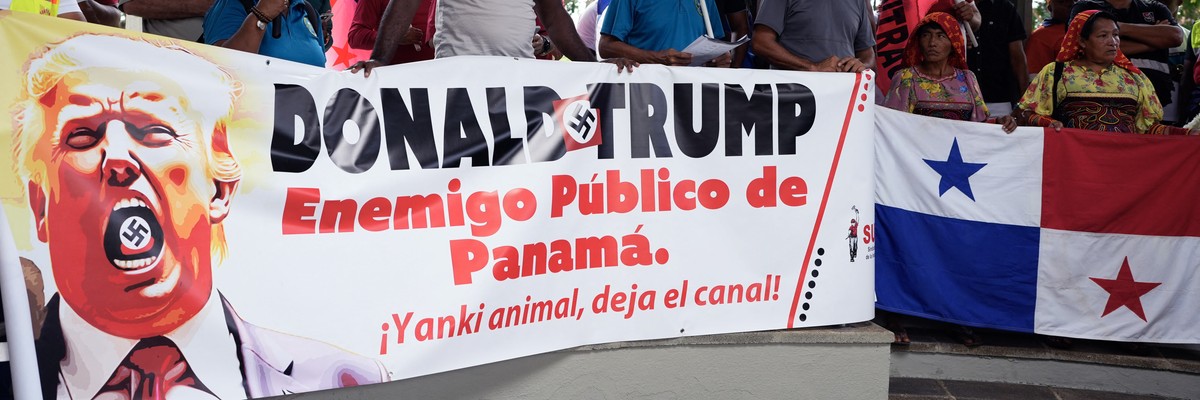
People demonstrate against U.S. President-elect Donald Trump in Panama City, Panama on December 31, 2024, as the country marks the 25th anniversary of the United States’ handover of the Panama Canal. (Photo: Arnulfo Franco/AFP via Getty Images)

Trump claimed both the canal and the Danish territory are needed for U.S. “economic security.”

U.S. President-elect Donald Trump has been rebuked in recent days by the leaders of both Panama and Denmark for his insistence that the Panama Canal and Danish territory Greenland must be under American control, and his latest comments on Tuesday were expected to garner more anger—and eye-rolling—from abroad.

At a press conference at his Florida resort, Mar-a-Lago, the Republican leader refused to rule out using military force to take over the canal and Greenland.

“It might be that you’ll have to do something. The Panama Canal is vital to our country,” said Trump. “We need Greenland for national security purposes.”

He added that both the canal and Greenland, the world’s largest island and home to a U.S. military base, are needed for U.S. “economic security.”

https://twitter.com/cspan/status/1876678479053259091?ref_src=twsrc%5Etfw%7Ctwcamp%5Etweetembed%7Ctwterm%5E1876678479053259091%7Ctwgr%5E1af877e8e497c3f3120f46d71803440dd1f466b5%7Ctwcon%5Es1_c10&ref_url=https%3A%2F%2Fwww.commondreams.org%2Fnews%2Fpanama-canal-importance-us-history

Sorry, this content could not be embedded.

X

Under President Jimmy Carter, who died late last month, the U.S. signed a treaty returning the Panama Canal Zone to Panama in 1979, and the waterway connecting the Atlantic and Pacific Oceans has been solely controlled by the Panamanian government since 1999.

Trump repeated a false claim that the canal is being “operated by China.”

Last month, after the president-elect demanded “that the Panama Canal be returned to the United States of America in full, quickly and without question,” Panamanian President José Raúl Mulino posted a video to social media in response.

“As president, I want to clearly state that every square meter of the Panama Canal and its adjoining zone is Panama’s and will remain so,” Mulino said. “The sovereignty and independence of our country is non-negotiable.”

Trump’s comments came as his son, Donald Trump Jr., joined right-wing activist Charlie Kirk and other Trump allies on a visit to Greenland.

The president-elect suggested in a social media post that the trip was made in an official capacity, writing: “The reception has been great. They, and the Free World, need safety, security, strength, and PEACE! This is a deal that must happen. MAGA. MAKE GREENLAND GREAT AGAIN!”

But Greenland officials clarified that Trump Jr. was visiting only as a “private individual” and said no representatives would be meeting with him.

Trump said at his press conference that “people really don’t even know if Denmark has any legal right to [Greenland], but if they do they should give it up because we need it for national security.”

Greenland is home to 60,000 people, and is self-ruling with its own legislature while its foreign and defense policy are controlled by Denmark. The Arctic island lies in a region where global powers are vying for military and economic control.

Trump also expressed a desire to purchase Greenland during his first term, a goal that was dismissed at the time as “absurd” by Danish Prime Minister Mette Frederiksen.

“Greenland belongs to the Greenlanders,” Frederiksen reiterated on Tuesday.

Original article by Julia Conley republished from Common Dreams under Creative Commons (CC BY-NC-ND 3.0). 

Continue ReadingTrump Won’t Rule Out Military Force to Seize Control of Panama Canal, Greenland

Facebook Follows X Down Path to Becoming Right-Wing ‘Cesspool’ by Ending Fact-Checking Efforts

Spread the love

Original article by Eloise Goldsmith republished from Common Dreams under Creative Commons (CC BY-NC-ND 3.0).

CEO of Meta, Mark Zuckerberg is seen during a Senate Judiciary Committee hearing with representatives of social media companies at the Dirksen Senate Office Building on Wednesday January 31, 2024 in Washington, DC. (Photo: Matt McClain/The Washington Post via Getty Images)

“Zuck isn’t just kissing the ring, he’s slobbering all over it,” said one media reporter.

In a move that some viewed as a means of currying favor with the incoming Trump administration, Meta CEO Mark Zuckerberg announced in a video Tuesday that the company is moving to end its third party fact-checking program.

Instead, the company will use a community notes approach, inspired by the Elon Musk’s platform X—where Musk’s misleading claims about the 2024 presidential election racked up billions of views.

Zuckerberg’s announcement was accompanied by a post authored by Meta’s new, “Trump-friendly” chief global affairs officer, Joel Kaplan, who described the change as “more speech and fewer mistakes.” Kaplan also went on Fox & Friends on Tuesday morning to discuss the update.

“Too much harmless content gets censored, too many people find themselves wrongly locked up in ‘Facebook jail,’ and we are often too slow to respond when they do,” wrote Kaplan in his post. Kaplan and Zuckerberg also noted that Meta plans to phase back in more civic content, as in posts about elections, politics, or social issues.

Real Facebook Oversight Board (RFOB), a group established to counter the perceived failures of Meta’s own oversight board, blasted the move, saying, “‘censorship’ is a manufactured crisis, political pandering to signal that Meta’s platforms are open for business to far-right propaganda.”

“Twitter’s shift from fact checking has turned the platform into a cesspool; Zuck is joining them in a race to the bottom,” the group wrote Tuesday.

The move generated other negative reactions.

“Meta went to Fox News to announce it’s ending its third-party fact checking program. Zuck isn’t just kissing the ring, he’s slobbering all over it,” wrote media reporter Oliver Darcy on Tuesday.

Also on Tuesday, Kara Swisher, a tech journalist, wrote “toxic floods of lies on social media platforms like Facebook have destroyed trust not fact checkers. Let me reiterate: Mark Zuckerberg has never cared about that and never will.”

Co-president of the watchdog group Public Citizen, Lisa Gilbert, weighed in, saying that “misinformation will flow more freely with this policy change, as we cannot assume that corrections will be made when false information proliferates. The American people deserve accurate information about our elections, health risks, the environment, and much more. We condemn this irresponsible move and the harm it will likely contribute to our discourse.”

“Meta’s new promise to scale back fact checking isn’t surprising—Zuckerberg is one of many billionaires who are cozying up to dangerous demagogues like Trump and pushing initiatives that favor their bottom lines at the expense of everything and everyone else,” wrote Nora Benavidez, senior counsel and director of digital justice and civil rights for the organization Free Press in a Tuesday statement.

Meta, which is angling for the U.S. government to use its AI and is facing an federal antitrust trial this spring, has made other bids to enter Trump’s good graces and thaw once frosty relations (Meta temporarily booted Trump from its platforms following his comments regarding the January 6 insurrection). Meta donated $1 million to Trump’s inauguration fund recently and Zuckerberg flew down to Trump’s Mar-A-Lago Club to meet with him this past fall.

Original article by Eloise Goldsmith republished from Common Dreams under Creative Commons (CC BY-NC-ND 3.0).

Continue ReadingFacebook Follows X Down Path to Becoming Right-Wing ‘Cesspool’ by Ending Fact-Checking Efforts

Israel uses ambulance to storm West Bank refugee camp

Spread the love

https://www.middleeastmonitor.com/20250107-israel-uses-ambulance-to-storm-west-bank-refugee-camp

Israeli armoured vehicle and an ambulance is seen during raid at the Jenin Refugee Camp in the city of Jenin, north of the West Bank on December 12, 2023 [İssam Rimawi/Anadolu Agency]

The Israeli occupation army yesterday admitted that its forces used an ambulance to infiltrate Balata refugee camp in Nablus in the northern West Bank, claiming that it is investigating the incident that Palestinians say led to the death of an elderly woman and a young man.

On Sunday, Palestinians shared videos taken by a surveillance camera in a shop showing Israeli occupation soldiers getting out of an ambulance in the heart of the camp and shooting at passersby, which they say led to the death of an elderly woman and a young man, according to Israeli newspaper Yedioth Ahronoth.

In a statement quoted by the paper yesterday, the occupation army claimed that it operates in accordance with international law and that the incident in question is being investigated.

“The investigation would examine the use of the vehicles shown in the video and allegations of harm to uninvolved individuals during the exchange of fire between the terrorists and our forces.”

The video was taken on 19 December 2024 during an Israeli raid on the camp. On the same day, Palestinians reported that two people were killed in the operation, one of them an 80-year-old woman, according to the Israeli newspaper.

At the time, the Israeli army said in a statement that its forces launched an operation to arrest a suspect in Balata camp, and “during the activity, there was an exchange of fire with fighters who fired shots and threw explosive devices at the forces,” the statement added.

READ: ‘Nablus, Jenin must look like Gaza’s Jabalia,’ says far-right Israel Minister

This work by Middle East Monitor is licensed under a Creative Commons Attribution-NonCommercial-ShareAlike 4.0 International License

Continue ReadingIsrael uses ambulance to storm West Bank refugee camp