Quaker group pulls New York Times ad over paper’s refusal to call Gaza bombing ‘genocide’

Spread the love

https://www.middleeastmonitor.com/20250109-quaker-group-pulls-new-york-times-ad-over-papers-refusal-to-call-gaza-bombing-genocide

The New York Times headquarters in New York, US, on 4 February, 2024 [Shelby Knowles/Bloomberg via Getty Images]

A prominent American Quaker organisation has cancelled its advertising with the New York Times (NYT) after the newspaper refused to allow an advertisement referring to Israel’s aggression in Gaza as genocide.

The American Friends Service Committee (AFSC), a century-old peace and justice organisation, had proposed an advertisement reading: “Tell Congress to stop arming Israel’s genocide in Gaza now! As a Quaker organization, we work for peace. Join us. Tell the President and Congress to stop the killing and starvation in Gaza.”

Commenting on the newspaper’s decision not to run the advertisement, AFSC General Secretary Joyce Ajlouny said: “The refusal of The New York Times to run paid digital ads that call for an end to Israel’s genocide in Gaza is an outrageous attempt to sidestep the truth. Palestinians and allies have been silenced and marginalised in the media for decades as these institutions choose silence over accountability. It is only by challenging this reality that we can hope to forge a path toward a more just and equitable world.”

US media reported that the NYT’s advertising team suggested AFSC replace the word “genocide” with “war” – a term with fundamentally different implications both colloquially and under international law. When AFSC rejected this proposal, the Times’ Ad Acceptability Team responded that “various international bodies, human rights organisations, and governments have differing views on the situation,” citing a need for “factual accuracy and adherence to legal standards.”

Ajlouny highlighted the organisation’s direct experience of the situation: “Our courageous staff members in Gaza witness daily horrors and continue to provide vital support despite Israel’s relentless attacks on their homes and families. Our ad campaign aims to shed light on these atrocities while urging people in the U.S. to pressure the President and Congress to halt weapons shipments to Israel and advocate for an end to the genocide.”

AFSC, which has operated in Gaza since 1948, currently maintains staff in the besieged Strip, Israeli occupied Ramallah and Jerusalem. Since October 2023, their Gaza team has distributed 1.5 million meals, hygiene kits and other humanitarian aid to displaced people.

The controversy comes after the International Court of Justice’s provisional ruling in January 2024 that Israel’s actions in Gaza were “plausibly genocidal” in the case brought by South Africa, now supported by 14 countries. Notably, the Washington Post has run advertisements from Amnesty International using genocide terminology.

“The suggestion that the New York Times couldn’t run an ad against Israel’s genocide in Gaza because there are ‘differing views’ is absurd,” said Layne Mullett, AFSC’s director of media relations. “The New York Times advertises a wide variety of products and advocacy messages on which there are differing views. Why is it not acceptable to publicise the meticulously documented atrocities committed by Israel and paid for by the United States?”

Read: ‘Yes, it is genocide’ in Gaza says Israeli professor of Holocaust studies

There is growing consensus among major human rights organisations, legal scholars and international experts that Israel’s military onslaught in Gaza amounts to genocide. This includes assessments from prominent organisations such as Amnesty International, Human Rights Watch, the Centre for Constitutional Rights, and the University Network for Human Rights, along with numerous Palestinian human rights groups and genocide scholars. Many of these organisations are regularly cited as authoritative sources in the New York Times’ own reporting on other matters.

The UK’s Guardian newspaper pointed out that the NYT has previously run advertisements using the term genocide. In 2016, it published an ad from the Armenian Educational Foundation thanking Kim Kardashian for opposing denial of the Armenian genocide. In 2008, presidential candidates Barack Obama, Hillary Clinton and John McCain co-signed a letter advertisement in the New York Times calling out the genocide in Sudan’s Darfur.

It also highlighted that the Times’ advertising guidelines state that its “advertising space is open to all points of view” and that submissions may be subjected to factchecking. It reserves the right to reject an ad if it is found to be deceptive or inaccurate.

This work by Middle East Monitor is licensed under a Creative Commons Attribution-NonCommercial-ShareAlike 4.0 International License.

Continue ReadingQuaker group pulls New York Times ad over paper’s refusal to call Gaza bombing ‘genocide’

British artist rejects OBE citing Gaza ‘horror’ and colonial legacy

Spread the love

https://www.middleeastmonitor.com/20250109-british-artist-rejects-obe-citing-gaza-horror-and-colonial-legacy

Susan Moffat, a British musician and theatre artist [Susan Moffat/linkedin]

British musician and theatre artist Susan Moffat has declined an OBE in this year’s Honours List, citing Britain’s colonial legacy and its response to what she describes as the “horrific war” being waged against Palestinians in Gaza.

Moffat, who was nominated for her services to the British community, penned a powerful letter explaining her decision, drawing parallels between her work with Bosnian genocide survivors and the current situation in Gaza.

“I remember screaming at the television during the Bosnian genocide, asking why nobody was stopping it. Now I find myself asking the same question about Gaza,” Moffat told MEMO.

Our leaders have placed value on one set of lives over another, while nations play games with which people get to live and which don’t.

Moffat, who has worked extensively with survivors of the Srebrenica genocide, drew powerful parallels between past and present atrocities. The artist cited the message from the Mothers of Srebrenica: “We must not remain silent, nor stand on the side. We must raise our voice, we must act for all those whose voice cannot be heard but who suffer injustice, especially if those are children, women, civilians.”

In her letter declining the OBE, Moffat addressed the ongoing impact of colonialism and its modern manifestations, particularly in Palestine. “Without acknowledging this legacy, would for me, feel discordant with the work I strive to do,” she wrote, questioning the appropriateness of accepting an honour tied to Britain’s imperial past while similar injustices continue.

Moffat also reflected on the broader implications of colonialism and its enduring impact: “The devastation wrought by empire is not a distant historical footnote but a profound reality that continues to shape our world. The structures of colonialism, its extraction of wealth, and the human suffering it inflicted have left enduring scars. Communities in the Global South are still recovering from the looting of resources and the imposition of arbitrary borders that fuel conflicts today.”

The artist went on to stress that “to accept an honour tied to the ‘Order of the British Empire’ without acknowledging this legacy, would for me, feel discordant with the work I strive to do.” Moffat explained that her decision is a response to the broader cultural context. “Conversations about history, accountability, and justice are often reduced to soundbites about so-called ‘cancel culture’,” Moffat said. “In truth, what is often dismissed as cancel culture is a growing demand for a more honest reckoning with our past,” Moffat went on to warn that the far-right seeks to “sanitise history” and “do a disservice to the potential for growth and reconciliation.”

Speaking to MEMO, Moffat emphasised the role of artists and musicians in combating injustice. “For our kids to understand their true legacy, both good and bad, we must be honest about our past and present actions,” Moffat explained.

When discussing what might have influenced her decision differently, Moffat outlined specific actions the UK government could have taken regarding Gaza, where more than 46,000 Palestinians, mostly women and children, have been killed. “We should have upheld international law and stopped the bombing of schools and hospitals. We should have ended the blockade and used our diplomatic leverage to ensure Israeli forces didn’t target civilians. We should have issued a stronger condemnation of illegal settlements and taken a more decisive stance against the targeting of civilian infrastructure and demonstrated that we as a nation truly stand against injustice.”

Read: UK suspends legal assessments on Israel’s compliance with international law

Moffat went on to add that “the British government has failed to play its moral role,” stressing: “If our nation had shown the courage to prioritise humanitarian concerns over political expediency, to stand firmly against civilian casualties, and to be a genuine voice for peace and justice – that would have given me reason to reconsider accepting this honour.”

Reflecting on the ongoing devastation, Moffat emphasised the urgency of immediate action: “We keep saying ceasefire now and all wars end, so let’s put the end at the beginning. Why wait for more suffering when we know peace negotiations are inevitable?”

This work by Middle East Monitor is licensed under a Creative Commons Attribution-NonCommercial-ShareAlike 4.0 International License.

Experiencing issues with this image not appearing. I suspect because it's so critical of Zionist Keir Starmer's support of and complicity in Israel's genocides.
Genocide denier and Current UK Prime Minister Keir Starmer is quoted that he supports Zionism without qualification. He also confirms that UK air force support has been essential in Israel’s mass-murdering genocide. Includes URLs https://www.declassifieduk.org/keir-starmers-100-spy-flights-over-gaza-in-support-of-israel/ and https://youtu.be/O74hZCKKdpA
UK Foreign Minister David Lammy confirms that UK government and military are active participants in Israel’s genocides and that the F-35 parts that they suspended from supplying to Israel are instead simply diverted via the United States. He says see https://youtu.be/QILgUHrdWRE
Continue ReadingBritish artist rejects OBE citing Gaza ‘horror’ and colonial legacy

Zuckerberg and Musk have shown that Big Tech doesn’t care about facts

Spread the love

Original article by Jasper Jackson republished from TBIJ under This work is licensed under a Creative Commons Attribution-NonCommercial-NoDerivs 3.0 Unported License.

With tech titans openly disregarding the truth ahead of Trump’s second term, 2025 is likely to herald a new era of disinformation

The online information ecosystem has been in critical condition for some years now, but the prognosis for 2025 is looking more dire than ever.

Already this year two of the world’s richest men, who between them control a huge chunk of our communications infrastructure, have made it clear that they are not interested in our access to the truth.

On Tuesday, Mark Zuckerberg announced that his company Meta – which owns Facebook, Instagram and WhatsApp – would be scrapping its fact checking programme. The only exception to this for now will be in the EU, where strong regulations require it to police its platform.

The core purpose of this programme was to check content that had been flagged as containing potentially harmful misinformation, such as false claims about vaccines or military conflicts. These checks were carried out by third-party organisations, which had to follow rules around process and transparency – and which received significant funding from Meta.

In their place, Meta will now adopt a “community notes-style” system, which enables users themselves to weigh in on content that might be false. A similar set-up has already been adopted by X, where it has proven open to manipulation and failed abysmally to curb misinformation on the platform.

Recommended Articles

To be clear, Meta’s fact checking programme was not without its problems. For a start, there was no way it could catch every falsehood on the platforms. Meta’s financial arrangements with these organisations also raised questions. And ultimately, there is no definitive proof that showing people fact checks has any real impact on whether they believe the false claims.

But the programme did provide vital financial support to newsrooms that did hugely valuable work, from uncovering Russian propaganda campaigns to exposing online scam artists. And while it was only ever a partial solution at best, Meta’s programme was a sign that the company at least wanted to be seen to care about the accuracy of the information spreading across its platforms.

Zuckerberg’s about-turn came after a week in which another tech tycoon, Elon Musk, had been weighing in on UK politics, most notably with twisted falsehoods about the handling of child grooming cases and messages of support for Tommy Robinson, the far-right figure currently in prison for contempt of court after targeting a Syrian refugee with lies. On Monday, Musk suggested in a poll posted on X that “America should liberate the people of Britain from their tyrannical government”.

Click to sign up to TBIJ newsletter now

The recent behaviour of Zuckerberg and Musk can only be seen in light of the impending second term of Donald Trump, whose propensity for lying is legendary. Musk was already all in on Trump’s presidency. But since the election, much of the rest of the tech world has sought to curry favour with the incoming president, with many prominent figures making big donations to his inauguration.

Like the Trump presidency itself, Musk and Zuckerberg’s dismantling of systems that help protect the truth are logical consequences of the digital structures we have built. An online economy that rewards attention above all else has given new power to false claims. Outlandish lies spread quicker than boring truths. Telling people what they want to hear is more engaging than telling them what they need to hear.

And all the signs suggest that the problem will only be worsened by the tech world’s latest obsession: generative AI. Systems such as ChatGPT, which can come up with content that seems human and accurate but is often simply a convincing lie, are rapidly being incorporated into all our major channels of information and communication. Apple is putting inaccurate headlines on curated news articles. Meta is planning to flood its social networks with AI bots mimicking humans. Google is pushing AI-driven search that regularly throws up false results.

A huge amount of money has been poured into generative AI, and much of the tech industry is banking on it to deliver another lucrative boom. But it has turned out to be even worse than humans at telling fact from fiction – and even more willing to make things up. Dealing with this problem is vital for democracy, but it also threatens the industry’s next big payout. As Zuckerberg proved this week, it’s a lot easier to simply give up on accurate information altogether.

Big Tech is no longer even keeping up the pretence that it is committed to the truth. Keeping our information ecosystem healthy is going to be up to the rest of us.

Reporter: Jasper Jackson
Deputy editor: Katie Mark
Editor: Franz Wild

Production editor: Alex Hess
Fact checker: Frankie Goodway

TBIJ has a number of funders, a full list of which can be found here. None of our funders have any influence over editorial decisions or output.

Original article by Jasper Jackson republished from TBIJ under This work is licensed under a Creative Commons Attribution-NonCommercial-NoDerivs 3.0 Unported License.

This image added 11/1/25

Elon Musk urges you to be a Fascist like him, says that you can ignore facts and reality then.
Continue ReadingZuckerberg and Musk have shown that Big Tech doesn’t care about facts

Truss sends cease and desist to Starmer demanding he stop saying she crashed the economy

Spread the love
Lettuce complains about being compared to Liz Truss.
Lettuce complains about being compared to Liz Truss. Cease and desist letters for this image are welcome …

https://www.independent.co.uk/news/uk/politics/liz-truss-keir-starmer-legal-letter-b2676352.html

Liz Truss has issued Sir Keir Starmer with a cease and desist letter, warning him to stop saying she “crashed the economy”.

The former prime minister’s lawyers have said the remarks – made since the lead up to the general election – are likely to “cause serious harm to her reputation”, claiming they are “false and defamatory”.

They also suggest that assertions made by the Labour leader before the July general election contributed to Ms Truss losing her South West Norfolk seat.

Sir Keir has repeatedly claimed the former prime minister crashed the economy, referring to the weeks after her 2022 mini-budget which sparked gilt market freefall and a run on sterling after she introduced unfunded tax cuts.

The letter, originally seen by the Telegraph, argues that the fallout did not amount to an economic crash, since there was no fall in economic output or rise in unemployment.

Article continues at https://www.independent.co.uk/news/uk/politics/liz-truss-keir-starmer-legal-letter-b2676352.html

I tend to avoid quoting the Independent because I’ve had a letter claiming copyright infringement from them …

Continue ReadingTruss sends cease and desist to Starmer demanding he stop saying she crashed the economy

A quarter of freshwater animals threatened with extinction, finds major new study

Spread the love

Iwan Jones, Queen Mary University of London

For far too long, the decline in the biodiversity of our rivers and lakes has been out of sight and out of mind. As a freshwater ecologist I have long felt frustrated as conservation and research is dominated by land and sea species, even though our rivers, lakes, ponds and other wetlands host a hugely disproportionate amount of the world’s biodiversity in their relatively small area.

The first comprehensive assessment of the risk of extinction of freshwater species, now published in the journal Nature, is set to change this. The scientists involved in the new study used the recently completed “red list” for freshwater fishes, and the one for dragonflies and damselflies.

Red lists are official inventories of conservation status compiled by the International Union for Conservation of Nature (IUCN). They combined this with data from the previously published red list for freshwater crabs, crayfishes and shrimps. In total, they assessed more than 23,000 species.

The authors conclude that close to a quarter (24%) of freshwater species are threatened with extinction. That is, they have been officially assessed as vulnerable, endangered, critically endangered or extinct in the wild.

These include the critically endangered European eel, and the endangered white-clawed crayfish, both of which were abundant in the streams of my childhood.

small crayfish on river weed
Once abundant, now endangered: a juvenile white clawed crayfish. valda butterworth / shutterstock

There is some uncertainty in the estimates, especially as there is insufficient data to establish the extinction risk for some species. The authors use an accepted and robust method to address this uncertainty but note that this lack of data affects a substantially larger proportion of freshwater species than those that live on land.

In fact, despite indications that a greater proportion of freshwater mollusc species are at risk of extinction, the authors could not include molluscs in their analysis as so many species are data deficient.

Furthermore, we have only the most rudimentary understanding of the status of the wide array other freshwater species, particularly invertebrates such as mayflies, stoneflies, or various beetles, many of which are highly sensitive to pollution. Although this new study represents an important step forward in our understanding, it should also act as a clarion call to galvanise efforts to fill these critical data gaps.

Freshwater species overlooked

While shocking, this figure of 24% of freshwater species threatened with extinction is comparable with the estimate for predominantly land-based amphibians, reptiles, birds and mammals, of which 23% are threatened. Comprehensive assessments of birds, amphibians and mammals have been available for over 20 years, with repeat assessments now available.

Rivers and lakes support whole ecosystems with all sorts of species. Martine Liu 58 / shutterstock

As the IUCN’s red lists are used to document trends in biodiversity and therefore to inform national and global strategy, data on terrestrial vertebrates has dominated conservation science and policy. Hence, to date, global environmental governance has focused on land and sea ecosystems, despite evidence that freshwaters require distinct management needs.

With this assessment, it is now clear that policy will have to be developed that protects and delivers improvements for freshwater species. That means thinking about entire river basins as a whole, rather than the immediate area occupied by the species.

It also means considering things like how rivers and lakes are connected and how the water available varies from season to season. Bodies of freshwater are like islands in a sea of land. Facilitating movement between these islands can help preserve species, particularly where they disappear seasonally.

Most species face multiple threats

In the new study, pollution, dams, water abstraction, land-use change, over-exploitation, invasive species and disease feature prominently as threats, with most species impacted by more than one. Freshwaters in areas of limestone and other porous calcium-rich rocks host consistently more threatened species than would be expected, highlighting the importance of chalk streams for example, where pressure due to exploitation of water resources and pollution is pronounced.

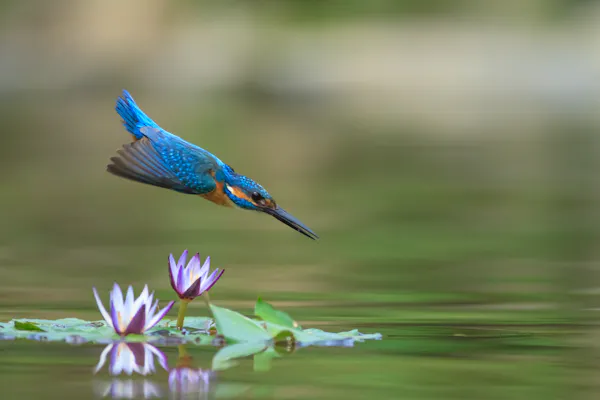
Chalk streams are valuable habitats for salmon, trout, otters, kingfishers and many other species. Tony Martin Long / shutterstock

While current efforts to hold UK water companies responsible for reducing inputs of sewage to rivers and lakes are commendable, water use efficiency and run-off should be considered throughout the decision-making process, from building design and town planning though to our individual daily use of water. Nature-based solutions such as tree planting or wetland protection offer a way forward that simultaneously benefit biodiversity and human well-being.

A lack of understanding can no longer be used as an excuse for inaction. As the authors of the new study point out, freshwaters support more than 10% of all known species, including about a third of vertebrates and half of fishes, while covering less than 1% of the surface of the Earth.

Many of the freshwater species considered in this study are socially and economically important. Freshwater fish provide an important source of protein for many human societies, and species such as Atlantic salmon support a fishing-tourism industry critical to many areas with limited opportunities to generate income.

Other species, while superficially unimportant to human society, thrive in clean water. The widespread decline in these species reflects increasing pollution and other pressures, which does not bode well for our society in the face of climate change and diminishing water availability.

Iwan Jones, Freshwater Ecologist and Head of the River Communities Group, Queen Mary University of London

This article is republished from The Conversation under a Creative Commons license. Read the original article.

Continue ReadingA quarter of freshwater animals threatened with extinction, finds major new study