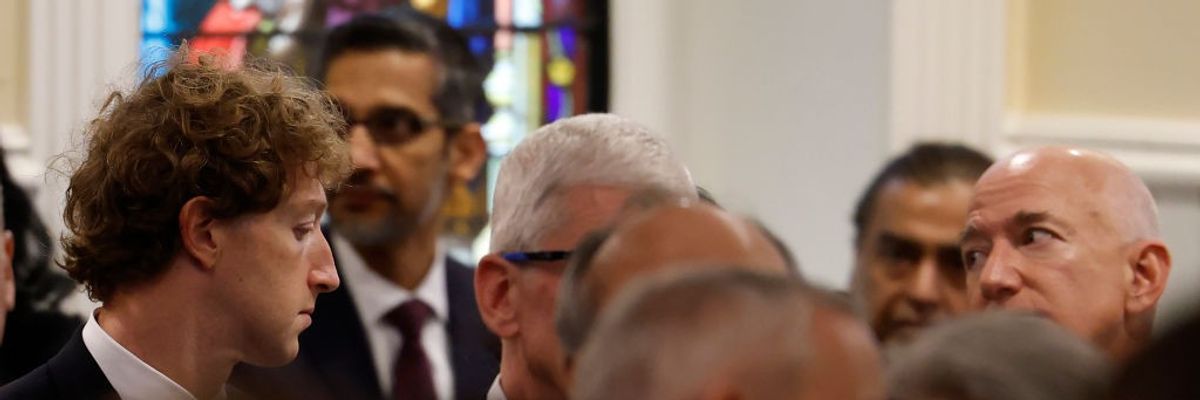
Meta and Facebook CEO Mark Zuckerberg (L), CEO of Apple Tim Cook, and Founder of Amazon and Blue Origin Jeff Bezos attend services as part of Inauguration ceremonies at St. John’s Church on January 20, 2025 in Washington, D.C. (Photo: Anna Moneymaker/Getty Images)
The very ripeness for scandal this time around calls for reasonable restrictions on the sources and amounts of inaugural donations.
U.S. President Donald Trump sounded a lot of populist notes on the campaign trail. But as he took the oath of office for the second time, he was joined onstage by billionaires and CEOs who’d spent millions to be there—leaving supporters who’d traveled across the country to attend literally out in the cold.
Presidential inaugurations have always been an opportunity for wealthy special interests to curry favor with the incoming administration with generous inaugural donations. But the nation has never seen influence peddling like we just witnessed at Trump’s second inauguration.
The sheer volume of today’s inaugural donations suggests that wealthy special interests believe it is worth the investment.
…
All the self-reporting donors—including Big Tech firms like Google, Microsoft, Meta, Amazon, and OpenAI—pledged $1 million or more. The cryptocurrency firm Ripple pledged $5 million. In fact, the cryptocurrency industry even hosted its own inaugural ball.
And of course, Wall Street is cozying up with major donations from Goldman Sachs, Bank of America, and billionaire hedge fund manager Ken Griffin.
“EVERYBODY WANTS TO BE MY FRIEND!!!” Trump marvels on his Truth Social account.
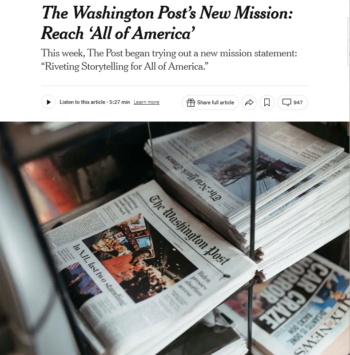
As the Washington Post faces a staff rebellion and plummeting subscription rates, billionaire owner Jeff Bezos has introduced a new mission statement: “Riveting Storytelling for All of America.”
The Washington Post‘s new slogan, “Riveting Storytelling for All of America,” is “meant to be an internal rallying point for employees,” the New York Times (1/16/25) reported.
The new path forward, as introduced in a slide deck to staff by Suzi Watford, the paper’s chief strategy officer, demands that the paper “understand and represent interests across the country,” and “provide a forum for viewpoints, expert perspectives and conversation” (New York Times, 1/16/25). It will do this as “an AI-fueled platform for news” that delivers “vital news, ideas and insights for all Americans where, how and when they want it.”
This appears to mean shifting resources toward opinion, specifically opinions from the right. According to the New York Times report:
Bezos has expressed hopes that the Post would be read by more blue-collar Americans who live outside coastal cities, mentioning people like firefighters in Cleveland. He has also said that he is interested in expanding the Post’s audience among conservatives.
The Post has already begun to consider ways to sharply increase the amount of opinion commentary published on its website, according to two people with knowledge of the talks. An adviser to the Post, Lippe Oosterhof, has conducted brainstorming sessions about a new initiative that would make it easier to receive and publish opinion writing from outside contributors.
How AI is meant to play into this is unclear.
The Post already has more columnists than you can shake a stick at. This new direction sounds like the Foxification of the Washington Post, a move away from any attempt to hold the powerful to account, toward inexpensive clickbait punditry.
‘Make money’
The red area represents the proportion of Jeff Bezos’s total wealth that would be required to cover the Washington Post‘s losses for a year.
Watford’s slide deck presented three pillars of the Post‘s new model: “great journalism,” “happy customers” and “make money.” The Postlost roughly $77 million in 2023. (It also lost some 250,000 subscribers after Bezos killed the paper’s planned endorsement of Kamala Harris—FAIR.org, 10/30/24.)
In order to make money, its new “Big Hairy Audacious Goal” (yes, that’s what the Post slide deck apparently called it) is to reach 200 million “paying users.” The paper currently has about 3 million subscribers, making it an “audacious” goal indeed. As the Times pointed out, even if the Post could achieve the impossible task of monetizing every visit to its website, no major corporate media outlet has been getting more than 100 million monthly unique visits—paying and non-paying—outside of the spike in traffic around the election.
Back in 2019, the Post was claiming 80–90 million unique visitors per month. Those visits peaked in November 2020 at 114 million, but quickly and steadily dropped after Biden’s inauguration. The Post stopped posting its audience numbers online after January 2023, when they were down to 58 million.
Of course, most online corporate media have been struggling. The thing about the Post is that its absurdly wealthy owner, the second-richest person on Earth, can easily afford to lose $77 million a year. That’s 0.03% of Bezos’s current net worth.
‘We are deeply alarmed’
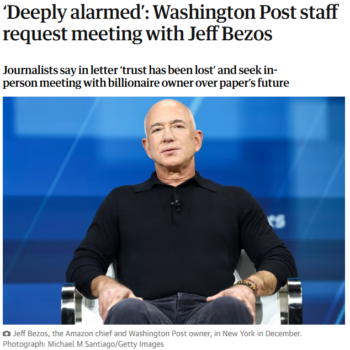
Guardian (1/15/25): “The plea from staff…comes a week after the Post laid off roughly 100 employees…roughly 4% of the publication’s staff.”
No doubt the Post needs help. Just days before the new mission statement was revealed, over 400 staff members signed a letter to Bezos asking for a meeting (Guardian, 1/15/25). The letter read:
We are deeply alarmed by recent leadership decisions that have led readers to question the integrity of this institution, broken with a tradition of transparency, and prompted some of our most distinguished colleagues to leave, with more departures imminent.
Bezos’s response—a slide deck about “riveting storytelling” on “an AI-driven platform” that prioritizes churning out opinions to draw in conservatives—is hardly likely to ease the mind of any serious journalist at the paper.
Nor is trying to “expand the Post audience among conservatives,” while still paying lip service to “great journalism,” likely to solve the Post‘s problems. As CNN‘s former CEO Chris Licht discovered (FAIR.org, 6/8/23), you can’t do good journalism while trying to appeal to both sides in the context of an increasingly radical right, because that side demands acceptance of lies and conspiracy theories that are incompatible with actual journalism.
When Bezos bought the Post (Extra!, 3/14), he assured the paper’s employees that “the paper’s duty will remain to its readers and not to the private interests of its owners.” That sentiment was repeated in Watford’s slide deck this week. But Bezos’s actions in the past months—including the killing of the Harris endorsement, Amazondonating $1 million donation to Trump’s inaugural fund and paying Melania Trump $40 million for her self-produced documentary, and, most recently, Bezos appearing onstage with other multibillionaires at Trump’s inauguration—make clear that the principle is as meaningless to Bezos as the slogan that debuted after Trump’s first election: “Democracy Dies in Darkness.”
That slogan will continue to adorn the front page for the time being, perhaps in the hope that readers searching for an actual news organization that holds those in power to account will be fooled into subscribing.
ACTION ALERT: You can send a message to the Washington Post at letters@washpost.com.
Please remember that respectful communication is the most effective. Feel free to leave a copy of your message in the comments thread here.
FAIR’s work is sustained by our generous contributors, who allow us to remain independent. Donate today to be a part of this important mission.
“We must ask who these decisions would be made for and why. Whose advice is the Government listening to, when record-high wealth inequality is causing harm to the economy and society in many different ways, while frequent flying is the preserve of the super-rich?
“The aviation lobby is loud and well-funded, but the Government should instead be listening to scientists and its own Climate Change Committee, which has already urged a halt to overall airport expansion. The previous Labour government’s poor record on airport expansion doesn’t have to continue.
“If Ed Miliband is serious in his role as Net-Zero Minister, he will work to prevent the Chancellor and Transport Secretaries making a huge mistake, and advise the Chancellor to not make any dangerous new decisions until they have heard and listened to the new advice from the Climate Change Committee which is due in February.”
Orcas comment on killer apes destroying the planet by continuing to burn fossil fuels.
The UK banking industry has warned that government plans to crackdown on benefit fraud could leave banks at risk of breaking consumer protection rules.
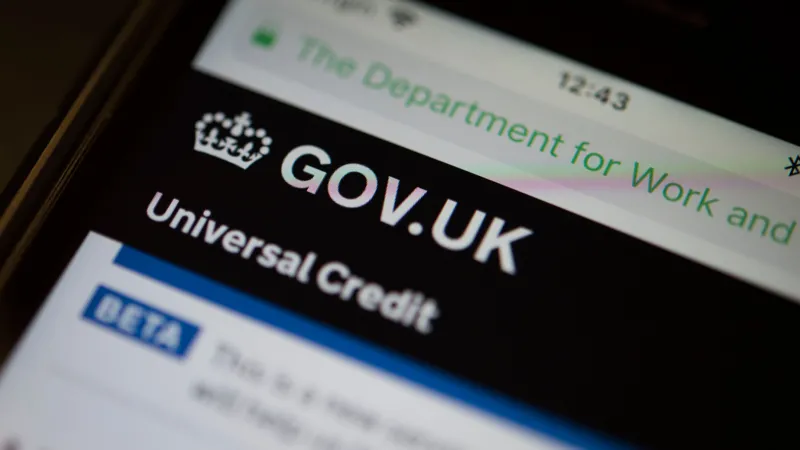
A new law unveiled on Wednesday would allow the Department for Work and Pensions (DWP) to reclaim money from accounts without a court order.
Ministers argue this will speed up the debt recovery process and help contribute to a wider crackdown on benefits fraud.
But UK Finance, the biggest business group representing British banks, has told the BBC the plans could undermine the banks’ own efforts to protect vulnerable account holders.
The government’s announcement on Wednesday is the culmination of years of work by officials in DWP about how to more closely involve banks in benefit fraud crackdowns.
Similar plans drawn up by the previous Conservative government failed to make it through Parliament before last July’s general election.
The banking sector is understood to have been quietly lobbying against the plans for more than a year, but this is the first time they have raised concerns publicly.
The pesticide Cruiser SB has the potential to kill off populations of bees. Photograph: Creative Touch Imaging Ltd/NurPhoto/Rex/Shutterstock
Emergency use of Cruiser SB, a neonicotinoid pesticide highly toxic to bees, to be outlawed in UK in line with EU
Bee-killing pesticides have been banned for emergency use in the UK for the first time in five years after the government rejected an application from the National Farmers’ Union and British Sugar.
The neonicotinoid pesticide Cruiser SB, which is used on sugar beet, is highly toxic to bees and has the potential to kill off populations of the insect. It is banned in the EU but the UK has provisionally agreed to its emergency use every year since leaving the bloc. It combats a plant disease known as virus yellows by killing the aphid that spreads it.
Prof Dave Goulson, a bee expert at the University of Sussex, has warned that one teaspoon of the chemical is enough to kill 1.25bn honeybees. Even at non-fatal doses it can cause cognitive problems that make it hard for bees to forage for nectar and the chemicals can stay in the soil for years.
The previous Conservative government repeatedly agreed to its use against the advice of the Health and Safety Executive (HSE) and the Expert Committee on Pesticides.
This year, ministers say they are refusing the application based on “robust assessments of environmental, health and economic risks and benefits, and advice from Defra’s chief scientific adviser, its economists, the Health and Safety Executive and the UK Expert Committee on Pesticides”.