The Green Party’s revised transport policy, approved at its Autumn Conference, sets out a radical programme to transform transport in England & Wales. The proposed measures would aim to reduce carbon emissions by around 75% within a decade by reducing travel and expanding electrification of all modes. The party says the measures would also hugely reduce transport’s impacts on road danger and health while delivering a more equitable society.
Among a raft of ambitious initiatives, the policies include:
Transforming road and public transport – A step change away from car dependency, with major investment in better buses and rail. It aims for a 50% increase in rail travel and more frequent and reliable bus services, connecting homes with jobs, education, shops, healthcare. The policy also opposes almost all new road building.
Making Active Travel the natural choice – Safe, high-quality walking, wheeling and cycling networks, using road space reallocated from private motor vehicles. The policy aims for at least half of journeys in England’s towns and cities to be by active travel within five years, compared to a third in 2025.
Fairer and cleaner aviation – Reduce demand for passenger and freight flights, halt airport expansion, and ensure those who take the most polluting and unnecessary flights contribute the most. The policy specifically targets private jets, premium-class travel, and frequent flyers, while supporting cleaner alternatives and sustainable aviation.
Green Party parliamentary spokesperson on transport, Sian Berry MP, said:
“For too long transport policy has focused on moving vehicles rather than enabling people to get where they need to go. Our new policy is about giving everyone genuine choices – reliable and affordable public transport, safe walking, wheeling and cycling, and communities where owning a car isn’t a prerequisite for participating fully in society.
“We also need to tackle transport’s contribution to the climate crisis in an equitable and fair way. That means providing attractive alternatives to car and air travel, moving more freight onto rail and electrification. Those responsible for the most polluting and unnecessary journeys, including users of private jets and frequent flyers, will make the greatest contribution.”
Co-convenors of the policy, Jeremy Drew and Mark Strong, said:
“We have worked hard with an expert team of professionals and academics to revise our policy. It sets out measures to achieve a 75% reduction in transport carbon emissions within ten years, while making it easier for people and businesses to choose cleaner and healthier alternatives, which will improve not just transport but wider society.”
Green party leader Zack Polanski (Green Party of England and Wales). Image: Bristol Green Party Creative Commons CC0 1.0 Universal Public Domain Dedication.
Commenting on John Healey’s forthcoming budget at the end of October containing a £35 billion funding gap, leaving the government facing a choice between higher spending on public services or deep real-terms cuts later in the decade Green Party leader Zack Polanski said:
“Economists are telling the Chancellor today that a steady-as-she-goes budget ‘is not an option’. With three in five families already cutting back on spending, and many about to see a £300 increase in their bills in January, we’re challenging the government to take bold and immediate action on the cost of living. For a start, this means moving more costs off energy bills, properly funding a national home insulation scheme, clamping down on profiteering by energy companies, and rapidly scaling up cheaper, cleaner energy.”
The dispute over whether Israel’s assault on Gaza amounts to genocide has largely been settled. Amnesty International, a UN commission of inquiry and the International Association of Genocide Scholars have all reached that conclusion, as have many leading scholars of genocide. The question that remains is how the greatest political crime of our time was allowed to happen. Adam H. Johnson’s How to Sell a Genocide goes a long way to explaining it.
Published by Pluto Press with a foreword by the Palestinian American human rights lawyer Noura Erakat, the book covers the crucial period from October 2023 to October 2024, when Western audiences were primed for genocide. Johnson shows that the mainstream American media did much of the priming. These outlets dehumanised Palestinians, treated the life of an Israeli as having more worth than the life of a Palestinian and supplied ready-made justifications for violence against the population of Gaza. Together, he argues, they formed a media ecosystem that was essential to Israel’s campaign to destroy the Palestinians of Gaza, in whole or in part.
None of this, in Johnson’s view, was inevitable. It took “deliberate choices by deliberate moral actors” – the editors, reporters, bookers, producers and TV presenters who decided in the first weeks that protecting the powerful mattered more than the truth. Rather than report honestly on Israel’s US-backed assault on Gaza, they spun a comforting fiction for Western liberal audiences to justify the horror.
Setting out to prove, “beyond a reasonable doubt, that the genocide in Gaza was enabled, facilitated, and cheerled by establishment US media providing cover for months of a nihilistic campaign of starvation, bombing, arbitrary detention, shooting, and sexual violence,” Johnson cites hard data rather than relying on polemic or cherry-picked examples. The author draws on more than 12,000 articles and 5,000 TV clips from nine major outlets, testimony from journalists inside those newsrooms and comparisons with coverage of other recent conflicts.
Why leave out Fox News and the right-wing media? Because, says Johnson, outlets such as Fox, the Daily Wire and the Wall Street Journal are openly genocidal towards Palestinians and make no pretence otherwise; a book exposing them would be met by their own reporters and columnists with an “Okay, and?”
Instead, the author focuses on the outlets that Democrats read and watch. A Democratic president was in office when the genocide began, and support from Democrats in Congress, think tanks and the press was decisive in keeping it going. He concentrates on the first year, and above all the first few months, because that, he argues, is when the logic of the “war on Hamas” took hold, Americans grew used to mass death in Gaza and the genocide became a fait accompli.
With the destruction in Gaza too brutal and too visible to ignore, the media supplied excuses to ease the public conscience. Johnson calls these “Moats of Rationalization”: a scaffolding of deflection, double standards and orientalist tropes that allowed viewers and journalists alike to excuse the war crimes their own government was funding. The real job of the centre-left press, he argues, was not to convey reality but to “make their readers and viewers feel better” about their country, their leaders and themselves.
The first chapter shows how this worked by tracing how Israel weaponised the false claim that Hamas had beheaded 40 babies. The claim, which originated with Israeli military personnel and ZAKA, an organisation Johnson describes as far-right, spread from Israeli officials through CNN and other outlets to President Joe Biden within a day. It was part of an early push by media executives and pro-Israel groups to “ISIS-ify” Palestinian militants. Israel promoted the hashtag #HamasisISIS, and US Defence Secretary Lloyd Austin called the attack “worse than ISIS”. Johnson’s analysis found that in the first month, seven major print and online outlets equated Hamas with ISIS 149 times. On air, CNN did so 350 times and MSNBC 369 times.
The media also abandoned one of its most basic duties: explaining why the attack happened. Providing context for 7 October was actively discouraged. When MSNBC’s Ali Velshi and Ayman Mohyeldin explained the history behind it on the day, Johnson’s sources say Comcast, the network’s owner, intervened; one summed up the editorial line as “We don’t want context.”
Strict gatekeeping of what can and cannot be reported also helped to sell the genocide. CNN ordered that all its reporting on Israel and Palestine be “approved in advance by the Jerusalem bureau”, which operates under Israel’s military censor. A source told The Intercept that lines were routinely edited to favour Israeli narratives. Yet lurid, unsourced claims about Palestinians were aired unchallenged, while allegations against Israelis, Johnson argues, had to be “triple vetted”.
The same double standard shaped coverage of sexual violence. Within days of 7 October, the Israeli claim that systematic rape was part of Hamas’s “terror strategy” was being repeated by liberal media outlets before Israel had offered any evidence for it. Like the “beheaded babies” story, Johnson argues, it cast Hamas as an organisation “for which any political settlement or ceasefire is not only impossible but morally objectionable”.
The flawed sourcing of the New York Times report “Screams Without Words”, Johnson says, pointed to “an ideological motivation at work” and to lower standards for stories that served Israel’s agenda. Israel’s sexual abuse of Palestinian detainees, meanwhile, barely registered. In the first three months of the genocide and three months in late summer 2024, CNN and MSNBC made 502 on-air mentions of Palestinians committing mass rape and just two of Israelis raping Palestinians. The New York Times, Washington Post, Politico and Axios did the same in print: 128 mentions against nine.
An important part of selling the genocide relied on creating a two-tier moral system. In the chapter “Who is allowed to be human?”, Johnson shows how, within hours of 7 October, pundits and reporters began ranking violence and its victims on what he calls a “moral tier system”. Palestinian violence was treated as uniquely evil, driven by hatred, while Israeli violence was treated as regrettable but necessary.
Illustrating the impact of such framing, Johnson’s figures show that in the first 100 days, seven print and online outlets used “massacre” 344 times in their own reporting to describe Palestinians killing Israelis, and not once for Israelis killing Palestinians. Over the first year, the claim that Palestinians used “human shields” was aired 888 times on CNN and MSNBC, although Human Rights Watch has long rejected such a broad use of the term. Documented cases of Israeli forces using Palestinians as human shields went unmentioned. Israel’s “right to defend itself” was asserted 755 times on the two networks; Palestinians were granted the same right eight times.
Later chapters examine how US media helped the Biden administration “distance itself from the horrors of Gaza”; how it narrowed the debate to “how many Palestinians should die”; and how it covered “war crimes like earthquakes”, reporting the carnage as if it were a natural disaster and obscuring or leaving out Israel’s role entirely.
The chapter on campus protests, which Johnson calls “‘Antisemitism’ show trials”, contains the starkest comparison in the book. In the month after Harvard president Claudine Gay testified to Congress on campus antisemitism, six major print and online outlets ran 207 stories about her. In the month after six-year-old Hind Rajab was killed by Israeli forces in Gaza, along with six relatives and the two paramedics sent to rescue her, the same outlets ran five. On air, the gap was wider still: CNN mentioned Gay 409 times and Hind 29; MSNBC mentioned Gay 210 times and Hind not once.
Johnson sees his job as that of a “prosecutor”, and the book reads like a case for the prosecution. It is packed with figures, which some readers may find heavy going, but the sheer weight of them makes the pattern of bias very hard to deny.
A book such as this asks us to consider what history has already taught us about the role of propaganda in mass atrocity. At Nuremberg, the Allies put on trial not only those who carried out mass murder but also the propagandists who primed the public to accept it. The lesson was that genocide does not begin with killing; it begins with words that teach people to see others as less than human. Johnson shows how US media treated Palestinian lives as worth less than Israeli ones, stripped Palestinians of their history and presented violence against them as necessary.
American newsrooms have yet to answer the questions this book raises about their coverage of Gaza. They reported the deaths, but they also offered endless excuses for them. Johnson has documented the choices that shaped that coverage. It is now for editors and journalists to explain why they so often showed more understanding for those doing the killing than for those being killed.
This work by Middle East Monitor is licensed under a Creative Commons Attribution-NonCommercial-ShareAlike 4.0 International License.
Keir Starmer objects to criticism of the IDF. He asks how could anyone object to them starving people to death, forced marches like the Nazis did, bombing Gaza’s hospitals and universities, mass-murdering journalists, healthworkers and starving people queuing for food, killing and raping prisoners and murdering children. He calls for people to stop obstructing his genocide for Israel. New Labour UK Prime Minister Andy Burnham continues Labour party policy of active support and complicity in Israel’s genocide.UK Prime Minister Andy Burnham admits to blatently lying and engaging in deception to become leader of the UK Labour Party and Prime Minister.
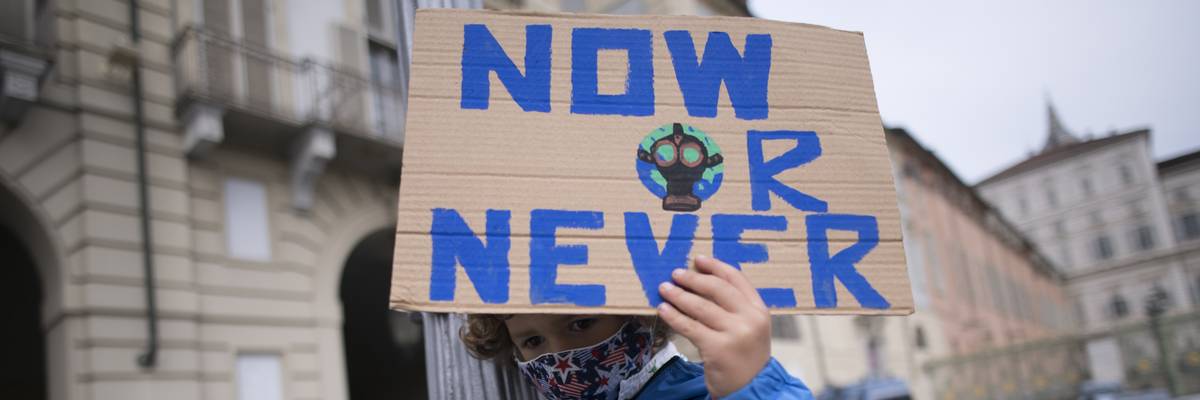
A Fridays for Future youth demonstrator rallies for climate action in Turin, Italy on October 9, 2020. (Photo by Stefano Guidi/Getty Images)
“This is no longer a warning for the future; it is a diagnosis of the present,” the report’s authors warned.
Earth’s life-support systems are “moving deeper into uncharted territory,” with greenhouse gas concentrations, ocean heat, and other vital indicators reaching unprecedented levels as human activity continues to push the planet toward points of no return, an international team of scientists warned Wednesday.
“We are witnessing the rapid destabilization of the Earth’s climate system. This is no longer a warning for the future; it is a diagnosis of the present,” the authors of The 2026 State of the Climate Report wrote. “Earth’s life-support systems are being pushed beyond stable limits, with changes unfolding faster than our ability to respond.”
“Human activities are driving profound shifts in the atmosphere, oceans, and biosphere,” the report—which was published in the peer-reviewed journal BioScience—continues. “Carbon dioxide levels in the atmosphere are higher now than any time in the last 2 million years. Across the globe, extreme heat, floods, droughts, storms, and wildfires are no longer rare events but defining features of a changing planet. For example, July 2026 was the hottest month on record for the contiguous United States (1895–present), while global ocean temperatures also reached a record high for July.”
>Post not found, it may have been deleted.
The report, led by Oregon State University scientists William Ripple and Christopher Wolf, measures 16 key climate indicators, seven of which “are at record extremes and multiple others are also trending in the wrong direction,” co-author Johan Rockström explained.
“Climate-related changes appear to be accelerating and intensifying, raising concerns about reinforcing feedbacks and crossing of tipping points, with potential irreversible impacts,” the report notes. “Climate change is increasingly interacting with global biodiversity loss, freshwater stress, food insecurity, pathogens, and geopolitical instability, amplifying risks across interconnected human and natural systems.”
“Yet, the gap between scientific understanding and societal response continues to widen despite mounting evidence of escalating risks,” the authors said. “The evidence for accelerating climate and ecological disruption is now so compelling that attention must shift toward rapid decarbonization as well as adaptation, resilience, scalable responses, and transformative systemic change.”
“Crucially, the communities least responsible for historical emissions, particularly in the Global South and small island states, are bearing disproportionately severe and early consequences, raising fundamental questions of climate justice that must inform both policy and science,” the publication adds.
This is frightening. Once the planet heats up and the climate breaks down, that's basically it on human timescales. We don't get a do-over.
So call your elected officials, tell them it's an emergency and say they must policy to build clean energy AND phase out fossil fuels.
2/
— Dr. Genevieve Guenther (she/they) 🪬 (@DoctorVive) October 15, 2026
The new report comes on the heels of this year’s Planetary Health Check assessment, which found that seven of nine measures of the Earth’s health are no longer within the “safe operating space”: ocean acidification, freshwater change, land system change, climate change, modification of biogeochemical flows, introduction of novel entities, and change in biosphere integrity.
Planetary Health Check lead author Boris Sakschewski said the findings indicate that “the risk of large-scale, persistent, and potentially irreversible change is increasing, while our margin for error in tackling these problems is shrinking.”
Some 2026 State of the Climate report authors—described by US meteorologist Jeff Berardelli as “a who’s who of the best in the world”—weighed in individually on their findings.
“Global warming appears to be accelerating,” Wolf told Scientific American.
“The climate emergency is already here, but the future is not yet determined,” he stressed. “We still have opportunities to avoid some of the worst outcomes through rapid emissions reductions, climate adaptation, and broader societal changes. The window for action is narrowing, but it has not closed.”
Rockström—who co-authored both reports—wrote on LinkedIn that “the global curve of emissions must start bending within the coming year or two.”
“A fossil fuel-free global economy must be the landing point within the next 25 years,” he said. “A global food system transition towards healthy diets from sustainable production systems must start now. Carbon dioxide removal needs to start scaling, fast.”
“We have the solutions,” Rockström continued. “They can be scaled. And, on essentially all fronts, we (meaning ALL peoples) come out as healthier, safer, more resilient, prosperous, and just, if we proceed with the transformation to a world within Earth’s safe operating space.”
“Failure is not inevitable,” he added. “It is a choice. Our choice.”
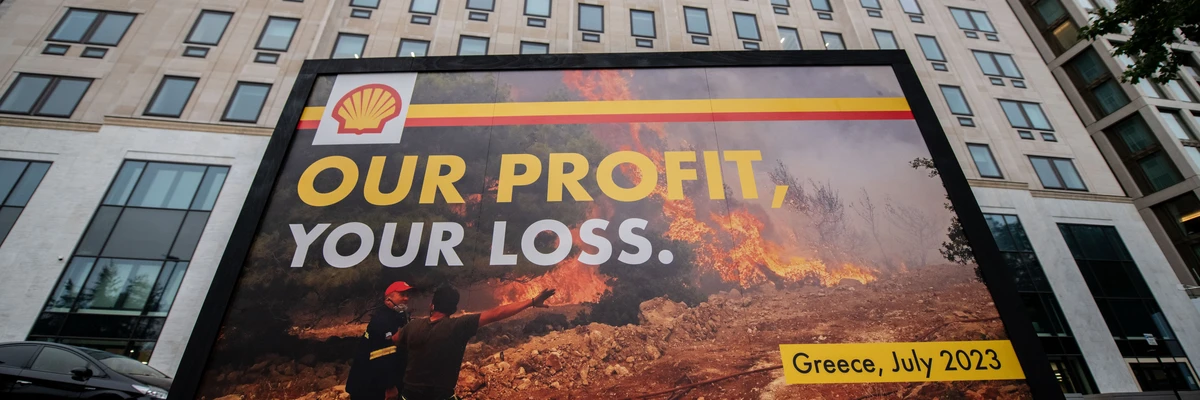
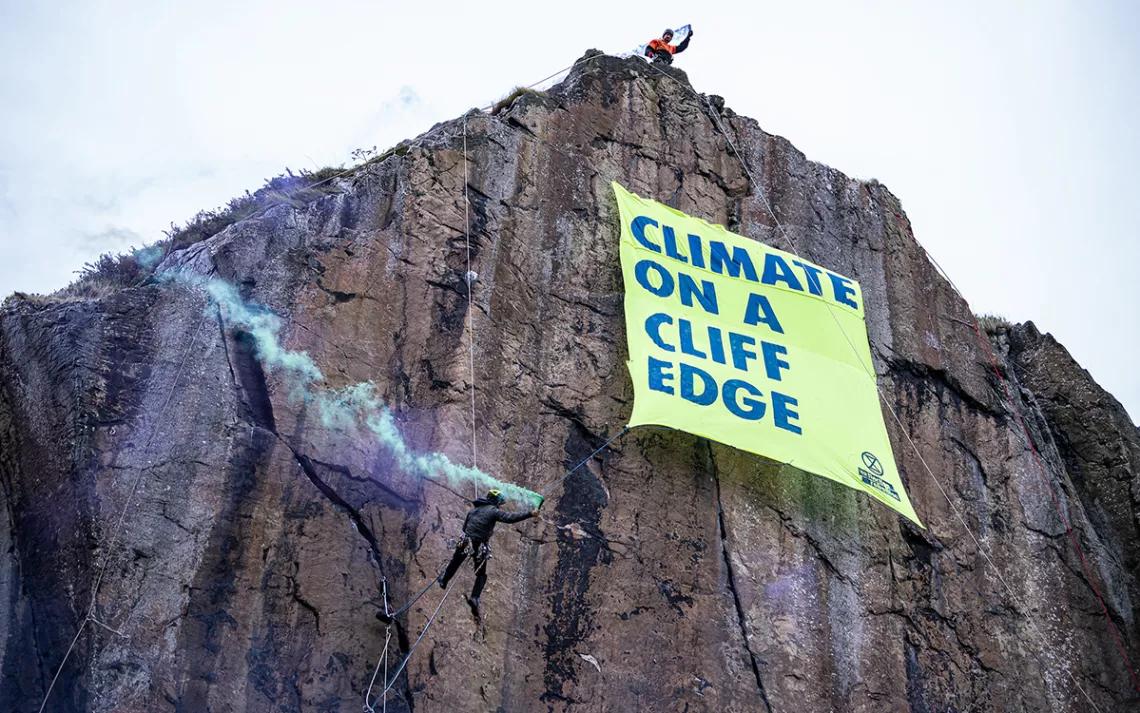
Donald Trump urges you to ignore facts and reality and be a Climate Science denier like him. He says that he makes millions and millions for destroying the planet, Burn, Baby, Burn and Flood, Baby, Flood.Greenpeace activists display a billboard during a protest outside Shell headquarters on July 27, 2023 in London. (Photo: Handout/Chris J. Ratcliffe for Greenpeace via Getty Images)Experienced climbers scale a rock face near the historic Dumbarton castle in Glasgow, releasing a banner that reads “Climate on a Cliff Edge.” One activist, dressed as a globe, symbolically looms near the edge, while another plays the bagpipes on the shores below. | Photo courtesy of Extinction Rebellion and Mark Richards
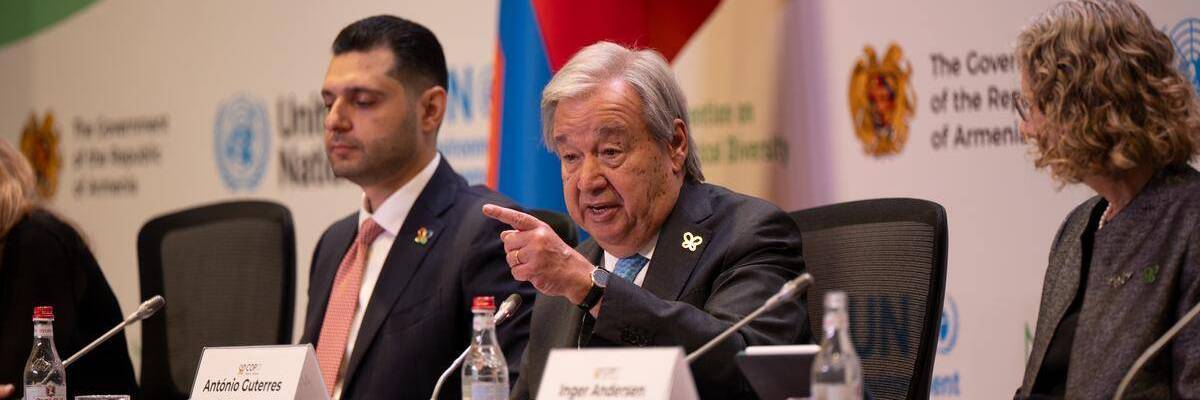
United Nations Secretary-General António Guterres briefs reporters on the launch the “State of Biodiversity Action” report on the sidelines of the 17th meeting of the Conference of Parties on the Convention on Biological Diversity in Yerevan, Armenia on October 16, 2026.(Photo by Hrant Sahakyan/UN)
“I urge governments everywhere to end these handouts once and for all, and to use the savings for people and planet instead,” said António Guterres.
“I urge governments everywhere to end these handouts once and for all, and to use the savings for people and planet instead,” said António Guterres.
“The food we eat, the water we drink, the very air we breathe—all are the gifts of biodiversity. Yet every day, humankind saws another branch off the tree of life,” outgoing United Nations Secretary-General António Guterres declared Friday, before a key global summit in Armenia.
“Climate chaos. Invasive species. Overgrazing and overfishing. Excessive fertilizers, pesticides, plastics, and heavy metals. All these and more are driving the triple planetary crisis of pollution, biodiversity loss, and climate chaos,” he warned. “Over 1 million species now face the risk of extinction, edging us ever closer towards an uninhabitable world.”
Guterres advocated for both government and financial leadership, calling out funding for “agribusiness that strips the land” as well as the leading driver of the worseningclimate emergency: fossil fuels. According to him, “Subsidizing fossil fuels is subsidizing suicide.”
“They are boiling our planet, and are the scourge of biodiversity,” said the secretary-general—who has often argued for not only phasing out fossil fuels but also making polluters pay for their damage. “I urge governments everywhere to end these handouts once and for all, and to use the savings for people and planet instead.”
Four years ago, at the 15th Conference of the Parties to the Convention on Biological Diversity, world leaders agreed to the Kunming-Montreal Global Biodiversity Framework—which critics called “weak” and “an open invitation to greenwash.” With COP17 kicking off in the Armenian capital on Monday, the UN chief said that “Yerevan is our moment of accountability.”
The “good news” is that the framework “has inspired action across the globe,” with nearly 90% of parties to the convention establishing national biodiversity targets, Guterres said. The “bad news” is that “progress is uneven, and far too slow. Even if current national commitments are met, only 26% of terrestrial, and 12% of marine ecosystems would be protected by 2030.”
“That is well short of the promise made in Montreal to protect 30% of land and sea by 2030. Major gaps also remain in targets linked to economic systems, including those focused on reducing harmful incentives,” he noted. “And many of the critical elements of progress—including finance, capacity, cooperation and data—are still largely missing in action.”
One of my greatest priorities as @UN Secretary-General has been fighting the triple planetary crisis of biodiversity loss, pollution & climate change, because I have children & grandchildren that are counting on world leaders to be leaders for nature.
The figures come from the United Nations Environment Program’s “State of Biodiversity Action” report, released in preparation for next week’s conference. That followed the September publication of the UNEP’s “Limiting Overshoot” report, which warns that the world will at least temporarily surpass the Paris Agreement’s temperature target for this century: 1.5°C beyond preindustrial levels.
In response to the overshoot report, Stephanie Roe, global climate and energy lead scientist at the international nonprofit WWF, said last month that “overshooting 1.5°C is not a cliff edge, but neither is it harmless. Every fraction of a degree of warming increases risks for people and nature, while every fraction avoided reduces harm.”
“What matters now is how far temperatures rise above 1.5°C and how long they stay there,” Roe continued. “The science shows that lower and shorter overshoot means fewer impacts on ecosystems, communities, and economies. Limiting peak warming and returning temperatures to safer levels as quickly as possible can help reduce risks, avoid irreversible losses, and improve resilience for the future.”
Roe’s organization has also released a series of relevant reports in the weeks before the summit, including a Wednesday analysis it commissioned from the Global Cooperation Institute that lays out “major barriers countries face in delivering the Global Biodiversity Framework and what could help unblock it,” and urges “decisive action in Yerevan.”
WWF International director general Kirsten Schuijt said that that “COP17 must move countries towards action and implementation. The benefits of collective action for nature are clear: stronger ecological resilience, more secure food and water systems, and reduced economic vulnerability. WWF’s latest ‘Living Planet Report’ shows that nature can recover when the right actions are taken.”
Released last month, that report found a 73% decline in the average size of monitored wildlife populations over a 52-year period—with an 85% decline in freshwater ecosystems, followed by 69% in terrestrial, and 59% in marine.
“Lasting progress,” said Schuijt, “depends on transforming the systems driving nature loss and shifting decision-making from short-term fixes to long-term solutions. For COP17, this requires governments, businesses, Indigenous peoples, local communities, women, youth, and wider society to all participate actively in decision-making that moves agreements into urgent implementation, to shape and deliver nature-positive solutions.”
As #COP17 approaches in Yerevan, Armenia, take a look at how protecting biodiversity helps secure a future where people and nature thrive together. pic.twitter.com/27ZDyQrtix
The political declaration released Friday by heads of state in Yerevan for a leaders’ summit preceding the conference already has some advocates, like WWF International president Adil Najam, issuing warnings. Najam explained from the Armenian capital that “leaders came together to discuss the promise made in Montreal in 2022 to halt and reverse biodiversity loss by 2030. The declaration acknowledges that progress is insufficient and that implementation must accelerate. It also recognizes that our economies, communities, and peace depend on nature. But recognition alone will not fulfill that promise.”
“The declaration lacks explicit commitments to align economic and financial decisions with nature goals, including reforming subsidies that harm nature,” he said. “Governments must make these choices if they are serious about delivering on their commitments. At COP17, they must turn the global review into clear implementation pathways backed by finance on the scale needed. The declaration signals a commitment to action across government; the real test is whether it changes decisions back home.”
Donald Fuhrump says that Amerikkka doesn’t bother with crimes or charges anymore, not being 100% Amerikkkan and opposing his real estate intentions is enough.Climate science denier Donald Trump confirms that he knows nothing about democracy and that more liquid gold is being secured according to his policy of global privateering.Orcas discuss Donald Trump and the killer apes’ concept of democracy. Front Orca warns that Trump is crashing his country’s economy and that everything he does he does for the fantastically wealthy.