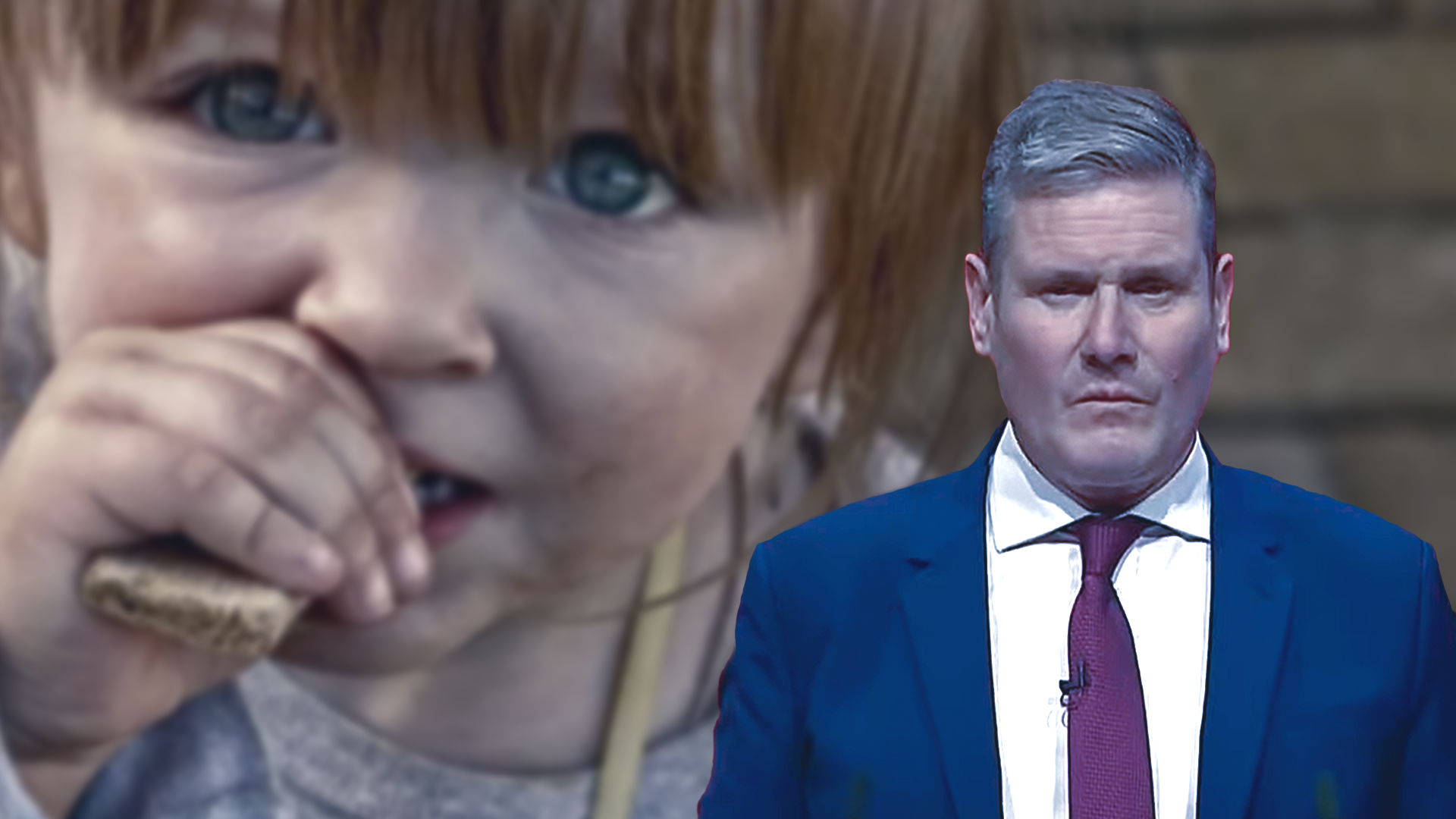
A poverty reduction of 35% on 2023 levels could avoid 293 infant deaths, 458 childhood admissions with nutritional anaemias and 32,650 childhood emergency admissions. Photograph: Andrew Matthews/PA
England research shows huge benefits with resulting savings for NHS and councils
Curbing child poverty by scrapping the two-child benefit cap would save hundreds of lives a year and avoid thousands of admissions to hospital, the largest study of its kind suggests.
Keir Starmer has faced repeated demands from within Labour ranks and opposition leaders to abolish the policy, which was announced in 2015 by George Osborne, then chancellor. Almost half of all children in some towns and cities now live below the breadline.
Now researchers from the universities of Glasgow, Liverpool and Newcastle have shown for the first time the extraordinary impact that reducing child poverty with measures such as ditching the two-child benefit cap could have in England.
Tackling it would substantially cut the number of infant deaths and children in care, as well as rates of childhood nutritional anaemia and emergency admissions, with the most deprived regions, especially in north-east England, likely to benefit the most, the projections indicate.
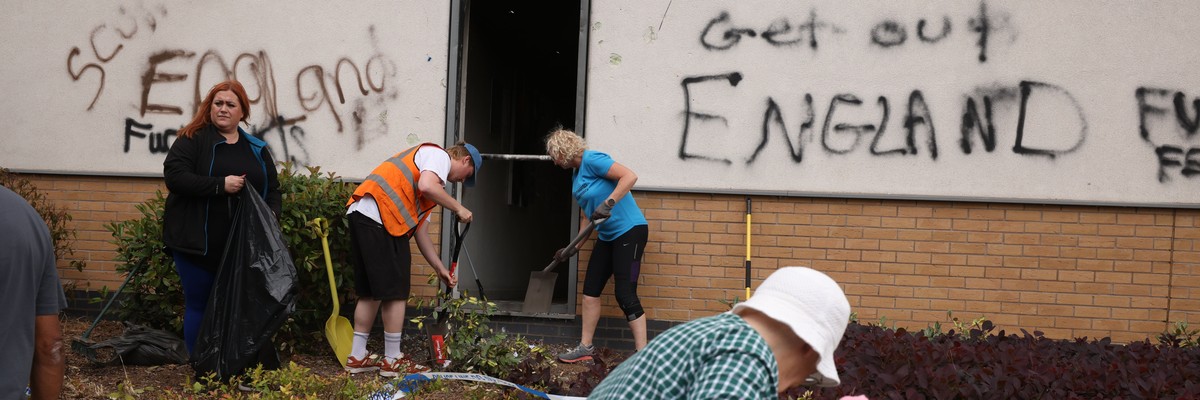
People clean up debris outside a Holiday Inn Express whose walls bear graffiti reading “Get Out England” and a racial epithet on August 5, 2024 in Tamworth, England.
“There are politicians and there are journalists who have played an active role in fanning the flames of hate and division, and we are seeing that play out,” said Zarah Sultana.
As British Prime Minister Keir Starmer covened an emergency security meeting on Monday to respond to violent attacks on immigrant and Muslim communities that have spread across the United Kingdom in recent days, progressive MP Zarah Sultana said the crisis—fueled by rampant disinformation and xenophobia—must serve as a reckoning for politicians and journalists who have “fanned the flames” of hatred for years.
Sultana, who represents Coventry South in the House of Commons, appeared on ITV’s “Good Morning Britain” to discuss the violent riots that have taken place in at least a dozen cities across the U.K. in recent days, mostly in England, with far-right protesters attacking mosques, libraries, and a hotel housing asylum-seekers.
The attacks have been in response to disinformation that has pinned the blame for a deadly stabbing attack on a children’s dance class in Southport, England last week on undocumented immigrants. The suspect was born and raised in the U.K., according to police.
“Rather than saying, this is the result of political decisions made by consecutive governments, people have blamed and scapegoated minorities.”
Sultana said that the violent attacks in cities including Blackpool, Leeds, and Manchester “shouldn’t be a surprise,” considering the years the British government—led for 14 years by the Conservative Party until the Labour Party won last month’s elections—has spent pushing anti-immigration policies and demonizing asylum-seekers, with the help of national news outlets.
“There is decades of work by the right-wing press and by politicians who have fanned the flames of this hate,” said Sultana in a panel discussion that also included journalists from The Daily Mail. “When we look at the role that media outlets like GB News has played, that The Daily Mail has played… There are politicians and there are journalists who have played an active role in fanning the flames of hate and division, and we are seeing that play out.”
The media and political class is complicit in the far right, racist and Islamophobic violence we’re seeing across our country.
Andrew Pierce of The Daily Mail took issue with Sultana’s remarks, demanding that she provide examples of anti-Muslim news stories in the paper.
The lawmaker did so after the broadcast, posting an image of 16 front pages from the outlet, including ones that asked “how many more” migrants the U.K. can take, referred to asylum-seekers as “illegals,” and claimed that migrants are taking the majority of jobs in the U.K. and sparking a “housing crisis.”
Here’s just a few examples of Daily Mail headlines that have fanned the flames of hate and normalised Islamophobic and anti-migrant rhetoric #GMBpic.twitter.com/kqzQqewnGk
Sultana added that former Home Secretary Suella Braverman referred to refugees arriving in the U.K. as an “invasion” and far-right Reform UK leader Nigel Farage said in May that British Muslims do not share “British values.”
“So when we look at the complicity,” said Sultana, “there’s a lot of mirrors that people have to be looking into.”
Sultana also implored politicians and the British media to explicitly refer to the riots over the weekend as Islamophobic, noting that Prime Minister Keir Starmer and others have denounced the attacks as racist but have not clearly expressed solidarity with the Muslim communities that have been targeted.
“Naming it as Islamophobia is really important because that allows us to shape our response,” said Sultana. “If we’re not identifying what is happening, the language that is being used and what this is about, we’re not going to be able to address this fundamentally.”
“Why is there such controversy around calling it Islamophobia?” asked Sultana after “Good Morning Britain” host Ed Balls dismissed her concerns, displaying what the lawmaker called “sneering contempt.”
The sneering contempt of ‘journalists’ will never stop me from calling out racism and Islamophobic hate. pic.twitter.com/cQoNKDzJ78
The interview took place a week after three children were killed and 10 were injured in a knife attack in Southport. The 17-year-old suspect, Axel Rudakubana, was born and raised in Britain, according to authorities, who took the unusual step of making his identity public to counter disinformation that quickly spread online and fueled riots that first began in Southport the day after the crime.
The first riot included anti-Muslim and anti-immigrant demonstrators throwing bricks at a mosque in the town, setting cars on fire, and damaging a convenience store.
The authorities’ decision to disclose the suspect’s identity did not stop the violence from escalating over the weekend, with rioters setting a library on fire in Liverpool, burning books, and attempting to block firefighters from putting out the flames on Saturday.
In Rotherham, an anti-immigration mob broke into a hotel housing asylum-seekers and attempted to set the building on fire while blocking exits.
Nearly 150 people were arrested for taking part in the attacks, and Starmer warned Sunday that “those who have participated in this violence will face the full force of the law.”
“This is not protest. It is organized, violent thuggery,” said Starmer.
BJ Harrington, the National Police Chiefs’ Council lead for public order, said in a statement Sunday that “disinformation is a huge driver of this appalling violence and we know a lot of those attending these so-called protests are doing so in direct response to what they’ve read online.”
“Often posts are being shared and amplified by high profile accounts. We’re working hard to counteract this,” added Harrington. “They won’t win.”
While calling on the government and media to directly confront the Islamophobia that has been fomented in the U.K. in recent decades, Sultana said the new Labour government should also correct the austerity policies that have caused unrest and scapegoating of immigrants and Muslim communities.
“The economic system which has allowed inequality to exacerbate in this country, has brought down living standards,” said Sultana. “Our communities have faced the brunt of Tory austerity, and what has happened on the right-wing side of politics, in the media and in politics, is that migrants, Muslims, and trans people have been blamed for people not being able to access council housing, not being able to get [National Health Service] appointments, not being able to find school places for their kids. Rather than saying, this is the result of political decisions made by consecutive governments, people have blamed and scapegoated minorities.”
Osborne– who was chancellor under David Cameron’s government and was instrumental in bringing about austerity – said that the cuts announced by Reeves on Monday were “almost identical in structure and form” to those he made in 2010, when he announced £6.2bn worth of cuts.
…
“I don’t think there was anything she announced that I would have violently disagreed with or not done myself.
“In fact, it was almost identical in structure and form to what I did in the first couple of months that I was Chancellor of the Exchequer.
“So, you know, ‘Continuity Osborne.”
Sharing a clip from the podcast on social media, SNP Westminster leader Stephen Flynn said: “No comment.”
AFTER months in which Labour argued that such is the dire state of the economy that Tory spending limits must be maintained, the Chancellor of the Exchequer now says that further cuts in public expenditure are needed.
…
The question raised by any talk about varying the structure of taxation is where taxes fall. The richest 10 per cent of families hold 43 per cent of all wealth. The bottom 50 per cent — and be sure that this includes the greater proportion of people who see themselves as working class — possess less than 10 per cent of wealth.
…
When the overwhelming majority of voters, including Tory voters, see public ownership of rail, mail, water and energy as desirable this is not simply a yearning for the more efficient delivery of these services and utilities than private ownership is able to provide. More, it is an expression of a clear understanding that revenues from these myriad transactions should not be privately appropriated but applied to the common good.
The present Labour administration has, with rare exceptions, ruled out the recovery into public ownership of privatised sectors and, less performatively than Gordon Brown in his day but no less systematically, has assured the corporate world that not only are the foundations of private ownership safe but that Labour, even more than its Tory predecessors, holds appeasing the bond markets a central part of its economic strategy. Hence the cuts announced today.
Reeves’s dilemma is highlighted by the necessity to find £1 billion to fund the juniors doctors’ pay increase; something similar for the teachers and a backlog of other public-sector pay claims.
Under this system spending is always about priorities. But there is money about. She is already committed by Starmer’s diktat to find £57.1bn in defence spending in 2024-25 which is a 4.5 per cent increase in real terms. No cuts there!
A bigger source of revenue would result from taxing wealth at the same level as income by raising the capital gains and dividend tax rates to the level at which workers pay on their wages.
An even bigger windfall would result from a socialist economy in which all rents, interest and profits arising from human economic activity were held in common rather than being privately acquired.
Zionist Keir Starmes is quoted “I support Zionism without qualification.” He’s asked whether that means that he supports Zionism under all circumstances, whatever Zionists do.
“Stability is Change!” This seemingly paradoxical, almost Orwellian statement is the principal slogan of the Labour Party’s current parliamentary election campaign. Labour leader Keir Starmer used the slogan at the party’s manifesto launch, and it provides a key prism for understanding the manifesto and its weaknesses.
There is little doubt that the UK electorate is in the mood for change. The widespread, off-stated consensus in the country is that nothing works. The National Health Service is so chronically underfunded that doctor’s appointments are difficult to get and long waiting lists proliferate. The trains are shockingly expensive but utterly unreliable.
The list could go on and on, but the image most frequently used to sum up the situation comes from the failure of the privatized water services. A lack of investment in infrastructure accompanied by the looting of those companies for huge shareholder dividend payouts has led to the near constant release of untreated sewage into the UK’s river system. It flows from there onto our beaches. The British are quite literally swimming in shit!
These problems are identified quite clearly in the Labour Party manifesto, but the diagnosis of their causes and therefore their solutions proves much less convincing. Labour may have a plan to win in July, but how it will govern in the interests of its voters is anybody’s guess.
…
The totality of Labour’s spending pledges amounts to just 0.2 percent of GDP, smaller even than the Conservative pledges of 0.8 percent and dwarfed by the previous two Labour manifestos, which promised 2.1 percent and 3.2 percent respectively. Even the pro-market Institute for Fiscal Studies called Labour’s plans “tiny, going on trivial”.
These policies do not point to stability, not least because they do not address the 18 billion pounds of government spending cuts that the Conservatives have already baked into the government budget going forward. The effects of implementing such cuts on government services — which have already suffered so badly under 14 years of severe austerity — makes it hard to imagine that Labour will stick to this commitment. It seems likely that money will be found to prevent the worst of these cuts through technical changes in accounting between the government and the notionally independent Bank of England.
Beyond this paddling, however, the need for investment in the UK is huge. Both public and private investment in the country has collapsed since 2008. It hasthe lowest business investment in the G7 and ranks just twenty-eighthout of the 31 OECD countries. In the face of this, Labour, hamstrung by self-imposed fiscal rules on bringing down government debt and pledges not to raise the main forms of taxation, are promising so little investment that their plans seem unbelievable.
…
Until last February, Labour was promising to immediately strengthen workers’ rights through a New Deal for Workers, and to spend 28 billion pounds per year to decarbonize the economy through its Green Prosperity Plan. The Labour Party’s current openness to corporate funding and lobbying, including the imposition of over30 parliamentary candidates with corporate lobbying backgrounds, has led to a dramatic watering down of these pledges. The Green Prosperity Plan has been reduced to just 3.5 billion pounds, but the form that spending will take reveals another logic or worldview which may come to the fore as crises mount.
The word “securonomics”, an ugly portmanteau favoured by shadow chancellor Rachel Reeves, makes an appearance in the manifesto, introducing the idea that public investment should support and de-risk private investment in strategically key sectors. The chief vehicle for this will be a National Wealth Fund “capitalised with £7.3 billion over the course of the next parliament”. What precisely this will look like has yet to be determined, but The National Wealth Fund “will have a target of attracting three pounds of private investment for every one pound of public investment”. This is an explicit return to and acceleration of the kind of public-private partnerships that lost legitimacy in the UK during the fallout from the disastrous Public Finance Initiative under New Labour.