
Category: austerity

  • How the UK’s social security system stopped tackling poverty

    Spread the love
    Ultraskrip/Shutterstock

    Sharon Wright, University of Glasgow

    The cost of living is the most important issue for many voters this election. It’s no surprise why. In 2022, nearly 4 million people in the UK experienced destitution, meaning they could not meet their basic physical needs such as having enough to eat and staying warm.

    The UK’s social security system is failing in its core purpose to prevent poverty. And yet the Conservatives have promised more crackdowns on welfare, with the prime minister linking this with his pledge to lower taxes.

    When the Conservative-Liberal Democrat coalition government came to power in 2010, they inherited a social security system in radically better shape than it is now. What happened?

    During the previous Labour governments (1997-2010), 2.4 million people were lifted out of poverty, including 700,000 children. This was done during favourable economic conditions, but was also the result of progressive social security measures such as tax credits and child benefits.


    Want more election coverage from The Conversation’s academic experts? Over the coming weeks, we’ll bring you informed analysis of developments in the campaign and we’ll fact check the claims being made. Sign up for our new, weekly election newsletter, delivered every Friday throughout the campaign and beyond.


    People received working-age benefit payments for different needs: jobseeker’s allowance, income support for single parents and incapacity benefit for long-term illness and disability. Housing benefit went directly to landlords to cover claimants’ rent.

    Enter the global financial crisis. The Conservative-led government’s response was austerity cuts: cutting back on welfare to tackle the budget deficit.

    Lowering the value of benefits is the biggest austerity cut to have affected incomes. In 2010, the government switched from uprating the value of benefits each year in line with the retail price index to using a different measure of inflation, the consumer price index, instead. This is usually lower and effectively makes payments worth less.

    This was expected to save the government around £6 billion pounds a year. In 2012, the value of benefits was capped to increase at 1% while inflation was forecast at 5.2%.

    Benefit sanctions and caps

    In 2012, the government introduced a new system of tougher rules and sanctions on people receiving benefits. Conservative politicians said this would end “the ‘something for nothing’ culture”, but the change has had lasting negative effects.

    Benefit sanctions were always part of the system, but became extreme in 2012. If, for example, someone misses one Jobcentre appointment their benefit could be reduced or removed for 28 days.

    Woman looking worried and tired sat by window with toddler
    Many people receiving benefits have been penalised with sanctions. Bricolage/Shutterstock

    Nearly a quarter of all jobseeker’s allowance claimants were sanctioned between 2010 and 2015. Research shows that sanctions have “profoundly negative outcomes”, including on people’s mental health.

    Other cuts to incomes followed the Welfare Reform Act 2012. The “bedroom tax” penalised social housing tenants who had “extra” bedrooms. The idea was to reduce renters’ housing benefit so they would downsize to a smaller home. However long-term housing shortages mean that smaller properties are rarely available.

    In 2013, the household benefit cap was introduced to limit the maximum amount a family could receive in benefits payments. It had the most impact on families with children and those with high rents.

    Universal credit

    Universal credit, introduced in 2013, was billed as the biggest shake-up of benefits in 70 years. It promised to make work pay and simplify the system. It replaced separate tax credit, unemployment, lone parent, disability and housing payments with a single payment.

    Research from think tank the Resolution Foundation suggests that universal credit provides more support for working people who rent their homes than the previous system. But disabled people who cannot work are likely to be much worse off than under the old system.

    There are other problems with universal credit. Unlike under the previous system that gave housing benefit straight to landlords, claimants have to pay their rent from a pot of money provided by the government that is almost certainly too small to cover all their costs.

    The first universal credit payment takes around five weeks to arrive, meaning people may fall into rent arrears. A result is that some landlords take legal action to evict those receiving universal credit.

    Further cuts

    In 2015, the Conservatives abandoned targets set by Labour to reduce child poverty. Then in 2016, new legislation slashed spending again. Benefits were frozen for four years.

    The two-child limit was applied to tax credits and universal credit in 2017 to remove income for third or subsequent children. Large families faced increased poverty as a result.

    In 2020, the pandemic hit. Universal credit and tax credits were raised by £20 per week, but this ended in late 2021. The cost of living crisis has since widened the gap between benefits and prices.

    Today, the value of universal credit falls £890 per month short of the cost of living for single people over 25. This is because of the changes to uprating and the benefit freeze.

    In Feburary 2024, charity the Trussell Trust published research showing that over half of people on universal credit had run out of money for food in the previous month.

    What can the next government do?

    The next UK government must make emergency repairs to social security to halt harrowing declines in health and life expectancy. This should ensure a minimum acceptable standard of living, including restoring the value of benefits such as universal credit to cover the costs of living.

    Since 71% of children living in poverty are in working families, employers should be required to pay the real living wage. In-work universal credit also needs to top up wages enough to make work pay.

    Repairing the social safety net is an enormous challenge, but public support for it has been on the rise for years. In 2010, many people thought benefit claimants didn’t deserve any help. But from 2015 there has been a growing preference to help people receiving benefits.

    Sharon Wright, Professor of Social Policy, University of Glasgow

    This article is republished from The Conversation under a Creative Commons license. Read the original article.
  • Labour and Tories would ‘both leave NHS worse off than under austerity’

    Spread the love

    https://www.theguardian.com/society/article/2024/jun/15/labour-and-tories-would-both-leave-nhs-worse-off-than-under-austerity-says-thinktank

    NHS emblem
    NHS emblem

    Analysis by leading experts the Nuffield Trust reveals that main parties’ manifestos would squeeze health spending

    Labour and the Conservatives would both leave the NHS with lower spending increases than during the years of Tory austerity, according to an independent analysis of their manifestos by a leading health thinktank.

    The assessment by the respected Nuffield Trust of the costed NHS policies of both parties, announced in their manifestos last week, says the level of funding increases would leave them struggling to pay existing staff costs, let alone the bill for massive planned increases in doctors, nurses and other staff in the long-term workforce plan agreed last year.

    The Nuffield Trust said that “the manifestos imply increases [in annual funding for the NHS] between 2024-25 and 2028-29 of 1.5% each year for the Liberal Democrats, 0.9% for the Conservatives and 1.1% for Labour.

    “Both Conservative and Labour proposals would represent a lower level of funding increase than the period of ‘austerity’ between 2010-11 and 2014-15.

    “This would be an unprecedented slowdown in NHS finances and it is inconceivable that it would accompany the dramatic recovery all are promising. This slowdown follows three years of particularly constrained finances.”

    The trust added that the planned funding increases “would make the next few years the tightest period of funding in NHS history”.

    Sally Gainsbury, senior policy ­analyst at the Nuffield Trust and a leading authority on NHS funding, said: “They will struggle to be able to pay the existing staff, let alone the additional staff set out in the workforce plan. It’s completely unrealistic.”

    …

    https://www.theguardian.com/society/article/2024/jun/15/labour-and-tories-would-both-leave-nhs-worse-off-than-under-austerity-says-thinktank

  • Andrew Feinstein: what’s wrong with the Labour manifesto

    Spread the love

    Andrew Feinstein is challenging Keir Starmer by standing as the independent candidate for Holborn & St Pancras.

    https://morningstaronline.co.uk/article/andrew-feinstein-whats-wrong-labour-manifesto

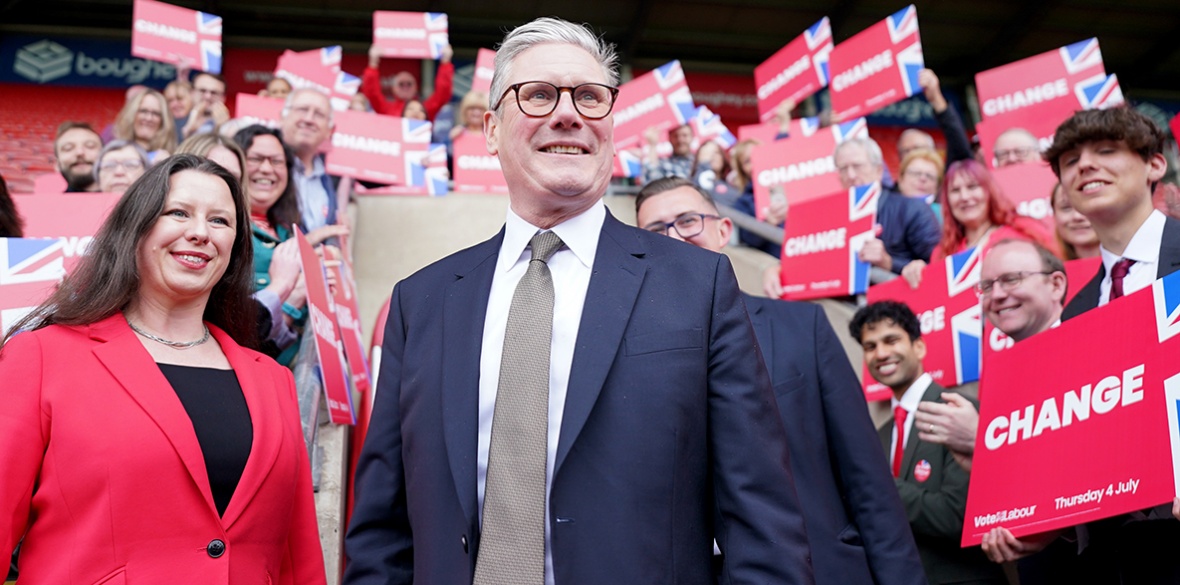
    Labour Party leader Sir Keir Starmer at the Mornflake Stadium, home to Crewe Alexandra while on the General Election campaign trail, June 13, 2024

    From muzzling Palestinian rights to embracing austerity and outsourcing the NHS, Labour’s ‘tough choices’ always seem to hurt normal people while sparing wealthy donors — that’s why I am running to unseat Keir Starmer on July 4

    …[T]he Labour Party launched its election manifesto — a dispiriting Thatcherite promise to continue endless austerity, soaring inequality and forever wars.

    I announced my bid to become the independent MP for Holborn and St Pancras three weeks ago. Then, I was convinced that Keir Starmer’s Labour Party would offer little to improve the lives of this constituency’s amazing and diverse communities, or meaningfully restrain Israel’s genocide of Gaza. Having read this manifesto, I am more convinced than ever.

    Starmer’s election campaign has traded on a series of stock phrases, all of which are profoundly misleading. Starmer promises to bring about “change,” but repeats tired economic shibboleths of the George Osborne variety.

    He also claims to have remade the party “in the service of the working people.” In fact, the party is financially reliant on donations from big business and billionaires and its MPs rake in donations from the private-sector companies who circle the NHS.

    The party’s long-feted New Deal for Working People is so disappointing that the party’s largest affiliated union, Unite, has refused to endorse the Labour Party manifesto.

    But the most galling of all of the current Starmerisms is his invocation of “tough choices.” Starmer deploys the line to explain why the country cannot afford to pull half a million children out of poverty by ending the two-child benefit cap: a decision now confirmed by the manifesto.

    Liz Truss’s mini-Budget, Starmer sadly explains, has made it impossible for the sixth-richest country in human history to lift children out of poverty at a cost little under £2 billion a year, a relatively measly sum in a country with a GDP of £2,274 trillion.

    As the Labour Party manifesto makes clear, there have been plenty of hard choices made by the party — but all of them to the detriment of the poor and to the benefit of the mega-rich and big business.

    Starmer makes the “tough choice” not to substantially increase funding the NHS, to end child poverty or reverse the swingeing cuts of the last decade; but only because he fails to make the “tough choice” to tax billionaires marginally more, even though the 10 richest people in the country are now richer than they have ever been.

    …

    I’m especially angry that the Labour Party, like the Tories, has promised to increase defence spending to 2.5 per cent of GDP: a real-term £7bn a year increase by 2029. This is almost double the entire £4.7bn a year the party intends to spend on its Green Prosperity Plan to tackle the imminent existential threat of climate change.

    What sort of security does this really buy? The party’s offer on Palestine is, frankly, an outrage; the manifesto speaking out of both sides of its mouth. So while it recognises that “Palestinian statehood is the inalienable right of the Palestinian people,” it then makes Palestinian statehood contingent on a meaningless word salad.

    “We are committed to recognising a Palestinian state as a contribution to a renewed peace process which results in a two-state solution with a safe and secure Israel alongside a viable and sovereign state.”

    So much for an inalienable right, which requires Israel to feel “safe” before Palestinians get statehood — just as Israeli leaders claim that Israel will only feel safe when Gaza is cleansed of its citizens because there are “no uninvolved.”

    This offer significantly dilutes the party’s previous commitment to recognising Palestinian statehood on the first day of government — something first brought in by Ed Miliband, appearing in the 2017 and 2019 manifestos. If there was any hope that Labour would be any better than the Tories on Gaza once in power, this should dispel it once and for all.

    Both the Lib Dems and the Green Party, by comparison, have committed to immediately recognising Palestine. The Labour Party now joins the ignominious company of the Tories and Reform in refusing to do so.

    …

    https://morningstaronline.co.uk/article/andrew-feinstein-whats-wrong-labour-manifesto

  • Nearly one million people only £10 a week away from poverty, study finds

    Spread the love
    Image of cash and pre-payment meter key
    Image of cash and pre-payment meter key

    https://www.bigissue.com/news/poverty-uk-joseph-rowntree-foundation-general-election/

    There have been six prime ministers since this country last made sustained progress on reducing poverty

    Nearly one million people in the UK are only £10 a week away from poverty, a study has found, in what has been called a “stain on the moral conscience of our nation”. 

    Analysis from poverty charity Joseph Rowntree Foundation (JRF) has revealed that alongside the estimated 14.2 million people in poverty in the UK, further millions are “teetering on the edge” and unable to afford essentials. 

    The JRF’s research found that just under a million people, including 200,000 children, are now within £10 a week from the poverty line. 

    An additional 3.2 million people in the UK – equivalent to the population of Wales – are only £40 a week from deep poverty. 

    The charity added that seven million households across the country had gone without essentials, like showers, toiletries or adequate clothing, in the last six months – or had gone hungry, or cut or skipped meals in the last 30 days. 

    For those already in poverty, large numbers are close to “deep” or “very deep” poverty lines, meaning they are living on incomes of less than 50% or 40% of the UK average.

    Around six million people were reported as living in very deep poverty in 2022/23, which is 1.5 million more than two decades ago.

    Politicians are missing a ‘level of urgency’ on poverty

    The JRF’s CEO Paul Kissack called on the government to act on rising poverty levels, as well as those “teetering on the edge” of poverty, telling whoever wins the general election on 4 July to “make reversing this dismal trend a priority”. 

    “There have been six prime ministers since this country last made sustained progress on reducing poverty,” he explained, referencing when poverty last fell consistently in the UK, between 1999/2000 and 2004/2005 under Tony Blair. 

    “During that time we’ve seen a sustained rise in the number of people in deep poverty, with hardship and destitution growing even faster.”

    He added: “Our political leaders must be specific and ambitious about how they will tackle poverty. But so far there hasn’t been anything like the level of urgency from either Rishi Sunak or Keir Starmer that we need to see. Pointing to future growth as a panacea just won’t cut it.  

    “Tonight’s (4 June) debate is a chance for both leaders to set out their plans and demonstrate they are serious about addressing hardship. Failure to act is a political and moral choice ≠ and one they should expect to be judged on.” 

    …

    https://www.bigissue.com/news/poverty-uk-joseph-rowntree-foundation-general-election/

  • ‘Higher prices here to stay’: Reactions to latest UK inflation figures

    Spread the love
    Image of cash and pre-payment meter key
    Image of cash and pre-payment meter key

    https://leftfootforward.org/2024/05/higher-prices-here-to-stay-reactions-to-latest-uk-inflation-figures/

    ‘’The cost of living crisis is not over – no matter how much ministers pretend it is’

    UK inflation fell from 3.2% to 2.3% in April, its lowest level in three years – having hit its highest rate for 40 years of 11.1% in October 2022. Nonetheless Tory MPs are taking the opportunity to bask in the news as Rishi Sunak said “today marks a major moment for the economy, with inflation back to normal”.

    However, for the millions affected by a continued cost-of-living crisis, it is not the time for Tory Ministers “to be popping champagne corks”, shadow Chancellor Rachel Reeves said, as many have been are quick to highlight the bigger picture on the state of the UK economy.

    Shadow Chief Secretary to the Treasury Darren Jones MP pointed out that inflation is still higher than the Bank of England’s 2% target, as he slammed the Tories for “years of chaos” that “people have already paid the price” for, telling Conservatives to “get off the victory lap”. 

    Trade union leaders have accused the Tories of presiding over the worst living standards for generations, as Paul Nowak, General Secretary of the Trades Union Congress (TUC) said the cost of living crisis “is not over – no matter how much ministers pretend it is.”

    Soaring mortgage repayments and increased food and energy bills are still affecting many people, Nowak has stressed, in light of the recent inflation figures. 

    …

    Article continues at https://leftfootforward.org/2024/05/higher-prices-here-to-stay-reactions-to-latest-uk-inflation-figures/