Category: benefits

  • Scientists, Experts Demand ‘Immediate End’ to EU Fossil Fuel Subsidies

    Spread the love

    Original article by Julia Conley republished from Common Dreams under Creative Commons (CC BY-NC-ND 3.0). 
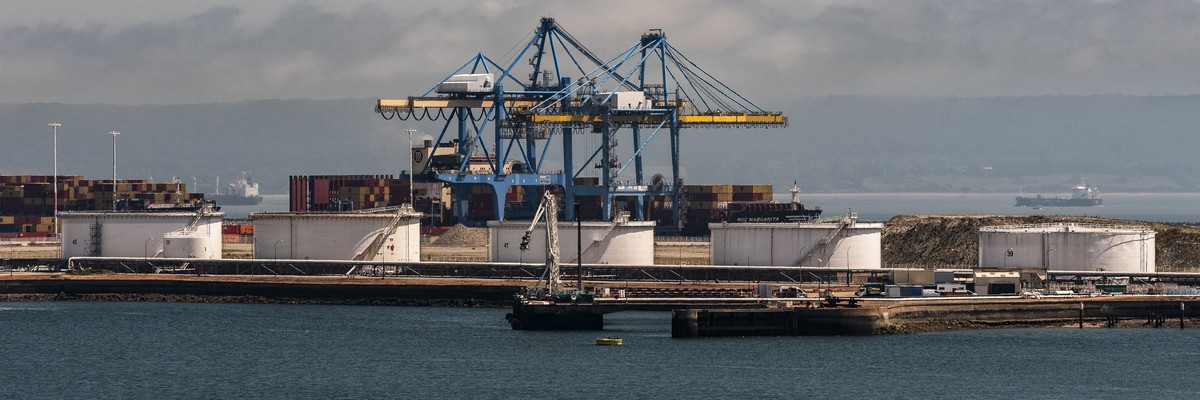
    Oil storage tanks and a container terminal are seen in the Port of Le Harve, northern France on June 12, 2023. (Photo: Peter Titmuss/UCG/Universal Images Group via Getty Images)

    “E.U. leaders must make a choice: Stand with the people and the planet, or continue propping up an economy that’s driving us towards climate catastrophe,” said one advocate.

    Warning that policymakers in the European Union are undermining the bloc’s own climate goals by continuing to subsidize fossil fuel extraction, climate scientists and other experts from across Europe were among the signatories of an open letter released Wednesday, demanding that officials redirect hundreds of billions of dollars in subsidies to “turbocharge climate solutions.”

    The coalition United for Climate Justice spearheaded the letter, which comes ahead of a planned march in Brussels on Saturday, October 5.

    “These subsidies go against Europe’s plans for a sustainable and just transition and fuel the devastating heatwaves we have seen this past summer in our continent,” reads the letter. “Europe is now the fastest warming continent; we have reached a turning point and cannot afford to delay any further.”

    Groups including Extinction Rebellion350.org, and Greenpeace E.U. pointed to goals the bloc has set in recent years, including the 8th Environmental Action Program, which entered into force in 2022 and included a commitment to “phasing out fossil fuel subsidies.”

    The subsidies, which were estimated at more than €400 billion ($441 billion) in 2023, also stand in the way of meeting climate targets put forward in the European Green Deal, said the signatories. The plan aims to make Europe “the first climate-neutral continent,” with no net emissions of greenhouse gases by 2050 and “interim targets of reducing greenhouse gas emissions by 55% by 2030 and by 90% by 2040,” notes the letter.

    “This will not happen without an immediate phaseout of fossil fuel subsidies,” said the groups bluntly, “as a step towards a fossil-free Europe.”

    By continuing to subsidize fossil fuel projects, they added, the E.U. is also flouting its own Parliament’s declaration of a climate emergency in 2019.

    To act in line with the declaration and its climate commitments, said the groups, the E.U. must:

    • Set a timeline for the phaseout of fossil fuel subsidies by 2025, providing technical and financial assistance to member states
      facing challenges in meeting phaseout deadlines and offer incentives for achieving milestones ahead of schedule;
    • Adopt comprehensive methodological guidance for member states that accurately and transparently accounts for both explicit and implicit subsidies associated with fossil fuels; and
    • Develop a binding framework to monitor and report on member states’ progress towards phasing out fossil fuel subsidies, with noncomplying members facing consequences such as financial penalties and reduced access to E.U. funding.

    The bloc’s fossil fuel subsidies “distort energy demand, perpetuate dependence on polluting energy sources, and undermine European energy security, while subsidizing industries that contribute significantly to greenhouse gas emissions,” said the groups.

    Phasing out the subsidies would “future-proof the European economy, reducing climate-related financial risks,” they added.

    The letter comes weeks after Storm Boris dumped record-breaking rains on European countries including Romania, Austria, and Poland, leading to deadly flooding.

    “The E.U. cannot claim leadership on climate action while continuing to support polluting industries with billions,” said Angela Huston Gold, spokesperson for United for Climate Justice. “E.U. leaders must make a choice: Stand with the people and the planet, or continue propping up an economy that’s driving us towards climate catastrophe. The recent disastrous floods in Central and Eastern Europe are yet another wake-up call. We must end our fossil fuel dependency and therefore eliminate all fossil fuel subsidies.”

    Also last month, the Portuguese government declared a “state of calamity” over wildfires that killed at least seven people. Last year, the World Meteorological Organization (WMO) and the E.U.’s Copernicus Climate Change Service (C3S) determined the Europe is the fastest-warming continent.

    “Year after year, commitments have been made and left unfulfilled, and we can no longer accept inaction,” said the signatories of Wednesday’s letter, who also included Luca Mercalli, president of the Italian Meteorological Society, and Paul Stubbs of the Institute of Economics in Croatia. “Until these necessary changes occur, people will continue to take to the streets to make our voices heard and hold you accountable.”

    Original article by Julia Conley republished from Common Dreams under Creative Commons (CC BY-NC-ND 3.0). 

  • Rachel Reeves on the hard times ahead

    Spread the love
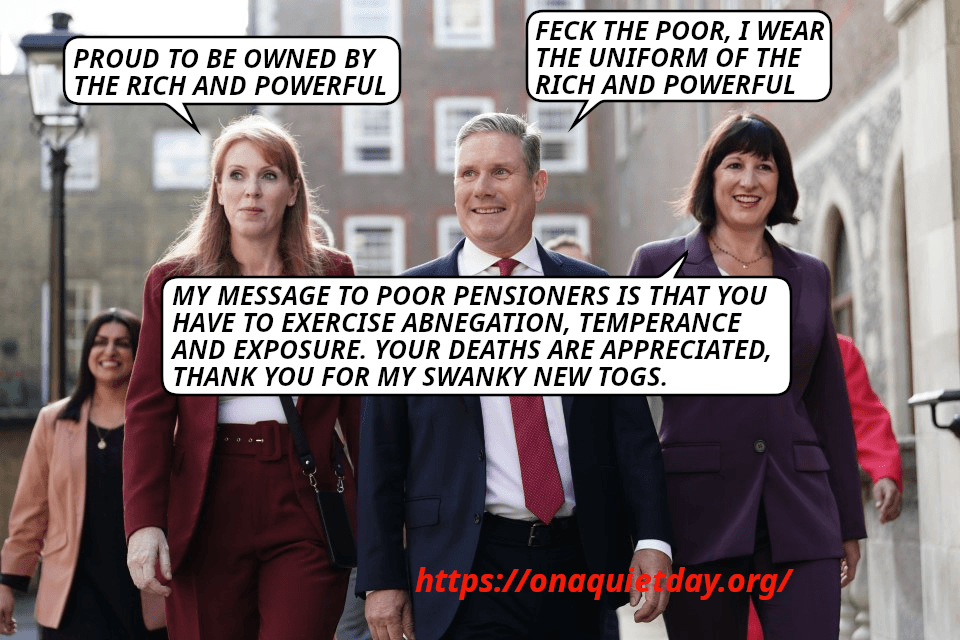
    Rachel Reeves says that there are difficult choices ahead, that the poor have to make sacrifices and thanks for her new clothes.
    Rachel Reeves says that there are difficult choices ahead, that the poor have to make sacrifices and thanks for her new clothes.
  • Spread the love
    Keir Starmer, Angela Rayner and Rachel Reeves wear the uniform of the rich and powerful. They have all had clothes bought for them by multi-millionaire Labour donor Lord Alli. CORRECTION: It appears that Rachel Reeves clothing was provided by Juliet Rosenfeld.
    Keir Starmer, Angela Rayner and Rachel Reeves wear the uniform of the rich and powerful. They have all had clothes bought for them by multi-millionaire Labour donor Lord Alli. CORRECTION: It appears that Rachel Reeves clothing was provided by Juliet Rosenfeld.
    Keir Starmer says pensioners can freeze to death and poor children can starve and be condemned to failure and misery all their lives.
    Keir Starmer says pensioners can freeze to death and poor children can starve and be condemned to failure and misery all their lives.
  • Getting shorter and going hungrier: how children in the UK live today

    Spread the love
    Keir Starmer says pensioners can freeze to death and poor children can starve and be condemned to failure and misery all their lives.
    Keir Starmer says pensioners can freeze to death and poor children can starve and be condemned to failure and misery all their lives. The child poverty and neglect discussed in this article occurred previously to Keir Starmer and the Labour Party being in office. They polices are however certainly continuing and reproducing child poverty and destitution.

    Danny Dorling, University of Oxford

    Children’s lives in the UK are changing.

    They are becoming shorter in height. More of them are going hungry than they were a few years ago. Recently, more have died each year than they did a few years ago. Increased poverty, more destitution and the effects of ongoing austerity are the clear culprits.

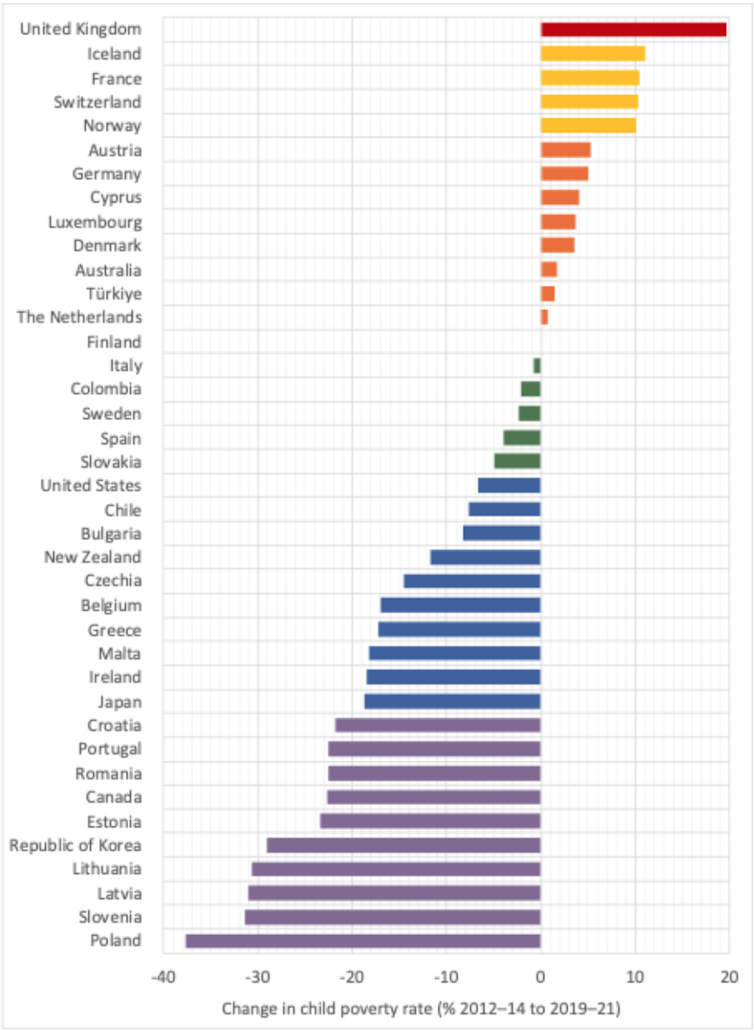
    But why did this happen to our children? This rise in child poverty is a change that has not been found to have occurred to the same extent anywhere else in the world, among all the places that the United Nations measures in the same way.

    Change in child poverty, 2012–14 to 2019–21

    Bar chart
    UNICEF Innocenti—Global Office of Research and Foresight (2023) ‘Innocenti Report Card 18: Child poverty in the midst of wealth’, CC BY-NC-ND


    This graph tells a story of hope and success. In much of Eastern Europe, child poverty has fallen by between as much as a third – and often at least a quarter – in a mere seven years.

    But it also shows that child poverty has risen the most in the UK. The poorest fifth of households in the UK are poorer than the poorest fifth in most of Eastern Europe. For many people in the UK, this will come as a surprise. Some will refuse to believe it can be this bad.

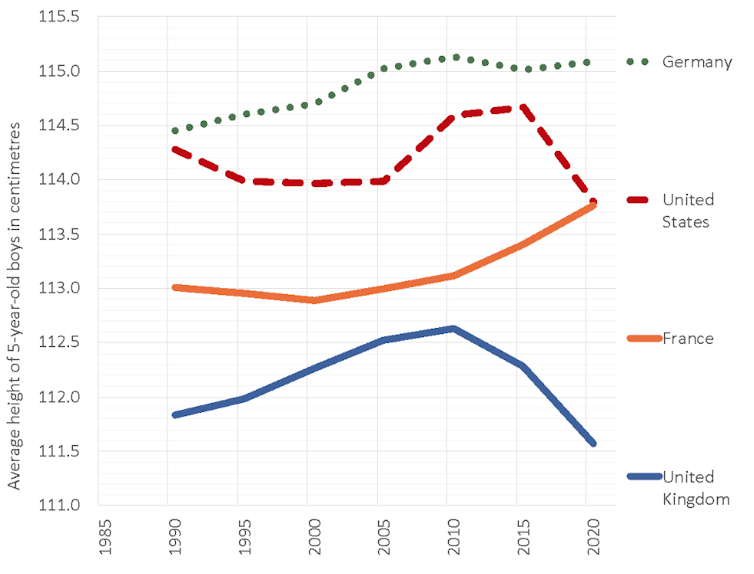
    The evidence for this poverty is seen in the declining heights of five-year-olds since 2010.

    Average height of five-year-old boys, 1985–2020

    Line graph
    Average height of 5-year-old boys, 1985–2020. Redrawn by the author from data in Press Association (2023) ‘British children shorter than other five-year-olds in Europe’, ITV News, 21 June., CC BY-NC-ND


    A 5-year-old in 1990 would have been born in 1985 and their height influenced mostly by nutrition in the years 1985–1990. Those were hard years for the UK: mass poverty resulting from over three million people being out of work in the early 1980s. But the average height of children was still increasing.

    It was not until 2010, for those children who had lived between 2005 and 2010, that we first saw heights plateau and then fall, coinciding with the post-2010 austerity years.

    My forthcoming book attempts to make sense of what has happened to the UK: why, in 2024, it is not merely one of the countries in Europe with a high rate of child poverty, but the one country above all others that the UN has singled out as having had the greatest rises in child poverty among all those it surveyed.

    Seven children

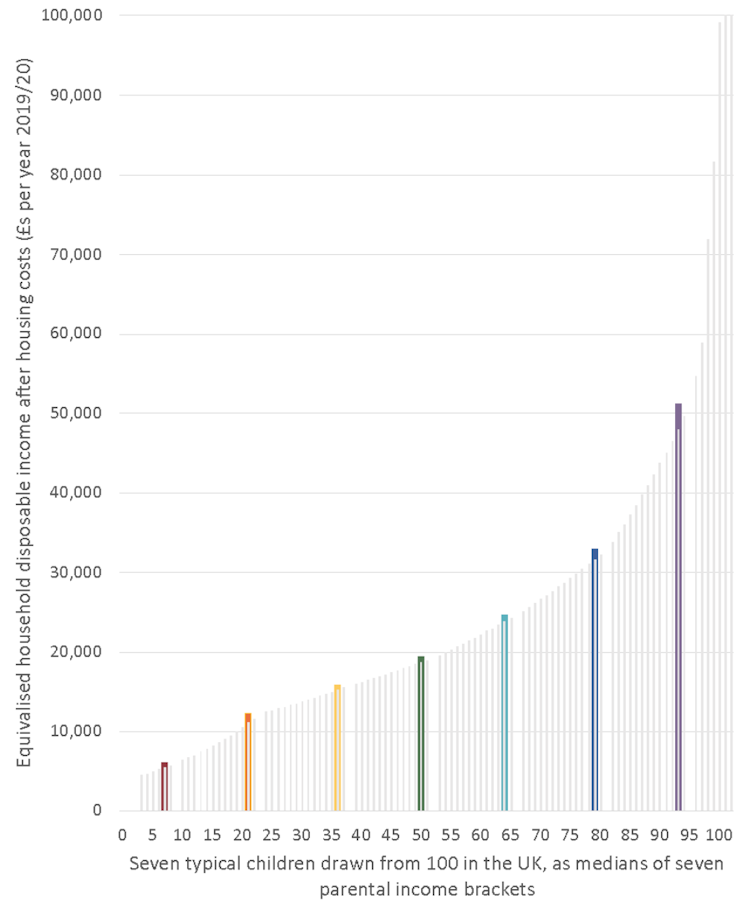
    To try to understand more about children’s lives in the UK, I constructed seven typical children. I divided all 14 million children living in the UK into seven groups of 2 million, according to the income of their families in 2018 and 2019. I then chose the middle child of each 2 million. I next looked at what had happened to those families between 2018 and 2024.

    The graph below shows the annual income of each of the seven households the children were drawn from.

    Annual household incomes after tax, benefits and housing costs in the UK, families with children 2019/20

    Annual household incomes after tax, benefits and housing costs in the UK, families with children 2019/20: seven typical children marked in colour. Danny Dorling, CC BY-NC-ND


    The first thing to note is just how incredibly well-off the children are who are better-off than our seven typical children.

    Some 6% of all children in the UK live in households richer than the best-off typical child in my analysis. Those 6% of children, the best-off children of all, live in families that each year receive and spend a third of all the income in the UK.


    Want more politics coverage from academic experts? Every week, we bring you informed analysis of developments in government and fact check the claims being made.

    Sign up for our weekly politics newsletter, delivered every Friday.


    These 6% are not typical, and neither are the 6% poorest: those most destitute, those whose families are most likely to use food banks. If you pick seven typical children, equally spaced out across the income scale, then these extremes are not part of what you see.

    But four of our typical seven children now live lives that most better-off people would consider to be in poverty. The other three are hardly well-off.

    The least well-off are in families struggling to pay bills and making sacrifices others do not have to think about. For instance, whether to save £10 a month, or have insurance against the effects of flood, fire or theft. Increasingly often they cannot afford both.

    But even the most well-off of our seven children lives in a family that worries about paying for an annual holiday. That is rare among the most affluent two million families, but possible.

    The UK in 2024 demonstrates to the world what living with high inequality means in a once affluent country. It means a few using up far more resources than the vast majority of other children, such as having access to many more school teachers – per child – as compared to the rest, better food, better shelter, more warmth, more toys, better material everything; often more than you might think any child needed.

    In future, almost all our children will tell their stories of growing up in the UK of the 2020s and – hopefully – what changed to make things better. It is hard to imagine them becoming much worse.

    Danny Dorling, Halford Mackinder Professor of Geography, University of Oxford

    This article is republished from The Conversation under a Creative Commons license. Read the original article.

  • Charities demand to meet UK ministers as 1.6m disabled OAPs set to lose winter fuel payments

    Spread the love

    https://www.theguardian.com/society/2024/sep/15/charities-demand-to-meet-uk-ministers-as-16m-disabled-oaps-set-to-lose-winter-fuel-payments

    A pensioner struggles to keep warm at home. Photograph: Studio Romantic/Shutterstock

    Call comes after government forced to reveal that 71% of pensioners with disabilities will lose entitlement despite dependence on warmer homes

    Groups representing disabled people are demanding urgent meetings with ministers after it was revealed that 1.6 million pensioners with disabilities will lose their winter fuel payments because of government cuts.

    The figures were released by the Department for Work and Pensions on Friday evening, in answer to a freedom of information request, despite the government having said it had done no official impact assessment on the policy. The internal DWP analysis also suggested that nine in 10 pensioners aged between 66 and 79, and eight out of 10 over-80s would lose their allowance.

    Since those over 80 receive a higher payment – £300 as opposed to £200 – they would take the greatest financial hit, the document said.

    The analysis revealed that although people with disabilities were more likely to retain the payment, 71% – 1.6 million – would still lose their entitlement, despite their greater dependence on heating their homes.

    The analysis also estimated that of the 880,000 pensioners entitled to pension credit but who do not claim the benefit, only 100,000 are expected to sign up to it as a result of a government campaign now under way, meaning about 780,000 pensioners on low incomes would continue to miss out.

    https://www.theguardian.com/society/2024/sep/15/charities-demand-to-meet-uk-ministers-as-16m-disabled-oaps-set-to-lose-winter-fuel-payments

    Keir Starmer says pensioners can freeze to death and poor children can starve and be condemned to failure and misery all their lives.
    Keir Starmer says pensioners can freeze to death and poor children can starve and be condemned to failure and misery all their lives.