Many Labour MPs still believe these are the wrong reforms and will vote against the bill next week. Photograph: Alishia Abodunde/Getty Images
Sir Keir Starmer’s plans risk creating lasting inequality – and alienating the very voters who once believed his party stood for their protection
…
The upshot is that existing claimants would be protected, but future ones face tougher rules. Two people with identical conditions could receive support, according to the Institute for Fiscal Studies, that differs by up to £6,560 a year – purely due to timing. This, we’re told, is compassion. The savings – halved to £2.5bn a year – come by offloading the cost on to future claimants. MPs rightly fear this locks in a two-tier system that is deliberately harsher on disabled people.
Older Labour MPs will remember denouncing this very playbook. A decade ago, Iain Duncan Smith pioneered a slow, procedural tightening of welfare – hitting new claimants first, then reassessing the rest – precisely to defuse resistance. Labour opposed it then. Today, it is governing by the same method. It feels out of step with a post-pandemic Britain grappling with a cost of living crisis.
Many Labour MPs believe these are still the wrong reforms and will vote against the bill when it comes back to the House of Commons next week. Clearly, tightened eligibility and a two-tier system may exclude many who need support. If the government wants to raise money, it might ask a little more of those with the broadest shoulders – not those with mobility aids, care plans and the audacity to ask for a fair deal. If ministers truly believe they are acting decently, they should publish the impact assessment and be honest about the consequences.
Keir Starmer in The Hague on Wednesday, where he called the rebellion over the welfare bill ‘noises off’. Photograph: Kin Cheung/Reuters
MPs describe receiving veiled deselection threats as No 10 sought to quash revolt before finally backing down
…
MPs say they received a litany of threats, including the possibility of a general election. Those on the right of the party were warned their actions could bring about a leadership challenge that would be won by Angela Rayner. The same threat was made to those on the left, but with Wes Streeting as the looming spectre.
Others say they have received veiled threats of deselection, or that their funding for the next general election would be decided on the basis of whether or not they toed the line. One party official allegedly rang a rebellious MP’s husband in order to get her to back down.
“I don’t even think some of this is sanctioned by No 10,” one MP said. “Until Wednesday they had their fingers in their ears. But those who are responsible for party management have been absolutely losing it.”
…
Yet the number of rebels continued to grow, and No 10 finally bowed to the inevitable. On Thursday morning, the prime minister used a Commons statement ostensibly about international affairs to promise a welfare rethink.
Until that point, Starmer had seemed oddly detached from the issue, surfacing intermittently at summits to bat away questions about the revolt – or “noises off” as he termed it – as a distraction from the vital task of transforming welfare.
Some MPs view this as indicative of a prime minister more than usually disconnected from the everyday grid of parliamentary business, as illustrated by the statistic that since winning the election he has voted in the Commons just seven times.
A few have begun to openly speculate about what the situation means for Starmer’s leadership. “It is very bad for Keir. It is one in four of his MPs [that intended to rebel]. He is toast,” one MP said.
Prime Minister Keir Starmer speaks during a reception for London Tech Week, at no 10 Downing Street, London, June 10, 2025
MPs will vote next week on welfare cuts aimed at disabled people, Prime Minister Sir Keir Starmer and Deputy Leader Angela Rayner pledged today.
Playing a game of chicken with the growing number of Labour rebels prepared to defy the government on the issue, Sir Keir pledged to press ahead with his savage cuts.
One Labour MP described it as a “charge of the political light brigade” by Blairite budgetary hardliners.
But Sir Keir told LBC radio that “there’ll be a vote on Tuesday, we’re going to make sure we reform the welfare system,” while Ms Rayner told MPs simply: “We will go ahead on Tuesday.”
This does not mean that the debate will definitely proceed as planned, only that Downing Street has not yet made a final determination.
The number of Labour MPs prepared to back an amendment which would end all progress on the Bill has risen to over 120.
This would mean that Sir Keir could only prevail with Tory support.
Conservative leader Kemi Badenoch is flirting with backing the government, but is demanding a pledge of no tax increases in the autumn Budget in return, something no government could offer while retaining any self-respect.
Sir Keir now faces several choices, all damaging to his political future.
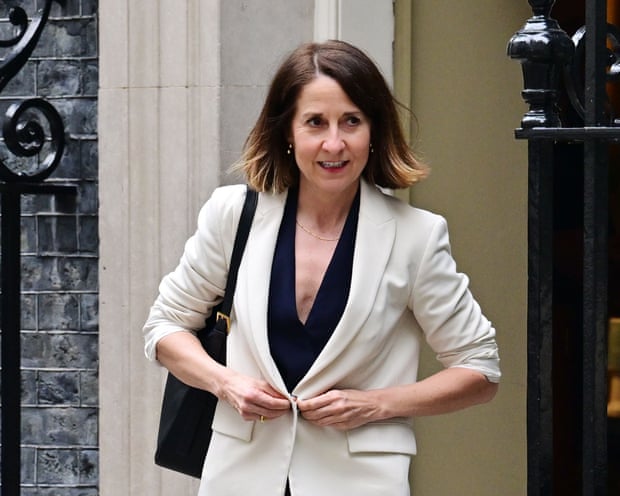
Liz Kendall urged her colleagues to support the bill; however, dozens of backbenchers have already signed the amendment seeking to kill it off. Photograph: James Veysey/Shutterstock
Amendment intended to kill off legislation that would cut benefits could be backed by up to 100 Labour MPs including senior figures
…
Dozens of backbench MPs have signed the amendment. Government whips have already been steeling themselves for a rebellion on the welfare bill when it is first voted on next week.
A senior MP said: “The government hasn’t listened to private concerns so now will have to address these very public ones.”
The aim would be to pass a so-called “reasoned amendment”, which halts the passage of a bill. It means the bill would not pass its second reading, saying that provisions “have not been subject to a formal consultation with disabled people, or co-produced with them, or their carers”.
It also says the bill should not pass until the Office for Budget Responsibility can publish its analysis of the employment impact of the changes this autumn. The amendment adds that most of the additional employment support funding will not be in place until the end of the decade.
It notes the government’s own impact assessment estimates that 250,000 people will be pushed into poverty as a result of the provisions, including 50,000 children. It calls for an assessment of the impact of the changes on health or care needs and for the conclusion of other reviews.
Chancellor of the Exchequer Rachel Reeves meeting members of the military during a visit to Rheinmetall BAE Systems Land (RBSL) in Telford, Shropshire, for an announcement on defence funding, March 24, 2025
While promising massive housebuilding with ‘no fiscal cost,’ DIANE ABBOTT MP reveals the government relies on planning reforms alone rather than public investment, as military expansion becomes the only significant investment
IN POLITICS, one should never over-promise and then under-deliver. At the same time, overall policy should be grounded in something more than wishful thinking. It is highly regrettable that the Chancellor made both these errors in delivering her Spring Statement.
Before the statement, all the talk was of enormous sums that would become available for desperately needed investment. At the same time, there was a strong campaign to refute any idea that the government was pursuing yet another round in the failed austerity experiment of its predecessors.
In the event, both were untrue. The actual new investment is extremely small and is mostly directed towards military and security investment, which is a completely wasteful and dangerous diversion of resources. A somewhat larger sum is planned to be “saved” by yet further attacks on welfare.
In effect, more spending on the military is being paid for by more attacks on the vulnerable, the sick and disabled people.
The Treasury has itemised the sums which illustrate these dangerously wrong priorities. By 2029-30, they project that the annual total of capital investment will have increased by £4.6 billion. But most of this does not properly fall into the category of investment at all, because it is military spending. You cannot produce something else from bombs, bullets and missiles.
Once military and security funding are excluded, real new productive investment amounts to less than £1.9bn at the end of this parliament. It does not qualify as investment. In terms of impact on the economy or living standards, it is a trivial amount.
…
Military spending is the only significant area of government spending which is seeing any significant rise in government capital spending. It aligns with Trump’s policy and begins to meet his demands. But we know that he will come back for more. There is already talk of doubling military spending as a proportion of GDP to 5 per cent.
Now, and in the future, that can only come from cutting spending elsewhere. Of course, if the economy were booming, then increases in welfare, in spending on public services, in genuine public investment and even increases in military spending could all take place simultaneously. But no-one is suggesting a boom is likely or even possible.
In reality, the rise in military spending is only possible by restraining spending on public services and cutting welfare. This increased military budget is being paid for by sick and disabled people. The economy will not get the public investment it needs and living standards and public services will both remain constrained. These choices are morally, politically and economically wrong.
Diane Abbott is Labour MP for Hackney North and Stoke Newington.
Keir Starmer says that the Labour Party under his leadership all feel a small part of Scunthorpe.Keir Starmer confirms that he’s proud to be a red Tory continuing austerity and targeting poor and disabled scum.

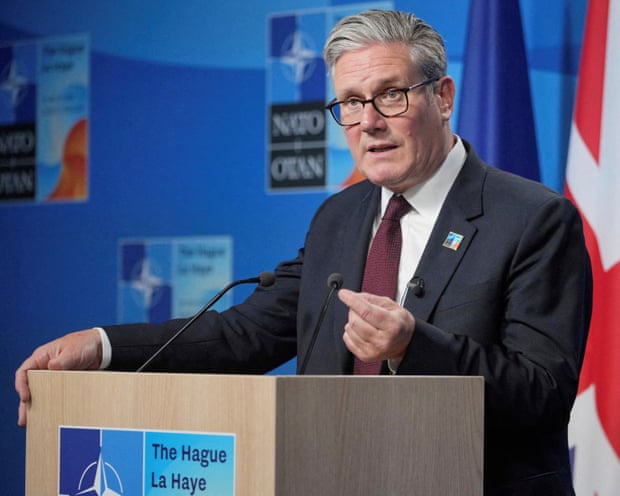


 Prime Minister Keir Starmer speaks during a reception for London Tech Week, at no 10 Downing Street, London, June 10, 2025