Category: Climate Crisis

  • Climate, migration and conflict mix to create ‘deadly’ intense tropical storms like Chido

    Spread the love
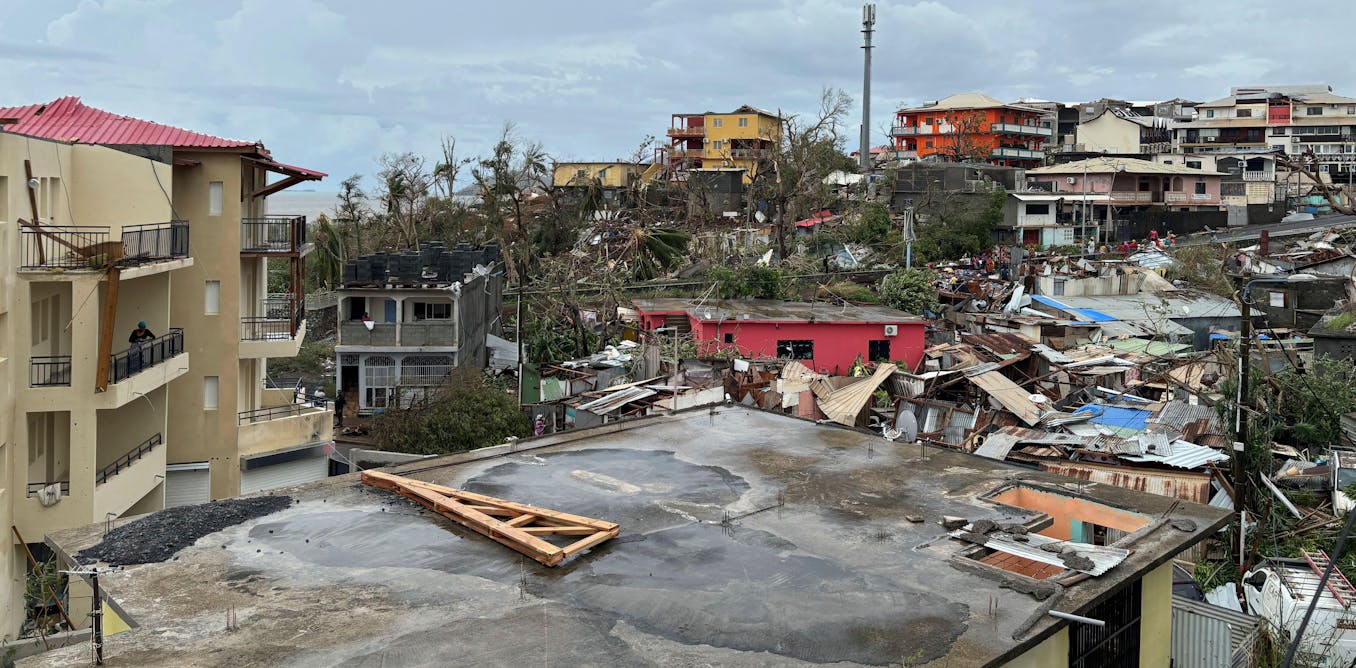
    Damaged houses in Mamoudzou, in the French Indian Ocean territory of Mayotte on December 16 2024 after being battered by the islands’ worst cyclone in nearly a century. Associated Press / Alamy Stock Photo

    Liz Stephens, University of Reading; Dan Green, University of Bristol, and Luis Artur, Universidade Eduardo Mondlane

    Cyclone Chido was an “intense tropical cyclone”, equivalent to a category 4 hurricane in the Atlantic. It made landfall in Mayotte, a small island lying to the north-west of Madagascar on December 14, generating wind gusts approaching 155mph (250km/hr). Later on, it hit Mozambique, East Africa with the same ferocity.

    This storm skirted north of Madagascar and affected the Comoros archipelago before making landfall in Mozambique. It is well within the range of what is expected for this part of the Indian Ocean. But this region has experienced an increase in the most intense tropical cyclones in recent years. This, alongside its occurrence so early in the season, can be linked to increases in ocean temperatures as a result of climate change.

    News of the effects of tropical cyclone Chido in Mayotte, Mozambique and Malawi continues to emerge. Current estimates suggest 70% of Mayotte’s population have been affected, with over 50,000 homes in Mozambique partially or completely destroyed.

    Ongoing conflict in Mozambique and undocumented migration to Mayotte will have played a key role in the number of deaths and the infrastructure damage.

    Assessing how these cyclones characteristics are changing across southern Africa is part of the research we are involved in. Our team also studies how to build resilience to cyclones where conflict, displacement and migration magnify their effects.

    A human-made disaster?

    The risk that tropical cyclones pose to human life is exacerbated by socioeconomic issues. Migrants on Mayotte, many of whom made perilous journeys to escape conflict in countries such as the Democratic Republic of Congo, now make up more than half of the island’s population.

    Precarious housing and the undocumented status of many residents reportedly made the disaster more deadly, as people feared evacuation would lead them to the police. On islands with poor infrastructure such as Mayotte, there is often simply nowhere safe to go. It takes many days for the power network and drinking water supply to be restored.

    The situation is particularly complex in Mozambique. The ongoing conflict and terrorist violence, coupled with cyclones, including Kenneth in 2019, has caused repeated evacuations and worsening living conditions. Cabo Delgado and Nampula in the far north of Mozambique, the provinces most affected by both Chido and the conflict, rank among the poorest and most densely populated in the country due to limited education, scarce livelihood options and an influx of people displaced by violence.

    As of June 2024, more than half a million people remained without permanent homes in the region, many living in displacement camps. That number is likely to rise significantly after Chido.

    Compounding the crisis, Chido’s landfall so early in the cyclone season meant that the usual technical and financial preparations were not yet fully ramped up, with low stock levels delaying the timely delivery of aid. Unrest following elections in November hampered preparations further, cutting the flow of resources and personnel needed for anticipatory action and early response.

    Tropical cyclones in a warmer world

    Warmer sea surface temperatures not only provide more fuel for stronger storms, but may also expand the regions at risk of tropical cyclones.

    The Indian Ocean is warming faster than the global average, and is experiencing a staggering increase in the proportion of storms reaching the intensity of Chido.

    Climate simulations predict that storms will continue getting stronger as we further warm our world, and could even lead to an unprecedented landfall as far south as the Mozambican capital, Maputo.

    Scientists carry out attribution studies to determine how climate change contributed to specific events. Scientists undertaking rapid attribution studies of Chido have found that the ocean surface temperatures along the path of the storm were 1.1°C warmer than they would have been without climate change. So, temperatures this warm were made more than 50 times more likely by climate change. Another study focusing on Chido itself concluded that the cyclone’s winds were 5% faster due to global heating caused by burning fossil fuels, enough to bump it from a category 3 to a category 4 storm.

    Intense winds are not the only hazard. Scientists are confident that tropical cyclones will dump more rain as a result of climate change. A trend towards slower-moving storms has been observed, causing more of that rain to accumulate in a single location, resulting in floods.

    Cyclone Freddy delivered a year’s worth of rain to southern Malawi in just four days in March 2023. Storm surges, exacerbated by sea level rise, also raise the scale of flooding, as in the devastating Cyclone Idai in March 2019. An increase in the number of storms that rapidly intensify, as Chido did before landfall in Mayotte has also been linked to climate change, which makes it harder to provide early warnings.

    To improve resilience to future cyclones, conflict, migration and social dynamics must be considered alongside climate change, without this, displaced and migrant communities will continue to be the most affected by the risks that climate change poses.


    Imagine weekly climate newsletter

    Don’t have time to read about climate change as much as you’d like?
    Get a weekly roundup in your inbox instead. Every Wednesday, The Conversation’s environment editor writes Imagine, a short email that goes a little deeper into just one climate issue. Join the 40,000+ readers who’ve subscribed so far.


    Liz Stephens, Professor of Climate Risks and Resilience, University of Reading; Dan Green, PhD Candidate in African Climate Science, University of Bristol, and Luis Artur, Lecturer and Researcher of Disaster Risk Reduction, Universidade Eduardo Mondlane

    This article is republished from The Conversation under a Creative Commons license. Read the original article.

  • UN Chief’s Message to the World as Blistering 2024 Ends: ‘We Must Exit This Road to Ruin’

    Spread the love

    Original article by Jake Johnson republished from Common Dreams under Creative Commons (CC BY-NC-ND 3.0). 

    United Nations Secretary-General António Guterres speaks at the U.N. headquarters on February 22, 2023. 
    (Photo: Lev Radin/Pacific Press/LightRocket via Getty Images)

    “This is climate breakdown—in real time,” said United Nations Secretary-General António Guterres.

    United Nations Secretary-General António Guterres said in a year-end message on Monday that “we have no time to lose” in the face of the worsening global climate crisis, which pushed temperatures to a record high this year and supercharged deadly extreme weather around the world.

    “Today, I can officially report that we have just endured a decade of deadly heat,” Guterres said in a video message posted to social media. “The top 10 hottest years on record have happened in the last 10 years, including 2024.”

    “This is climate breakdown in real time. We must exit this road to ruin,” he continued. “In 2025, countries must put the world on a safer path by dramatically slashing emissions and supporting the transition to a renewable future. It is essential—and it is possible.”

    https://twitter.com/i/status/1873655412198916332

    Sorry, this content could not be embedded.
    X

    Guterres’ call to action came in the waning days of what scientists say is almost certain to be the hottest year on record and the first full year to breach the critical 1.5°C temperature threshold.

    Celeste Saulo, secretary-general of the World Meteorological Organization (WMO), echoed Guterres’ warning about the dire consequences of the status quo, saying in a statement Monday that “if we want a safer planet, we must act now.”

    “It’s our responsibility. It’s a common responsibility, a global responsibility,” Saulo said. “Every fraction of a degree of warming matters, and increases climate extremes, impacts, and risks. Temperatures are only part of the picture. Climate change plays out before our eyes on an almost daily basis in the form of increased occurrence and impact of extreme weather events.”

    Last month, with emissions continuing to surge as the rich nations most responsible for the climate emergency refuse to ditch fossil fuels, world leaders convened for a U.N. climate summit in Azerbaijan that was swarmed by oil and gas lobbyists. The key gathering ended with a deal that climate advocates described as a step backward in the necessary push to rein in fossil fuel emissions.

    Climate-denier and fossil fuel booster Donald Trump’s looming return to office in the U.S.—the world’s largest historical emitter—has campaigners and scientists increasingly concerned about the future of existing global climate agreements such as the Paris accord, from which the president-elect has pledged to withdraw once again.

    One recent analysis projected that a second Trump administration could unleash an additional 4 billion tonnes of carbon dioxide equivalent by 2030, which would inflict $900 billion in global climate damages and deal a devastating blow to efforts to forestall runaway warming.

    Throughout 2024, Guterres used his role as head of the U.N. to sound the alarm about the world’s dangerous trajectory, saying in an October address that “there is a direct link between increasing emissions and increasingly frequent and intense climate disasters.”

    “We’re playing with fire,” he said, “but there can be no more playing for time.”

    Original article by Jake Johnson republished from Common Dreams under Creative Commons (CC BY-NC-ND 3.0). 

  • 26 Climate-Fueled Extreme Weather Events Killed at Least 3,700 People in 2024: Report

    Spread the love

    Original article by Jake Johnson republished from Common Dreams under Creative Commons (CC BY-NC-ND 3.0).

    Residents collect garbage and debris to burn in the town of Acoua after Cyclone Chido wreaked havoc on the French island territory of Mayotte on December 25, 2024. (Photo: Patrick Meinhardt/AFP via Getty Images)

    “This exceptional year of extreme weather shows how dangerous life has already become… and highlights the urgency of moving away from planet-heating fossil fuels as quickly as possible.”

    Just over two dozen climate-fueled extreme weather events killed at least 3,700 people worldwide and displaced millions in 2024, according to a report published Friday as the hottest year on record drew to a close.

    The new analysis from World Weather Attribution (WWA) and Climate Central states that extreme weather “reached dangerous new heights in 2024” as “record-breaking temperatures fueled unrelenting heatwaves, drought, wildfire, storms, and floods that killed thousands of people and forced millions from their homes.”

    “This exceptional year of extreme weather shows how dangerous life has already become with 1.3°C of human-induced warming, and highlights the urgency of moving away from planet-heating fossil fuels as quickly as possible,” said the two organizations, which examined 26 destructive weather events that occurred in 2024—a fraction of the hundreds that took place globally this year.

    Those 26 events—from Hurricane Helene in the United States to the typhoon that hammered the Philippines, China, and Taiwan— caused close to 4,000 deaths, according to WWA and Climate Central.

    “It’s likely the total number of people killed in extreme weather events intensified by climate change this year is in the tens, or hundreds of thousands,” the analysis states.

    “Extremes will continue to worsen with every fraction of a degree of fossil fuel warming.”

    Around the world, the fossil fuel-driven climate emergency added, on average, 41 additional days of dangerous heat this year, Climate Central found.

    “The countries that experienced the highest number of dangerous heat days are overwhelmingly small island and developing states, who are highly vulnerable and considered to be on the frontlines of climate change,” the analysis says.

    WWA and Climate Central said their findings should spur global action to shift away from fossil fuel, the burning of which is “the primary reason extreme weather is becoming more severe,” they said.

    “Extremes will continue to worsen with every fraction of a degree of fossil fuel warming,” WWA and Climate Central added. “A rapid move to renewable energy will help make the world a safer, healthier, wealthier, and more stable place.”

    Original article by Jake Johnson republished from Common Dreams under Creative Commons (CC BY-NC-ND 3.0).

  • Climate crisis exposed people to extra six weeks of dangerous heat in 2024

    Spread the love

    https://www.theguardian.com/environment/2024/dec/27/climate-crisis-dangerous-heat-2024

    Nearly half of countries endured at least two months of high-risk temperatures, data shows. Photograph: Fernando Bustamante/AP

    Analysis shows fossil fuels are supercharging heatwaves, leaving millions prone to deadly temperatures

    The climate crisis caused an additional six weeks of dangerously hot days in 2024 for the average person, supercharging the fatal impact of heatwaves around the world.

    The effects of human-caused global heating were far worse for some people, an analysis by World Weather Attribution (WWA) and Climate Central has shown. Those in Caribbean and Pacific island states were the hardest hit. Many endured about 150 more days of dangerous heat than they would have done without global heating, almost half the year.

    Nearly half the world’s countries endured at least two months of high-risk temperatures. Even in the least affected places, such as the UK, US and Australia, the carbon pollution from fossil fuel burning has led to an extra three weeks of elevated temperatures.

    Worsened heatwaves are the deadliest consequence of the climate emergency. An end to coal, oil and gas burning was vital to stopping the effects getting even worse, the scientists said, with 2024 forecast to be the hottest year on record with record-high carbon emissions.

    The researchers called for deaths from heatwaves to be reported in real time, with current data being a “very gross underestimate” because of the lack of monitoring. It is possible that uncounted millions of people have died as a result of human-caused global heating in recent decades.

    …

    Article continues at https://www.theguardian.com/environment/2024/dec/27/climate-crisis-dangerous-heat-2024

    Climate crisis to blame for dozens of ‘impossible’ heatwaves, studies reveal