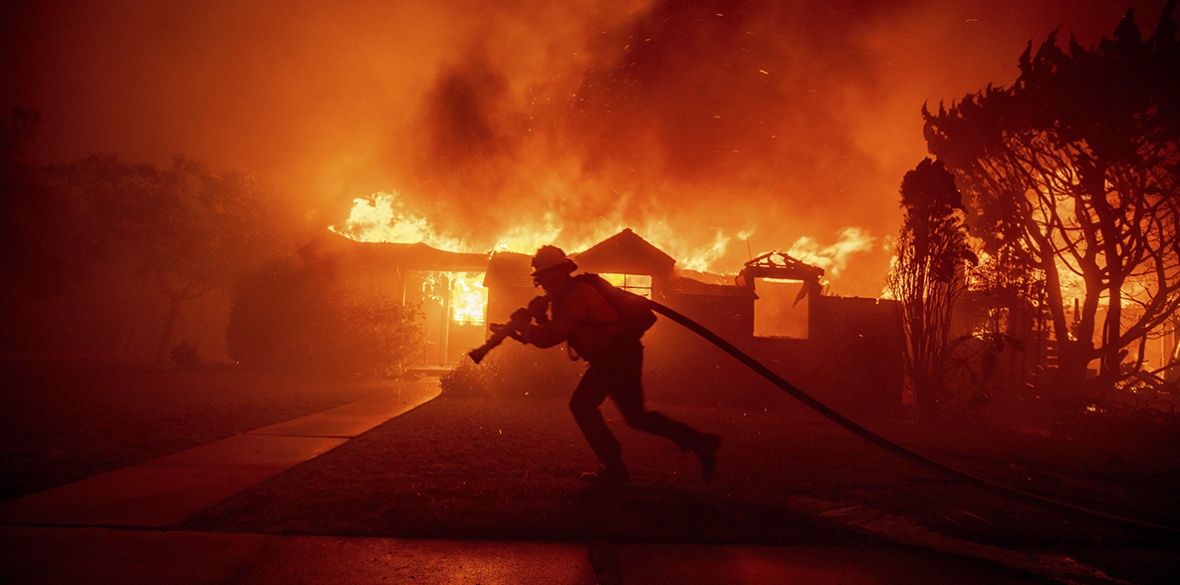
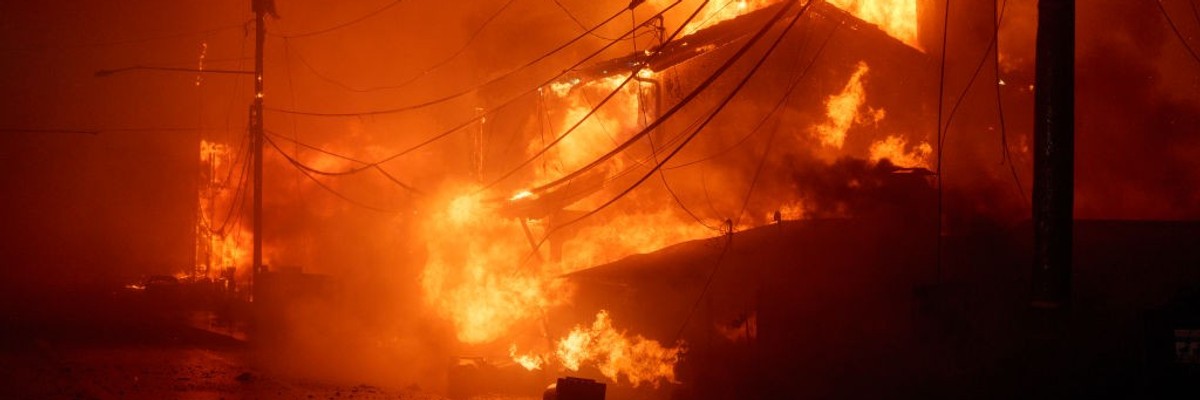
A firefighter battles the Palisades Fire as it burns a structure in the Pacific Palisades neighbourhood of Los Angeles, January 7, 2025
World’s wealthiest 1% have already burned through their share of the entire annual carbon limit, Oxfam warns
THE world’s wealthiest 1 per cent have already burned through their share of the entire annual carbon limit, a damning analysis of super-rich climate destruction has revealed.
A new study by charity Oxfam has analysed the “global carbon budget” — the amount of CO2 that can be emitted without exceeding the international target of limiting global warming to 1.5°C above pre-industrial levels.
Its findings showed that while the richest capitalists had already exceeded that limit in the first 10 days of 2025, it would take someone from the poorest half of the global population nearly three years to use up their share.
Inaction will continue to have deadly consequences, the charity said — and eight in 10 deaths from heat will occur in low and lower-middle-income countries.
Oxfam estimated that by 2050, emissions by the 1 per cent will cause crop losses that could have provided enough calories to feed at least 10 million people a year in eastern and southern Asia.
Emissions from the ultra-wealthy are also causing trillions in economic losses -– the impact on low and lower-middle-income countries over the past three decades has been three times greater than the total climate finance provided by wealthy nations.
…
A spokesperson for Just Stop Oil also issued a rallying call, saying: “We live within a system that serves the few over the many, and the rich are on course for destroying all our lives if they carry on unopposed. We must get organised and resist.
“We need a revolution in politics and economics, and we need to reclaim Parliament from the corporations and billionaires, whilst prioritising the interests of ordinary people.”
Last year, much of the world’s largest coral reef system was transformed into a white boneyard, featuring ghostly silhouettes of horns, brains and lettuces. The threat of sudden biodiversity loss from climate change had been realised through what’s known as a mass bleaching event.
The abrupt loss of many species from a system is generally attributed to a breakdown in ecological functioning. As species are sequentially knocked out, the whole community becomes unstable, and it all comes crashing down. There is, however, another mechanism that may be at play.
In our new paper, colleagues and I argue that despite the fact life on Earth displays such great variety, many species that live together appear to share remarkably similar thermal limits. That is to say, individuals of different species can tolerate temperatures up to similar points.
Ghost brains and lettuces: corals turn white when the water is too warm. blueplanet97 / shutterstock
This is deeply concerning as it suggests that, as ecosystems warm due to climate change, species will disappear from an ecosystem at the same time rather than gradually, resulting in sudden biodiversity loss. It also means that ecosystems may exhibit few symptoms of heat stress before a threshold of warming is passed and catastrophic losses occur.
One way we can see this is by looking at how species are distributed across the globe to infer their maximum tolerance to heat. In doing so, it becomes apparent that species living in the same places tend to have similar tolerances, warning of potentially abrupt losses of biodiversity in the decades to come.
This will be felt most acutely in the tropics, where maximum tolerances are closest to the temperatures already experienced by its inhabitants.
Ground truthing
These “global models” are rather abstract, however. Do we find the same phenomenon if we actually go out into the natural world and test this? Scientists can do just that by measuring the temperatures at which species stop being able to function normally by putting them through “heat trials” (think of it as a sauna for bugs or plants).
The trees that make up a rainforest canopy in Panama are a good place to start. Surely, with all their weird and wonderful shapes, we might expect the wide variety of species here to have variable tolerances to warming? It turns out they don’t. By measuring photosynthetic rates in leaves, researchers have shown that the leaves of many tree species malfunction at roughly 50°C.
But what about animals? To work out their thermal limits, biologists heat up creatures until they fall over to predict when they would become incapacitated by heatwaves in the wild.
A few years ago, I conducted experiments on 45 species of dung beetle in south-east Asia, showing that almost half of them stopped functioning normally at around 39°C. When the lush forests of Borneo get too hot, we might expect half of their resident dung beetles to go extinct as temperatures reach this threshold. Without these diligent forest caretakers, the dung could really hit the fan.
Ecologically crucial – and vulnerable to hot temperatures. Andries Combrinck / shutterstock
My colleagues and I reviewed the literature to identify several mechanisms that may drive these similar warming tolerances. The first operates at the scale of our entire planet. The most common temperatures on Earth are relatively hot, as the tropics cover a much larger area than the poles. This could drive species to be adapted to the conditions that have been most prevalent, meaning many of them have the same tolerance to high temperature.
Alternatively, we know that tolerances to heat evolve slowly compared to tolerances to the cold. We are unsure why this is the case, but it might simply be that it is highly costly (and therefore difficult to evolve) a change in molecular make-up that would allow a species to tolerate more heat. For example, at higher temperatures cell membranes become more fluid. Perhaps the costs of preventing cell death in such conditions are simply too high.
Hope for the future
Without deep and rapid cuts to greenhouse gas emissions, clustered thermal tolerances will continue to threaten the ecosystems on which humanity depends. Regardless of whether drivers occur at the scale of proteins or planets, understanding how and why species have similar thermal tolerances may give us clues as to how we can promote climate change resilience in the natural world.
For example, we know that more distantly related groups of species will probably have more diverse thermal tolerances. A practical step we can take, therefore, is to protect a wide-ranging sample of the tree of life through conservation action. If distinct lineages of life are protected, we increase our chances of harbouring a diverse portfolio of responses to warming.
Crucially, by advancing our understanding of why, and in what contexts, thermal tolerances are more similar, we can predict where and when catastrophic declines may occur. Are they more similar in reefs or rainforests, in Africa or Antarctica? When we answer such questions, we can intervene in at-risk systems, safeguarding the future of our fragile planet.
Joseph Williamson, Research Fellow in Biological Responses to Climate Change, UCL
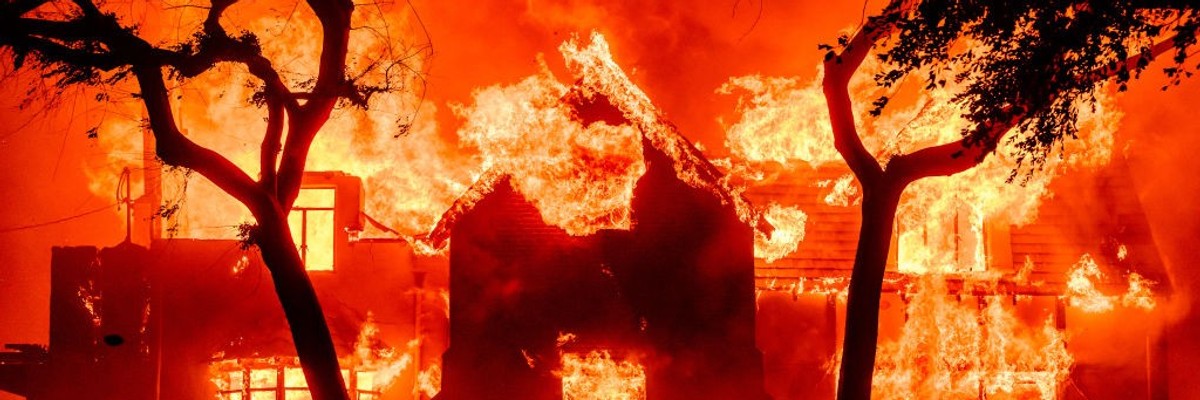
A home is engulfed in flames during the Eaton fire in the Altadena area of Los Angeles County, California on January 8, 2025. (Photo: Josh Edelson/AFP via Getty Images)
“The fires in Los Angeles aren’t just a tragedy, they’re a crime.”
As massive wildfires continued ripping through Los Angeles on Thursday, leaving utter devastation in their wake, climate campaigners said blame for the infernos ultimately lies with the mega-profitable oil and gas giants that have spent decades knowingly fueling the crisis that made the emergency in southern California possible.
“Los Angeles is burning. Entire neighborhoods have been wiped off the map. We are devastatingly unprepared for the climate that fossil fuel greed is creating,” the youth-led Sunrise Movement wrote on social media as several mostly uncontained fires wreaked havoc, supercharged by roaring winds and abnormally dry conditions.
“Oil and gas CEOs know they’re responsible for these disasters,” the group added. “But still, they choose to fight investments in renewable energy, spread propaganda, and bribe politicians into supporting $757 BILLION in fossil fuel subsidies.”
With appalling speed, the Los Angeles fires have so far scorched tens of thousands of acres, destroyed thousands of homes, and killed at least five people—a death toll that’s expected to rise.
“It’s like Armageddon,” said one resident, a sentiment echoed by a CNN reporter in Los Angeles.
“Everyone keeps saying ‘apocalyptic,’” said CNN‘s Leigh Waldman. “But that doesn’t begin to cover it.”
The Palisades fire, the largest of five blazes currently ravaging Los Angeles County, has already been deemed the most destructive in LA history.
Early estimates indicate the total economic damage of the Los Angeles fires could exceed $50 billion.
With a Thursday social media post featuring footage of the raging fires and damage in Los Angeles, Warren Gunnels, staff director for Sen. Bernie Sanders (I-Vt.), wrote: “They say the Green New Deal is expensive. Compared to what?”
Ben Jealous, executive director of the Sierra Club, said in a statement Wednesday that “these fires have taken lives and destroyed homes, livelihoods, and landscapes.”
“We are holding those affected by this disaster close in our hearts and appreciate the first responders who are bravely working to contain the fires. It is essential that federal and state authorities continue to provide these communities with all the resources and support they need to recover and heal,” said Jealous. “Barely a week into the new year, and fire season is here. This is not normal.”
“Time and again, we are witnessing fossil fuel-driven climate change heighten extreme weather, making wildfires increasingly common and increasingly destructive,” he continued. “We cannot be passive. We cannot elevate misinformation about what is needed to confront the worsening crisis. Leaders must take the action necessary to fund and support the home-hardening efforts that make our communities resilient.”
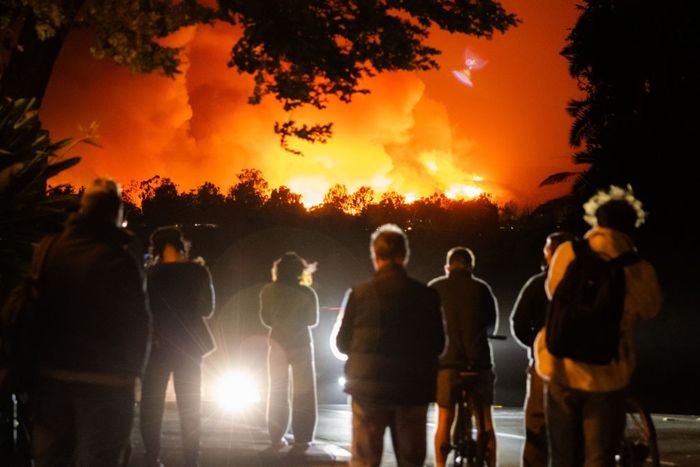
People watch smoke and flames from the Palisades Fire on January 7, 2025 in Los Angeles, California. (Photo: Tiffany Rose/Getty Images)
The Los Angeles fires come as states and localities across the United States are suing oil and gas companies for climate damages as extreme weather becomes increasingly frequent and destructive on a warming planet.
According to the Center for Climate Integrity, more than one in four Americans currently live in a community taking legal action against Big Oil, “underscoring the rapidly growing wave of calls to hold the oil and gas industry accountable for its decades-long climate deception and the harms it has caused.”
Aaron Regunberg, an attorney who is helping build a legal case against the fossil fuel industry, wrote Wednesday that the Los Angeles crisis “didn’t just happen.”
“A recent study found that nearly all of the observed increase in wildfire-burned area in California over the past half-century is attributable to anthropogenic climate change,” Regunberg, senior policy counsel with Public Citizen’s Climate Program, wrote on social media. “This devastation is the direct result of Big Oil’s conduct.”
Did you know that California has a law that makes it a crime to "recklessly cause a fire," as well as a victim restitution statute requiring those conficted of crimes to pay their victims for their economic losses?Big Oil did this. Prosecute them and make them pay.
Jamie Henn, director of Fossil Free Media, offered a similar assessment, writing that “the fires in Los Angeles aren’t just a tragedy, they’re a crime.”
“This is exactly the sort of disaster that Exxon’s own scientists predicted more than 50 years ago, but they spent billions to keep us hooked on fossil fuels,” Henn added. “It’s time to make polluters pay.”
Flames from the Palisades fire burn homes on January 7, 2025 in the Pacific Palisades neighborhood of Los Angeles, California. (Photo: Eric Thayer/Getty Images)
“There is no ‘firefighting’ in these kinds of conditions,” said one meteorologist. “There is only saving as many lives as possible and getting the heck out of the fire’s way.”
Several major wildfires burned out of control in California’s Los Angeles County on Wednesday as roaring winds fueled the rapid spread of the blazes, forcing tens of thousands to evacuate as state, local, and federal officials mobilized resources to confront the emergency.
Los Angeles Mayor Karen Bass wrote on social media late Tuesday that the city is “working aggressively” to stem the wildfires, which scientists and government officials characterized as uniquely devastating.
“Emergency officials, firefighters, and first responders are all hands on deck through the night to do everything possible to protect lives,” California Gov. Gavin Newsom said early Wednesday. The governor noted that more than 1,400 firefighting personnel have been deployed to “combat these unprecedented fires.”
The Palisades, Eaton, and Hurst fires broke out on Tuesday. It quickly exploded amid what the National Weather Service described as “extremely critical fire weather,” with wind gusts up to 99 mph propelling the devastating blazes. The extreme winds forced emergency crews to ground aircraft that were working to contain the fires.
“For some context, fire crews are up against near hurricane-force winds occurring mid-winter in rugged terrain during a drought at night,” wrote meteorologist Eric Holthaus. “There is no ‘firefighting’ in these kinds of conditions. There is only saving as many lives as possible and getting the heck out of the fire’s way.”
“The emergence of extreme wintertime wildfires in California presents one of those classic ‘this is climate change’ moments.”
The Eaton fire, which broke out Tuesday evening in the Pasadena area, “spread so rapidly that staff at a senior living center had to push dozens of residents in wheelchairs and hospital beds down the street to a parking lot,” The Los Angeles Times reported.
“The residents waited there in their bedclothes as embers fell around them until ambulances, buses, and even construction vans arrived to take them to safety,” the newspaper added.
The three fires have together burned thousands of acres so far and destroyed or endangered tens of thousands of homes and buildings, according to Newsom’s office. So far, at least 19 school districts have announced complete or partial closures due to the fires.
Video footage posted to social media showed residents watching in horror as flames surrounded their homes:
“There has been a recent massive increase in wildfires in California but really, a fire this big in January? This is unprecedented,” scientist Hayley Fowler wrote on social media. “One of many extreme events fueled by the climate crisis.”
Holthaus wrote Tuesday that Southern California is “facing a rare and dangerous juxtaposition of extreme winds and midwinter drought,” the meteorologist described as “a worrying example of the state’s expanding wildfire threat as climate change worsens.”
“The National Weather Service defines ‘extremely critical’ fire weather as sustained winds over 30 mph and relative humidity of less than 10% in drought conditions and temperatures warmer than 70 degrees,” Holthaus observed. “This is the first time in history these criteria have been met anywhere in the United States during January.”
“The emergence of extreme wintertime wildfires in California,” he added, “presents one of those classic ‘this is climate change’ moments: A specific set of weather conditions are now occurring in such a way to produce the potential for rare disasters to become much more common.”
Donald Trump has voiced plans to withdraw the US from the Paris Agreement, and possibly from the entire UNFCCC, after assuming the US presidency this year (Credit: Getty Images)
…
Yearlong: Extreme weather continues
As these global opportunities to make a difference on climate roll around, there is another certainty running through the calendar year: climate-driven extreme weather.
As long as we continue to burn fossil fuels, headlines in 2025 and beyond will continue to be dominated by large death tolls, suffering and destruction due to ever more extreme weather events – Friederike Otto
What’s harder to know is exactly when disasters will hit. But 2025 is also expected to be a scorcher: it will be one of the three hottest years on record globally, according to an outlook from the UK’s Met Office, falling just behind 2024 and 2023. Warm temperatures are forecast in 2025 despite the Pacific Ocean moving into a La Niña phase, in which sea surface temperatures are lower than usual and conditions overall are cooler.
“Years such as 2025, which aren’t dominated by the warming influence of El Niño, should be cooler,” Adam Scaife, head of long-range prediction at the Met Office, stated in the outlook.
Still, the Met Office expects average global temperature in 2025 to be 1.29C to 1.53C above pre-industrial temperatures.
Friederike Otto, who leads World Weather Attribution group, says the La Niña predictions mean 2025 “might be cooler than 2024” but argues “this is really irrelevant” if natural climate variability is masking the overall warming trend.