Catalina Lake in East Greenland, where scientists recently observed glacial flooding in real time, photographed in 2013. NASA
Scientists have, for the first time, observed the unleashing of an enormous glacial lake flooding event in East Greenland. The rare outburst involved 3,000-plus billion liters of meltwater bursting forth in a matter of weeks.
Witnessed by researchers from the University of Copenhagen, the natural phenomenon provides insight into the powerful and potentially dangerous forces that can be released by meltwater, a press release from University of Copenhagen’s Niels Bohr Institute said.
“Imagine an enormous bathtub atop a mountain filled with water equivalent to three times Denmark’s annual water consumption, and then suddenly bursting. This is essentially what happened when the massive Catalina Lake in East Greenland released 3.4 cubic kilometers of meltwater — 3,000 billion liters — into the Scoresby Sound fjord,” the press release said.
The enormous volume of water released by the lake made it one of the three largest events of its kind ever to be documented.
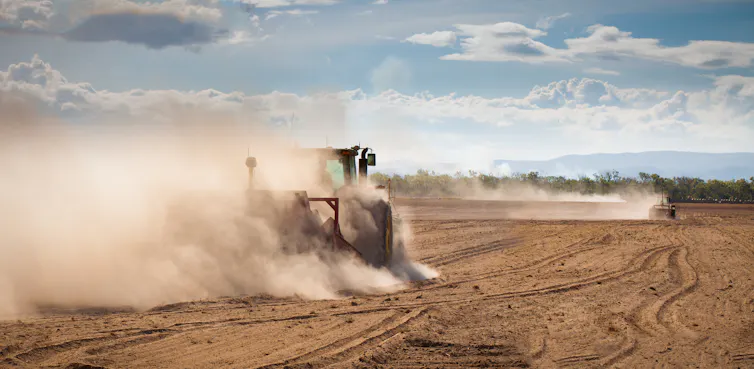
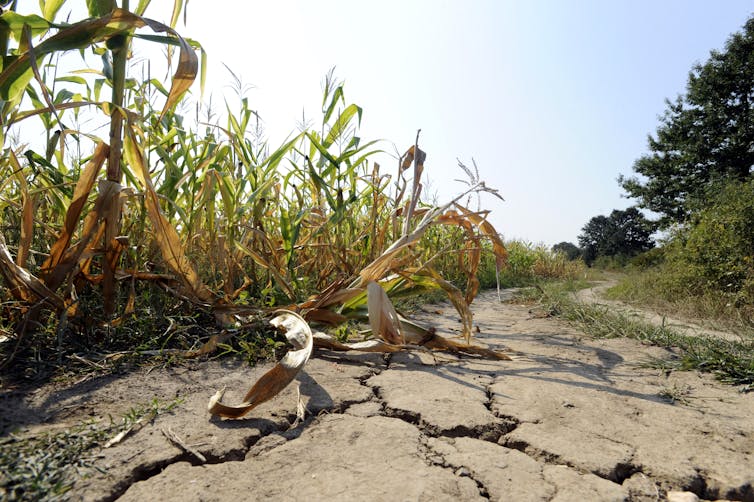
Three-quarters of Earth’s land has become drier since 1990.
Droughts come and go – more often and more extreme with the incessant rise of greenhouse gas emissions over the last three decades – but burning fossil fuels is transforming our blue planet. A new report from scientists convened by the United Nations found that an area as large as India has become arid, and it’s probably permanent.
A transition from humid to dry land is underway that has shrunk the area available to grow food, costing Africa 12% of its GDP and depleting our natural buffer to rising temperatures. We have covered several consequences of humanity’s fossil fuel addiction in this newsletter. Today we turn to the loss of life-giving moisture – what is driving it, and what we are ultimately losing.
Why is the land drying out so fast? It’s partly because there is more heat trapped in the atmosphere by greenhouse gases emitted from burning fossil fuels. This excess heat has exacerbated evaporation and is drawing more moisture out of soil.
‘Oil, not soil’
Climate change has also made the weather more volatile. When drought does cede to rain, more of it arrives in bruising downpours that slough the topsoil.
A stable climate would deliver a year’s rain more evenly and gently, nourishing the soil so that it can nurture microbes that hold onto water and release nutrients.
This is the kind of soil that industrial civilisation inherited. It’s disappearing.
“Soil is being lost up to 100 times faster than it is formed, and desertification is growing year on year,” says Anna Krzywoszynska, a sustainable food expert at the University of Sheffield.
“The truth is, the modern farming system is based around oil, not soil.”
Fossil fuels have unleashed agriculture from the constraints of local ecology. Once, the nutrients that were taken from the soil in the form of food had to be replaced using organic waste, Krzywoszynska says. Synthetic nitrogen fertilisers, made with fossil energy at great cost to the climate, changed all that.
Next came diesel-powered machinery that brought more wilderness into cultivation. Farm vehicles as heavy as the biggest dinosaurs now churn and compact the soil, making it difficult for earthworms and assorted soil organisms to maintain it.
Tractors and chemicals served humanity for a long time, Krzywoszynska says. But soil is now so degraded that no amount of fossil help can compensate.
“Across the world, soils have been pushed beyond their capacity to recover, and humanity’s ability to feed itself is now in danger.”
Green pumps and white mirrors
The primary way that we have been making up for lost food yield is turning more forests into farms. This is accelerating our journey towards a drier, less liveable world because forests, if allowed to thrive, create their own rain.
“Water sucked up by tree roots is pumped back into the atmosphere where it forms clouds which eventually release the water as rain to be reabsorbed by trees,” say Callum Smith, Dominick Spracklen and Jess Baker, a team of biologists at the University of Leeds who study the Amazon rainforest.
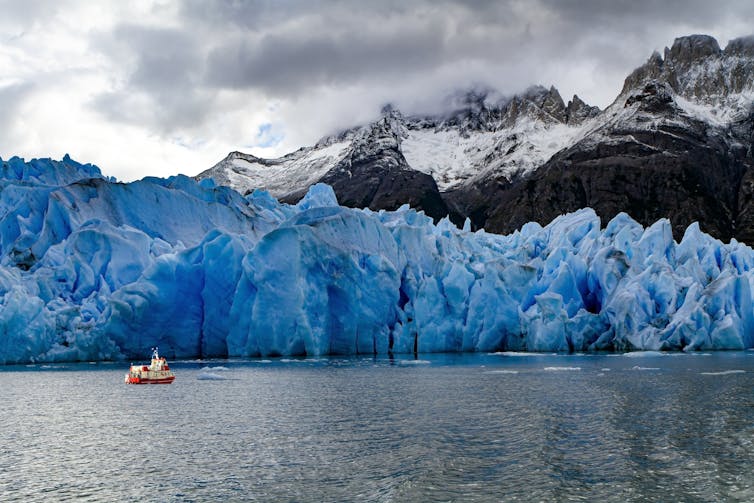
Some experts have argued that the UN report understates Earth’s growing aridity by overlooking the water that is held in snow caps, ice sheets and glaciers. Climate change is melting this frozen reservoir, which also serves as a seasonal source of water.
Rising temperatures are depleting stores of freshwater, including glaciers. Kavram/Shutterstock
“And as water in its bright-white solid form is much more effective at reflecting heat from the sun, its rapid loss is also accelerating global heating,” says Mark Brandon, a professor of polar oceanography at The Open University.
How do we adapt our relationship with the land to remoisturise the world? Krzywoszynska argues that there is no easy solution, but the future of food-growing “is localised and diverse”.
“To ensure that we eat well and live well in the future, we’ll need to reverse the trend towards greater homogenisation which drove food systems so far.”
The good news, according to Krzywoszynska, is that farmers are experimenting with methods that restore the soil even as they produce a diverse range of nutritious food. These innovators need rights and secure access to the land, the opportunity to share their experiences and financial and political support.
“Regenerating land is a win-win, for humans and their ecosystems, if we dare to look beyond the immediate short-term horizon,” she says.
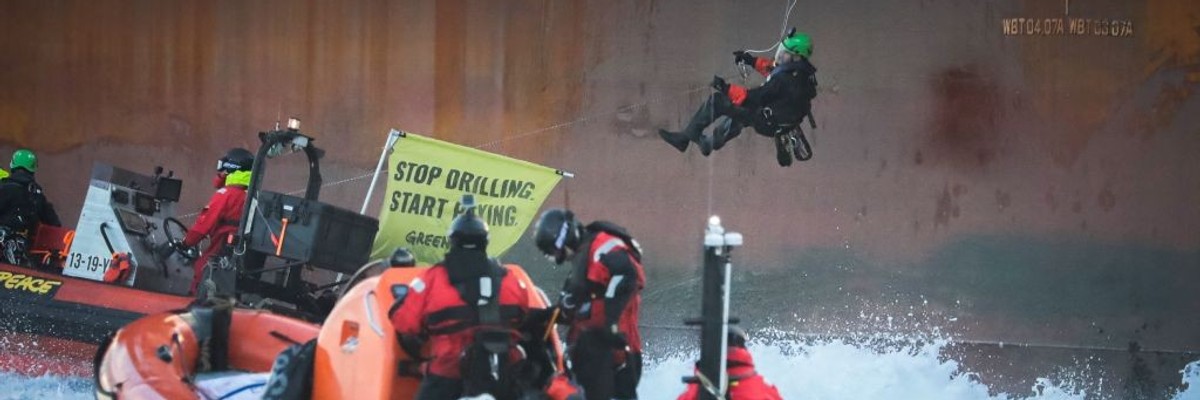
Greenpeace activists board a Shell platform headed toward the North Sea on February 6, 2023. (Photo: Lou Benoist/AFP via Getty Images)
“Shell thought suing us for millions over a peaceful protest would intimidate us, but this case became a PR millstone tied around its neck,” said the co-executive director of Greenpeace U.K.
The United Kingdom-based oil giant Shell agreed Tuesday to settle a major lawsuit the company brought against Greenpeace after activists from the group boarded and occupied a company oil platform last year to protest fossil fuel expansion.
Greenpeace said in a statement that as part of the settlement, it agreed to donate £300,000—roughly $382,000—to the Royal National Lifeboat Institution, a charity that helps save lives at sea, but will pay nothing to Shell and accept no liability. The donation represents a fraction of the over $11 million in damages and legal costs defendants faced, the group said.
The Greenpeace defendants have also “agreed to avoid protesting for a period at four Shell sites in the northern North Sea.”
“Shell thought suing us for millions over a peaceful protest would intimidate us, but this case became a PR millstone tied around its neck,” said Areeba Hamid, co-executive director of Greenpeace U.K. “The public backlash against its bullying tactics made it back down and settle out of court.”
“This settlement shows that people power works. Thousands of ordinary people across the country backed our fight against Shell and their support means we stay independent and can keep holding Big Oil to account,” Hamid added. “This legal battle might be over, but Big Oil’s dirty tricks aren’t going away. With Greenpeace facing further legal battles around the world, we won’t stop campaigning until the fossil fuel industry stops drilling and starts paying for the damage it is causing to people and planet.”
“These aggressive legal tactics, the huge sums of money, and attempts to block the right to protest pose a massive threat.”
Shell brought the case, which Greenpeace characterized as a “textbook” strategic lawsuit against public participation (SLAPP), in February 2023 and sought $1 million in damages from activists who boarded a Shell-contracted ship carrying equipment to drill for oil in the North Sea.
“When the protest ended, the only damage Shell could find was a padlock which, they alleged, our activists broke. That’s it,” Greenpeace U.K. said Tuesday. “Yet they came after us with a million-dollar lawsuit, which they justified for their spending on safety.”
The group, which warned that the case had dire implications for the right to protest, credited a “sustained, year-long campaign against the suit” for forcing the oil behemoth to back down. The campaign, according to Greenpeace, “turned the legal move into a PR embarrassment for Shell.”
“The case was dubbed the ‘Cousin Greg’ lawsuit by Forbes after a scene in the Emmy-awarded drama Succession, in which the hapless character threatens to sue Greenpeace to universal dismay,” the environmental group noted Tuesday.
Greenpeace is currently facing several other SLAPP suits, including one brought by Energy Transfer, majority-owner of the Dakota Access pipeline. The group said Tuesday that the Energy Transfer suit “threatens the very existence of Greenpeace in the U.S.”
“These aggressive legal tactics, the huge sums of money, and attempts to block the right to protest pose a massive threat. It could stop Greenpeace being able to make a real difference on the things that matter most,” the organization said Tuesday. “It’s part of a growing trend by powerful corporations and governments to crush peaceful protest—using draconian laws or intimidation lawsuits like this.”
“It seeks to silence the people most impacted by the climate crisis. This threatens the global fight for climate justice,” the group added. “We won’t give up. This is Shell versus all of us.”
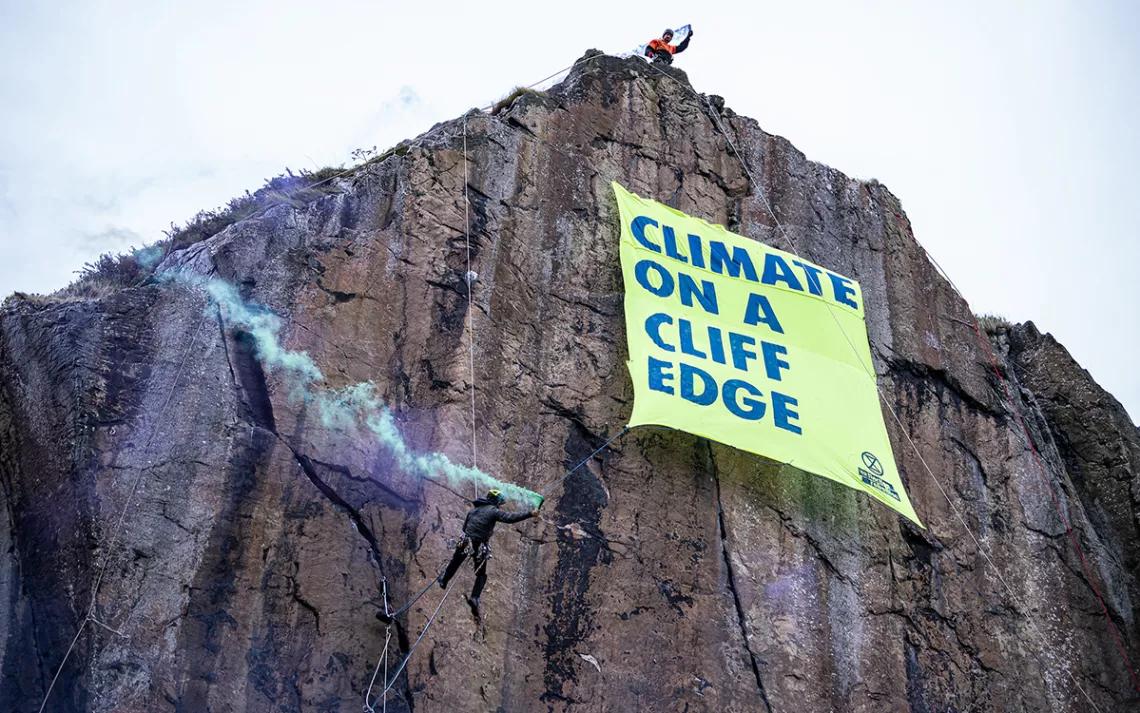
Experienced climbers scale a rock face near the historic Dumbarton castle in Glasgow, releasing a banner that reads “Climate on a Cliff Edge.” One activist, dressed as a globe, symbolically looms near the edge, while another plays the bagpipes on the shores below. | Photo courtesy of Extinction Rebellion and Mark Richards
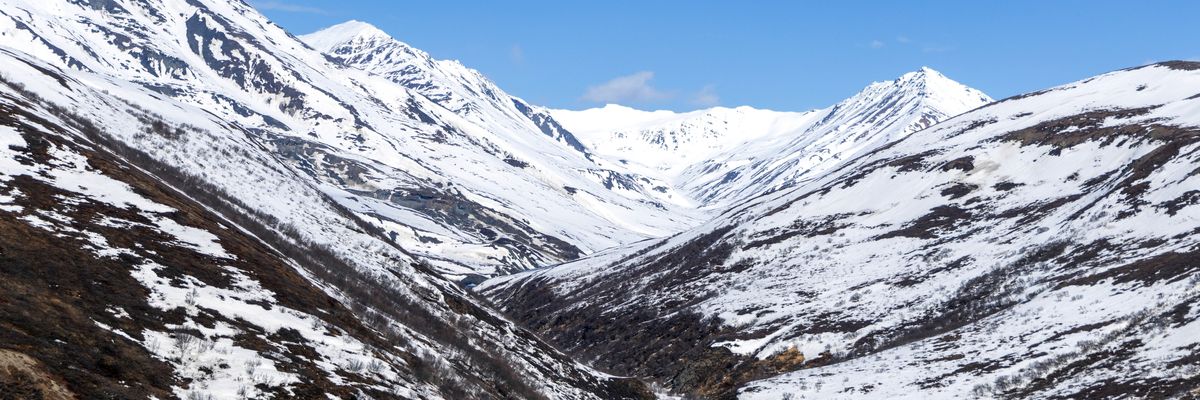
A view of Brooks Range as seen from the Dalton Highway on May 10, 2024 in North Slope Borough, Alaska. (Photo: Lance King/Getty Images)
“This is yet one more sign, predicted by scientists, of the consequences of inadequately reducing fossil fuel pollution,” said one scientist.
Permafrost in the Arctic has stored carbon dioxide for millennia, but the annual Arctic Report Card released by the National Oceanic and Atmospheric Administration reveals a concerning shift linked to planetary heating and a rising number of wildfires in the icy region: The tundra is now emitting more carbon than it is storing.
The report card revealed that over the last year, the tundra’s temperature rose to its second-highest level on record, causing the frozen soil to melt.
The melting of the permafrost activates microbes in the soil which decompose the trapped carbon, causing it to be released into the atmosphere as planet-heating carbon dioxide and methane.
The release of fossil fuels from the permafrost is also being caused by increased Arctic wildfires, which have emitted an average of 207 million tons of carbon per year since 2003.
“Our observations now show that the Arctic tundra, which is experiencing warming and increased wildfire, is now emitting more carbon than it stores, which will worsen climate change impacts,” said Rick Spinrad, administrator of NOAA. “This is yet one more sign, predicted by scientists, of the consequences of inadequately reducing fossil fuel pollution.”
Sue Natali, a scientist at the Woodwell Climate Research Center in Massachusetts and one of 97 international scientists who contributed to the Arctic Report Card, told NPR that 1.5 trillion tons of carbon are still being stored in the tundra—suggesting that the continued warming of the permafrost could make it a huge source of planet-heating greenhouse gas emissions.
Along with the “Arctic tundra transformation from carbon sink to carbon source,” NOAA reported declines in caribou herds and increasing winter precipitation.
The report card showed that the autumn of 2023 and summer of 2024 saw the second- and third-warmest temperatures on record across the Arctic, and a heatwave in August 2024 set an all-time record for daily temperatures in several communities in northern Alaska and Canada.
The last nine years have been the nine warmest on record in the Arctic region.
“Many of the Arctic’s vital signs that we track are either setting or flirting with record-high or record-low values nearly every year,” said Gerald (J.J.) Frost, a senior scientist with Alaska Biological Research, Inc. and a veteran Arctic Report Card author. “This is an indication that recent extreme years are the result of long-term, persistent changes, and not the result of variability in the climate system.”
Brenda Ekwurzel, a climate scientist at the Union of Concerned Scientists, emphasized that the continuous release of fossil fuel emissions from oil and gas extraction and other pollution has caused the Arctic to warm at a faster rate than the Earth as a whole over the past 11 years.
“These combined changes are contributing to worsening wildfires and thawing permafrost to an extent so historic that it caused the Arctic to be a net carbon source after millennia serving as a net carbon storage region,” said Ekwurzel. “If this becomes a consistent trend, it will further increase climate change globally.”
The Arctic Report Card was released weeks before President-elect Donald Trump is set to take office. Trump has pledged to slash climate regulations introduced by the Biden administration and to increase oil and gas production. He has mused that sea-level rise will create “more oceanfront property” and has called the climate crisis a “hoax,” while his nominee for energy secretary, Chris Wright, the CEO of the fracking company Liberty Energy, has claimed that climate warming is good for the planet.
“These sobering impacts in the Arctic are one more manifestation of how policymakers in the United States and around the world are continuing to prioritize the profits of fossil fuel polluters over the well-being of people and the planet and putting the goals of the Paris climate agreement in peril,” said Ekwurzel. “All countries, but especially wealthy, high-emitting nations, need to drastically reduce heat-trapping emissions at a rapid pace in accord with the latest science and aid in efforts of climate-vulnerable communities to prepare for what’s to come and help lower-resourced countries working to decrease emissions too.”
Experienced climbers scale a rock face near the historic Dumbarton castle in Glasgow, releasing a banner that reads “Climate on a Cliff Edge.” One activist, dressed as a globe, symbolically looms near the edge, while another plays the bagpipes on the shores below. | Photo courtesy of Extinction Rebellion and Mark Richards
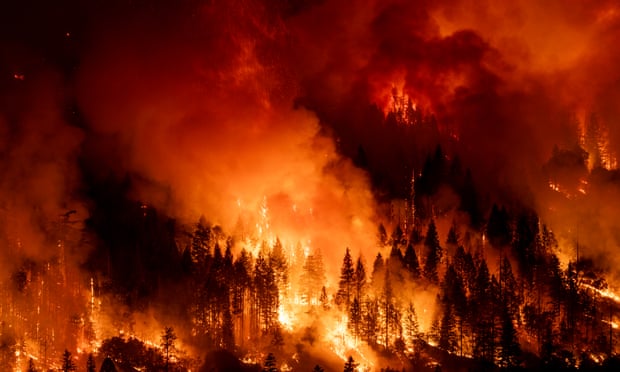
A wildfire in California this year. Fires driven by severe droughts have affected the western US, Canada, the Amazon forest and particularly the Pantanal wetlands. Photograph: David McNew/Getty Images
Average global temperature in November was 1.62C above preindustrial levels, bringing average for the year to 1.60C
This year is now almost certain to be the hottest year on record, data shows. It will also be the first to have an average temperature of more than 1.5C above preindustrial levels, marking a further escalation of the climate crisis.
Data for November from the EU’s Copernicus Climate Change Service (C3S) found the average global surface temperature for the month was 1.62C above the level before the mass burning of fossil fuels drove up global heating. With data for 11 months of 2024 now available, scientists said the average for the year is expected to be 1.60C, exceeding the record set in 2023 of 1.48C.
…
Fossil fuel emissions must fall by 45% by 2030 to have a chance of limiting heating to 1.5C. The recent Cop29 climate summit failed to reach an agreement on how to push ahead on the transition away from coal, oil and gas. The C3S data showed that November 2024 was the 16th month in a 17-month period for which the average temperature exceeded 1.5C.
The supercharging of extreme weather by the climate crisis is already clear, with heatwaves of previously impossible intensity and frequency now striking around the world, along with fiercer storms and worse floods.