This week, the international court of justice (ICJ) opened two weeks of hearings on states’ climate-related legal obligations – and the consequences, if “significant harm” is caused.
It is taking place against a backdrop of rapidly escalating climate impacts. Emissions continue to rise, rather than falling rapidly, as needed to avoid dangerous levels of global warming.
It is the ICJ’s largest ever case, with more than 100 countries and international organisations making interventions, deploying a wide variety of legal arguments.
Ralph Regenvanu, climate envoy for Vanuatu, which led the campaign for the ICJ hearings, said in his opening address: “[T]his may well be the most consequential case in the history of humanity.”
Below, Carbon Brief interviews leading international law scholar Prof Philippe Sands – who drafted the pleadings for Mauritius, but is speaking here in a personal capacity – to find out more about the legal issues at stake and the wider significance of the ICJ case.
On the significance of the case: “It’s the first time the ICJ has been called upon to address legal issues relating to climate change.”
On climate obligations under the UN: “Will the court open the door to the situation that the 1992 [UN climate] convention … [is] not the be all and end all?”
On the responsibility of states: “The question at the beating heart of this case, really, is the consequences of emissions over time.”
On historical emissions: “The big issue is, are you liable for the continuing consequences of your past emissions?”
On applying international law: “When drafting the climate treaty regime, [did] states…exclude the application of general international law?”
On expectations for the case: “What I’m interested in, really, is an advisory opinion that is capable of having hard, practical application.”
On the state of the science: “A procedure in which the judges hear privately from any person…is unusual. It’s unorthodox.”
On the significance of the submissions: “The oral phase is very important, because it basically concentrates the issues down to the most significant and narrow set of issues.”
Carbon Brief: Would you be able to start by just situating this case in its wider legal context and explaining why it could be so consequential?
Philippe Sands: Well, it’s the first time the international court of justice has been called upon to address legal issues relating to climate change. The ICJ is the principal judicial organ of the United Nations and, although the advisory opinion that it hands down will not be binding on states, it is binding on all UN bodies. The determinations that the court makes will have consequences that go very far and that will have a particular authority, in legal and political terms. Of course, everything turns on what the court actually says.
CB: Would you be able to summarise the key legal arguments that are being fought over in this case?
PS: No! I mean, there’s just a huge number of issues that are coming up. But, essentially, the court has been asked two questions by the UN General Assembly – the first time, I believe, that a request from the General Assembly has been consensual, with no objections. The two questions are, firstly, what are the obligations for states under international law to protect the climate system? And, secondly, what are the legal consequences under these obligations, where, by their acts and emissions, [states] cause significant harm to the climate system? So, there are two distinct questions – and about 100 states and international organisations of various kinds have made submissions on the vast range of issues that are raised by these two questions. The questions are very, very broad and that signals to me that the court’s response may be quite general. But, for me, the crucial issues are, firstly, what the court says about the state of the science: is it established, or is there any room for doubt? Secondly, what are the obligations of states having regard to the clarity of the science? Thirdly, are there legal obligations on states in relation to the climate system that exist and arise outside of the treaty regime – the 1992 [UN Framework] convention [on climate change], the Kyoto Protocol, the Paris Agreement and so on and so forth. And, related to that, fourthly – this is the most intense, legally interesting aspect – what are the responsibilities of states for historic emissions under general international law? And, in particular, are the biggest contributors liable under international law to make good any damages that may arise from their historic actions? But, I mean, there’s just such a vast array of questions that are addressed, it’s impossible to summarise briefly.
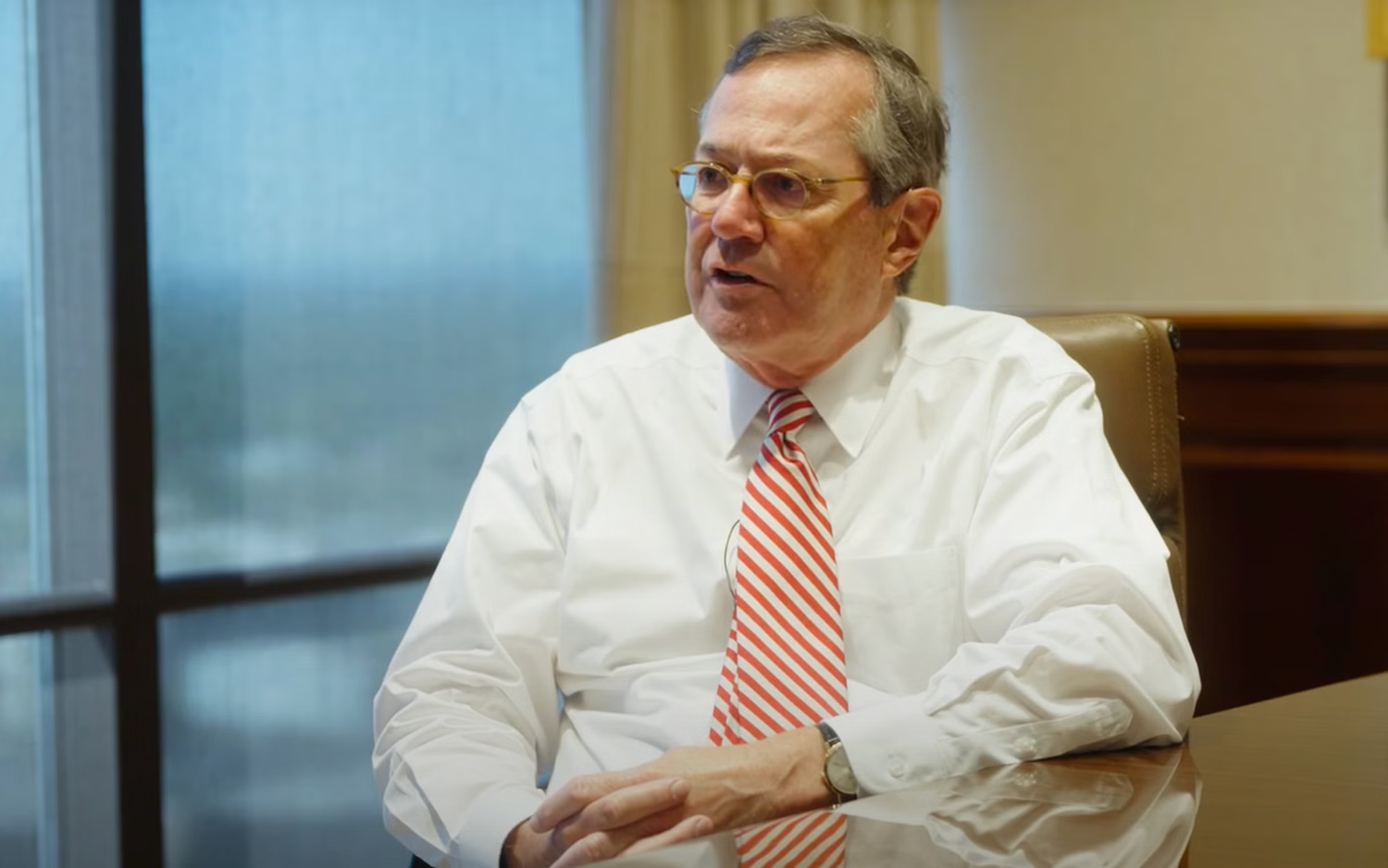
Warren Stephens. Credit: The Golfer’s Journal / YouTube
Campaigners warn that the UK will face “pressure from American fossil fuel interests” to slow its energy transition.
U.S. president-elect Donald Trump’s pick to be UK ambassador runs a firm with investments in several oil and gas companies, DeSmog can reveal.
Billionaire Warren Stephens, a major Trump donor who was nominated on Monday to be the next UK ambassador, is chairman, president, and CEO of Stephens Inc., one of the largest privately-owned investment banks in the U.S..
The firm’s portfolio includes at least five companies that make their money from oil and gas exploration and production, including one, Stephens Natural Resources, which is “solely owned” by the Stephens family business.
“President-elect Trump’s promise to boost U.S. fossil fuel production is reflected in his choice of UK ambassador, raising concerns about the potential impact on the UK’s own climate leadership”, said Fossil Free Parliament campaigner Carys Boughton.
Tessa Khan, executive director of the environmental campaign group Uplift, told DeSmog the appointment was a sign that “the UK is going to be under pressure from American fossil fuel interests to slow its transition away from oil and gas”.
Trump has vowed to “drill, baby, drill” for oil and gas in the U.S. while his presidential campaign received the backing of major fossil fuel interests. The president-elect has called climate change a “hoax” and is expected to once again pull the U.S. out of the flagship 2015 Paris Agreement, which established a global ambition to limit warming to 1.5C above industrial levels.
The Stephens hire comes just weeks after the UK Labour government unveiled an ambitious new climate target to cut emissions by 81 percent by 2035. The move was criticised by Conservative Party leader Kemi Badenoch, who this week flew to Washington DC reportedly to build ties with senior Republicans ahead of a second Trump presidency.
As DeSmog revealed last week, Badenoch has hired advisors who have criticised climate action and have links to fossil fuel-funded think tanks. Badenoch, who describes herself a “net zero sceptic” has also received donations from the head of Net Zero Watch, a climate science denial group.
Oil and Gas Investments
Stephens Inc.’s investments in oil and gas include Stephens Natural Resources, a company run by Warren’s uncle Witt Stephens.
The company, which trades as Stephens Production, “has a rich history of drilling and producing both oil and natural gas”, according to its website, and “continues to expand its production and reserves in the continental U.S. and offshore Gulf of Mexico”.
The company is “solely owned” by the Stephens family, whose investment stretches back to 1953, according to the website.
Stephens Inc.’s other current investments, which date back to the mid-2010s, include Four Corners Petroleum, an oil exploration and production company based in Colorado.
Stephens Inc. lists RK Supply in its portfolio, a “leading distributor of piping, oil and gas valves, fittings, and other oilfield service equipment” based in Texas. It also lists Dakota Midstream, a company that “provides infrastructure support to oil and gas exploration and production”, based in Colorado.
Another company in the Stephen Inc. portfolio, Texas-based Basin Oil & Gas, buys “non-operating oil and gas interests”, and is developing carbon capture and sequestration projects. Carbon capture is a favoured climate solution of the oil and gas industry, and is often used simply to extract more fossil fuels.
Stephens Inc. lists a firm called Capture Point in its portfolio, which specialises in enhanced oil recovery – a method for extracting hard-to-get oil. Capture Point told DeSmog that Stephens Inc. was not an investor in the company, though did not respond when asked if Stephens Inc. was previously an investor.
All the companies cited were approached for comment.
Trump Tensions
Stephens’s appointment comes at a critical time for the UK’s energy transition, and highlights the differences between the new Labour government and the incoming Trump administration.
Prime Minister Keir Starmer last month attended the COP29 climate summit in Baku, Azerbaijan, pledging that the UK would restore its role “as a climate leader on the world stage”. In its 2024 election manifesto, Starmer’s Labour Party pledged to ban all new licenses for oil and gas exploration in the North Sea. However, after five months in office, the government has yet to implement that promise.
“While the UK government has pledged to turn the UK into a ‘clean energy superpower’, it has not enacted its manifesto commitment to ban new licenses, nor provided a plan for a just transition away from fossil fuels”, Carys Boughton told DeSmog.
“Trump’s choice of ambassador will gift the fossil fuel industry yet more influence within UK politics, which is particularly concerning while the government is still wavering on the future of fossil fuels.
“It is therefore yet more important that the government take action to restrict fossil fuel industry influence – to protect its developing climate and energy policy from the industry’s polluting interests.”
As DeSmog has reported, Trump’s would-be energy secretary Chris Wright, chief executive of fracking company Liberty Energy, has praised Danish climate crisis denier Bjorn Lomborg as a friend. Wright’s nomination was welcomed by the CO2 Coalition, a climate science denial group which has received funding from the Koch Industries oil dynasty.
Analysis by the climate outlet Heated found that all of Trump’s cabinet picks have made misleading statements about climate change.
Science denial and an enthusiasm for fossil fuels are also views shared by Trump’s UK supporters. In September, DeSmog reported that Trump ally Nigel Farage, the Clacton MP and leader of Reform UK, was a keynote speaker at an event in Chicago run by the Heartland Institute, where he called on the U.S. to “drill, baby, drill” for more fossil fuels.
“It’s no surprise that this appointment – like the rest of Trump’s administration – is shot through with oil and gas interests”, Uplift’s Tessa Khan, told DeSmog.
“Fossil fuel companies will prove extremely influential in the incoming U.S. government, and they want nations across the world to remain hooked on oil and gas for years to come just so they can keep profiting.
“The UK is going to be under pressure from American fossil fuel interests to slow its transition away from oil and gas. To succumb would be against the UK’s national interest”.
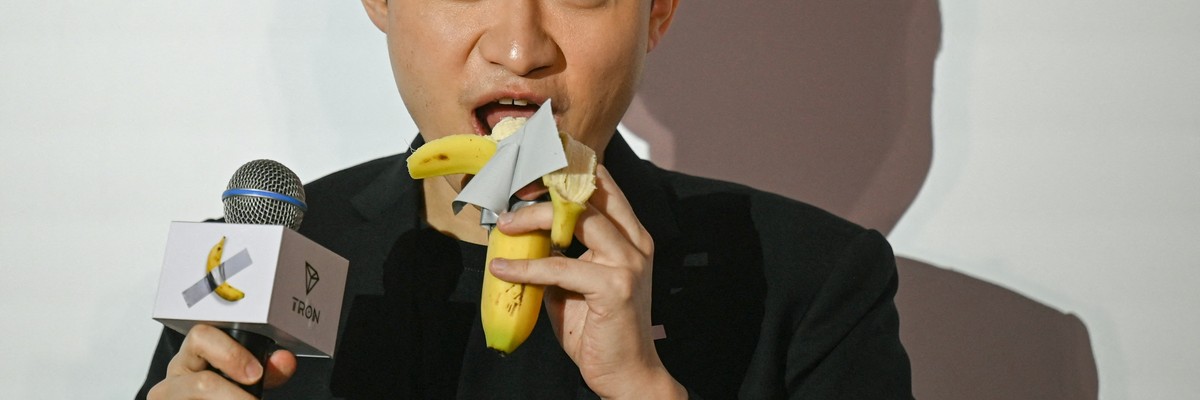
Chinese-born crypto founder Justin Sun eats a banana artwork composed of a fresh banana stuck to a wall with duct tape, in Hong Kong on November 29, 2024, after buying the provocative work of conceptual art by Italian artist Maurizio Cattelan at a New York auction for $6.2 million. (Photo: Peter Parks/AFP via Getty Images)
Billions upon billions give our world’s wealthiest an overabundance of mind-boggling political power, and right now they’re wielding that power to protect their fortunes at the expense of our planet’s future.
Looking to find something special this holiday season for that mega-millionaire in your life? The Italian retailer Valextra has just what you may need: a cocktail set that offers a “vision of design fluidity and discreet luxury.” Just $13,400 for a leathered and lacquered box that includes “a shaker, cocktail tools made from silvered brass, and two martini glasses.”
Or maybe you’re looking for a nice, new waterfront condo in South Florida. The private-equity movers and shakers at Apollo Global have just advanced the $307 million needed to plop 92 sumptuous residences on Florida’s “Millionaire’s Mile” near Pompano Beach. Each of these seaside palaces will enjoy “direct access to a private beach with food and beverage service.”
Or do you have your heart set on a thrilling new artistic experience? The billionaire crypto king Justin Sun certainly delivered one last Friday. Two days earlier, at a Sotheby’s auction, Sun had outlasted six other bidders and won—for $6.2 million—an artwork from an Italian absurdist artist. Sun proceeded to work up an appetite and then, before a packed news conference at a pricey Hong Kong hotel, ate his historic acquisition: a banana duct-taped to a wall. Only a video of the banana remains.
What wealthy nations do take seriously: the interests of their wealthy. And that seriousness is setting the world up for abject climate failure.
For Justin Sun and his fellow billionaires, no artwork or beachfront palace or luxury gift can make more—at worst—than a modest dent of their grand personal fortunes. Today’s global billionaires, a new report from the world’s top commercial tracker of grand fortunes calculates, more than doubled their combined wealth last year, to a record $12.1 trillion.
These 3,323 billionaires make up, the new data from researchers at Altrata show, less than 1% of our world’s “ultra-high net worth” population, those wealthy worth at least $30 million. But these few thousands of billionaires are sitting upon 25% of global ultra-high net worth.
Billionaires worth over $10 billion, add Altrata’s analysts in their latest annual Billionaire Census, make up only 6% of the billionaires who call our Earth home. These fortunate few hold 41% of billionaire wealth.
Billionaires who call the United States home, meanwhile, once again dominate Altrata’s latest global wealth stats. Americans hold a full third of the world’s billion-dollar fortunes, over three times the share of China, the world’s second-largest billionaire hotspot.
Another sign of America’s billionaire dominance: The world’s four richest individuals—Elon Musk, Jeff Bezos, Mark Zuckerberg, and Larry Ellison—all just happen to be Americans. The Bloomberg Billionaires Index is now listing their combined net worth at nearly $1 trillion.
Fortunes as massive as these don’t just give our richest plenty of pocket change for the world’s most extravagant luxuries. These billions upon billions give our nation’s—and our world’s—wealthiest an overabundance of mind-boggling political power, and right now they’re wielding that power to protect their fortunes at the expense of our planet’s future.
Some of our world’s most perceptive climate journalists have been tracking that wielding this past month at two pivotal global conferences.
The first of these, in Rio de Janeiro, involved what have become known as the “G20” nations, a grouping that includes some 19 top national economic powers and two regional bodies, the European Union and the African Union. Different countries chair the G20 each year, but none have done their chairing more aggressively than Brazil, this past year’s chair.
Under Brazil’s progressive president, the former union leader Luiz Inacio Lula da Silva, this home to the endangered Amazon rainforest has spent 2024 pushing the G20 to get serious about taxing the world’s super rich—and using the proceeds from those taxes to address the world’s deepening climate calamity.
Earlier this year, Brazil brought before a meeting of the G20’s national finance ministers the famed E.U. Tax Observatory economist Gabriel Zucman, one of the world’s top experts on tax-the-rich options. Zucman proceeded to make a powerful case for an annual global 2% tax on the fortunes of the world’s wealthiest.
On paper, Brazil’s tax advocacy has made a real impact. The final declaration that nations attending last month’s 2024 G20 summit in Rio adopted is overflowing with admirable egalitarian sentiments.
“We live in times of major geopolitical, socioeconomic, and climate and environmental challenges and crises, which require urgent action,” the G20 nations solemnly declared. Added their official statement: “We recognize that inequality within and among countries is at the root of most global challenges that we face and is aggravated by them.”
This noble G20 summit declaration, notes350.org climate activist Kate Blagojevic, shows that Brazil and other G20 environmentally conscious nations have essentially “gained consensus for one of the most logical solutions to one of the world’s most pressing issues—taxing billionaires to pay for climate action.”
But now, stresses Blagojevic, G20 governments “must build on the growing popular support for taxing extreme wealth by putting words into action.”
Those rich holding that extreme wealth, agrees Emma Seery, Oxfam’s lead on development finance, have plenty of billions they could be sharing.
“Today,” Seery notes, “the world’s 16 richest individuals would still be billionaires even if 99% of their wealth vanished overnight.”
Those super rich a bit below that top-16 status have ample quantities of wealth to share as well. Since 1980, Seery points out, the G20’s richest 1% “have seen their tax rates fall by roughly a third” over the same years their share of global income was jumping by 45%.
Despite stats like these, several key G20 powerhouses—most notably the United States and Germany—have been showing little interest in moving expeditiously in any significant tax-the-rich direction. “Some” G20 leaders, as the Brazilian environment minister Marina Silva has cautiously acknowledged, have objections “to issues linked to the climate agenda, to the financing agenda, above all to the issue of taxing the super rich.”
These objections turned out to be far more upfront at last month’s second pivotal global gathering on climate chaos, the United Nations annual climate “Conference of the Parties,” COP for short, a huge assembly held this year in Baku, the capital of oil-rich Azerbaijan. This year’s COP29 ended a few days after the G20 session and focused on the pivotal questions of how much fighting climate change is going to cost and who ought to be footing the bill.
What makes these two questions so absolutely pivotal?
“Without help,” as Heated World’s Arielle Samuelson puts it, “poorer countries will be unable to transition away from fossil fuels, driving up emissions for the whole planet.”
The poorer of the nearly 200 nations attending COP29 did considerable pushing for at least $1.3 trillion a year in climate aid, an outlay that, Fiji deputy prime minister Biman Prasad observed, “pales in the face of the $7 trillion” wasted annually on subsidies for fossil fuels and the corporations they enrich.
In the end, “after marathon talks and bitter recriminations,” COP29 did produce a consensus of sorts. The gathered nations agreed on the need for $1.3 trillion in help for developing nations, but only $300 billion of that total will come in grants and low-interest loans. All the rest, reportsTheGuardian’s Fiona Harvey, “will have to come from private investors” and unspecified new sources of revenue.
This COP29 outcome, sums up a disgusted Mohamed Adow of the think-tank Power Shift Africa, amounts to a “disaster for the developing world,” a “betrayal of both people and planet by wealthy countries who claim to take climate change seriously.”
What wealthy nations do take seriously: the interests of their wealthy. And that seriousness is setting the world up for abject climate failure.
The governments of wealthy nations, as the British economist Michael Roberts reflects, ought to be bankrolling shifts to renewable energy, a power source that’s continuing to get ever less expensive. But the world’s most powerful governments are insisting instead “that private investment should lead the drive to renewable power,” and that insistence is crippling the move to renewables.
Why? Private investors, Roberts explains, only invest when investing figures to pay—in healthy profits. With prices for renewables falling, these healthy profits aren’t materializing. Investors, consequently, are making no rush to invest in renewables. They might as well, many of these wealthy have come to believe, double down on fossil fuels.
Given all these dynamics, will all the rest of us be able to save our planet? Maybe—if we double down on saving our planet from our plutocrats.
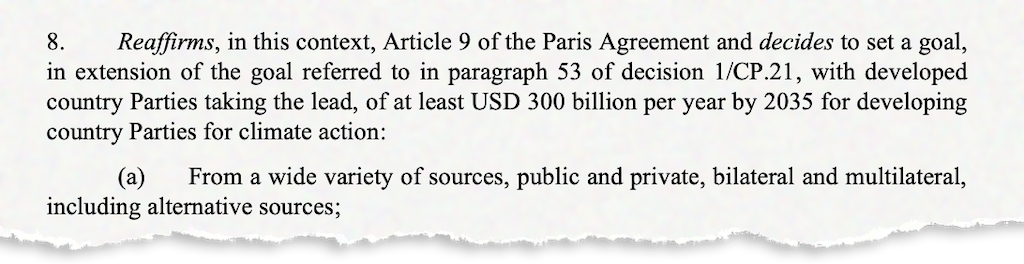
At COP29 in Baku, developed-country parties such as the EU, the US and Japan agreed to help raise “at least” $300bn a year by 2035 for climate action in developing countries.
The goal was welcomed by global-north leaders and presented as a “tripling” of the previous target for international climate finance.
Yet it faced a strong backlash from many developing countries, with some branding it a “joke” and “betrayal”.
Closer analysis of the goal and climate-finance data helps to explain this response.
Analysts have shown that the target is achievable with virtually “no additional budgetary effort” from developed countries, beyond already-committed increases.
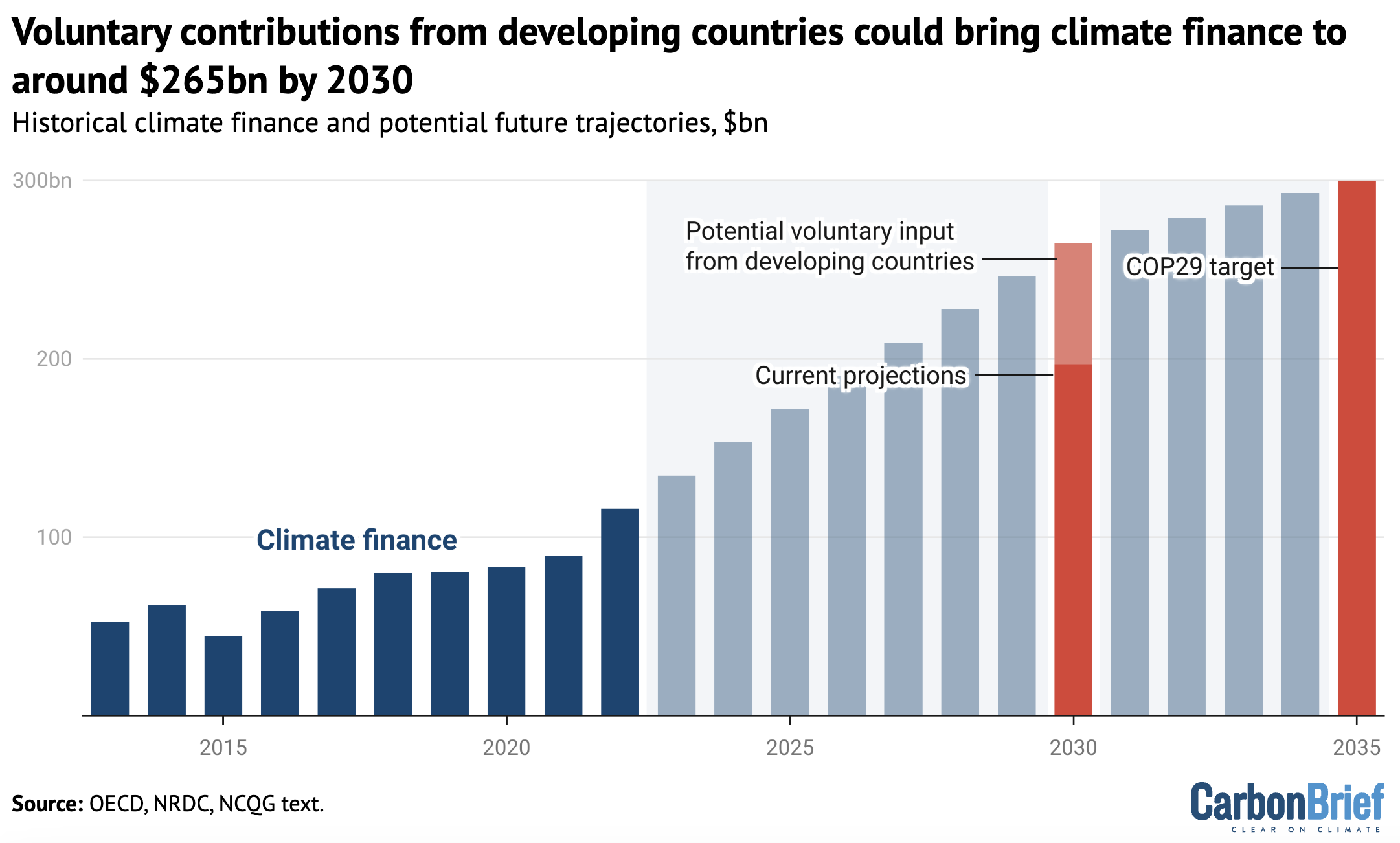
Counting money already being distributed by emerging economies such as China – as “encouraged” under the new goal – could bring the total to $265bn by 2030. This could mean the target is well on its way to being met by that date, with minimal extra effort.
Moreover, as activists and academics have noted, the $300bn target does not account for inflation. When this is factored in, its “real” value could shrink by around a quarter.
The new target has emerged against a backdrop of financial strain and political uncertainty in developed countries.
At the same time, developing countries have stressed that they need climate finance to reach the “trillions of dollars” needed to cut emissions and protect themselves from climate change.
This article looks at three ways in which the $300bn goal could be met with little extra financial effort by developed countries – and provide fewer benefits for developing countries than the figure suggests.
1. Much of the goal will be met with ‘no additional effort’
The $300bn climate-finance target agreed at COP29 in Baku will be met with finance from a “wide variety of sources”, largely coming from developed countries.
This part of the “new collective quantified goal” (NCQG) for climate finance is likely to be made up of public finance provided directly by governments, as well as money from MDBs, specialised climate funds and private finance “mobilised” by public investments.
The wording of the $300bn goal frames it as an extension of the $100bn target. This was the amount that developed countries agreed in 2009 to raise for developing countries annually by 2020 – a goal that was extended through to 2025 by the Paris Agreement.
Beyond the central goal of $300bn, the NCQG also includes a much broader “aspirational” target of $1.3tn a year in climate finance by 2035.
However, this is harder to assess, as the text of the deal is vague about who will be responsible for raising the funds, which could include various sources that are beyond the jurisdiction of the UN climate process.
Developed countries and MDBs had already committed to raising their climate-finance contributions before a deal was struck at COP29, as noted in a joint analysis by the Natural Resources Defense Council (NRDC), ODI, Germanwatch and ECCO.
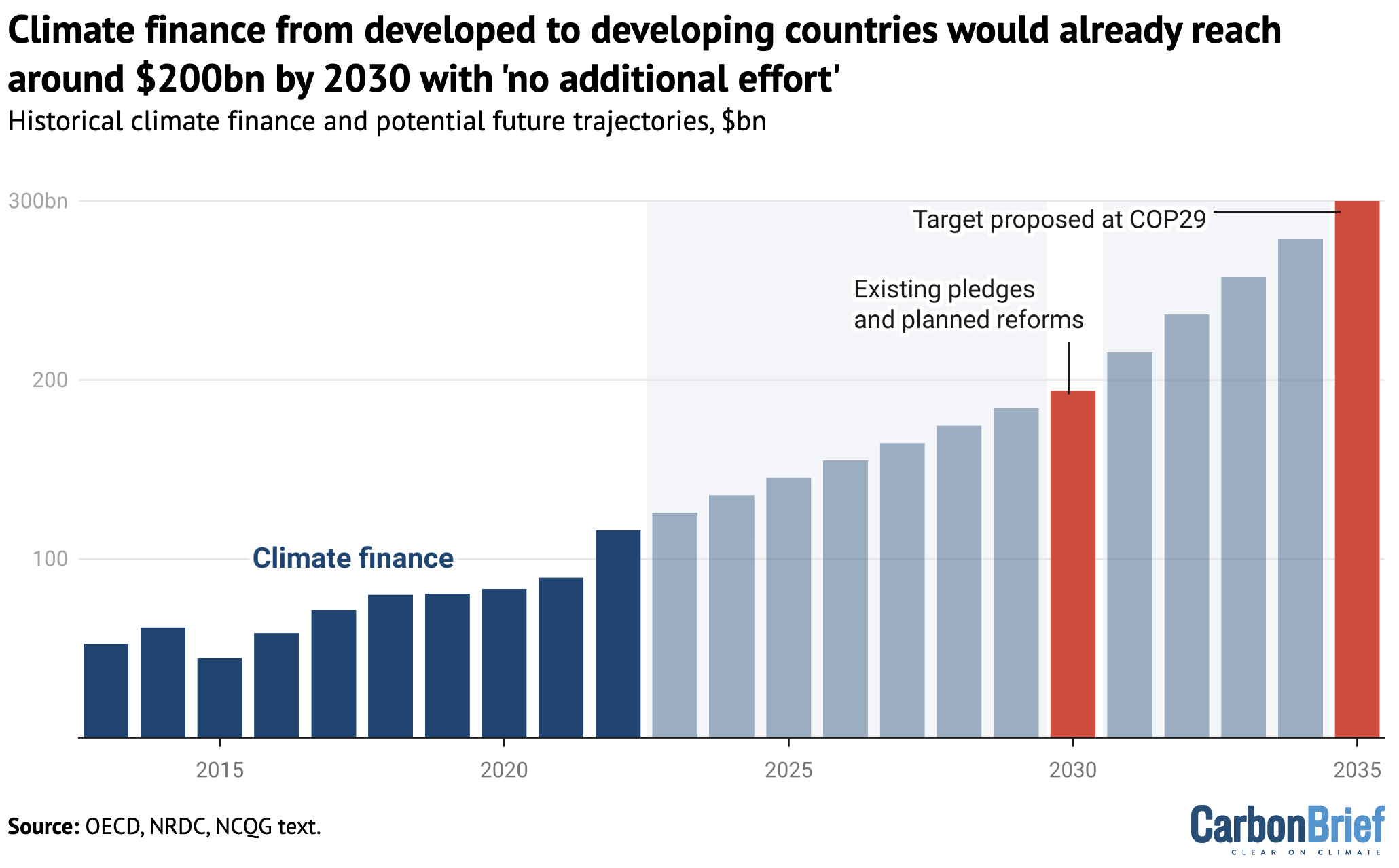
The collective impact of these pre-existing commitments can be seen below, with climate finance from developed countries set to increase from $115.9bn in 2022 – the most recent year for which data is available – to $197bn in 2030. This can be seen in the chart below, which does not account for inflation. (See: Inflation wipes out much of the increase in climate finance.)
Estimated climate finance in 2030, based on funds that have already been pledged, and target set at COP29 for 2035 (red). Dark blue bars show historical climate finance recorded by the Organisation for Economic Co-operation and Development (OECD), 2013-2022 (grey). The light blue bars indicate an estimated trajectory to reach the 2030 and 2035 levels. These figures do not account for inflation. Source: OECD, NRDC, NCQG text.
The expected increase between 2022 and 2030 comes from a few different sources.
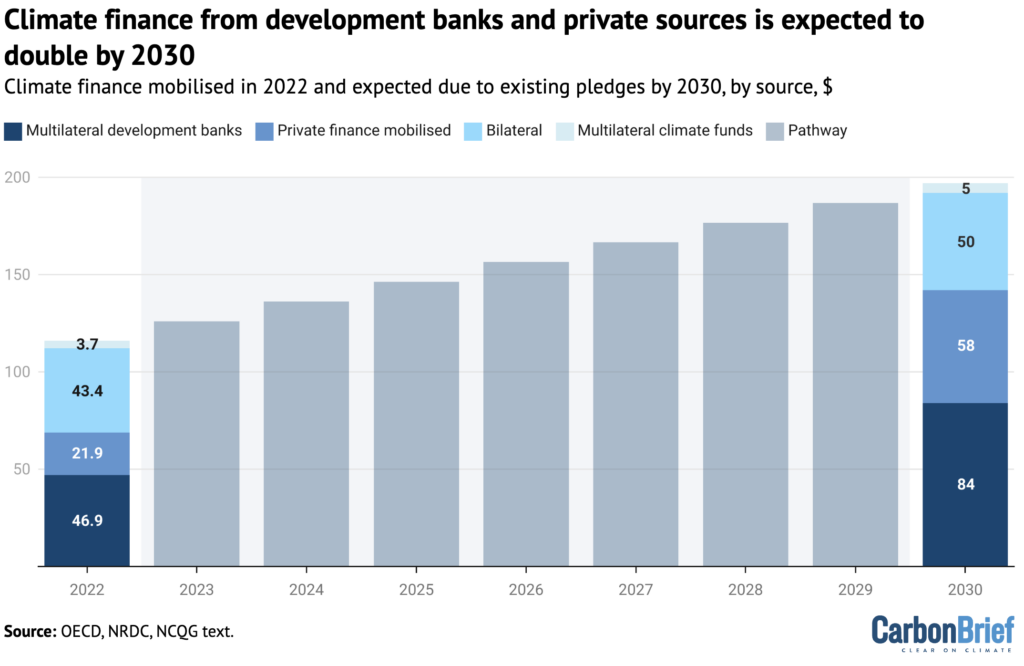
The analysts calculated that climate finance distributed “bilaterally” – as grants or loans via overseas aid and other public funding – was already expected to increase $6.6bn annually by 2025, based on existing pledges, bringing the total to $50bn. (The chart above assumes that bilateral finance remains at this level up to 2030.)
They also estimated that existing pledges and reforms at specialised climate funds, such as the Green Climate Fund and Climate Investment Funds, would add another $1.3bn per year by 2030. This would bring their contribution to $5bn.
The biggest increase that was already locked in before the COP29 deal was a pledge by MDBs – which provide 40% of existing climate finance – to increase their contributions further.
A joint statement by the World Bank, the Asian Development Bank and others in the first week of COP29 committed to raising $120bn of climate finance per year by 2030 for low- and middle-income countries. Of this, $84bn can be attributed to developed countries, based on their shareholdings in these banks.
On top of this, the climate-finance analysts estimated that $58bn of private finance would be mobilised by these bilateral and multilateral contributions in 2030 – up from $21.9bn in 2022.
The chart below shows the estimated breakdown, by source, of climate finance in 2030, compared to 2022.
Historical climate finance in 2022 and estimated climate finance in 2020, by source. Source: OECD, NRDC, NCQG text.
These expected increases over the course of this decade mean that with “no additional efforts”, beyond what had already been agreed prior to COP29, developed countries would have been on a trajectory to reach around $200bn per year by 2030, and $250bn per year by 2035. (The latter was the first numerical target proposed by developed countries at COP29, which was, ultimately, negotiated upwards to $300bn on the final day.)
NRDC climate-finance expert Joe Thwaites, one of the researchers who undertook the Natural Resources Defense Council’s (NDRC) analysis, tells Carbon Brief that bilateral funding directly from governments is the “big constraint” in climate finance. COP29 came just after the re-election in the US of climate-sceptic Donald Trump and many European countries have cut their aid budgets. Thwaites says:
“The MDBs are growing and doing all kinds of reforms and getting bigger and better, but the bilaterals are what are politically very stuck.”
Moreover, the COP29 climate-finance deal contains no pledge by developed countries to provide a set amount of public, bilateral finance, despite strong pressure from developing countries to include such a goal.
Following COP29, Thwaites released updated modelling to calculate different ways of reaching the $300bn target. He wrote:
“What is clear is that $300bn by 2035 is eminently achievable, with little to no additional budgetary effort required from developed countries, let alone other contributors, to meet the goal.”
2. Developing-country contributions could cover part of the goal
Unlike the earlier $100bn target, contributions from developing countries could count towards the new climate finance goal.
Only developed countries are obliged to provide climate finance to developing countries under the Paris Agreement. But the NCQG outcome says that developing countries can “voluntarily” declare any climate-related funds they contribute, if they choose to do so.
This allowed negotiators at COP29 to skirt the controversial issue of formally expanding the list of official donors that are required to help with financial aid.
Developed countries had previously been pushing to enlist relatively wealthy developing nations, such as China and the Gulf states, to share the financial burden.
Several countries described since the early 1990s as “developing” under the UN’s climate convention are known to already make large, climate-related financial contributions to other developing countries. Examples include China’s Belt and Road initiativesupporting clean-energy expansion and South Korea’s contributions to the GCF.
In fact, at COP29 China announced for the first time that it had “provided and mobilised” more than $24.5bn for climate projects in developing countries since 2017 – confirming that its contributions are comparable with those of many developed countries.
This roughly aligns with calculations by research groups that have placed China’s annual climate finance at around $4bn a year.
Both developed and developing countries pay money into MDBs. As well as “encouraging” developing countries to voluntarily contribute directly to climate finance, the NCQG outcome also specifies that these countries could start counting the share of climate-related money paid out of MDBs that can be traced back to their inputs.
Roughly, 30% of the banks’ “outflows” can be attributed to developing countries in this way.
Counting the developing-country share of the projected increase in climate finance from MDBs by 2030 would add an extra $36bn to the global total, plus an extra $20bn of private finance mobilised by the funds.
It is not possible to say for sure how much climate finance new contributors such as China will choose to officially declare.
However, the chart below shows an estimate based on an “illustrative scenario”, by NRDC and others, of bilateral finance and multilateral climate funds, combined with expected MDB outflows and the associated private finance that this would mobilise. This could bring total annual climate finance up to $265bn by 2030.
Potential voluntary contributions of climate finance by developing countries, including bilateral finance, contributions to multilateral funds, outflows from MDBs allocated to developing countries and private finance mobilised by developing country contributions to MDBs (lighter red), on top of estimated climate finance from developed countries in 2030 (red). The second red bar indicates the NCQG climate-finance target agreed for 2035 at COP29. The light blue bars indicate an estimated trajectory to reach the 2030 and 2035 levels. These figures do not account for inflation. Source: OECD, NRDC, NCQG text.
Some observers at COP29 said they hoped that officially counting developing-country contributions towards UN “climate finance” targets would enable parties, such as the EU, to set more ambitious goals.
However, Michai Robertson, lead finance negotiator for the Alliance of Small Island States (AOSIS), dismissed this as an “accounting trick”, because these funds are already being provided.
Li Shuo, head of the China climate hub at the Asia Society Policy Institute (ASPI), tells Carbon Brief that the NCQG outcome could bring more attention to China’s climate-related aid and lead to “stronger and better climate support from Beijing”. However, he notes that this is in the context of a low-ambition global target that is a “far cry” from what is needed:
“I take this as a classic example of geopolitical competition weakening environmental ambition, namely, the geopolitical desire of including China as a donor without corresponding desire of developed countries to contribute more limited the overall scale of climate finance.”
3. Inflation wipes out much of the increase in climate finance
One issue that has surfaced in the wake of COP29 is the impact of inflation. Campaigners have noted that the failure to factor this into the 2035 climate-finance target means that, by the time it is met, the true value of the money pledged will be far lower than it is today.
In an article highlighting this issue, the Guardian reported that the $300bn goal was, therefore, “not the tripling of pledges that has been claimed”.
Researchers had flagged this before COP29, pointing out that the previous $100bn annually by 2020goal, which was first set in 2009, had also not accounted for inflation.
They noted that merely correcting the $100bn for inflation would bring it to between $139bn and around $150bn a year. (Such calculations depend on the rate of inflation applied to the starting figure, as well as the base year for the calculation.)
Civil-society groups at COP29, such as Power Shift Africa, estimated that the impact of inflation would cut the “real” value of the $300bn to $175bn in today’s money by 2035. This is based on an annual inflation rate of 5%.
In its analysis, the Guardian opted for an inflation rate of 2.4% – based on the average rate in the US over the past 15 years. This is taken to reflect the conditions for governments contributing climate finance and the currency much of it would be provided in.
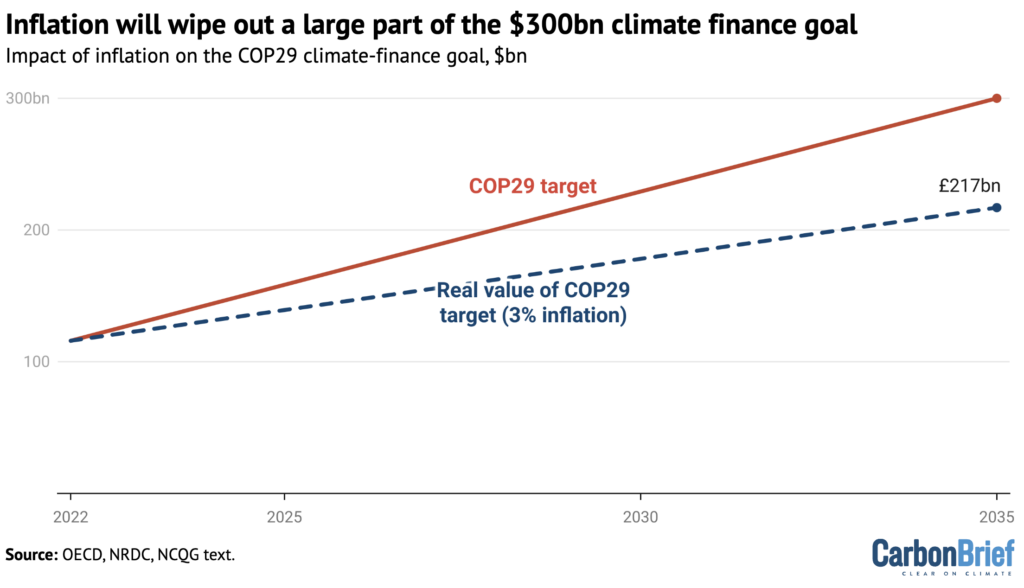
The figure below shows the impact of an inflation rate of 3%. This is based on input from economists and analysis by the Center for Global Development (CGD), which, in turn, is based on the World Bank’s global GDP deflator.
If inflation over the next decade follows this trend, the $300bn pledged in 2024 would only be worth $217bn in today’s money in 2035 – a 28% reduction in value.
In order to offer climate finance with a real value of $300bn in 2035, countries would have needed to set a goal for that year of around $415bn.
Increase in climate finance between 2022 and 2035 under the NCQG commitment in nominal terms (red line), and based on the “real” value of the $300bn climate-finance pledge in 2024 value terms (blue dotted line). Source: Carbon Brief calculation based on a 3% inflation rate, as used by CGD.
(The figures in the chart above cannot be directly compared with the existing pledges made by governments and MDBs, as those too would need to be adjusted for inflation.)
CGD modelling suggests that if developed countries’ climate-finance contributions simply increase in line with expected inflation and gross national income (GNI) growth, they would reach $220bn by 2035.
The CGD analysts write in a blog post that “by the time the new goal is met, beneficiary countries will find that the purchasing power of these resources has eroded significantly”.
Independentexperts, as well as climate-vulnerable countries themselves, emphasised both before and during COP29 that more than $1tn dollars will be needed each year to help developing countries deal with climate change. Many developing nations said that around $600bn of this should come directly from developed countries’ public coffers.
With such a relatively small amount of finance pledged for the NCQG, some developing countries have already indicated that they may scale back their future climate ambitions.