Category: Climate Crisis

  • ‘Frontlines of a Crisis We Did Not Create’: Low-Lying Nations Make Climate Case to ICJ

    Spread the love

    Original article by Eloise Goldsmith republished from Common Dreams under Creative Commons (CC BY-NC-ND 3.0). 
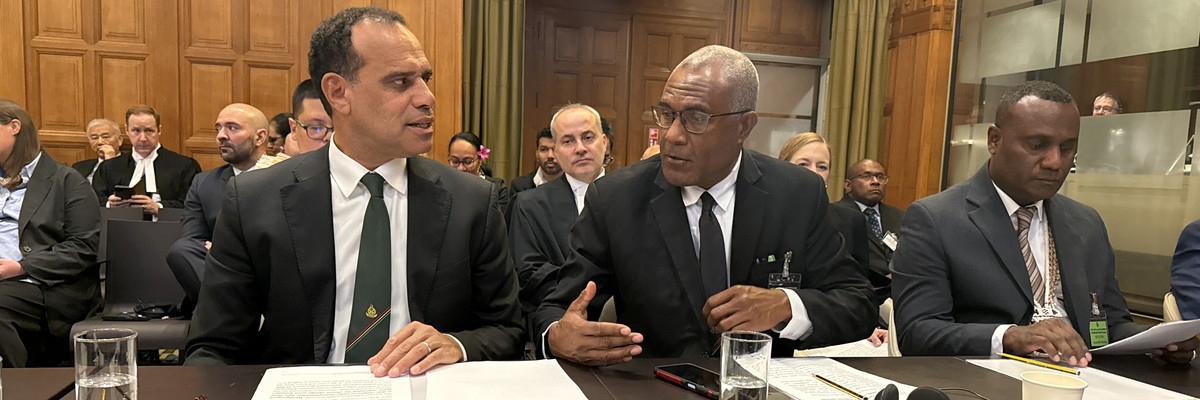
    Ralph Regenvanu (left), Vanuatu’s special envoy on climate change and the environment; Arnold Kiel Loughman (center), attorney general of Vanuatu; and Ilan Kiloe (right), legal advisor to the Melanesian Spearhead Group attend the advisory opinion sessions at the International Court of Justice (ICJ) in The Hague, Netherlands on December 2, 2024. (Photo: Selman Aksunger/Anadolu via Getty Images)

    “What started in the Pacific is now a historic climate justice campaign, as the world’s most urgent problem of climate change reaches the worlds highest court,” said one campaigner.

    The International Court of Justice (ICJ) heard arguments Monday in the largest climate case ever brought before it as a coalition of low-lying and developing nations demanded larger polluting nations be held to account under international law for causing “significant harm to the climate system and other parts of the environment” with runaway fossil fuel emissions over recent decades.

    In the first day of hearings in The Hague that could last weeks, multiple representatives from the Pacific island of Vanuatu, which is leading the coalition of over 100 countries and allied organizations, laid the blame for the climate crisis at the feed of a small number of states that are large emitters of greenhouse gases.

    “We know what the cause of climate change is: a conduct of specific States … Vanuatu’s contribution to global greenhouse gas emissions is negligible, and yet we are among those most affected by climate change,” said Arnold Kiel Loughman, attorney general of the Republic of Vanuatu.

    “We find ourselves on the frontlines of a crisis we did not create,” said Ralph Regenvanu, Vanuatu’s special envoy for climate change and environment, told the court.

    Monday’s historic moment at The Hague follows years of work on the part of Pacific Island nations, particularly Vanuatu, to push for the ICJ to take up the issue of global warming and human rights. The stakes of the planetary emergency are particularly high for these countries, which are under threat from rising seas and other climate impacts.

    Ilan Kiloe, legal counsel for the Melanesian Spearhead Group, a regional subgroup that includes Fiji, Papua New Guinea, Solomon Islands, and Vanuatu, issued a stark warning during his remarks to the court: “Climate change is now depriving our peoples, again, of our ability to enjoy our right to self-determination in our lands. The harsh reality is that many of our people will not survive.”

    Last year, the United Nations General Assembly unanimously adopted a resolution calling on the ICJ to issue an advisory opinion on climate change and human rights. The measure, which was introduced by Vanuatu and co-sponsored by more than 130 governments, requested that the world’s highest court outline countries’ legal responsibilities for combatting fossil fuel-driven climate change and the legal consequences of failing to meet those obligations.

    Over the next two weeks, the court will hear statements from nearly 100 nations, including wealthy developed countries such as the United States. Advisory opinions, unlike judgments, are not binding—but Vanuatu and other supporters hope that a forthcoming opinion would accelerate action around the climate emergency.

    The country began pushing for the ICJ resolution in 2021, following a campaign launched in 2019 by a group of students from the University of the South Pacific.

    “What started in the Pacific is now a historic climate justice campaign, as the world’s most urgent problem of climate change reaches the world’s highest court,” said Shiva Gounden of Greenpeace Australia Pacific.

    “The next two weeks of hearings are the culmination of collective campaigning from 2019, powerful advocacy, and mobilizing the world behind this landmark campaign, to ensure the human rights of current and future generations are protected from climate destruction, and the biggest emitters are held accountable.”

    Polly Banks, Vanuatu country director for Save the Children, who travelled to The Hague for the proceedings, said that “the hearing before the Court goes to questions about the efficacy, equity and fairness of the current responses to climate change, which are particularly relevant for children, who have contributed the least to climate change but will be most affected by its consequences.”

    “Currently, only 2.4% of climate finance from multilateral funding sources is child-responsive. Even without the Court’s opinion, we know that states need to do far more to protect children from the worst impacts of this crisis, by significantly increasing climate finance to uphold children’s basic rights and access to health, education and protection,” Banks added.

    The start of hearings at The Hague come on the heels of a COP29 climate summit that was heavily criticized. The summit focused heavily on climate finance, but the resulting deal was panned by critics as rich nations agreed to voluntarily provide just $300 billion to help developing nations decarbonize and deal with the impacts of the climate emergency. Poor nations and climate campaigners had demanded over a trillion dollars in funding in the form of debt-free grants and direct payments.

    Original article by Eloise Goldsmith republished from Common Dreams under Creative Commons (CC BY-NC-ND 3.0). 
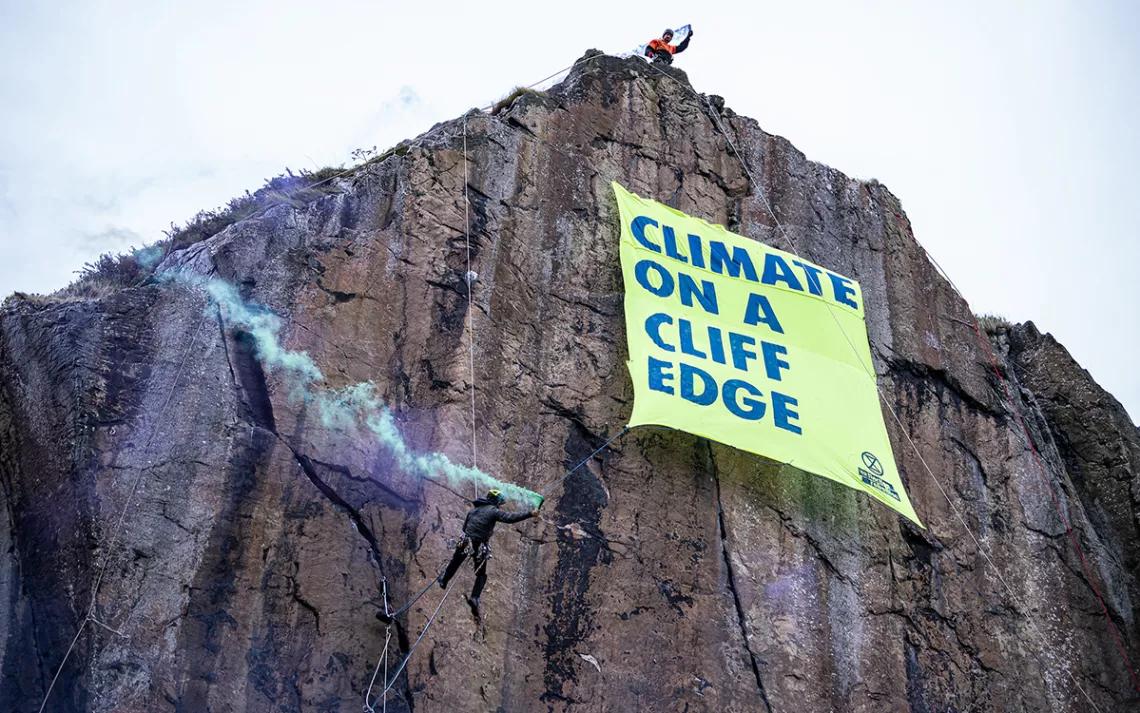
    Experienced climbers scale a rock face near the historic Dumbarton castle in Glasgow, releasing a banner that reads “Climate on a Cliff Edge.” One activist, dressed as a globe, symbolically looms near the edge, while another plays the bagpipes on the shores below. | Photo courtesy of Extinction Rebellion and Mark Richards
    Experienced climbers scale a rock face near the historic Dumbarton castle in Glasgow, releasing a banner that reads “Climate on a Cliff Edge.” One activist, dressed as a globe, symbolically looms near the edge, while another plays the bagpipes on the shores below. | Photo courtesy of Extinction Rebellion and Mark Richards
  • Protesters demand government end ‘green’ subsidies for Britain’s largest carbon emitter

    Spread the love

    https://morningstaronline.co.uk/article/protesters-demand-government-end-green-subsidies-britains-largest-carbon-emitter

    Greenpeace, Axe Drax, Friends of the Earth and Stop Burning Trees Coalition protest outside DESNZ to call for an end to Drax subsidies and for genuine clean power Photo: © Chris J Ratcliffe / Greenpeace

    PROTESTERS descended on Westminster today to demand that the government stop using taxpayers’ money to bankroll the destruction of forests.

    More than 100 environmental activists from groups including Axe Drax, Fossil Free London and Greenpeace gathered outside the Department of Energy Security and Net Zero, calling for an end to the vast subsidies granted to the Drax biomass power plant.

    The North Yorkshire plant is Britain’s largest carbon emitter, yet receives almost £1.5 million a day for burning biomass wood chips, a fuel source that Drax claims is “carbon neutral.”

    As part of the action, a choir celebrated Christmas trees in song and handed out origami trees to civil servants entering the building.

    Four people dressed as tree-like creatures representing the millions of trees burned by Drax presented the department with a Greenpeace petition, bearing the signatures of over 120,000 people, calling for an end to the subsidies.

    The power plant burned six million tonnes of wood pellets last year, equivalent to about half a billion Christmas trees.

    In February, a BBC Panorama investigation revealed that Drax had continued to burn wood from rare primary forests in Canada, after the programme first made the discovery two years ago.

    The plant was then forced to pay £25 million to Ofgem for failing to provide adequate data on the type of wood it sources.

    …

    https://morningstaronline.co.uk/article/protesters-demand-government-end-green-subsidies-britains-largest-carbon-emitter

  • Climate activists serving combined 41 years of jail time granted mass appeal hearing

    Spread the love

    https://morningstaronline.co.uk/article/climate-activists-serving-combined-41-years-jail-time-granted-mass-appeal-hearing Many articles from the Morning Star today

    The Whole Truth Five (from left to right) Lucia Whittaker De Abreu, Cressida Gethin, Louise Lancaster, Daniel Shaw and Roger Hallam Photo: Just Stop Oil

    SIXTEEN non-violent Just Stop Oil protesters handed draconian sentences since July have been granted an extraordinary mass hearing before the Court of Appeal next year, it was announced on Saturday.

    The hearing on January 29 and 30 at the Royal Courts of Justice in London will examine four separate cases involving activists from the group. Key points of contention will include whether conscientious motivation should be considered a mitigating factor.

    The outcome is anticipated to be a defining moment for protest rights in Britain.

    The 16 include the “Whole Truth Five,” who organised a protest on the M25 calling for a halt to new oil and gas licences. Roger Hallam, Cressida Gethin, Louise Lancaster, Daniel Shaw, and Lucia Whittaker De Abreu received a combined total of 21 years for their action.

    At the time, UN special rapporteur Michel Forst said the verdict marked a dark day for “anyone concerned with the exercise of their fundamental freedoms” in Britain.

    …

    Spokesman for the Free Political Prisoners campaign Lex Korte said: “A subset of judges have responded all too eagerly to the call from the disgraced Lord Walney, the arms and oil industry lobbyist, to jail peaceful climate campaigners for longer than if they’d committed serious crimes of sexual violence.

    …

    https://morningstaronline.co.uk/article/climate-activists-serving-combined-41-years-jail-time-granted-mass-appeal-hearing Many articles from the Morning Star today

  • ‘Greenwashing’ banks raised 1 trillion dollars for fossil fuel giants

    Spread the love

    Original article by Josephine Moulds republished from TBIJ under a Creative Commons Attribution-NonCommercial-NoDerivs 3.0 Unported License.

    NatWest among several banks in ‘net zero’ alliance continuing to support the fossil fuel industry

    At a glance

    • Banks with net zero pledges helped raise $1 trillion for companies expanding fossil fuels
    • Among them is NatWest, which may have broken climate pledge by funding BP
    • BP is developing a ‘carbon bomb’ in Azerbaijan, host of COP climate talks

    Less than a hundred miles from where world leaders are discussing how to meet their climate pledges, BP is drilling for gas.

    The Shafag-Asiman project, a sprawling gas field off the Azerbaijani coast, could inject more than 1 billion tonnes of carbon into the atmosphere. That is more than the UK would emit over three years, striking a major blow to efforts to slow down global warming.

    BP has said it intends to invest heavily in new oil and gas fields in the coming years. But it would be unable to pursue these dirty projects without billions in support from big banks. NatWest, for one, helped BP raise almost $500m last year in an apparent breach of its climate commitments.

    Banks will be in focus at Cop29, currently underway in Baku, Azerbaijan, as world leaders discuss how to raise trillions of dollars for countries suffering the effects of climate change.

    Although talks are unlikely to address their continued support for dirty energy, more than 140 banks worldwide have pledged to cut emissions associated with their lending and investments to almost zero by 2050.

    In May 2021, the IEA, the global body coordinating countries’ energy policies, sounded the alarm. Any new oil and gas developments would make it inevitable that temperatures would rise by more than 1.5 degrees. In other words, they would devastate the planet.

    https://flo.uri.sh/visualisation/20019523/embed

    Meanwhile, at BP’s Shafag-Asiman field, engineers were celebrating after finding fossil gas several thousand metres under the seabed – a new discovery that could significantly increase its output from the region. And the bankers were preparing to raise billions more for BP.

    That’s not all. Since May 2021, global banks that have committed to net zero have poured almost $1 trillion into companies pursuing expansion of oil and gas projects that would push the world beyond its survivable limits. Taken together these projects would produce almost seven times the annual emissions of the US.

    “It’s indefensible,” said John Lang, founder of the Net Zero Tracker, which evaluates big companies’ green plans. “There’s no way we can meet the temperature goals of the Paris Agreement if we continue financing the exploration of oil and gas.”

    He said banks with net zero commitments covering direct and indirect emissions could not fund oil and gas expansion. “It’s greenwashing, plain and simple.”

    NatWest said it could not comment on specific customers. It said it had conducted a review into its relationships with a number of oil and gas companies “to ensure they had a credible transition plan aligned with the 2015 Paris Agreement”. It refuted the suggestion it had not met its public commitments.

    BP said it is aiming to be a net zero company by 2050 or sooner and believes its strategy is consistent with the goals of the Paris Agreement.

    ‘Net zero’

    It was at Cop26 three years ago that a number of major banks first pledged that by 2050 they would cut almost all the emissions from their lending and investments to zero and invest in financial products to offset the remaining emissions – which has come to be known as “net zero”. NatWest, for instance, promised to stop funding companies that do not have a credible plan to shift their business away from fossil fuels. Its support for BP suggests it may have broken that promise.

    BP reported record profits in February last year and promptly announced it would scale back its climate commitments and increase investments in oil and gas. It then enlisted the help of NatWest and a host of other ‘net zero’ banks to raise a total of $5.3bn in 2023 – and went on to invest $4.8bn in its oil and gas operations in the first half of this year.

    In April, BP announced the first oil to be extracted from a new platform off the coast of Azerbaijan, which is expected to be operating until at least 2049, just a year before the world is supposed to have cut its dependence on fossil fuels.

    https://flo.uri.sh/visualisation/19957754/embed

    The world-leading Grantham Research Institute assessed how credible the largest oil and gas companies’ transition plans were. It said BP’s fell short by a significant margin.

    Many of the world’s biggest banks trumpet their net zero pledges to bolster their green credentials. But Nigel Topping, a member of the UK’s Climate Change Committee, explains that even when banks commit to cutting emissions associated with their financing in line with net zero, “it doesn’t stop them from financing companies who are continuing to expand [oil and gas production]”.

    More than 180 companies expanding fossil fuel production have raised money from ‘net zero’ banks since May 2021, according to an analysis of data from the environmental campaign group, Rainforest Action Network. Their expansion projects are spread across the globe, from ConocoPhillips in the Arctic circle to Petrobras near the mouth of the Amazon river, and Shell in the UK’s North Sea.

    A TBIJ analysis of the Global Oil and Gas Exit list, compiled by environmental campaign group Urgewald, shows these expansionary projects could produce almost 90 billion barrels of oil equivalent, which scientists say should stay in the ground. Around half of that is oil and half is gas, according to Urgewald, and calculations suggest it could generate more than 34 billion tonnes of CO2 emissions when burned.

    Topping said: “The fundamental problem is that the transition is not driven by regulation … The only people who can make companies change are regulators, and the regulators are letting us down.”

    Lead image: Offshore oil rigs at Baku Bay, near Baku, Azerbaijan. Anatoliy Zhdanov / Sipa US / Alamy Stock Photo

    Reporter: Josephine Moulds
    Environment editor: Rob Soutar
    Deputy editors: Katie Mark & Chrissie Giles
    Editor: Franz Wild
    Production editor: Alex Hess
    Fact checker: Somesh Jha

    TBIJ has a number of funders, a full list of which can be found here. None of our funders have any influence over editorial decisions or output.

    Original article by Josephine Moulds republished from TBIJ under a Creative Commons Attribution-NonCommercial-NoDerivs 3.0 Unported License.

  • Fossil fuel supply: the elephant in the room at climate change conferences

    Spread the love

    Ded pixto/Shutterstock

    Jordi Roca Jusmet, Universitat de Barcelona

    “Natural resources … are a gift from God. Every natural resource, whether it’s oil, gas, wind, sun, gold, silver, copper, they are all natural resources. Countries should not be blamed for having them, and should not be blamed for bringing these resources to the market because the market needs them. The people need them.”

    These were the words of Ilham Aliyev, president of Azerbaijan, at the opening of the recent United Nations COP29 convention on climate change in Baku. https://www.youtube.com/embed/4pqVwrMAGSc?wmode=transparent&start=0 Ilham Aliyev’s speech at COP29.

    It seems completely inappropriate to sing the praises of fossil fuels at an international gathering that aims to radically reducing greenhouse gas emissions. Indeed, this goal is absolutely unachievable without drastic cuts to fossil fuel use, but Aliyev’s speech does have a positive, if indirect, impact – it points a spotlight at the elephant in the room, one that has remained virtually invisible throughout the United Nations Framework Convention on Climate Change’s (UNFCCC) long history.

    COP agreements have never made commitments to limit fossil fuel extraction, even though this would be the most direct – and the only certain – way to rein in the leading cause of climate change.

    Reducing demand but not supply: a pointless endeavour

    Fossil fuels are key to climate change, but they are largely absent from COP agreements. The biggest achievement came in 2023, at COP28 in Dubai (United Arab Emirates), when an unspecified proposal was made to “transition away from fossil fuels”. This was not ratified at COP29, mainly due to pressure from Saudi Arabia.

    In economic terms, the focus of climate agreements has always been on demand. It is expected that national measures, such as promoting renewable energy and public transport, or penalising the use of fossil fuels by putting a price on carbon emissions will indirectly lead to less fossil fuels being put on the market.

    While these measures can be effective, they often end up lacking, or even non-existent, because they depend completely on the policies and reactions of the nations and companies who own, supply, and profit from these resources.

    Commitments to supply-side agreements are not on the COP agenda, even though most of the fossil fuel reserves that are considered exploitable – and therefore economically valuable – cannot be burned if we are to even come close to the UNFCCC climate goals. They must be left in the ground.

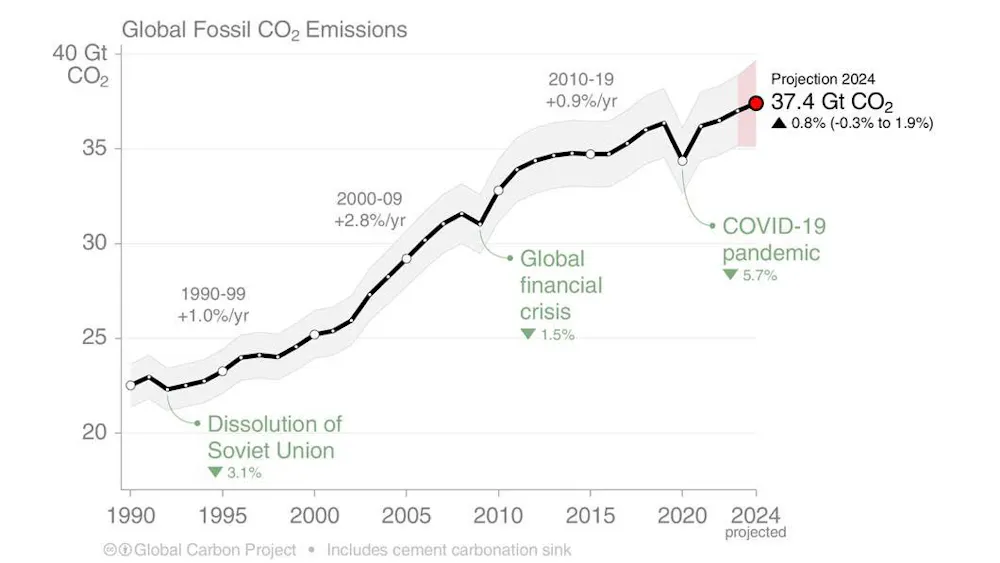
    However, global CO₂ emissions are not falling. On the contrary, the use of coal, petroleum and natural gas have hit record highs in 2024.

    Evolution of global CO₂ emissions. Global Carbon Project, CC BY-SA

    How can we restrict fossil fuel extraction?

    Limits have been put forward in the past. In 2014, for instance, economists Paul Collier and Anthony J. Venables proposed a sequenced plan for phasing out coal, which would involve progressive measures not to start new operations and to close mines, with countries staggered in a fair order. “Fairness” would be determined by ability to pay, per capita emissions and historical responsibility.

    We can also take inspiration from nuclear weapons treaties, as Professor of International Relations Peter Newell and political economist Andrew Simms have done. They advocate for a fossil fuel non-proliferation treaty along the lines of the nuclear non-proliferation treaty. Many states and cities around the world have already signed up to the initiative.

    There have also been local initiatives, such as the commitment to stop extracting oil in an area of the Yasuní National Park in Ecuador due to its exceptional biodiversity and the existence of populations in voluntary isolation. This will also benefit the global climate by reducing emissions.

    The proposal was initially taken up in 2007 by the then president Rafael Correa on the condition that the international community would financially compensate part of the sacrificed monetary income. However, scarce contributions to the compensation fund led Correa to renounce the initiative and allow oil exploitation.

    Environmentalists, affected communities and academics demanded a referendum and, after years of litigation, the right to consultation was recognised by the courts. In August 2023, a large majority (almost 60 %) voted in favour of keeping the oil reserves “in the ground indefinitely”. Money does not always prevail, even in poor countries, though the Ecuadorian government has postponed its mandate to dismantle drilling sites, meaning many are still operational today.

    A blessing for some, a curse for others

    The above case and many others – such as the Niger Delta (Nigeria), where Shell has been extracting oil since 1958 – remind us that “God’s gift” of natural resources can also be a curse.

    A gift for some – usually multinational companies or small numbers of wealthy people – can be a curse not only for the planet, but also for the local population who suffer the devastating environmental and social consequences of extracting these resources, and who face violent repression when they protest.

    It was in places like Nigeria and Ecuador that the activist slogan “leave fossil fuels in the ground” was coined. Even if their motivation is primarily or solely to protect their territory, social movements opposing coal mining or hydrocarbon extraction undeniably contribute – from the supply side – to curbing climate change.

    Together with social movements, academic and political work is key to defining the areas where preventing the exploitation of fossil fuels is a priority, and to establishing economic compensation. Martí Orta-Martínez, from the University of Barcelona, is doing just this. He is leading a project to geographically define the fossil fuel deposits that should not be burned, which was presented at a seminar in the framework of COP29.

    It may sound utopian to seek supply-side international agreements, but the truth is that it is impossible to reduce global emissions and move towards decarbonisation without a rapid decrease in the extraction of fossil fuels. COPs should heed this evidence.

    Given the magnitude of the climate challenge, it is not a question of deciding between demand or supply-side policies, but of using both, promoting them in each country, and reaching robust agreements at an international level.

    Jordi Roca Jusmet, Catedrático de Economía, Universitat de Barcelona

    This article is republished from The Conversation under a Creative Commons license. Read the original article.