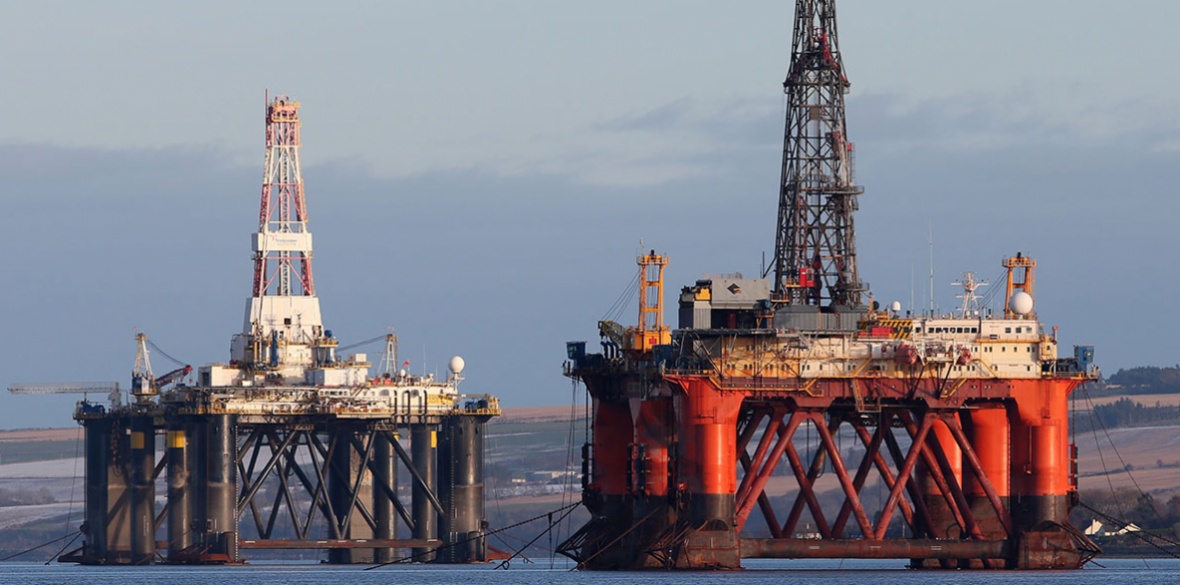
An oil platform standing amongst other rigs that have been left in the Cromarty Firth near Invergordon in the Highlands of Scotland, February 15, 2016
BUSINESSES across Britain have backed the Labour government’s ban on new oil and gas licensing in the North Sea, according to new research today.
The study, carried out by Public First on behalf of fair transition think tank Uplift, found that 70 per cent of British business leaders and 65 per cent in Scotland backed the policy, 54 per cent believed it would benefit their business, and 77 per cent believed phasing out fossils fuels was in the public interest.
In Scotland, the heart of Britain’s fossil fuel industry, 82 supported wider UK government efforts to end use of fossil fuels for energy.
And despite 47 per cent believing the pace of change to be too slow, a majority believe it will be achieved by the government’s 2050 target.
Fifty-two per cent of business leaders in Scotland expressed confidence that new jobs would be created to replace the tens of thousands lost as North Sea oil and gas production dwindles.
But echoing the views of trade unions, they argue it is governments’ responsibility to support workers through that shift.
After a disappointing COP29, we should prepare for more extreme weather events like the floods that hit Valencia last month | David Ramos/Getty Images
Summit proves change won’t come until floods and wildfires are killing tens of thousands in rich Global North cities
While COP29 in Baku narrowly avoided collapsing, its results were bitterly disappointing for delegations from across the Global South, who ended up with barely a quarter of the annual $1.3trn of support they were seeking by 2035 to respond to climate breakdown.
Quite apart from other factors, more than 1,500 pro-carbon lobbyists worked hard to limit progress and ensure that burning oil, gas and coal at profit continues for as long as possible whatever the global consequences. After all, the world’s fossil fuel industries rake in around a trillion dollars in profits a year.
Meanwhile, more and more examples are emerging of accelerating climate breakdown. The flooding in Valencia is just one, but scarcely noticed in Europe is the thoroughly weird weather being experienced in the eastern United States.
This autumn there have been over five hundred wildfires in New Jersey alone, a 5,000-acre fire has been burning for a week on the New York-New Jersey border prompting a voluntary evacuation, and New York City’s Fire Department was called out to deal with 271 brush fires in the first two weeks of November alone.
As if timed for that and certainly released with COP29 in mind, Carbon Brief, a website covering the latest developments in climate science, climate policy and energy policy, has mapped every published study on ‘impossible’ weather events – record heatwaves or storms that would not have happened without the overall global climate changes.
The first such study came in 2004, the year after weeks of extreme heat hit Europe and killed 70,000 people across the continent over several months. That early example of an ‘impossible’ weather event kick-started a new field of research known as ‘extreme event attribution’, which looks at how climate change has influenced extreme weather.
There are now 600 studies of 750 such extreme events spanning the past 20 years – a tiny fraction of the total number of these kinds of events. Of these 750, Carbon Brief found that scientists and researchers had concluded that 74% were made more likely or more severe because of climate change.
This has added to the growing sense of urgency right across the climate science community coupled with a highly critical view of the whole COP process. Even before the dismaying summit in the Azerbaijani capital, both last year’s COP in Abu Dhabi and the year before in Egypt were notable for their lack of progress even as the urgency of preventing climate breakdown was becoming more and more obvious.
There are other risks to global security including nuclear weapons, pandemics, cyber warfare, AI misuse and the progressive destruction of biodiversity, but climate breakdown is different from all of these. It is not a future risk, it is a current happening, it is accelerating, and we now have very few years left to get on top of it. If we don’t then a worldwide catastrophe with many hundreds of millions dying and societal collapse will become increasingly likely.
Does it have to be like that?
As things stand, in terms of changing attitudes, developments in renewables, resistance of the fossil carbon industries and, of course, Donald Trump’s looming presidency in the US, a reasonable prognosis for the next decade has three elements.
First, the use of renewable energy resources does continue to increase but not at anything like the rate required, so net carbon emissions will continue to rise, not fall, for most of the next ten years. Second, resistance to decarbonisation will continue from many quarters, no doubt now including the White House. Finally, severe weather events will become both more common and more destructive.
Eventually, and it might take more than a decade, the disasters will be so great, including sudden weather events in rich cities in the Global North killing many tens of thousands of people, that public pressure across the world will force governments to respond. There will be no alternative to engage in truly transformative change.
But what that means is that the task ahead by then will be hugely greater than if the transformation starts much sooner, so timescales become crucial, especially what can speed up the process.
There is, though, one thing to remember at a time of widespread pessimism. If nations had got their act together 25 years ago after the Kyoto Protocols, were signed we would be in a far more favourable position worldwide than we are now. We are acting more than two decades late.
But climate breakdown is not happening as a slow, steady process of change, creeping up almost unawares. If that had been the case then with all the reasons not to act, especially the global fossil carbon lobby, we would have been in an even worse position now. Instead, it is happening at variable rates in two respects, some parts of the world – such as the polar regions – are warming up much faster than others and extreme weather events are happening much more often.
We are therefore getting a foretaste of what will affect everyone a few years before it does, and this gives us just a little more time to act. It means that the next ten years, and perhaps even the five years to 2030, will be the key time for us to come to terms with the transformation in society that is essential for global well-being. That is possible, just.
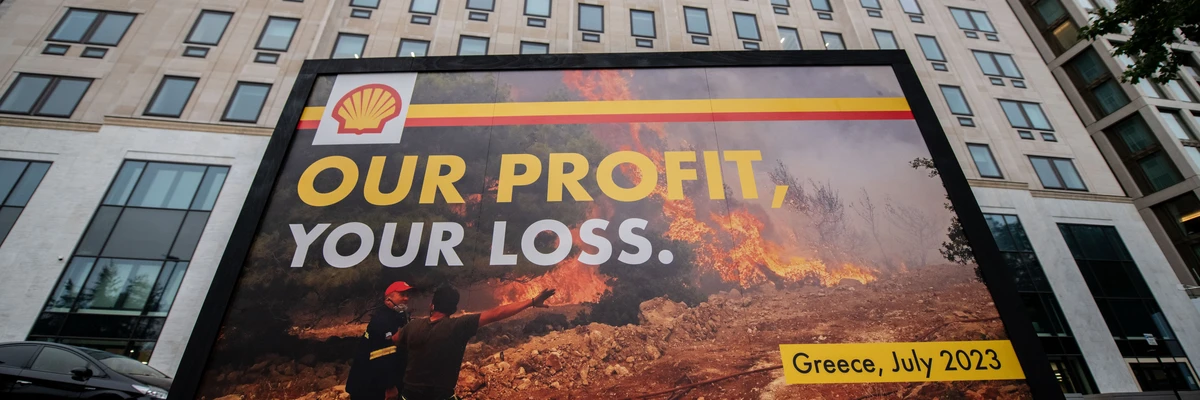
Greenpeace activists display a billboard during a protest outside Shell headquarters on July 27, 2023 in London. (Photo: Handout/Chris J. Ratcliffe for Greenpeace via Getty Images)
Storm Bert caused serious flooding in UK, particularly in the South Wales town of Pontypridd. Gross Capitalists scum and governments scum refuse to accept responsibility for their actions in destroying the climate at COP29. Yet more false solutions pushed by the fossil fuel industry pursued by governments …
It seems like nothing changes. Our climate is fekked. The fossil fuel industry and politicians are responsible for it since they have known since the 1960s. Governments and politicians are supposed to protect their populations. Instead they are controlled and quite willingly work for the rich and powerful. Despite the UK government committing to radical action to address climate, they still pursue false solutions i.e. carbon capture and nuclear power.
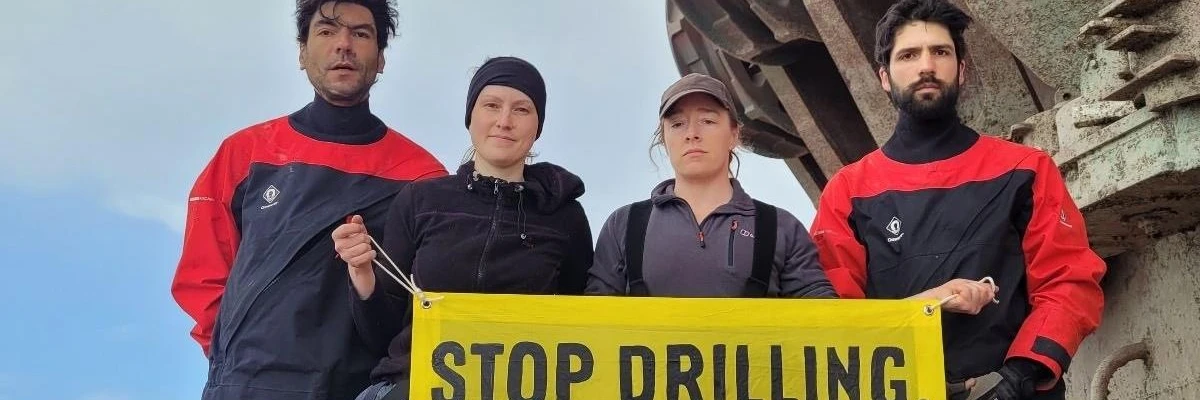
Four Greenpeace activists are pictured on a Shell vessel in the Atlantic Ocean on January 31, 2023.
ed: We are at 1.5C increase now, the limit proposed by the Paris Agreement. We’re flying past it because gross Capitalists and Capitalist politicians are refusing to address the climate crisis. We are on course to far more and far more severe extreme weather events because of these cnuts.
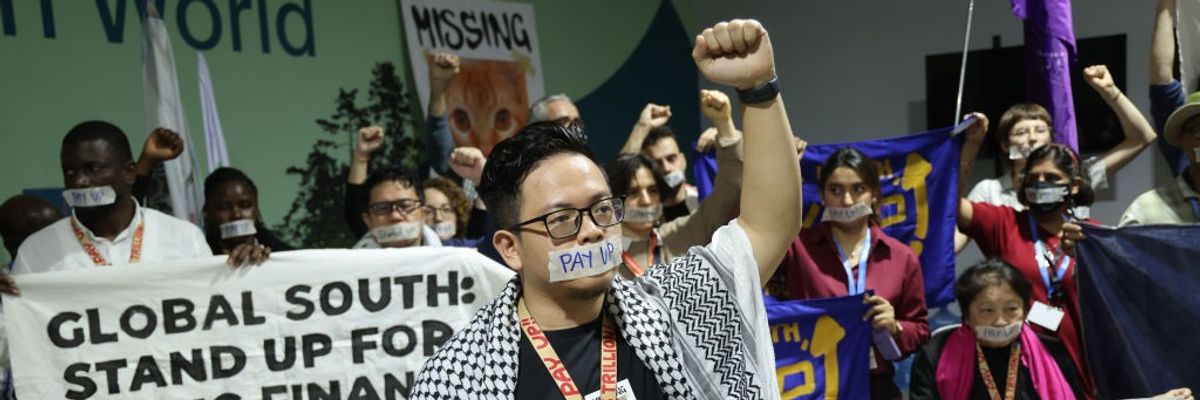
Activists demanding that rich countries pay up for climate finance protest at COP29 in Baku, Azerbaijan on November 22, 2024. (Photo: Sean Gallup/Getty Images)
Critics of the “COP of false solutions” said that instead of much-needed funding, developing nations got “a global Ponzi scheme that the private equity vultures and public relations people will now exploit.”
It was early Sunday by the time the United Nations climate summit wrapped up in Baku, Azerbaijan after running into overtime to finalize deals on carbon markets and funding for developing countries that were sharply condemned by campaigners worldwide.
“COP29 was a dumpster fire. Except it’s not trash that’s burning—it’s our planet,” declared Nikki Reisch of the Center for International Environmental Law. “And developed countries are holding both the matches and the firehose.”
Recalling last year’s conference in the United Arab Emirates, Oil Change International global policy senior strategist Shady Khalil highlighted that “the world made a deal at COP28 to end the fossil fuel era. Now, at COP29, countries seem to have been struck with collective amnesia.”
“With each new iteration of the texts, oil and gas producers managed to dilute the urgent commitment to phase out fossil fuels,” Khalil said. “But let’s be clear: Rich countries’ failure to lead on fossil fuel phaseout and to put the trillions they have hoarded on the table has done more to imperil the energy transition than any obstructionist tactics from oil and gas producers.”
This year’s conference began November 11 and was due to conclude on Friday, but parties to the Paris agreement were still negotiating the carbon market rules, which were finalized late Saturday, and the new collective quantified goal (NCQG) on climate finance.
“The carbon markets in Article 6 of the Paris agreement were pushed through COP29 in a take-it-or leave-it outcome,” said Tamra Gilbertson of Indigenous Environmental Network, decrying “a new dangerous era in climate change negotiations.”
Sorry, this content could not be embedded. [yet again] X
As Climate Home Newsreported, they establish two types of markets: “The first—known as Article 6.2—regulates bilateral carbon trading between countries, while Article 6.4 creates a global crediting mechanism for countries to sell emissions reductions.”
The outlet pointed to expert warnings that “the rules for bilateral trades under 6.2 could open the door for the sale of junk carbon credits—one of the weaknesses of the previous crediting mechanism set up by the U.N. known as the Clean Development Mechanism (CDM).”
Jonathan Crook of Carbon Market Watch said in a statement that “the package does not shine enough light on an already opaque system where countries won’t be required to provide information about their deals well ahead of actual trades.”
“Even worse, the last opportunity to strengthen the critically weak review process was largely missed,” he continued. “Countries remain free to trade carbon credits that are of low quality, or even fail to comply with Article 6.2 rules, without any real oversight.”
As for Article 6.4, “much lies in the hands of the supervisory body” that’s set to resume work in early 2025, said Crook’s colleague, Federica Dossi. “To show that it is ready to learn from past mistakes, it will have to take tough decisions next year and ensure that Article 6.4 credits will be markedly better than the units that old CDM projects will generate.”
“If they are not, they will have to compete in a low-trust, low-integrity market where prices are likely to be at rock bottom and interest will be low,” Dossi added. “Such a system would be a distraction, and a waste of 10 years worth of carbon market negotiations.”
Some campaigners suggested that no matter what lies ahead, the embrace of carbon markets represents a failure. Kirtana Chandrasekaran at Friends of the Earth International said that “the supposed ‘COP of climate finance’ has turned into the ‘COP of false solutions.’ The U.N. has given its stamp of approval to fraudulent and failed carbon markets.”
“We have seen the impacts of these schemes: land grabs, Indigenous peoples’ and human rights violations,” Chandrasekaran noted. “The now-operationalized U.N. global carbon market may well be worse than existing voluntary ones and will continue to provide a get out of jail free card to Big Polluters whilst devastating communities and ecosystems.”
Sorry, this content could not be embedded. [What a surprise!] X
Chandrasekaran’s colleague Seán McLoughlin at Friends of the Earth Ireland was similarly critical of the conference’s finance deal, asserting that “Baku is a big F U to climate justice, to the poorest communities who are on the frontlines of climate breakdown.”
“COP29 has failed those who have done least to cause climate change and who are most vulnerable to climate breakdown because the process is still in thrall to fossil fuel bullies and rich countries more committed to shirking their historical responsibility than safeguarding our common future,” he said. “Now it’s back to citizens to demand our governments do the right thing. We must keep demanding the trillions, not billions owed in climate debt and a comprehensive, swift, and equitable fossil fuel phaseout. The struggle for climate justice is not over.”
Campaigners and developing nations fought for $1.3 trillion in annual climate finance from those most responsible for the planetary crisis. Instead, the NCQG document only directs developed countries to provide the Global South with $300 billion per year by 2035, with a goal of reaching the higher figure by also seeking funds from private sources.
The deal almost didn’t happen at all. As The Guardiandetailed Saturday: “Developed countries including the U.K., the U.S., and E.U. members were pushed into raising their offer from an original $250 billion a year tabled on Friday, to $300 billion. Poor countries argued for more, and in the early evening two groups representing some of the world’s poorest countries walked out of one key meeting, threatening to collapse the negotiations.”
While Simon Stiell, executive secretary of U.N. Climate Change, celebrated the NCQG as “an insurance policy for humanity, amid worsening climate impacts hitting every country,” Chiara Martinelli, director at Climate Action Network Europe, put it in the context of the $100 billion target set in 2009, which wealthy governments didn’t meet.
“Rich countries own the responsibility for the failed outcome at COP29,” Martinelli said. “The talk of tripling from the $100 billion goal might sound impressive, but in reality, it falls far short, barely increasing from the previous commitment when adjusted for inflation and considering the bulk of this money will come in the form of unsustainable loans. This is not solidarity. It’s smoke and mirrors that betray the needs of those on the frontlines of the climate crisis.”
Also stressing that “it’s not even real ‘money,’ by and large,” but rather “a motley mix of loans and privatized investment,” Oxfam International’s climate change policy lead, Nafkote Dabi, called the agreement “a global Ponzi scheme that the private equity vultures and public relations people will now exploit.”
“The terrible verdict from the Baku climate talks shows that rich countries view the Global South as ultimately expendable, like pawns on a chessboard,” Dabi charged. “The $300 billion so-called ‘deal’ that poorer countries have been bullied into accepting is unserious and dangerous—a soulless triumph for the rich, but a genuine disaster for our planet and communities who are being flooded, starved, and displaced today by climate breakdown.”
Sorry, this content could not be embedded. [Who broke the twitter/X embed?]
X
Rachel Cleetus from the Union of Concerned Scientists, who is in Baku, took aim at not only rich governments, but also the host, saying that “the Azerbaijani COP29 Presidency’s ineptitude in brokering an agreement at this consequential climate finance COP will go down in ignominy.”
Cleetus’ group is based in the United States, which is preparing for a January transfer of power from Democratic President Joe Biden to Republican President-elect Donald Trump, who notably ditched the Paris agreement during his first term.
“The United States—the world’s largest historical contributor of heat-trapping emissions—is going to see a monumental shift in its global diplomacy posture as the incoming anti-science Trump administration will likely exit the Paris agreement and take a wrecking ball to domestic climate and clean energy policies,” Cleetus warned. “While some politically and economically popular clean energy policies may prove durable and action from forward-looking states and businesses will be significant, there’s no doubt that a lack of robust federal leadership will leave U.S. climate action hobbled for a time.”
“Other nations—including E.U. countries and China—will need to do what they can to fill the void,” she stressed. “Between now and COP30 in Brazil next year, nations have a lot of ground to make up to have any hope of limiting runaway climate change.”
Ben Goloff of the U.S.-based Center for Biological Diversity called out the departing Biden administration, arguing that it “should be going out with at least a signal of its moral climate commitment, not copping out ahead of the Trump 2.0 disaster.”
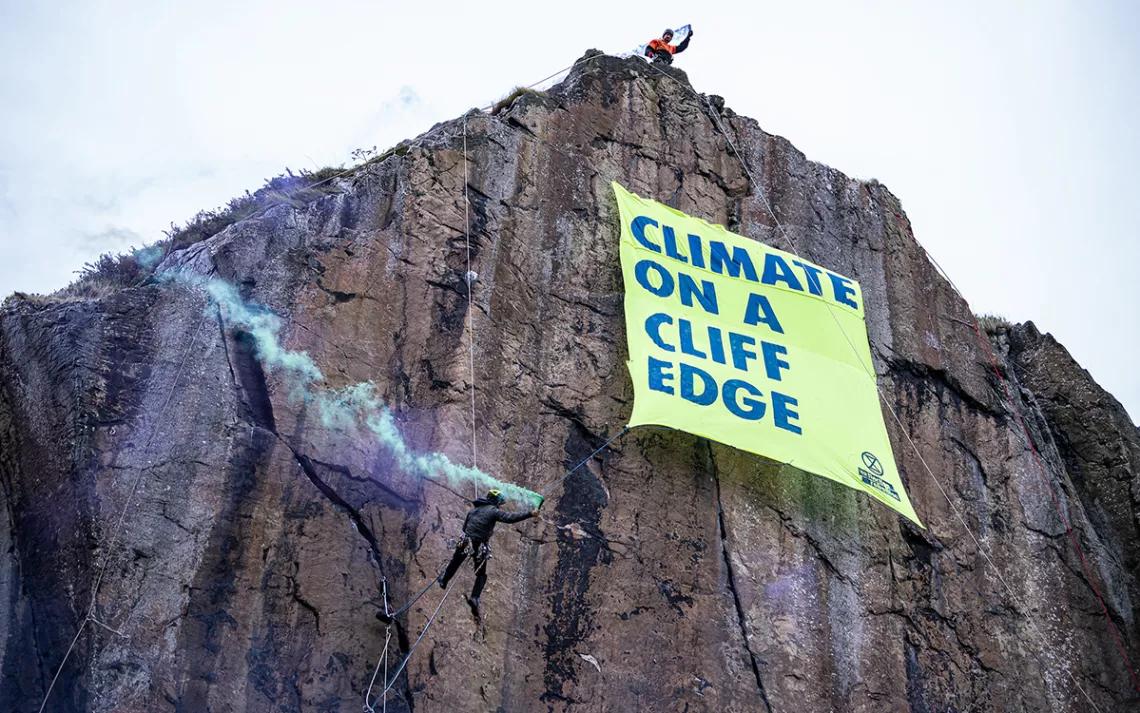
Experienced climbers scale a rock face near the historic Dumbarton castle in Glasgow, releasing a banner that reads “Climate on a Cliff Edge.” One activist, dressed as a globe, symbolically looms near the edge, while another plays the bagpipes on the shores below. | Photo courtesy of Extinction Rebellion and Mark RichardsOrcas comment on killer apes destroying the planet by continuing to burn fossil fuels.
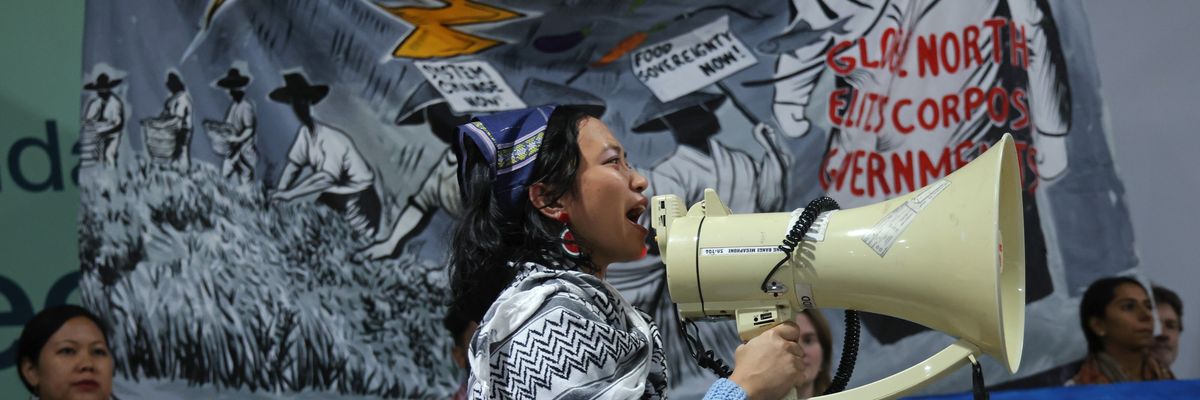
Activists demonstrate against industrial agriculture and agribusiness lobbyists on day eight at the UNFCCC COP29 Climate Conference on November 19, 2024 in Baku, Azerbaijan. (Photo by Sean Gallup/Getty Images)
“By the end of the UN climate talks, we must see at least a trillion dollars in public finance on the table,” said one campaigner.
As the clock winds down at the UN climate summit taking place in Baku, Azerbaijan, green groups are sounding the alarm Thursday following the release of a draft climate finance deal that they say falls short of what’s needed to support climate-vulnerable countries and adequately address the planetary crisis.
“The clock is ticking. COP29 is now down to the wire,” said UN Secretary-General António Guterres on Thursday, just a day before the two-week conference is set to conclude.
Finance has been a major focus of this year’s summit. Under the 20125 Paris Agreement, countries are supposed to come up with a “new collective quantified goal”—or NCQG in COP jargon—that will govern how much money from rich countries will be transferred to developing countries in order to help the latter cut their emissions and adapt to climate change.
No equivalent climate finance arrangement has been agreed to before, though countries at the summit broadly agree that richer countries, who are responsible for much of historic CO2 emissions, should help poorer and more climate-vulnerable nations deal with natural disasters and their transition to green energy.
The draft text that dropped early Thursday, however, was received poorly.
Oxfam International’s climate justice lead, Safa’ Al Jayoussi, said “COP29 must do more than simply repeat the same threadbare promises. Rich countries have spent decades now stalling and blocking genuine progress on climate finance. This has left the Global South suffering the most catastrophic consequences of a climate crisis they did not create. The draft text scandalously misses the crucial element of declaring a clear public commitment to a new climate finance goal.”
Instead of specifying how much annually should be funneled towards developing countries via climate finance, the NCQG draft text displayed “X” in place of any actual figures or monetary commitments.
Oscar Soria, a director at the Common Initiative think tank, told the Guardian: “The negotiating placeholder ‘X’ for climate finance is a testament of the ineptitude from rich nations and emerging economies that are failing to find a workable solution for everyone.”
“By the end of the UN climate talks, we must see at least a trillion dollars in public finance on the table,” added Andreas Sieber, 350.org associate director of policy and campaigns. Economists told the summit attendees last week that developing countries need at least $1 trillion annually by 2030 to deal with climate change.
A specific and shared concern from campaigners was the draft text’s inclusion of carbon market schemes as a way “to scale up” climate finance. While the draft promotes “high-integrity voluntary carbon markets” and other “instruments that mobilize new sources of climate finance and private finance” as part of the equation, critics have long warned that these market-based approaches are nothing but false solutions designed to benefit corporate investors, wealthier nations, and the fossil fuel industry itself.
“Labelling carbon credits as climate finance—which they are unreservedly not—should be axed from the text or risk creating a dangerous escape route for polluters. The same goes for explicitly allowing investments in fossil fuel infrastructure. This is fundamentally incompatible with the goals of the Paris Agreement,” said Laurie van der Burg, Oil Change International’s global public finance manager, in response to the draft text.
While Article 6 of the Paris Agreement allows for the international transfer of carbon credits, groups warned the changes in the COP29 draft would dramatically strengthen the foothold of such schemes.
“Shockingly, COP29 is set to agree to carbon markets that are even worse than the voluntary carbon markets,” said Kirtana Chandrasekaran, a climate campaigner with Friends of the Earth International. “We know these markets have failed. They are riddled with fraud and they do not reduce emissions or provide finance. Communities everywhere and, in fact, the planet itself is on the line.”
Without addressing these concerns, advocates of a meaningful deal at the conference say COP29 is headed for failure.
As 350.org‘s Sieber argued, paying the “historic debt that rich countries owe will enable all nations to take action on climate at home and meet the collective goal agreed last year at COP28—to triple renewable energy, and transition away from fossil fuels. Right now, we only see cowardice and a void in leadership, ignoring the undeniable science that we can’t keep polluting our planet with dirty oil, gas and coal.”
“The time to course correct is now—the European Union and other rich countries must stop playing poker with the planet and humankind’s future at stake,” Sieber added. “It’s time to put their cards on the table and commit real, transformative funding—no more excuses, no more delays, it’s time.”
Experienced climbers scale a rock face near the historic Dumbarton castle in Glasgow, releasing a banner that reads “Climate on a Cliff Edge.” One activist, dressed as a globe, symbolically looms near the edge, while another plays the bagpipes on the shores below. | Photo courtesy of Extinction Rebellion and Mark RichardsOrcas comment on killer apes destroying the planet by continuing to burn fossil fuels. Second version, corrected text.