Category: Climate Crisis

  • Two paintings souped as Just Stop Oil supporters sentenced

    Spread the love
    Just Stop Oil second occasion of souping Van Gogh at the National Gallery 27 Sept 2024.
    Just Stop Oil second occasion of souping Van Gogh at the National Gallery 27 Sept 2024. Image by JSO.

    Just Stop Oil supporters have thrown soup over two of Vincent Van Gogh’s Sunflowers paintings at the National Gallery in London in a sign of defiance after the original soup throwers, Phoebe Plummer and Anna Holland were imprisoned for up to two years at Southwark Crown Court today. Just Stop Oil is demanding that governments work together to establish a fossil fuel treaty, to end the extraction and burning of oil, gas and coal by 2030.

    At around 2:30pm, three supporters of Just Stop Oil entered the Van Gogh ‘Poets and Lovers’ exhibition at the National Gallery and proceeded to throw Heinz vegetable soup over two Van Gogh masterpieces:  ‘Sunflowers’ 1889 and ‘Sunflowers’ 1888. The latter was splashed with soup by Phoebe Plummer and Anna Holland in 2022.

    Taking off jackets they revealed Just Stop Oil t-shirts and spoke to the assembled crowds. Referring to the 25 Just stop Oil supporters now in prison, Phil Green announced: ” Future generations will regard these prisoners of conscience to be on the right side of history.”

    Subsequently Ludi Simpson said: “We will be held accountable for our actions today, and we will face the full force of the law. When will the fossil fuel executives and the politicians they’ve bought be held accountable for the criminal damage that they are imposing on every living thing?”

    Just Stop Oil second occasion of souping Van Gogh at the National Gallery 27 Sept 2024. Image by JSO.
    Just Stop Oil second occasion of souping Van Gogh at the National Gallery 27 Sept 2024. Image by JSO.

    One of those taking action today is Phil Green, 24, a community worker from Cornwall who said:

    “Whilst deadly flooding, food shortages and extreme heat wreak havoc around the world, the state is choosing to focus energy on prosecuting ordinary people with the harshest sentences. Future generations will see those who stood up against suffering, genocide and greed as heroes and our reckless governments as the real criminals.”

    Also taking action today is Ludi Simpson, 71, a retired Professor from Bradford, who said

    “My action is from the heart and the head. I know politicians can do the right thing if they listen to the facts, but their inaction is burning up our lives. Is it too much to ask for a safe future? Soup on sunflowers is a splash of protest. The treasured pictures remain unharmed.  What is harming our future is the criminal greed of the fossil fuel economy. Our government can choose to end it now.”

    Mary Patricia Somerville, 77, a grandmother from Bradford who was also taking action today said:

    “I am more and more frightened that we’re running out of time to save humanity from extinction. We desperately need an international Fossil Fuel Treaty to prevent this from happening in the lifetime of my grandchildren.  Harvey, aged 8, told me his plans for when he grows up. ‘I’d like to write musicals,’ he said,  ‘but with climate change  I might be dead.’ “

    Just Stop Oil supporters throw soup on Van Gogh artwork again

  • Labour just gave a TOP government JOB to someone from its £4m hedge fund donor, Quadrature

    Spread the love
    Keir Starmer commits to play the caretaker role for Capitalism through the "hard times".
    Keir Starmer commits to play the caretaker role for Capitalism through the “hard times”.

    https://www.thecanary.co/uk/analysis/2024/09/25/labour-quadrature-rachel-kyte

    As predictable as night following day, there WAS some backscratching involved in the £4m donation the Labour Party got from offshore tax-registered hedge fund Quadrature. The pay off? The co-chair of a board of its charitable foundation arm – Rachel Kyte – is now the UK government’s climate envoy.

    Thanks to openDemocracy doing the journalism the corporate media consistently fail to, we now know that the Labour Party accepted a huge donation just after Rishi Sunak called July’s general election from Quadrature Capital.

    We also know that the company behind it invest themselves in the worst of the worst. However, for a final sting in the tail, look no further than what this hedge fund does with some of the cash it makes.

    Labour Party: £4m in slush funding…?

    As openDemocracy revealed:

    The Labour Party’s largest-ever donation came from a Cayman Islands-registered hedge fund with shares worth hundreds of millions of pounds in fossil fuels, private health firms, arms manufacturers and asset managers.

    While the £4m donation by Quadrature Capital is the sixth-largest in British political history, it is noteworthy not just for its size, but also its timing.

    Of course, no one should really be surprised that Keir Starmer’s Labour Party is accepting donations from hedge funds registered in tax havens. However, there were further revelations from openDemocracy. These include the fact that Quadrature had investments in fossil fuel, arms, and private healthcare companies.

    However, the donation got its reward for Quadrature.

    Now we know what Quadrature’s £4m was for

    As journalist Michael Crick revealed on X, the Labour government’s new climate envoy is Rachel Kyte – who just happens to sit on the advisory board of Quadrature Charitable Foundation:

    …

    Article continues at https://www.thecanary.co/uk/analysis/2024/09/25/labour-quadrature-rachel-kyte

    dizzy: The on-the-take shower of sihts that currently govern us probably see nothing wrong with a rich offshore hedge fund buying a plump government role to promote it’s own interests. Years ago it was called corruption.

  • Climate scientists call on Labour to pause £1bn plans for carbon capture

    Spread the love

    https://www.theguardian.com/environment/2024/sep/25/climate-scientists-call-on-labour-to-pause-1bn-investment-plans-carbon-capture-blue-hydrogen

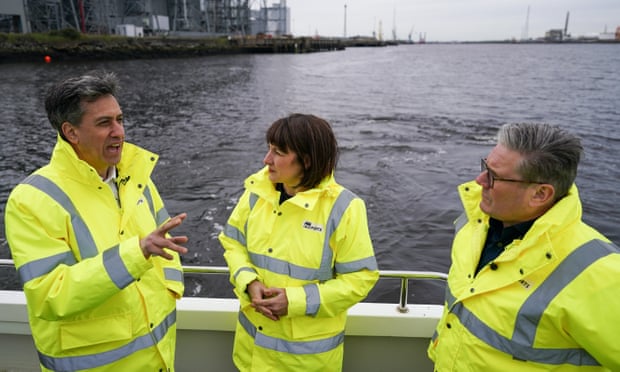
    Ed Miliband, Rachel Reeves and Keir Starmer visit Teesside, the location of a proposed multibillion-pound carbon capture and storage project. Photograph: Ian Forsyth/Getty Image

    Letter says technologies to produce blue hydrogen and capture CO2 are unproven and could hinder net zero efforts

    Leading climate scientists are urging the government to pause plans for a billion pound investment in “green technologies” they say are unproven and would make it harder for the UK to reach its net zero targets.

    Labour has promised to invest £1bn in carbon capture, usage and storage (CCUS) to produce blue hydrogen and to capture carbon dioxide from new gas-fired power stations – with a decision on the first tranche of the funding expected imminently.

    However, in the letter to the energy security and net zero secretary, Ed Miliband, the scientists argue that the process relies on unproven technology and would result in huge emissions of planet-heating CO2 and methane – gases that are driving the climate crisis.

    “We strongly urge you to pause your government’s policy for CCUS-based blue hydrogen and gas power, and delay any investment decision … until all the relevant evidence concerning the whole-life emissions and safety of these technologies has been properly evaluated,” they write.

    The letter, which is signed by leading climate scientists from the UK and US as well as campaigners, argues the plans would:

    • Lock the UK into fossil fuel production for generations to come.
    • Result in huge upstream emissions from methane leaks, transport and processing of liquefied natural gas (LNG) from the US.
    • Rely on carbon capture and storage (CCS) during the production of hydrogen – technology they say has been abandoned in the vast majority of similar projects around the world.
    • Pose a danger to the public if there are any leaks from pipes carrying the captured carbon. At least 45 people had to be taken to hospital after a leak in the US.

    …

    https://www.theguardian.com/environment/2024/sep/25/climate-scientists-call-on-labour-to-pause-1bn-investment-plans-carbon-capture-blue-hydrogen

  • ‘Red Alert’ as 7th of 9 Planetary Boundaries On Verge of Being Breached: Report

    Spread the love

    Original article by Edward Carver republished from Common Dreams under Creative Commons (CC BY-NC-ND 3.0). 

    A diver checks the coral reefs of the Society Islands in French Polynesia in 2019. (Photo: Alexis Rosenfeld/Getty Images).

    “Our updated diagnosis shows that vital organs of the Earth system are weakening, leading to… rising risks of crossing tipping points.”

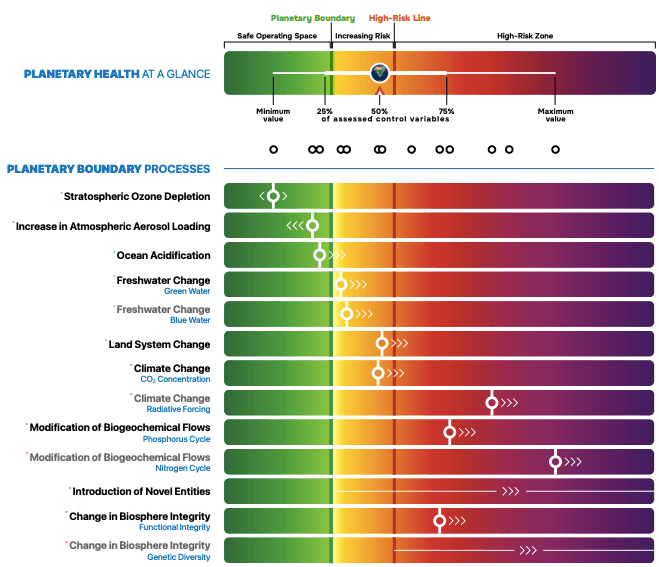
    Six of nine planetary boundaries have already been transgressed, and a seventh, for ocean acidification, is on the verge of being breached, according to a major report released Monday.

    The 96-page report, produced by the Potsdam Institute for Climate Impact Research (PIK), is the first in a planned series of annual “planetary health checks.”

    The authors found that safe planetary boundaries had already been crossed for the climate, freshwater, land use, biogeochemical flows, novel entities, and biosphere integrity—in keeping with a study in Science Advances last year. They found a “clear trend towards further transgression”—moving deeper into the danger zone, where irreversible tipping points are more likely to be triggered—in each of the six categories.

    “Our updated diagnosis shows that vital organs of the Earth system are weakening, leading to a loss of resilience and rising risks of crossing tipping points,” Levke Caesar, a PIK climate physicist lead author of the report, said in a statement that announced a “red alert.”

    The health check also showed that ocean acidification, a seventh category, has reached a dangerous precipice, putting the foundations of the marine food web at risk. Ocean acidification, which can threaten coral reefs and phytoplankton populations, is caused by the buildup of carbon dioxide from burning fossil fuels and other human activities.

    Caesar said a “safe operating space” threshold for acidification could be crossed in the next few years.

    “Looking at the current evolution, I’d say it’s really, really difficult to prevent that [boundary] crossing,” she toldMongabay.

    A graphic shows the status of nine environmental categories, four of which have been broken down into two control variables. Image from Planetary Health Check 2024. Design by Globaïa.

    PIK director Johan Rockström, a co-author of the new report, helped develop planetary boundary research in the late 2000s. In a seminal 2009 paper in Nature, he and his co-authors found that three of the nine boundaries had already been crossed. That number has gradually gone up based on a series of studies over the last decade.

    The planet boundary framework, which is often connected to the degrowth movement, emphasizes that the categories are interconnected.

    “The interconnectedness of [planetary boundary] processes means that addressing one issue, such as limiting global warming to 1.5°C, requires tackling all of them collectively,” the new report says.

    Boris Sakschewski, a climate scientist who, along with Caesar, is a lead author of the report said that, “We know that all planetary boundary processes act together and each one needs protection to protect the whole system.”

    The consequences of continued ocean acidification, which is primarily measured by aragonite saturation, would be severe, the report warns.

    Ocean acidification is approaching a critical threshold, with significant declines in surface aragonite saturation, particularly in high-latitude regions like the Arctic and Southern Ocean. These areas are vital for the marine carbon pump and global nutrient cycles, which support marine productivity, biodiversity, and global fisheries. The growing acidification poses an increasing threat to marine ecosystems, especially those reliant on calcium carbonate for shell formation.

    Some researchers believe that the ocean acidification threshold has already been crossed, especially given regional variability, with cooler polar waters absorbing more carbon dioxide, causing a faster drop in pH levels.

    The report was written with a general audience in mind and is not peer-reviewed, though it’s based on peer-reviewed studies, the authors said.

    The final pages of the report present solutions, especially agricultural. A radical overhaul of the global food system, heavily dependent on fertilizer and other harmful inputs, will be necessary to reverse the disturbing trends documented in the report, the authors wrote.

    “Sometimes overlooked compared to the impacts of energy production and consumption—particularly the use of fossil fuels—the food systems we depend on are among the largest drivers of environmental degradation. The global food system is the single largest driver behind the transgression of multiple planetary boundaries,” the report says.

    Original article by Edward Carver republished from Common Dreams under Creative Commons (CC BY-NC-ND 3.0). 

  • Ending Oil Subsidies, Taxing the Rich Could Help Free Up $5 Trillion a Year for Climate: Report

    Spread the love

    Original article by Jake Johnson republished form Common Dreams under Creative Commons (CC BY-NC-ND 3.0).

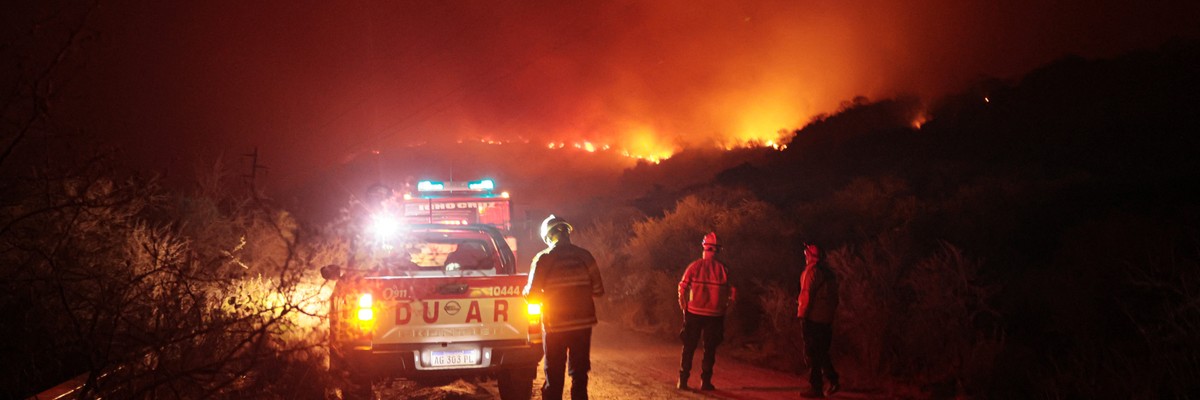
    Wildfires are seen in San Marcos Sierra, Cordoba province, Argentina, on September 23, 2024. (Photo: Stringer/AFP via Getty Images)

    “The real question isn’t whether we can afford to act, but whether we can afford not to.”

    Research published Tuesday estimates that rich countries could mobilize over $5 trillion a year for climate action worldwide by cutting off subsidies to the oil and gas industry, imposing a levy on big polluters, and cracking down on tax evasion by large corporations and the rich.

    The new report from Oil Change International (OCI) was released as world leaders gathered in New York City for high-level United Nations General Assembly talks, a meeting that comes less than two months before the COP29 climate summit in Azerbaijan.

    OCI’s research, which includes a fact sheet outlining various proposals to raise funds for climate action, stresses that “there is no shortage of public money available for rich countries to pay their fair share on fair terms for climate action at home and abroad.”

    “The urgency and extent of growing economic inequality, unfair sovereign debt crises, climate disasters, and fossil fuel profits have created significant momentum towards many of these measures in international and domestic policy spheres,” OCI’s research brief notes. “Finance has been in the spotlight in most major international political fora in the past few years in recognition that our current financial architecture is a major driver of these overlapping crises.”

    Among the proposals laid out in OCI’s brief are an equitable end to “public finance, direct subsidies, and state-owned company investments in fossil fuels,” which could raise $846 billion a year globally; a “climate damages tax” on fossil fuel extraction, which could raise $618 billion a year; a 25% minimum corporate tax rate, which could raise $479 billion annually; and a wealth tax on billionaires, which could raise roughly $2.60 trillion a year in the Global North and over $5.6 trillion worldwide.

    Laurie van der Burg, OCI’s public finance lead, said that the rich nations most responsible for the climate emergency “owe this money to Global South countries that have not caused this crisis and need fair finance to deliver strong climate plans next year that phase out fossil fuels.”

    “This is essential to avoid climate breakdown and save lives,” she added.

    The COP29 climate summit will take place a year after nations agreed at COP28 to transition “away from fossil fuels in energy systems” in a “just, orderly, and equitable manner.”

    The success of that pledge, OCI said, depends on rich nations contributing massively to global climate finance after years of falling short of their pledges and continuing to expand fossil fuel extraction and handouts. Worldwide, environmentally harmful subsidies—including fossil fuel subsidies—have surged to $2.6 trillion a year, according to a report released last week.

    “Global North countries have a responsibility to redirect their share of these subsidies in support of climate action,” OCI said Tuesday.

    The new report comes on the heels of a record-hot summer and amid devastating extreme weather, from massive flooding across Europe and Africa to wildfires in South America.

    Andreas Sieber, associate director of policy and campaigns at 350.org, said Tuesday that “the real question isn’t whether we can afford to act, but whether we can afford not to.”

    “It is a bitter irony that rich nations hide behind claims of fiscal restraint, yet trillions are still spent on fossil fuel subsidies and militarization,” said Sieber. “The truth is simple: the money exists, but the political will does not. By treating climate finance as a zero-sum game, wealthy countries not only deepen global inequality but also undermine their own futures.”

    “The energy transition isn’t charity—it’s an investment in global stability and security,” Sieber added. “Ignoring the need for support only worsens the climate crisis, which knows no borders.”

    Original article by Jake Johnson republished form Common Dreams under Creative Commons (CC BY-NC-ND 3.0).