The Whole Truth Five (from left to right) Lucia Whittaker De Abreu, Cressida Gethin, Louise Lancaster, Daniel Shaw and Roger Hallam
FIVE Just Stop Oil (JSO) activists who were given record jail time after attending a Zoom call formally launched an appeal against the sentences, legal charity Plan B Earth announced today.
Roger Hallam, Daniel Shaw, Louise Lancaster, Lucia Whittaker De Abreu and Cressida Gethin were imprisoned for co-ordinating a peaceful action on the M25 over Zoom in November 2022.
The action aimed to press the government to halt new oil and gas licences, something that has since been implemented by Labour since it took office.
They were convicted of “conspiracy to cause a public nuisance” under the Tories’ draconian Police, Crime, Sentencing and Courts Act.
Mr Hallam, co-founder of JSO, was sentenced to five years’ imprisonment — the longest for a peaceful action in Britain — while the four others were each jailed last month for four years.
So far, those convicted for their part in racist riots over the last weeks have been sentenced to between two months and three years in prison.
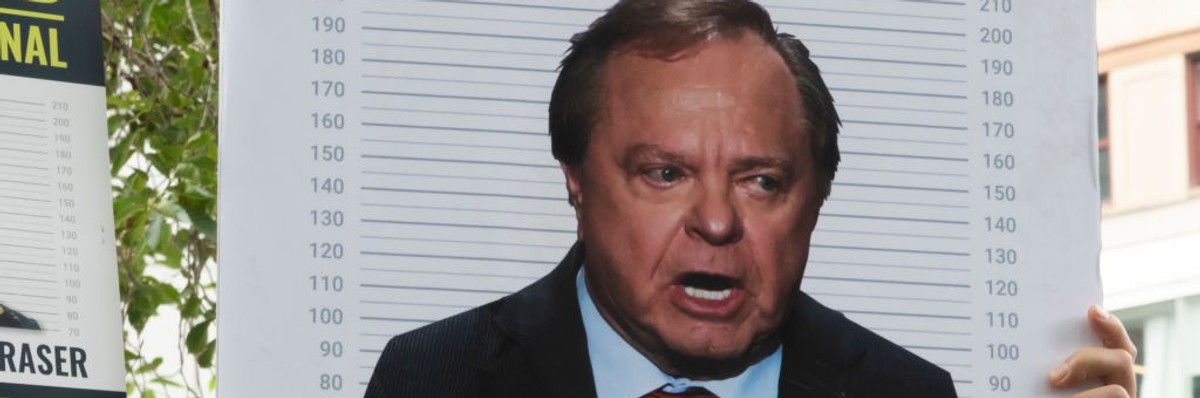
A climate campaign holds a symbolic wanted poster for Harold “Frackenstein” Hamm, CEO of Continental Resources and one of several individuals characterized by a campaign as a top climate criminal, in New York City on July 22, 2024. (Photo: John Senter/UCG/Universal Images Group via Getty Images)
“Oil barons are bankrolling the Trump campaign because Donald Trump promises to impose their policy ‘wish list’ that will make them even richer,” said the Harris campaign.
“Not familiar with Harold Hamm? You should be.”
That’s according to Washington Post climate policy editor Stuart Leavenworth, who shared the newspaper’s Tuesday reporting on the fossil fuel executive’s relationship with former President Donald Trump, the Republican nominee for the November election.
“This oil tycoon is bringing in millions for Trump,” the editor noted, “and is relaying to Trump what the fossil fuel industry wants.”
The Post‘s Josh Dawsey and Maxine Joselow revealed in May that during an event in Florida, Trump vowed to gut the Biden administration’s climate regulations if elected in November as long as the oil and gas industry put $1 billion toward his campaign—a revelation that sparked alarm and even congressional investigations.
In Tuesday reporting described by other journalists as ” great” and “important,” the pair exposed how “Hamm, the billionaire founder of Continental Resources, called other oil executives and encouraged them to attend fundraisers and open their wallets” after the April dinner at Mar-a-Lago, Trump’s Florida residence.
Hamm reportedly described the November contest as “the most important election in our lifetime” and “railed against President Joe Biden’s energy policies.” Following a disastrous debate performance against Trump, the Democratic incumbent passed the torch to Vice President Kamala Harris, who has since secured her party’s nomination.
Donna Brazille, a political strategist and former Democratic National Committee chair, used the new reporting to compare the candidates. As she put it, “This oil tycoon brings in millions for Trump, and may set his agenda.”
Hamm’s top priorities, according to the Post, are “opening up more federal lands to drilling, easing the Endangered Species Act, and curbing numerous regulations at the Environmental Protection Agency.”
Brazille pointed out that “meanwhile, as attorney general in California, Harris prosecuted oil companies for leaks from pipelines and storage tanks, and even sued the Obama administration.”
Harris has quickly garnered support from various organizations concerned about the fossil fuel-driven climate emergency, including some that had declined to endorse Biden. Her running mate is Minnesota Gov. Tim Walz—a choice widely welcomed by green groups, despite his record on the Line 3 oil pipeline—while Trump picked Big Oil-backed Sen. JD Vance (R-Ohio).
Both Trump and Vance have made clear that if they win, they plan to “drill, baby, drill,” a promise that wealthy figures in the fossil fuel industry seem to be buying. The Post reported that thanks in part to introductions by Hamm, “Trump has now ‘called almost everyone in the sector,”” and “the money has been flowing in,” with the industry contributing over $20.3 million.
How you know government is for sale:
Oil billionaire Hamm turned to DeSantis, Haley before Trump. Why?
“Privately, he complained to friends that Trump had not responded to his request for a pardon for an associate near the end of his term” https://t.co/JC8Z3v3BHu
Harris campaign spokesperson Joseph Costello said in a statement that “oil barons are bankrolling the Trump campaign because Donald Trump promises to impose their policy ‘wish list’ that will make them even richer at the expense of the middle class and a healthy future for our children.”
“Trump’s extreme Project 2025 agenda will give handouts to billionaires, crush jobs, and send costs skyrocketing,” Costello added. “America is more energy independent than ever under the Biden-Harris administration, and Vice President Harris is helping create hundreds of thousands of good paying energy and manufacturing jobs—a boom for working families that Trump would dismantle.”
Hamm—who initially backed two Trump primary challengers: Florida Gov. Ron DeSantis and former South Carolina Gov. Nikki Haley—did not respond to the Post‘s requests for comment while the campaign said that Trump “is proud to be supported by people who share his vision of American energy dominance to protect our national security and bring down the cost of living for all Americans.”
More Perfect Unionnoted in response to the Tuesday reporting that Hamm is among dozens of billionaires backing Trump—who is also expected to push tax cuts for rich individuals and corporations if he returns to the White House.
As Sludgedetailed last month, ultrawealthy contributors to the Trump campaign and related groups include casino mogul Miriam Adelson, bankers Andy Beal and Warren Stephens, GOP donors Scott Bessent and Stephen Schwarzman, real estate investor Richard Kurtz, Jimmy John’s founder James J. Liautaud, and crypto industry twins Cameron and Tyler Winklevoss.
They are joined by associates of billionaire Elon Musk—who created a pro-Trump super political action committee—and others in the tech industry, including Palmer Luckey, Tom Siebel, and Kenny Trout, as well as “New York City retail and oil refinery owner John Catsimatidis, an old friend of Trump’s who has been a public defender of the former president’s character and public record.”
GREENPEACE has said that a legal case launched by Shell intended to intimidate it and drain its resources has instead had the opposite effect, with members of the public donating over £1 million to support the NGO.
The group launched the fundraiser last November after Shell announced that it was suing over a peaceful climate protest in the North Sea, in which activists occupied a moving oil platform to protest against the damage caused by the oil giant.
Although Shell, which reported a record £22.3 billion in profits last year, acknowledges no damage was caused to its equipment, it is still demanding extensive damages.
Donations are being used to fight the case and to campaign for oil giants to “stop drilling and start paying” for the environmental damage they have caused.
Almost 25,000 donations were received in just nine months, and the funds raised now exceed the amount Shell is seeking in damages ($1m, or £789,000), although it is likely legal costs will run into the millions.
Greenpeace UK campaigner Philip Evans said: “Shell’s attempt to intimidate us is only making us stronger.
Wind turbines at Loftsome Bridge, East Yorkshire, with Drax Power station in the distance
ACTIVISTS slammed the police today for diverting resources away from tackling racist riots and targeting peaceful climate protesters instead.
Protesters opposing Drax power station, Britain’s largest carbon emitter, were due to set up a protest camp today.
But police pre-emptively arrested 22 activists under public order offences, including conspiracy to interfere with key national infrastructure.
Police seized tents, toilets, a track for wheelchairs and other equipment to make the peaceful protest safe and accessible, organisers Reclaim the Power said.
The Silver Commander for the police operation, Supt Ed Haywood-Noble, admitted that police resources were “stretched nationally,” but still thought it was “essential” that the operation go ahead.
He claimed: “Policing is not anti-protest, we are anti-crime, and we are here to protect the public.”
The protest organisers hit back at the force for making the “unfathomable decision” to divert resources away from communities under attack in the racist violence sweeping Britain.
They accused the police of prioritising the arrest of peaceful protesters over “locating and arresting people who are actually organising far-right riots with bricks, knives and other weapons.”
I’m wondering why the police are seizing “tents, toilets, a track for wheelchairs and other equipment to make the peaceful protest safe and accessible”. Is that part of their job too?
A firefighter working to put out a fire in the Pantanal in Mato Grosso do Sul, Brazil on 7 July 2024. Credit: Xinhua / Alamy Stock Photo
Human-caused climate change made the “unprecedented” wildfires that spread across Brazil’s Pantanal wetlands in June 2024 between four and five times more likely, according to a new rapid attribution study.
South America’s Pantanal – the world’s largest tropical wetland – experienced exceptionally hot, dry and windy conditions in June, causing blazes in the region to soar.
The World Weather Attribution (WWA) service finds that the month was the hottest, driest and windiest year in the 45-year record.
The team conducted an attribution study to find the “fingerprint” of climate change on these weather conditions.
They find that, in a world without climate change, these conditions would be very rare – occurring only once every 161 years.
In today’s climate, which has already warmed by 1.2C above pre-industrial temperatures as a result of human-caused warming, these conditions are a one-in-35 year event.
The authors also explore how wildfires in the region could continue to worsen as the planet warms.
They find that if that planet reaches warming levels of 2C, the likelihood of these conditions could double, to once every 18 years.
Soaring fires
The vast Pantanal wetland extends across Brazil, Bolivia and Paraguay.
It is one of the most biodiverse places on earth, home to more than 4,700 plant and animal species.
Every year, hot and dry weather conditions make the wetland prone to wildfires – usually between July and September.
By June this year, intense wildfires were already soaring. The number of Pantanal fires increased by 1,500% in the first half of this year compared to the same period in 2023, according to data from Brazil’s National Institute for Space Research reported by the Brasil de Fato newspaper.
This amounts to more than 1.3m hectares of the wetland burned so far this year – an area around eight times the size of London.
A firefighter working to put out a fire in the Pantanal in Mato Grosso do Sul, Brazil on 7 July 2024. Credit: Xinhua / Alamy Stock Photo
Around 2,500 fires were identified in June, which is the highest number since 1998 and more than six times the level reported in 2020, which was “known as the ‘year of flames,’ when wildfires ravaged the area and sparked widespread outcry”, the Associated Press said.
The region is currently experiencing its worst drought in 70 years, which Brazil’s government has said is being “intensified by climate change and one of the strongest El Niño phenomena in history”.
Prolonged dry periods, high temperatures and land-use change all contribute to wildfire conditions, says Dr Maria Lucia Barbosa, a postdoctoral researcher at the Federal University of São Carlos in Brazil, who was not involved in the attribution study. She tells Carbon Brief:
“While fires are a natural part of the Pantanal ecosystem, the recurrence of extreme fire seasons – such as the current one, shortly after the devastating 2020 fires – suggests that, alongside climate change, a new fire regime may be emerging in the ecosystem, characterised by increased severity and frequency.”
Hot, dry and windy
Wildfire intensity and duration are influenced by a wide range of factors, including weather, vegetation and fire management strategies.
The authors of the new study focus on a metric called the “daily severity rating” (DSR), which combines information on maximum temperature, humidity, wind speed and precipitation. Dr Clair Barnes – a research associate at Imperial College London’s Grantham Institute and author on the study – told a press briefing that this metric “indicates how difficult it is likely to be to control the fire once it starts”.
High temperatures and wind speeds, as well as low humidity and rainfall, are very conducive to wildfires spreading and, therefore, produce a high DSR.
The map below shows the average DSR in the Pantanal in June 2024. It reveals that most of the Pantanal was experiencing wildfire risk above the 1990-2020 average over that month.
DSR in the Pantanal in June 2024. Light red indicates a low DSR and low fire risk conditions. Dark red indicates high DSR and high fire risk conditions. Source: WWA (2024)
The weather conditions in the Pantanal in June 2024 were “really unusual for the time of year”, Barnes said.
To investigate how atypical the weather conditions in June 2024 were, the authors analysed temperature, windiness, rainfall and humidity data from the past 45 years.
The chart below depicts annual average rainfall and annual average daily maximum temperature in the Pantanal over 1979-2024. It shows that over the past 45 years, the average temperature in the Pantanal has been steadily increasing and total rainfall has been decreasing.
Annual average rainfall and annual average daily maximum temperature in the Pantanal region over 1979-2024. Each dot indicates one year. Green indicates years between 1979-99, yellow indicates 2000-18, orange shows 2019-23 and dark red shows 2024. Source: WWA (2024)
The authors find that June 2024 was the hottest, least rainy and windiest June since records began. They also find that the relative humidity was the second lowest on record.
Annual rainfall across the Pantanal has been decreasing over the past 40 years, the authors note. They point out that natural variability and deforestation are known to impact rainfall patterns across South America, but add that climate change “may also be influencing the drying trend”.
Attribution
Attribution is a fast-growing field of climate science that aims to identify the “fingerprint” of climate change on extreme-weather events, such as heatwaves and droughts.
To conduct attribution studies, scientists use models to compare the world as it is today to a “counterfactual” world without human-caused climate change. In this study, the authors investigated the impact of climate change on DSR in the Pantanal region.
They find that in today’s climate – which has already warmed by 1.2C as a result of human activity – fire weather conditions like the ones that drove the wildfires in the Brazilian Pantanal during June 2024 are a “relatively rare event”, and would be expected to occur roughly once every 35 years.
However, they say, if the planet continues to warm, these events could become more likely. If the climate warms to 2C above pre-industrial levels, the likelihood of these fire conditions will double compared to today.
The graphic below shows how often June fire weather conditions, such as those seen in the Brazilian Pantanal in June 2024, could be expected under different warming levels.
The square on the left shows a world without climate change, in which these DSR levels would happen once every 161 years. The middle square shows that in today’s climate, the DSR is a one-in-35 year event. And the square on the right shows that in a 2C world, a June DSR like that of 2024 could be expected once every 18 years.
How often June fire weather conditions – such as those seen in the Brazilian Pantanal in June 2024 – could be expected under different climates: (from left to right) pre-human-caused climate change, today and under 2C warming. Each dot indicates one year, and pink dots indicate years in which June DSR matches or exceeds the levels seen in 2024 in the Brazilian Pantanal. Source: WWA (2024)
The authors also investigate how climate change affected DSR “intensity”. They find that human-induced warming from burning fossil fuels increased the June 2024 DSR by about 40%.
The authors add that as the climate continues to warm, this trend is likely to worsen. The authors warn that if warming reaches 2C above pre-industrial temperatures, similar June fire weather conditions will become 17% “more impactful”.
(These findings are yet to be published in a peer-reviewed journal. However, the methods used in the analysis have been published in previous attribution studies.)
Fire impacts
Wildfires have wide-ranging impacts on people and nature in the Pantanal. In one example, a 2021 study found that around 17m vertebrates were “killed immediately” by the fires in 2020.
Wildfires can “devastate [the] livelihoods” of people living in the Pantanal and “pose significant health risks” from the resulting smoke, Barbosa says.
She notes that wildfires release CO2 into the atmosphere, contributing to climate change, and they “lead to widespread loss of habitat, endanger wildlife and disrupt ecological balances”. She tells Carbon Brief:
“Species that are already threatened or have limited ranges are particularly vulnerable to habitat destruction caused by fires.
“Repeated fires can push fire-sensitive vegetation into a state of permanent degradation, further threatening the ecological integrity of the region.”
Some fires are permitted for agricultural purposes – such as to burn degraded pasture – during the rainy season, from around November to April. This practice is banned in the drier summer months, but a 2020 piece from Mongabay notes that “in reality, the ban is not always respected and enforcement is haphazard”.
A jaguar in an area scorched by wildfires at the Encontro das Aguas park in the Pantanal wetlands in Mato Grosso, Brazil on 17 November 2023. Credit: Associated Press / Alamy Stock Photo
Filippe Santos, a researcher at Portugal’s University of Évora and one of the authors of the study, told a press briefing that “fire is part of the dynamics” of the Pantanal – when it is controlled.
Low-intensity fires allow animals “time to leave” the area, he said, adding:
“What we see with wildfires, is that this does not happen, because the fire is so intense and on such a large scale that animals don’t have time to run away.”
The “highly intense” wildfires also “don’t give nature enough time to recover”, Santos says.
In June, Brazil’s environment minister, Marina Silva, told the government news agency Agencia Brasil that the country is “facing one of the worst situations ever seen in the Pantanal”, adding that the fires are heightened by climate extremes and criminal activities.
Most Pantanal fires are caused by human activity, a 2022 study found. Police in Brazil are investigating the “possible culprits” behind 18 fire outbreaks in the region, Silva said last month.
A plane dropping water as part of firefighting efforts in an area of the Pantanal affected by forest fire in Mato Grosso do Sul, Brazil on 5 July 2024. Credit: Xinhua / Alamy Stock Photo
In recent weeks, a law to improve coordination on tackling fires took effect in Brazil.
Barbosa says it will be a “challenge” to implement this policy. She would like to see a “comprehensive national early warning system for multiple hazards to ensure risk reduction” for a range of threats – including wildfires. She tells Carbon Brief:
“Collaboration with local communities, firefighters and brigades is crucial for prevention and response efforts…A coordinated approach that integrates all stakeholders, along with the establishment of a national fund dedicated to fire management, is essential for mitigating the impacts of future fire seasons.”