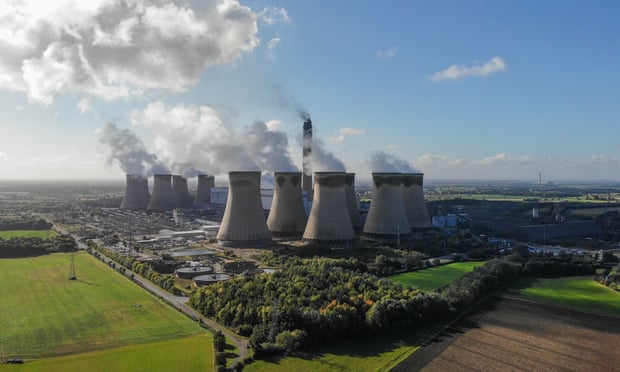
Drax was responsible for 11.5m tonnes of CO2 last year, or nearly 3% of the UK’s total carbon emissions. Photograph: SOPA Images/LightRocket/Getty Images
Drax received £22bn in subsidies despite being UK’s largest emitter in 2023, though company rejects ‘flawed’ research
The Drax power station was responsible for four times more carbon emissions than the UK’s last remaining coal-fired plant last year, despite taking more than £0.5bn in clean-energy subsidies in 2023, according to a report.
The North Yorkshire power plant, which burns wood pellets imported from North America to generate electricity, was revealed as Britain’s single largest carbon emitter in 2023 by a report from the climate thinktank Ember.
The figures show that Drax, which has received billions in subsidies since it began switching from coal to biomass in 2012, was responsible for 11.5m tonnes of CO2 last year, or nearly 3% of the UK’s total carbon emissions.
Drax produced four times more carbon dioxide than the UK’s last remaining coal-fired power station at Ratcliffe-on-Soar in Nottinghamshire, which is due to close in September. Drax also produced more emissions last year than the next four most polluting power plants in the UK combined, according to the report.
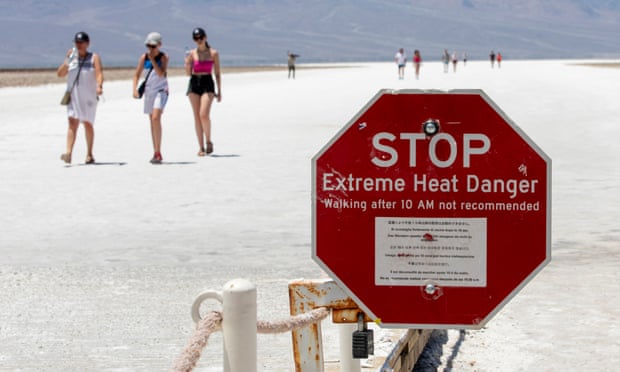
A sign warns tourists of extreme heat in Death Valley national park in July in California. Photograph: Daniel Jacobi II/AP
Climate scientists say that the world is continuing to warm, despite brief respite in record breaking temperatures
Earth’s string of 13 straight months with a new average heat record came to an end this past July as the natural El Niño climate pattern ebbed, the European climate agency Copernicus announced on Wednesday.
But July 2024’s average heat just missed surpassing last year’s July, and scientists said the end of the record-breaking streak changes nothing about the threat posed by the climate crisis.
“The overall context hasn’t changed,” Copernicus’s deputy director, Samantha Burgess, said in a statement. “Our climate continues to warm.”
Human-caused climate change drives extreme weather events that are wreaking havoc around the globe, with several examples just in recent weeks. In Cape Town, South Africa, thousands were displaced by torrential rain, gale-force winds, flooding and more. A fatal landslide hit Indonesia’s Sulawesi island. Beryl left a massive path of destruction as it set the record for the earliest category 4 hurricane. And Japanese authorities said more than 120 people died in record heat in Tokyo.
Those hot temperatures have been especially merciless.
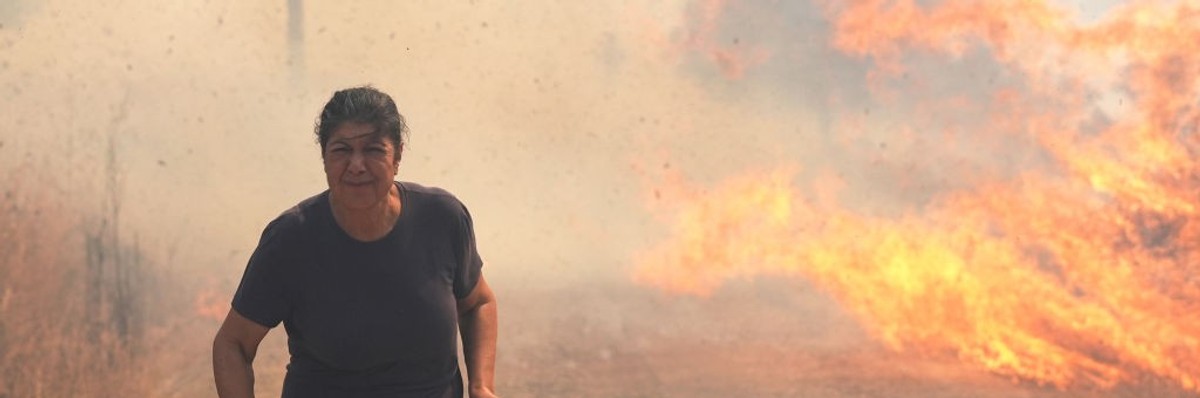
Civilians flee a forest fire that broke out close to residential areas at Cesmealti in Urla district of Izmir, Turkey on July 31, 2024. (Photo: Mahmut Serdar Alakus/Anadolu via Getty Images)
“We need to tackle the root cause and get serious about reducing record levels of greenhouse gas emissions,” said the head of the World Meteorological Organization.
As scientists around the world on Thursday released new data about recent record-smashing heat, one United Nations adviser placed blame for the lack of ambitious climate action on the fossil fuel industry’s decadeslong disinformation efforts.
“There is this prevailing narrative—and a lot of it is being pushed by the fossil fuel industry and their enablers—that climate action is too difficult, it’s too expensive,” Selwin Hart, a special adviser to the U.N. Secretary-General António Guterres and assistant secretary-general of the Climate Action Team, told The Guardian‘s Fiona Harvey.
“It is absolutely critical that leaders, and all of us, push back and explain to people the value of climate action, but also the consequences of climate inaction,” said Hart, former executive director of the Caribbean at the Inter-American Development Bank and Barbados’ ambassador to the United States and the Organization of American States.
Investigations by academics, journalists, and lawmakers as well as ongoing legal battles have exposed how Big Oil not only has heated and polluted the planet but also knew about the devastating impacts of fossil fuels decades ago and opted to spread lies so shareholders could make massive profits—which they continue to rake in today.
“Climate appears to be dropping down the list of priorities of leaders,” Hart said, pointing to polling that shows people around the world want a rapid transition to clean energy. “But we really need leaders now to deliver maximum ambition. And we need maximum cooperation. Unfortunately, we are not seeing that at the moment.”
According to The Guardian:
[Hart] warned that the consequences of inaction were being felt in rich countries as well as poor. In the U.S., many thousands of people are finding it increasingly impossible to insure their homes, as extreme weather worsens. “This is directly due to the climate crisis, and directly due to the use of fossil fuels,” he said. “Ordinary people are having to pay the price of a climate crisis while the fossil fuel industry continues to reap excess profits and still receives massive government subsidies.”
Yet the world has never been better equipped to tackle climate breakdown, Hart added. “Renewables are the cheapest they’ve ever been, the pace of the energy transition is accelerating,” he said.
Hart’s comments came as the European Union’s Copernicus Climate Change Service (C3S) announced that last month “was the second-warmest July globally in our data record, with an average ERA5 surface air temperature of 16.91ºC,” or 62.44ºF.
From June 2023 to June 2024, each month was the hottest on record, according to C3S. Samantha Burgess, the agency’s deputy director, noted that now, “the streak of record-breaking months has come to an end, but only by a whisker.”
“Globally, July 2024 was almost as warm as July 2023, the hottest month on record,” Burgess stressed. “July 2024 saw the two hottest days on record. The overall context hasn’t changed, our climate continues to warm. The devastating effects of climate change started well before 2023 and will continue until global greenhouse gas emissions reach net-zero.”
The U.N.’s World Meteorological Organization (WMO) said Thursday that the new C3S data “underlines the urgency of the Call to Action on Extreme Heat” issued by Guterres last month, shortly after July 22 became the hottest day ever recorded.
“Widespread, intense, and extended heatwaves have hit every continent in the past year,” said WMO Secretary-General Celeste Saulo in a statement. “At least 10 countries have recorded daily temperatures of more than 50ºC in more than one location. This is becoming too hot to handle.”
Saulo highlighted that “Death Valley in California registered a record average monthly temperature of 42.5ºC (108.5ºF)—possibly a new record observed for anywhere in the world. Even the remote frozen ice sheets of Antarctica have been feeling the heat.”
“The WMO community is committed to responding to the U.N. secretary-general’s Call to Action with better heat-health early warnings and action plans,” she pledged. “Recent estimates produced by WMO and the World Health Organization indicate that the global scale-up of heat-health warning systems for 57 countries alone has the potential to save an estimated 98,000 lives per year. This is one of the priorities of the Early Warnings for All initiative.”
“Climate adaptation alone is not enough,” she added. “We need to tackle the root cause and get serious about reducing record levels of greenhouse gas emissions.”
C3S wasn’t alone in releasing new data on Thursday; the U.S. National Oceanic and Atmospheric Administration (NOAA) also shared some key points for the country’s climate in July, with the full report set to be released on Tuesday.
NOAA’s top takeaways were:
The average temperature of the contiguous U.S. in July was 75.7ºF, 2.1ºF above average, ranking 11th warmest in the 130-year record.
The Park Fire is the fourth-largest wildfire in California history as of August 6; beginning on July 24, it burned approximately 401,000 acres and destroyed over 560 structures.
On July 15, a derecho that spawned 32 tornadoes broke the Chicago-area record for most tornadoes in a day.
On July 1, Beryl became the earliest Category 5 hurricane and the second Category 5 on record during the month of July in the Atlantic Ocean.
Other major events in July included California’s Thompson Fire, which forced over 13,000 people to evacuate, and Washington, D.C. enduring 101ºF on July 17, tying a record for the longest streak of temperatures above 100ºF. NOAA also found that “for the January-July period, the average contiguous U.S. temperature was 54.5ºF, 3.2ºF above average, ranking second-warmest on record.”
Hundreds gathered in Parliament Square on Saturday in solidarity with the 21 political prisoners currently incarcerated for demanding an end to the fossil fuel era, as well as all political prisoners fighting for change in the UK and abroad, including two imprisoned for taking action with Palestine Action. In recent weeks Just Stop Oil has been taking action with groups internationally to demand governments establish a fossil fuel treaty, to end the extraction and burning of oil, gas and coal by 2030.
Supporters of Just Stop Oil, Extinction Rebellion, Defend our Juries and Fossil Free London, gathered at the Gandhi statue in Parliament Square. The crowd heard speeches from a range of speakers and messages from those currently in prison. Attendees could be seen holding signs which read ‘You can’t lock up the Truth’ and ‘No Justice when Juries are Denied the Truth.’ After the rally, many attendees joined the Palestinian solidarity march in London, in resistance to the ongoing genocide in Gaza.
One of those speaking at the rally today was Raj Chada, a lawyer who has represented many of these 21 political prisoners in court. He said:
“This is about the nature of our democracy, in which peaceful protestors are routinely being imprisoned now. In the Supreme Court, a few years ago, they said that ‘protest was the lifeblood of our democracy.’ Our democracy is on its knees then, because they are not paying attention to protest.”
“I have been doing this job now for 20 years and until 3 years ago, I hadn’t had one client imprisoned. Something has changed in the establishment. In the shadow of this [Gandhi] statue, it shows the importance of nonviolent action and what it can achieve and why it should be so important. We will continue that fight for as long as we possibly can.”
Raj Chada appears in this video.
My anaysis – dizzy – is that the fossil fuel industry has bought these laws by financing think tanks and lobbying organisations and that judges are blatently biased, not even pretending to be neutral and impartial. If you routinely use private transport to travel even moderate distances, you should expect to be occasionally delayed. Driving delays of hours are commonplace. For consistency shouldn’t people causing delays by conducting road works or having an accident also be imprisoned for many years FFS? It is overwhelmingly biased and punitive. How did some of these harsh judges get to try so many JSO trials?
later ed: The argument that people causing delays by roadworks or having an accident should be imprisoned is strengthened by the fact that motivations are not considered relevant.
7/8/24 Apologies, I can and should do better that my ‘analysis’ above. The argument about imprisoning for roadworks or accidents: The point I’m making is that since motivations are not considered relevant in trials of climate protesters then what is left is the effect: delays to private vehicle users and delays are also caused by roadworks and accidents. I wonder if that’s clear, can be followed.
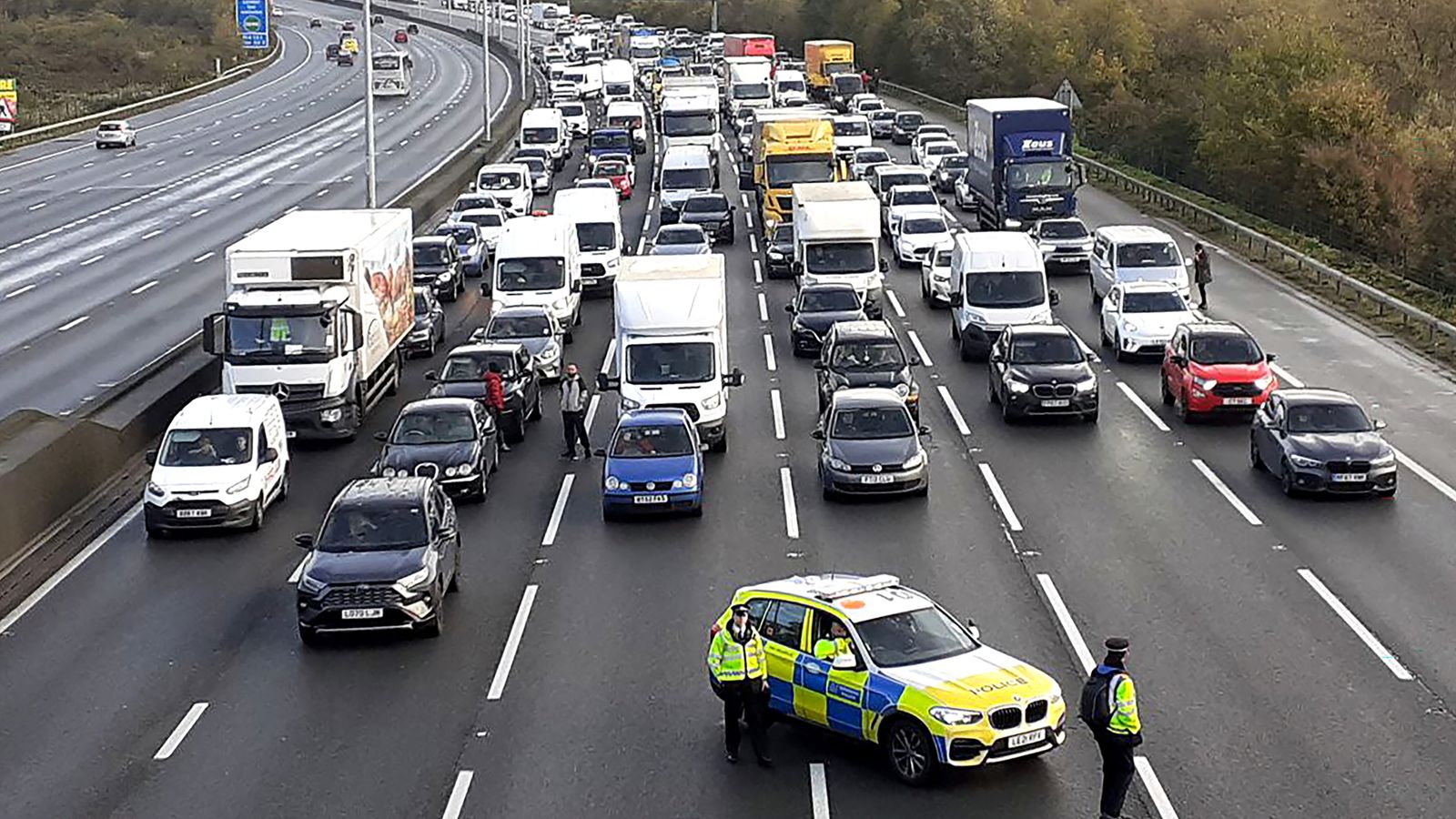
Delays on the M25 from a Just Stop Oil protest. Pic: Just Stop Oil/PA
Protesters now face up to two years in prison, but there has been international condemnation of the increasing severity of sentences for non-violent protest.
Five Just Stop Oil activists have just been jailed for up to two years after they climbed gantries over the M25 motorway and caused temporary gridlock.
For many of the 181,000 motorists the Highways Agency estimated were delayed in November 2022 by the coordinated four-day-long campaign of disruption, it may feel like justice served.
But there has been international condemnation of the increasing severity of sentences for non-violent protest.
“There can be no justification for the level of sentences that are being imposed,” says Raj Chada, a solicitor at Hodge Jones & Allen who represented one of the activists – a 77-year-old woman.
“These are sentences which have traditionally been reserved for violent offences. And in the UK, we’ve always said that no matter what the protest, even if it is disruptive, you get credit for it being non-violent,” said Mr Chada.
The latest sentences, of between two years and 20 months, follow those in July of jail terms between four and five years for Just Stop Oil campaigners who planned and recruited volunteers for the M25 protest.
“Today marks a very dark day for fundamental human rights in the UK,” wrote Michel Forst, the United Nations Special Rapporteur on Environmental Defenders, who attended their trial at Southwark Crown Court.
…
Lawyers representing some of the Just Stop Oil activists sentenced in both recent court cases said they would appeal the length of sentences.
The Court of Appeal has previously upheld judges decisions in protest cases, meaning the UK’s recent record on punishing environmental activists is likely to end up before the European Court of Human Rights.