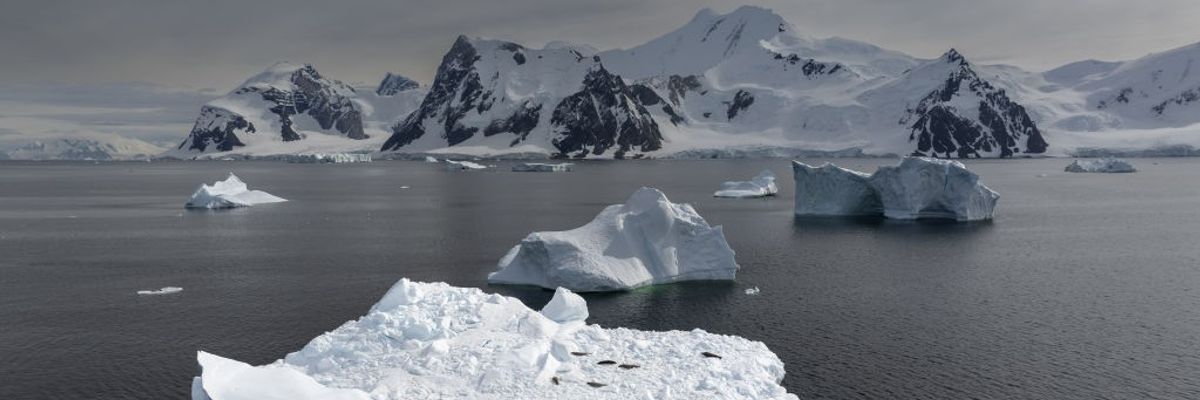
Seals rest on an ice mass in Antarctica in April 2024. (Photo: Sebnem Coskun/Anadolu via Getty Images)
The long-lasting heatwave is an “eye-opening sign that climate change is starting to really transform the planet,” a climate scientist said.
Antarctica is experiencing its second extreme heatwave in the last three years, with temperatures more than 50°F higher than normal, The Washington Post reported Wednesday.
The heatwave is notable not just for its intensity but also its timing and duration: It’s hit during Antartica’s winter and is expected to last. Temperatures of 36°F to 50°F above average are expected to persist up to 10 days, and July temperatures were already well above average before it began. The spiking temperatures were also spread across a large area, covering much of the continent, scientists said.
The world has faced exceptionally high temperatures in the last year, with 13 straight monthly heat records and counting, and the poles are warming at roughly twice the rate of the global average. Scientists say the changing conditions around Antarctica have increased the likelihood of higher winter temperatures on the continent.
“It is likely that having less sea ice and a warmer Southern Ocean around the Antarctic continent ‘loads the dice’ for warmer winter weather over Antarctica,” Edward Blanchard, an atmospheric scientist at the University of Washington, told the Post.
Scientists warned that this heatwave was a sign of what’s to come as the planet heats up thanks primarily to fossil fuel emissions.
“This historic warm spell in East Antarctica is an ominous example of the temperature spikes this polar climate could experience more of in a warming world,” the Post reported.
Jonathan Overpeck, a climate scientist at the University of Michigan, said on social media that the heatwave is an “eye-opening sign that climate change is starting to really transform the planet.”
In March 2022, Antarctica experienced the most intense heatwave in the planet’s recorded history, with temperatures up to 72°F above normal. On-site scientists at the time wore shorts and removed their shirts to bask in the sun. The heatwave was the subject of intense scientific research in the two years that followed, with a 54-person team trying to decipher the causes, which they described as “head-hurting” in their complexity.
The 2022 heatwave contributed to reduced sea ice levels. Antarctica experienced the lowest summer and winter levels of sea ice ever recorded last year.
High temperatures in Antarctica are relative—this week’s heatwave still had temperatures hovering at about minus-4°F. But sustained periods at such temperatures are highly unusual.
“The heatwave on the Antarctic Plateau is extraordinary more for its duration than for its intensity, although some values are notable,” Stefano Di Battista, an expert on Antarctic temperatures, told the Post.
The heatwave is likely the result of changes in the stratosphere roughly 20 miles above ground, scientists said. At the South Pole, the stratosphere contains a polar vortex that is normally stable with cold temperatures and low pressure during the Antarctic winter, but a sudden stratospheric warming event occurred due to atmospheric wave activity, Amy Butler, an atmospheric scientist at the National Oceanic and Atmospheric Administration, told the Post.
“The idea that rich and poor are equal before government in democratic societies is ludicrous,” writes Polychroniou. “As disparities in wealth and income grow, so do the disparities in political influence.” (Photo: flickr/Creative Commons)
Wealth taxation may sound like a good idea, but can it really address, let alone solve, the problem of inequality?
Economic inequality is the scourge of the 21st century. The rich are getting richer and faster than any other time since the onset of neoliberalism, which calls for “free-market” capitalism, regressive taxation, fiscal austerity and the rejection of the social state. They get richer not only when the economy is on an upswing but even amid crises. Billionaires more than doubled their net worth during the pandemic, according to Bloomberg Billionaires Index.
The latest analysis shows that the richest 1 percent gained $42 trillion in new wealth over the past decade, which amounts to “nearly 34 times more than the entire bottom 50 percent of the world’s population.” In the meantime, the very poor and low-income people across the globe, including the U.S., are actually getting poorer. So much for trickle-down economics which was popularized during the 1980s by the Reagan administration’s vast capital gains and income tax cuts and continues to persist to this day in spite of its major flaws. Cutting taxes on the rich not only increases economic inequality but has no effect on economic growth and unemployment.
There must be something very rotten with an economic system that allows individuals to generate obscene amounts of wealth to the point they can hijack the political system and undermine democracy.
However, inequality should not be examined purely from an economic perspective. Over the years, numerous studies have shown that economic inequality influences public attitudes toward democracy by generating political disillusion and low trust in government and other institutions, like Congress. Inequality also undermines social mobility, contributes to political polarization and fuels authoritarianism.
Finally, inequality contributes to climate change. The richest 1 percent is responsible for more carbon emissions than the poorest 66 percent, according to a 2023 report by Oxfam. Of course, while the world’s wealthiest people make a huge contribution to climate change, they are also able to insulate themselves from the worst impacts of global warming.
In sum, the super-rich can be blamed for many of the most serious ills confronting societies in the twentieth-first century. The only consequential question here is this: what can be done about it then?
One of the most frequent responses to the problem of rising inequality is a call for the implementation of a wealth tax. Wealth taxation may sound like a good idea, but can it really address, let alone solve, the problem of inequality? The answer is an unqualified “no.” At least for the world’s advanced economies. Indeed, even if it’s possible to discover all the wealth that the very rich people own (much of which is hidden in companies or put in trusts) and then proceed with an accurate asset valuation, this will have very little impact, if any, on the daily lives of people who try to survive on minimum wages. Wealth taxation alone will have no impact on workers without social protection and no bargaining power at companies. It won’t protect workers at the “gig economy” and part-time workers.
To effectively address economic inequality, we must identify the root cause of the problem, and one simple way to do this is by asking a rather simple question: How does one become superrich? Where does this immense wealth come from? Because as the renowned progressive economist James K. Boyce recently put it “nobody ‘earns’ a billion dollars.
There must be something very rotten with an economic system that allows individuals to generate obscene amounts of wealth to the point they can hijack the political system and undermine democracy. Democracy cannot exist when we have wealth concentrated in the hands of a few. The idea that rich and poor are equal before government in democratic societies is ludicrous. As disparities in wealth and income grow, so do the disparities in political influence.
Take corporations, for example, which exert enormous influence, thanks primarily to campaign donations and lobbying Their actions, which range from opposing labor laws and policies that benefit workers to restricting unionization, exacerbate inequalities at all levels of society and across the globe. Moreover, the surge in billionaire wealth and the surge in “corporate power and monopoly power” form a powerful connection. The very rich are not simply beneficiaries of the existing economic order. They are in control of the working arrangements of the global economic system. Yet despite the enormous power that corporations have on people’s lives and the communities in which they operate, there are very few policies and mechanisms at national or international level to curtail that power.
Of course, we know that billionaires and big corporations pay very little in taxes, but we need much more than wealth and corporate taxation. We need ways to curb the power of big corporations and their drive to maximize shareholder value at the expense of everything else. We should also set a cap on extreme wealth. There is no social value for having billionaires. We should abolish the superrich, perhaps an easier task, politically speaking, than finding ways to tax them. Democratic societies could hold a referendum on whether we should abolish extreme wealth.
In addition, we could create economic arrangements that provide a minimum income to ensure that everyone’s basic needs are met. This can be done either through universal basic income or guaranteed income programs.
Last, but not least, we can challenge the rule of capital by advancing democratic forms of economic governance and economic planning. Participatory economics is one such alternative that would change the economy as we know it since it entails social ownership of production and self-managed workplaces. Worker cooperatives are established is various parts of Europe, particularly in Italy and Spain. The Mondragon Corporation in the Basque region of Spain is owned by its workers and represents the biggest and most successful case of worker cooperatives. Of course, for economic transformation to occur, breaking down hierarchical structures and putting workers in charge of business activities is not enough. What needs to happen is that the values of worker cooperatives spread across the economy and that power is wrested away from the capitalist class.In today’s world, we can tackle economic inequality only by shifting the conversation to its root causes and then coming up with blends of policies that work together to put an end to the driving forces behind inequality. Spending all political capital on something like a wealth tax will only help to prolong the life of an immensely cruel and dangerous economic system. An easier and far more effective way to end plutocracy is through the power of democracy via a binding referendum that calls on citizens to decide whether or not we should abolish altogether extreme wealth.
A host of parliamentarians were previously employed by agencies with fossil fuel clients.
At least 24 newly elected MPs used to work for public relations, consultancy and lobbying firms that have a history of representing oil and gas companies, DeSmog can reveal.
A DeSmog analysis of the MPs entering Parliament after the 2024 general election found that two dozen had a background working for oil and gas giants, coal power station conglomerates, as well as other highly polluting clients.
The findings have sparked concerns that fossil fuel interests in Parliament may influence policy-making.
“I entered politics after working as an engineer in the renewables industry exactly because I could see we had the technology to make the transition to clean and green energy, but we were lacking the political will to make it happen,” said Green Party co-leader and Bristol Central MP Carla Denyer.
“Part of what stops this transition from occurring is the embedded influence of the fossil fuels industry in politics.”
Labour’s new Ossett and Denby Dale MP Jade Botterill started working at lobbying firm Portland after her parliamentary candidacy was announced in September 2023. Portland’s clients include oil major BP, French energy firm EDF, Heathrow Airport, and Chinese state-owned oil company CNOOC. Another Labour MP – Laura Kyrke-Smith – worked for Portland several years ago. She told DeSmog that she didn’t represent any oil firms while working for the company.
Portland told DeSmog that they “do not comment on client relationships”.
At least three new Labour MPs – Oliver Ryan, Mary Creagh, and Steve Race – previously worked for Lexington Communications, a lobbying firm that works for oil giant Phillips 66, the International Airlines Group (IAG), and Eren Holding, a firm that runs coal-fired power stations in Turkey.
New Conservative MP for Bromsgrove Bradley Thomas spent at least five years working for Phillips 66, latterly as a strategy lead, before becoming an independent consultant to the sector.
Almost a third of Labour’s new MPs have a background working in communications and lobbying, according to the Sunday Times, a similar share to the Conservatives. Due to the UK’s limited transparency rules around lobbying, it’s often impossible to know whether these individuals worked on behalf of oil and gas clients.
However, we do know that several other major lobbying and consultancy firms with fossil fuel links – in addition to Lexington and Portland – used to employ a number of new MPs. These include:
Teneo (clients include BHP, Centrica, and EnQuest)
Four Communications emphasised that its work for the Oman Oil Company ended in 2019, though the firm also has offices in the petrostates United Arab Emirates, and Saudi Arabia.
In June 2024, United Nations Secretary-General António Guterres said that PR agencies had “aided and abetted” the fossil fuel industry, “acting as enablers to planetary destruction”. He called on these agencies to stop taking on new fossil fuel clients, and to set out plans to drop their existing ones.
“Fossil fuels are not only poisoning our planet – they’re toxic for your brand,” he said.
All the MPs named in this article were approached for comment.
Gas Lobbyists and Energy Consultants
Several new MPs have also worked for much smaller groups with links to the energy industry. This includes Labour’s new Cannock Chase MP Josh Newbury, who between 2019 and 2022 worked as senior parliamentary officer for the Energy and Utilities Alliance (EUA) – a trade group for the gas industry and fossil fuel boiler manufacturers.
DeSmog revealed in 2023 that the EUA, which is led by former Labour MP Mike Foster, was behind a barrage of negative press attacking heat pumps as a home heating source. Foster has repeatedly labelled pro-heat pump campaigners as a “green cult”.
New Liberal Democrat MP for St Neots and Mid Cambridgeshire Ian Sollom worked as the principal of StrategicFit, an energy sector strategic consultancy that has worked for the oil major ExxonMobil, and the Chinese state oil firm CNOOC.
Sollom told DeSmog that “as a scientist entering Parliament, I am committed to the phasing out of fossil fuels, and my previous career primarily focused on improving decision making and collaboration between energy companies, regulators and other stakeholders”.
Liberal Democrat MP for Cheltenham Max Wilkinson used to work for Camargue, which lobbied politicians in Westminster on behalf of the oil company Esso while he was employed by the firm.
A spokesperson for the Liberal Democrats stressed that Wilkinson did not work for any oil and gas clients.
Fossil fuel companies have extensive existing ties to Westminster politics. DeSmog revealed that, from the 2019 general election to the start of the 2024 election campaign, the Conservative Party received £8.4 million from oil and gas interests, climate science deniers, and polluting industries.
Meanwhile, a number of leading right-wing think tanks have received direct funding from the fossil fuel industry. Onward, which hosted the most government meetings of any think tank in 2023, receives funding from Shell and BP.
All the agencies named in this article were approached for comment.
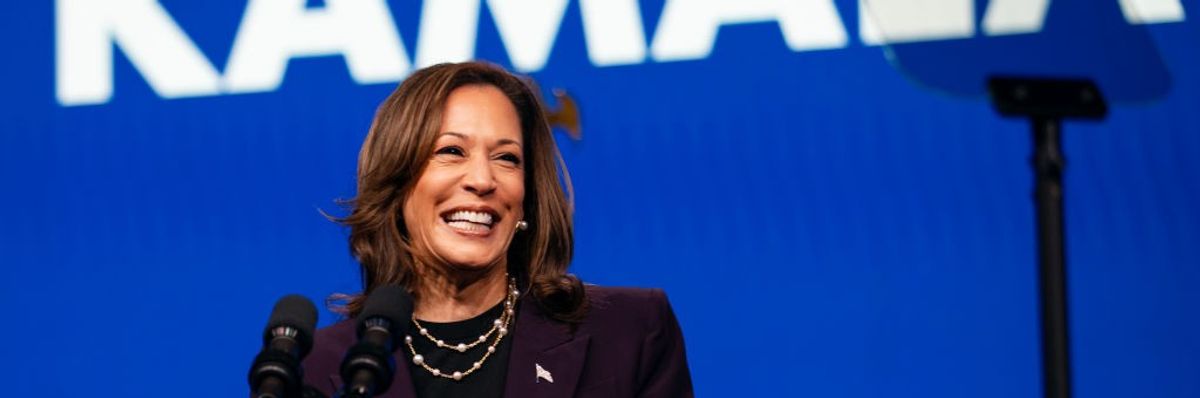
Vice President Kamala Harris speaks at the American Federation of Teachers’ 88th National Convention on July 25, 2024 in Houston, Texas. (Photo: Montinique Monroe/Getty Images)
“With a President Harris, we will have a chance to build the political power to move the bold climate initiatives we need.”
Progressive climate and environmental advocacy groups on Wednesday stressed the threat posed by the Republican presidential ticket and endorsed Vice President Kamala Harris, the presumptive Democratic nominee for the November election.
One coalition of six groups—350 Action, Center for Biological Diversity Action Fund, Clean Water Action, Climate Hawks Vote, Food and Water Action, and 350 Action, Center for Biological Diversity Action Fund, Clean Water Action, Climate Hawks Vote, Food and Water Action,350 Action, Center for Biological Diversity Action Fund, Clean Water Action, Climate Hawks Vote, Food and Water Action, and Friends of the Earth Action—cited Harris’ record as vice president and a U.S. senator from California.
Despite his months as the presumptive Democratic nominee, none of the organizations had endorsed President Joe Biden before he dropped out of the race and backed Harris earlier this month.
“Vice President Harris is a visible leader in the Biden-Harris administration’s successful work to address environmental injustice, tackle the climate crisis, hold polluters accountable, reduce water pollution, and ensure clean drinking water for all,” said Clean Water Action president and CEO Jeff Carter, emphasizing that her actions “have made a real difference in people’s lives.”
Jeff Ordower of 350 Action highlighted that in addition to being “part of the administration that invested in renewable energy through the historic Inflation Reduction Act,” Harris “has a history of taking on Big Oil and advocating for environmental justice.”
“As a global climate movement, we know Harris represents not just the ability to make progress in the U.S., but globally as well,” he added. “For those… who care about democracy, climate, and decreased corporate capture of our government, Kamala Harris is our only choice.”
“For those… who care about democracy, climate, and decreased corporate capture of our government, Kamala Harris is our only choice.”
Kierán Suckling, president of the Center for Biological Diversity Action Fund, similarly urged “everyone who cares about our planet, environmental justice, women’s rights, civil rights, and our democracy to get out and vote for Kamala Harris to be our next president.”
Suckling also took aim at former President Donald Trump, the Republican nominee, declaring that “Harris will lead us toward a brighter future for our children and grandchildren, and put the nightmare of Trump behind us.”
Trump—who earlier this month announced Big Oil-backed Sen. JD Vance (R-Ohio) as his running mate—has vowed to “drill, baby, drill” and roll back the Biden-Harris administration climate policies if fossil fuel executives pour money into his campaign.
Although the U.S. is among five wealthy countries that have led a global surge in oil and gas development this year, Harris’ campaign has warned that “oil barons are salivating” over Trump’s potential return to the White House.
A March study found that Trump’s plans for a second term would lead to 4 billion more tons of carbon dioxide being released into the atmosphere by 2030 when compared with the policies of Biden—who has passed the torch to Harris, whose online nomination process is set to start on Thursday.
— Prof Michael E. Mann (@MichaelEMann) July 30, 2024
“Kamala Harris’ record provides a stark contrast with Donald Trump and the far-right, pro-polluter Project 2025,” said Wenonah Hauter, founder and executive director of Food and Water Action. “Of course, much more needs to be done, and Harris’ positions do not yet go far enough to tackle the existential threats to our food, water, and climate.”
“But with a President Harris, we will have a chance to build the political power to move the bold climate initiatives we need,” Hauter emphasized. “Four more years of Trump and Project 2025 will further accelerate an already escalating climate crisis and eviscerate important protections for our food and water.”
The six groups that backed Harris but not Biden were among the campaigners and scientists angered by the president supporting the Willow project and Mountain Valley Pipeline, continuing fossil fuel lease sales, skipping last year’s United Nations summit, and declining to declare a national climate emergency.
As HEATED, which scooped the endorsement news, reported late Tuesday:
Harris has already received endorsements from the so-called “Big Green” groups—the political arms of the League of Conservation Voters, the Natural Resources Defense Council, the Sierra Club, and Clean Energy for America. But those weren’t much of a surprise, as each group had already backed Biden’s reelection bid, and are traditionally loyal to Democratic Party politicians.
The groups endorsing Harris on Wednesday, however, had so far held off on throwing their support behind Biden while he was running for reelection—in part because of the sitting president’s mixed record on climate policy.
“It was very much a debate” on whether to endorse Biden, said one of the group’s staffers, who spoke on background because the Harris announcement is not yet public. But with Harris, the calculus has changed.
“Because of her work in California and when she was a senator—a lot of us worked with her on creating the Environmental Justice for All Act—it gives us hope,” the staffer said. “She’s just a different person [than Biden], and has a stronger track record.”
“Friends of the Earth Action is excited to endorse Kamala Harris for president of the United States,” the group’s president, Erich Pica said Wednesday. “We are not going back to an era dominated by fossil fuel interests, corporate greed, and disenfranchisement. Instead, we’re looking forward to building a healthy and just future with Vice President Harris.”
For Climate Hawks Vote, this is the organization’s first presidential endorsement since its founding over a decade ago.
“We’re breaking our usual rule of not endorsing in presidential elections, given our strong history with Kamala Harris (we endorsed her in her 2016 Senate race), her track record in taking on Big Oil and holding polluters accountable, and the extraordinary moment of this election,” explained RL Miller, the group’s president. “We are climate hawks who vote, and we’ll be flocking together for Kamala Harris.”
The Green New Deal Network—which also never endorsed Biden—separately threw its support behind Harris on Wednesday.
“What the Green New Deal really is, is understanding that everything’s connected,” the network’s national director, Kaniela Ing, toldInside Climate News. “Making sure our tax dollars aren’t just going to kill children abroad, but to build schools and hospitals here at home… Local control of resources, self-determination of our communities. That’s the vision Kamala Harris, given her background—being bused to schools, really being a product of a lot of our social programs—really understands.”
One group that has not yet endorsed Harris but has certainly been attentive to both major party tickets is the youth-led Sunrise Movement. The organization warned earlier this month that the Republicans would cause “catastrophic and irreversible damage” to the climate if elected, and some members were arrested for a Monday protest Vance’s Senate office on Capitol Hill.
That same day, Sunrise rallied outside of the Democratic National Committee headquarters in Washington, D.C. to urge Harris “to put forward a comprehensive plan on the economy and climate.”
Sunrise is also part of a youth-led coalition—which includes Gen-Z for Change, March for Our Lives, and United We Dream Action—that wrote to Harris last week, “This is your chance to energize young people and our communities to vote, mount one of the greatest political comebacks in decades, and deliver a resounding defeat to the far-right agenda of Trump and Vance.”
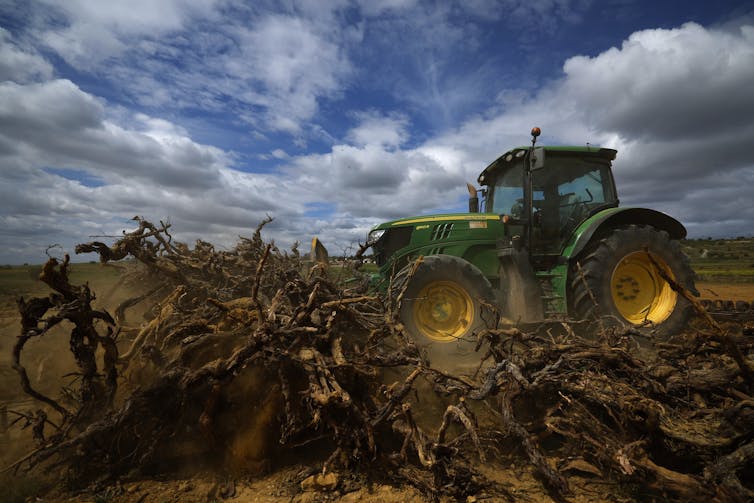
Extreme weather is by definition rare on our planet. Ferocious storms, searing heatwaves and biting cold snaps illustrate what the climate is capable of at its worst. However, since Earth’s climate is rapidly warming, predominantly due to fossil fuel burning, the range of possible weather conditions, including extremes, is changing.
Scientists define “climate” as the distribution of possible weather events observed over a length of time, such as the range of temperatures, rainfall totals or hours of sunshine. From this they construct statistical measures, such as the average (or normal) temperature. Weather varies on several timescales – from seconds to decades – so the longer the period over which the climate is analysed, the more accurately these analyses capture the infinite range of possible configurations of the atmosphere.
Typically, meteorologists and climate scientists use a 30-year period to represent the climate, which is updated every ten years. The most recent climate period is 1991-2020. The difference between each successive 30-year climate period serves as a very literal record of climate change.
This way of thinking about the climate falls short when the climate itself is rapidly changing. Global average temperatures have increased at around 0.2°C per decade over the past 30 years, meaning that the global climate of 1991 was around 0.6°C cooler than that in 2020 (when accounting for other year-to-year fluctuations), and even more so than the present day.
A moving target for climate modellers
If the climate is a range of possible weather events, then this rapid change has two implications. First, it means that part of the distribution of weather events comprising a 30-year climate period occurred in a very different background global climate: for example, northerly winds in the 1990s were much colder than those in the 2020s in north-west Europe, thanks to the Arctic warming nearly four times faster than the global average. Statistics from three decades ago no longer represent what is possible in the present day.
Second, the rapidly changing climate means we have not necessarily experienced the extremes that modern-day atmospheric and oceanic warmth can produce. In a stable climate, scientists would have multiple decades for the atmosphere to get into its various configurations and drive extreme events, such as heatwaves, floods or droughts. We could then use these observations to build up an understanding of what the climate is capable of. But in our rapidly changing climate, we effectively have only a few years – not enough to experience everything the climate has to offer.
Extreme weather events require what meteorologists might call a “perfect storm”. For example, extreme heat in the UK typically requires the northward movement of an air mass from Africa combined with clear skies, dry soils and a stable atmosphere to prevent thunderstorms forming which tend to dissipate heat.
Such “perfect” conditions are intrinsically unlikely, and many years can pass without them occurring – all while the climate continues to change in the background. Based on an understanding of observations alone, this can leave us woefully underprepared for what the climate can now do, should the right weather conditions all come together at once.
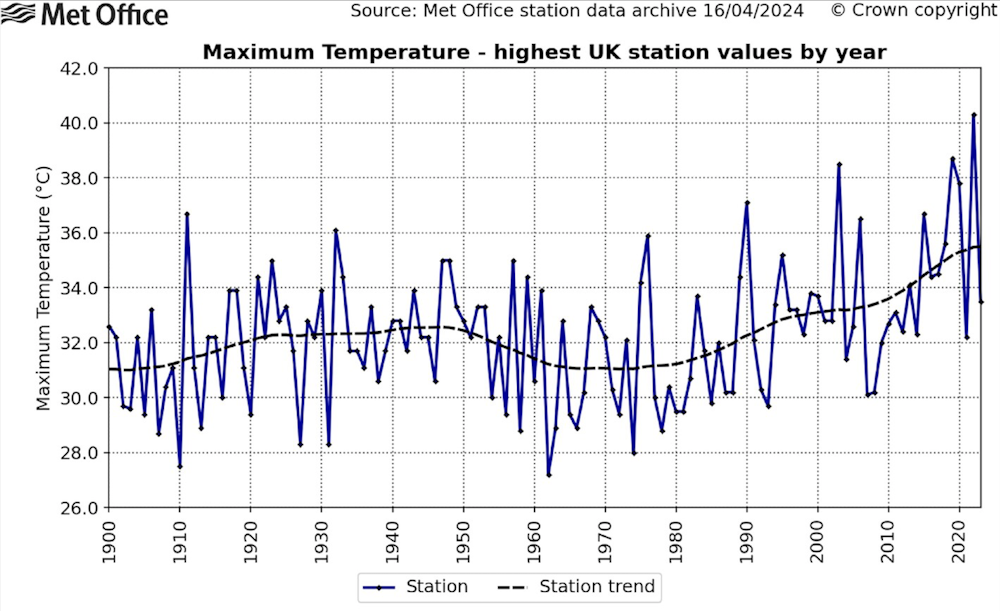
Startling recent examples include the extreme heatwave in the Pacific north-west of North America in 2021, in which temperatures exceeded the previous Canadian record maximum by 4.6°C. Another is the occurrence of 40°C in the UK in summer 2022, which exceeded the previous UK record maximum set only three years earlier by 1.6°C. This is part of the reason why the true impact of a fixed amount of global warming is only evident after several decades, but of course – since the climate is changing rapidly – we cannot use this method anymore.
Playing with fire
To better understand these extremes, scientists can use ensembles: many runs of the same weather or climate model that each slightly differ to show a range of plausible outcomes. Ensembles are routinely used in weather prediction, but can also be used to assess extreme events which could happen even if they do not actually happen at the time.
When 40°C first appeared in ensemble forecasts for the UK before the July 2022 heatwave, it revealed the kind of extreme weather that is possible in the current climate. Even if it had not come to fruition, its mere appearance in the models showed that the previously unthinkable was now possible. In the event, several naturally occurring atmospheric factors combined with background climate warming to generate the record-shattering heat on July 19 that year.
The highest observed temperature each year in the UK, from 1900 to 2023
Later in summer 2022, after the first occurrence of 40°C, some ensemble weather forecasts for the UK showed a situation in which 40°C could be reached on multiple consecutive days. This would have posed an unprecedented threat to public health and infrastructure in the UK. Unlike the previous month, this event did not come to pass, and was quickly forgotten – but it shouldn’t have been.
It is not certain whether these model simulations correctly represent the processes involved in producing extreme heat. Even so, we must heed the warning signs.
Despite a record-warm planet, summer 2024 in the UK has been relatively cool so far. The past two years have seen global temperatures far above anything previously observed, and so potential extremes have probably shifted even further from what we have so far experienced.
Just as was the case in August 2022, we’ve got away with it for now – but we might not be so lucky next time.