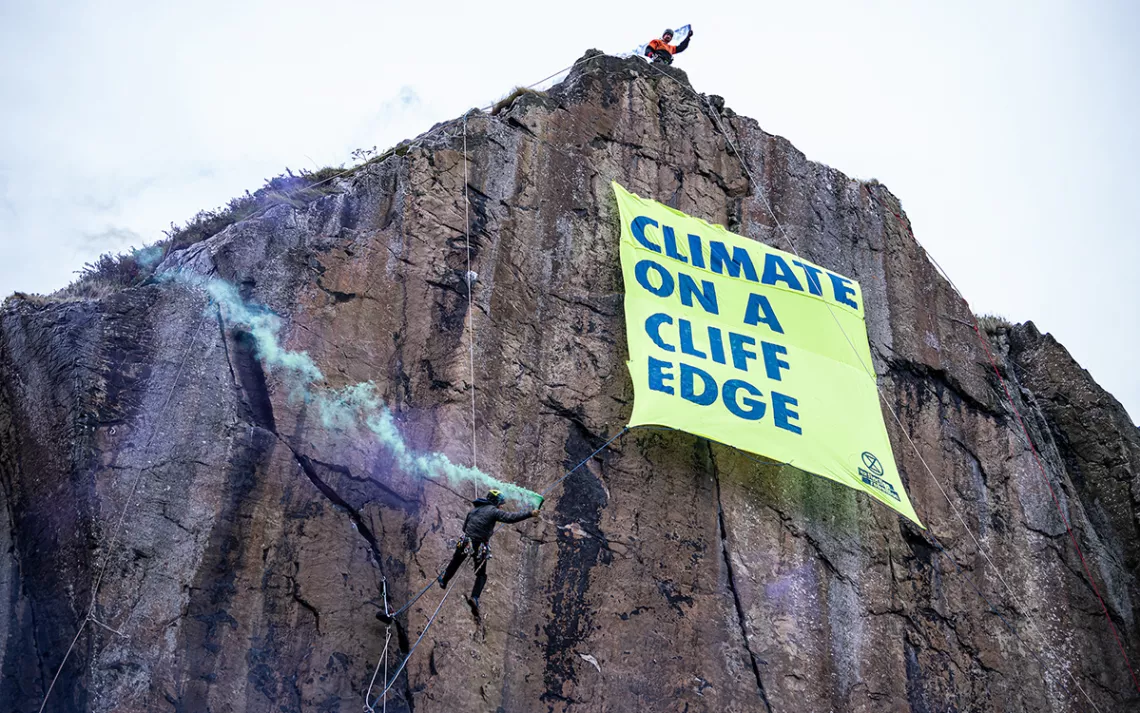
Protesters hang banners outside RAF Fairford in Gloucestershire during a demonstration to oppose any use of the base by US bombers, March 7, 2026
CAMPAIGNERS against a US deep space radar being built in Pembrokeshire celebrated yesterday after the Welsh government agreed to call in the planning decision.
The Pembrokeshire Against Radar Campaign (Parc) said their lobbying work with Plaid Cymru ahead of the Senedd election had paid off, after Planning Minister Sian Gwenllian intervened before Pembrokeshire County Council’s planning committee was due to decide on the scheme next Tuesday.
The campaigners described the move as a “seismic and significant positive step” for the new Plaid Cymru government.
A Parc spokesperson said: “[The Deep Space Advanced Radar Capability] Darc is a proposal for a huge 27-dish radar array overlooking the St Davids Peninsula of the Pembrokeshire Coast national park.
…
“… the development is of more than local importance and the application should be determined by the Welsh ministers.”
The Welsh government also said that the decision to call in the planning decision was not an indication of the eventual decision.
But as this was a Ministry of Defence application to build the radar installation, it may put further strain on the relationship with Prime Minister Andy Burnham and his new Defence Secretary Wes Streeting.
The Welsh government also said that the decision to call in the planning decision was not an indication of the eventual decision.
But as this was a Ministry of Defence application to build the radar installation, it may put further strain on the relationship with Prime Minister Andy Burnham and his new Defence Secretary Wes Streeting.
dizzy: climate should instead be recognised and addressed as an overwhelming and immediate threat. For example recent and current weather experienced in UK is causing huge issues UK agriculture.
Climate activists from Greenpeace and Uplift during a demonstration outside the Scottish Court of Session, Edinburgh, on the first day of the Rosebank and Jackdaw judicial review hearing, November 12, 2024
CONTROVERSIAL North Sea oil and gas plans “won’t take a penny off our bills” and instead increase “profits of a few,” campaigners warned as a public consultation opened into projects today.
Fossil fuel firm Adura claimed the Rosebank oil field and Jackdaw development would “deliver the greatest benefit for the UK.”
But campaigners and researchers with Uplift, which won the legal case against Rosebank in 2025, warned Brits not to fall for the plans which only serve to increase profits for energy firms.
Its executive director Tessa Khan said: “Rosebank won’t take a penny off our bills or meaningfully boost UK energy supplies — it’s overwhelmingly oil for export.
“But burning its oil would produce emissions equal to 70 per cent of the UK’s annual total, making it utterly incompatible with safe climate limits.
“Rosebank has nothing to do with the UK’s energy security and everything to do with increasing the profits of a few, already obscenely wealthy, oil companies.”
In Greater London, the number of days over 30C and nights over 18C more than quadrupled in the last decade, compared with 1961-1990. Photograph: Anadolu/Getty Image
Annual State of the UK Climate analysis finds last four years in UK are in top five hottest on record
The UK’s climatic extremes are becoming increasingly normal, a report has found, with last year the hottest on record and further “unprecedented changes” likely to break the record again soon.
Data stretching back to 1884 shows the UK has never experienced a year as hot as 2025, according to the annual State of the UK Climate report, with temperatures pushed to dizzying heights by carbon pollution clogging the atmosphere.
Average temperatures have increased across most of the UK
The country experienced its warmest spring and summer on record last year, while England was hit by its driest spring in a century.
The report comes as the UK faces the third deadly heatwave to have scorched Europe over the last two months. On Tuesday, the Met Office said the UK had already recorded as many 30C (86F) days in 2026 as in the extraordinarily hot year of 1976.
“What we used to think of as extreme, we increasingly consider as normal,” said Mike Kendon, a scientist at the National Climate Information Centre and lead author of the report. “We are seeing unprecedented changes continuing … and every year adds to this body of evidence.”
Donald Trump urges you to be a Climate Science denier like him. He says that he makes millions and millions for destroying the planet, Burn, Baby, Burn and Flood, Baby, Flood.Nigel Farage urges you to ignore facts and reality and be a climate science denier like him and his Deputy Richard Tice. He says that Reform UK has received £Millions and £Millions from the fossil fuel industry to promote climate denial and destroy the planet.Orcas discuss Donald Trump and the killer apes’ concept of democracy. Front Orca warns that Trump is crashing his country’s economy and that everything he does he does for the fantastically wealthy.
A farming storage area is flooded in Taiwan — events such as this will become more frequent in an increasingly erratic climate. Credit: Cheng Chia Huang/Getty
Increasing instability of the ocean, ice and atmosphere threatens farming, finance and society. We all need to wake up to that fact.
How we get there — how the tipping unfolds — is more important, and there is an urgent need to understand the process. This is missing from current analyses because the scales in time and space it occurs on fall between those of climate and weather. Tipping analyses focus on huge climate changes, often globally, over decades. Weather events are fast and local. But look at the interplay between the two and it’s clear that the transition between one climate state and another is not smooth but extremely volatile.
Climate tipping, therefore, will manifest as a period of increasingly dramatic weather volatility, rather than a sharp shift in average conditions. A fluctuating climate will bring swings and crashes in crop yields, flash flooding and erratic storms. It will stress economies by disrupting supply chains and amplifying insurance losses. Societies are unprepared, because weather volatility related to tipping points is absent from risk assessments.
This problem is urgent. Earth subsystems, including oceans, the cryosphere and biosphere, already seem to be destabilizing. The planet is heading for climate free fall.
Climate is destabilizing
By definition3, tipping points are reached when a series of interlinked changes amplify one another until the whole system becomes unstable and shifts uncontrollably into a different state. Loss of sea ice at the poles, for example, reduces the amount of sunlight reflected into space, further heating Earth’s surface, which then accelerates ice loss. These vicious cycles of change define a tipping point, at which the climate cannot return to its former patterns.Are we all doomed? How to cope with the daunting uncertainties of climate change
Before that point, the climate system becomes increasingly unstable. It fluctuates considerably — a rise in variability is a well-established property of such ‘non-linear dynamical systems’ approaching a critical threshold4,5. That society will face these fluctuations and that they will intensify through the tipping transition hasn’t been realized by scientists and policymakers, so far.
Earth will experience an increasingly erratic climate: more and stronger fluctuations in flows of melt water, ocean circulations and the extent of sea ice. These changes will lead to more frequent and intense extremes in temperature, precipitation and storms — leading not only to more heatwaves and droughts, but also to more cold spells and floods.
The scale of the consequences might not be obvious at first — ice sheets and ocean currents are so large that their responses to warming are relatively slow and delayed. Once a critical temperature threshold for instability is crossed, it takes time for such systems to collapse, but the collapse is inevitable (see ‘Tipping into trouble’).
Source: A. Levermann
Ice sheets in West Antarctica6 and Greenland7 have already passed their tipping temperature. Arctic sea ice will do so in a few years. For the Atlantic Ocean, scientists simply don’t know8. The period between passing the tipping temperature and reaching the tipping point is when fluctuations increase dramatically.
Research into early warning of tipping points has identified increased climate variability as a signal of reduced stability and used it to estimate the time remaining before widespread tipping begins. But variability caused by instability as a mechanism of climate impact has been widely neglected.
Modern economies are adapted to relatively stable climatic baselines. Agricultural productivity, infrastructure design, insurance pricing and financial risk management all rely not only on expected mean conditions but also on the predictability of variability.
Power-mad orange gasbag Donald Trump says Burn, Baby, Burn.Nigel Farage urges you to ignore facts and reality and be a climate science denier like him and his Deputy Richard Tice. He says that Reform UK has received £Millions and £Millions from the fossil fuel industry to promote climate denial and destroy the planet.Elon Musk urges you to be a Fascist like him, says that you can ignore facts and reality then.