Category: Climate Crisis

  • CCC: Heathrow expansion could push flights to ‘80% of UK emissions by 2050’

    Spread the love

    Article by Josh Gabbatiss republished from Carbon Brief under a CC license. 

    Plane flying over a road sign for Heathrow airport, London, UK. Credit: Avpics / Alamy Stock Photo

    Aviation is on track to be responsible for 80% of the UK’s carbon dioxide (CO2) emissions by 2050, according to the Climate Change Committee (CCC).

    Emissions from flying have more than doubled since 1990 – driven by rising passenger numbers – even as the climate impact of every other sector in the UK economy has fallen.

    The UK does not have “credible” policies in place to reverse this trend of rising emissions, says the CCC in new advice to the government on future aviation policy.

    The government has signalled its support for expanding Heathrow, the nation’s largest airport, while relying on “techno-fixes” such as “sustainable aviation fuels” (SAFs) to cut emissions. 

    Yet, even without Heathrow expansion, the CCC says aviation emissions are on track to be higher in 2050 than they are today – reaching 38m tonnes of CO2 (MtCO2).

    As the chart below shows, this would account for most of the remaining CO2 from the UK economy, all of which would need to be removed from the atmosphere in order to meet the legal target of net-zero emissions.

    Expanding Heathrow would add another 2.4MtCO2 in 2050, amounting to around 5% of all the UK’s emissions. (This would increase to 4.5MtCO2 when expansion is complete in 2054.)
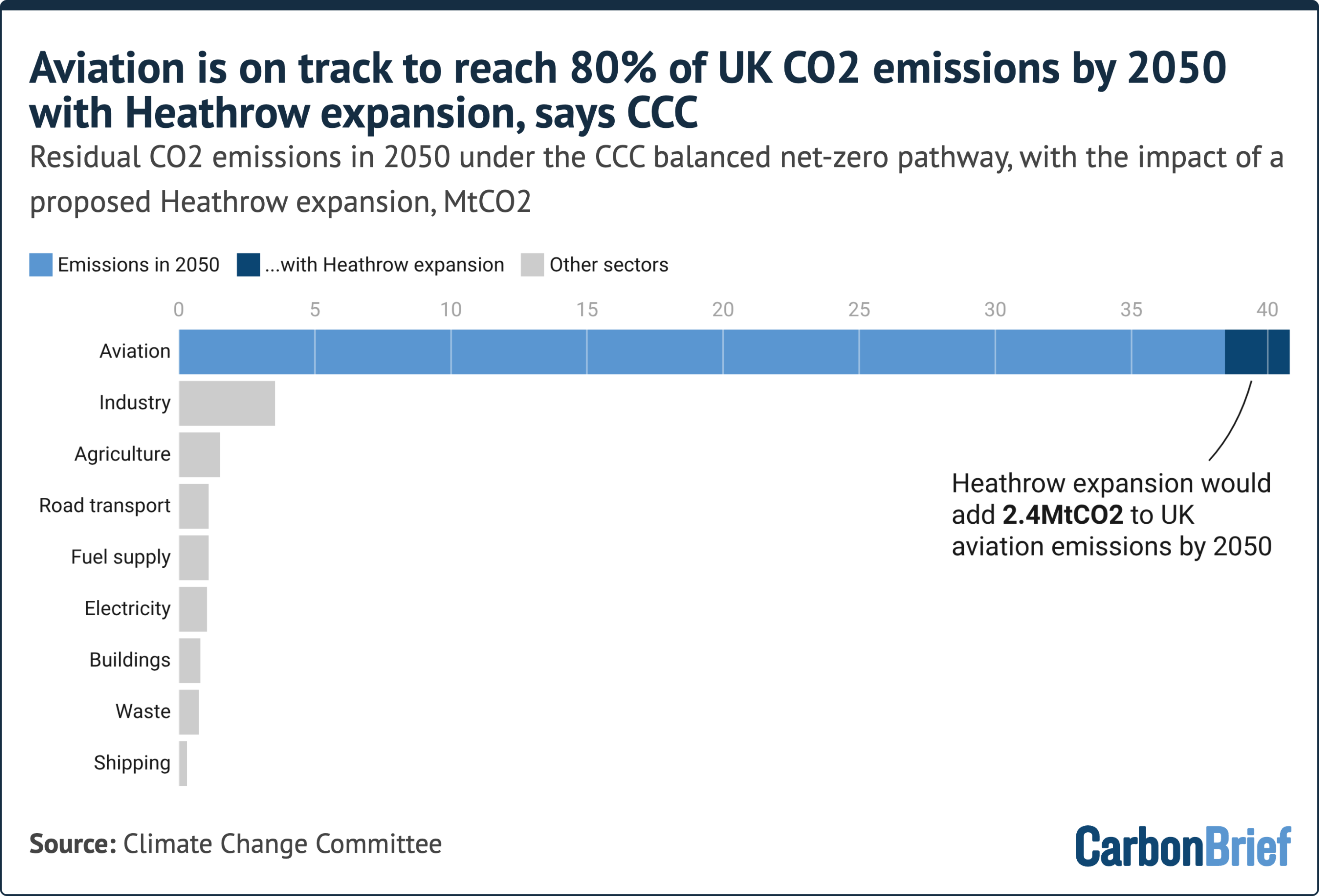
    Aviation is on track to reach 80% of UK CO2 emissions by 2050 with Heathrow expansion, says CCC. Residual CO2 emissions in 2050 under the CCC balanced net-zero pathway, with the impact of a proposed Heathrow expansion, MtCO2. Horizontal bar chart showing aviation far exceeding all other sectors. Source: Climate Change Committee - (alt text generated by Google Gemini)

    With a final decision on Heathrow expansion expected by 2029, the government asked the CCC  for its advice on whether the plan is compatible with the UK’s climate targets. 

    The CCC has concluded that the UK simply lacks sufficient policies to reduce aviation emissions and “expanding Heathrow would compound the problem”. In a press briefing, CCC chair Nigel Topping told journalists:

    “The UK does not currently have a credible plan to reduce [aviation emissions] in line with net-zero, so that creates a serious challenge for meeting our climate commitments.”

    The “jet-zero strategy”, launched by the previous Conservative government in 2022, set out plans to cut aviation emissions. However, the Labour government has since accepted that the strategy’s expectations for SAFs, electric planes and fuel-efficiency improvements were unrealistic.

    The CCC says a “credible and robust net-zero policy framework for aviation” should be set out in a revised strategy, which is planned for 2027. Only then could Heathrow expansion be aligned with the net-zero goal, adds the committee.

    As part of this new strategy, the CCC says the “aviation sector needs to take responsibility for its emissions”. It says policies should be designed based on the “polluter pays” principle, requiring the aviation industry to fund its own SAFs and CO2 removal.

    Specifically, the committee says funding will be needed for “engineered removal” technologies, such as direct air carbon capture and storage (DACCS). 

    These technologies are currently “not yet available at the scale required”, but are vital for the kind of permanent CO2 removal needed to mop up aviation emissions, says the CCC.

    (“Natural solutions” such as tree planting are the other main way CO2 is expected to be removed from the atmosphere. However, the CCC envisages these removals offsetting the remaining methane emissions from livestock agriculture in the UK, whereas it says “engineered removals” would be required to remove and store CO2 from flights.)

    The CCC acknowledges that placing decarbonisation costs on airlines would likely lead to higher ticket prices. It estimates that this could mean an increase, in 2024 prices, of around £150 for a return trip to Alicante, Spain, and £400 for a return trip to New York by 2050. 

    However, it says this is preferable to a public spending approach, which would result in the roughly 50% of the population who do not fly paying for flight-related CO2 removals.

    In addition, the committee notes that higher costs would help to manage demand for flights, which would otherwise be expected to increase considerably over the coming decades.

    Article by Josh Gabbatiss republished from Carbon Brief under a CC license. 

    Orcas comment on killer apes destroying the planet by continuing to burn fossil fuels.
    Orcas comment on killer apes destroying the planet by continuing to burn fossil fuels.

    Analysis: Global fossil-fuel emissions set to fall in 2026 amid Hormuz crisis

    El Niño: Indonesia fire emissions in 2026 ‘on track’ to match record for this century

    UK aviation emissions to be 50% higher than thought by 2050, government admits

    Analysis: UK solar power hits record high over summer 2026

  • Greta Thunberg Is Taking Sweden to Court Over Climate Crisis Again

    Spread the love

    https://novaramedia.com/2026/09/22/greta-thunberg-is-taking-sweden-to-court-over-climate-crisis-again/

    Greta Thunberg was detained by police in The Hague along with other climate protesters. Photograph: Peter Dejong/AP
    Greta Thunberg. Photograph: Peter Dejong/AP

    Her youth-led group has raised more than £180k to fund the lawsuit.

    Greta Thunberg and Swedish youth climate organisation Aurora are suing the Swedish government over its failures to tackle the climate crisis.

    While Sweden has reduced its greenhouse gas emissions at a rate faster than the EU average, the country is not on track to meet its own target of net zero by 2045.  

    Thunberg said on Monday that Aurora has filed a second lawsuit, arguing that Sweden is failing in its legal duty to protect its citizens – especially children and the young – from the effects of climate change.

    The group is demanding that Sweden take action to limit global warming to 1.5C by cutting emissions and protecting ecosystems like forests. A third demand involves accounting for emissions that it says are currently excluded from government calculations such as burning imported biomass.

    “Sweden, as a rich country with high historical and current emissions, has a legal duty to lead the climate transition,” the group wrote in its fundraiser. “A safe and just world is still possible, but only if rich, high-emitting states like Sweden stop violating their duty to protect people from the devastation of the climate crisis, and start transforming their societies before 2030.” 

    …

    Atrticle continues at https://novaramedia.com/2026/09/22/greta-thunberg-is-taking-sweden-to-court-over-climate-crisis-again/

    Orcas discuss Donald Trump and the killer apes' concept of democracy. Front Orca warns that Trump is crashing his country's economy and that everything he does he does for the fantastically wealthy.
    Orcas discuss Donald Trump and the killer apes’ concept of democracy. Front Orca warns that Trump is crashing his country’s economy and that everything he does he does for the fantastically wealthy.
    Donald Trump urges you to ignore facts and reality and be a Climate Science denier like him. He says that he makes millions and millions for destroying the planet, Burn, Baby, Burn and Flood, Baby, Flood.
    Donald Trump urges you to ignore facts and reality and be a Climate Science denier like him. He says that he makes millions and millions for destroying the planet, Burn, Baby, Burn and Flood, Baby, Flood.
    Nigel Farage urges you to ignore facts and reality and be a climate science denier like him and his Deputy Richard Tice. He says that Reform UK has received £Millions and £Millions from the fossil fuel industry to promote climate denial and destroy the planet.
    Nigel Farage urges you to ignore facts and reality and be a climate science denier like him and his Deputy Richard Tice. He says that Reform UK has received £Millions and £Millions from the fossil fuel industry to promote climate denial and destroy the planet.
  • Bristol Becomes First UK City to Ban Fast Fashion Adverts Over Industry’s Environmental Toll

    Spread the love

    Article by Ellen Ormesher republished from DeSmog.

    Climate commentary added to a British Airways billboard. (Credit: Brandalism)

    Policy update also restricts advertising for fossil fuels products and services in council owned ad sites.

    Bristol has joined nearly two dozen other UK cities in cracking down on the promotion of high-carbon products like petrol and airline flights on council-owned property.

    In a UK first, however the ban also includes adverts that encourage the over-consumption of fast fashion – an industry that demands vast amounts of resources such as water and oil-based synthetic materials to keep up with global clothing trends. The textile sector is responsible for 2-10 percent of global carbon emissions yearly, according to a 2023 report by the United Nations Environment Program, along with nearly 10 percent of ocean microplastic pollution.

    Bristol city councillors voted on September 14 to expand the city’s 2021 policy restricting advertising for junk food, alcohol, gambling, payday loans, and tobacco to include products and services that are major sources of climate-heating carbon pollution.

    Along with fast fashion, the ban now includes adverts or marketing for oil and gas companies, alongside cars running in whole or part on petrol or diesel, all SUVs, airlines, airports, and cruises.

    The restrictions apply to council-owned sites across the city, including bus stops. However, ads for these industries may still run on billboards and screens that are not owned by the council.

    Local representatives and campaigners welcome the ban, saying it will reduce climate impacts and improve neighbourhoods.

    “Advertising forces itself upon all of us. While scrolling, while walking, while waiting for the bus, it has negative impacts on our health and wellbeing,” said deputy leader of Bristol City Council Heather Mack, who spearheaded the policy. “The advert ban “is something we can do quite easily to reduce our climate impact and improve our local neighbourhoods,” she said.

    “We know ad bans are a catalyst for healthy change,” said Nicola Wilks, co-founder and co-director of the campaign group Adfree Cities, in a statement. “Removing tobacco ads saved lives by reducing levels of smoking. As a Bristol resident who cares deeply about climate change and air pollution, I am proud that Bristol has gone even further than other UK councils in curbing polluting ads. It feels like common sense.” 

    According to Adfree Cities, more than 20 UK councils have now introduced some form of restriction on the advertising of polluting products and services, citing their incompatibility with goals to improve air quality and reduce climate-harming emissions.

    Bristol councillors’ decision is the latest in a global trend of cities and regions targeting major polluters with ad bans. In the UK, Sheffield and Edinburgh have adopted similar bans on high-carbon advertising on council-owned property. In the Netherlands,  The Hague, and Amsterdam have introduced legal bans on fossil fuel advertising in public spaces citywide.

    The advertising and fossil fuel industries are resisting these bans. DeSmog recently revealed that 15 companies and trade associations, including oil and gas giant TotalEnergies, lobbied to dilute France’s national restrictions on fossil fuel advertising. 

    DeSmog also exposed a last- minute lobbying attempt earlier this year by the world’s largest outdoor advertising company, JCDecaux, to prevent the Amsterdam ban.

    While supporting the ban in Bristol, city councillors said there was a “moral argument” for banning ads for industries that are harmful. However, Conservative councillor John Goulandris said the policy made him “uneasy”. “I’m surprised you haven’t said that we’re going to ban Christmas, because Christmas is a time of great consumption, it’s very bad for the environment”, he said.

    Goulandris is not the first Tory representative to oppose advertising restrictions on harmful products. Former culture minister Lord Ed Vaizey pushed back against increasing regulation of the advertising industry at the annual Advertising Association conference in January 2026.

    “I see a political class that is tempted to ban what it doesn’t like rather than use the power of advertising to change behaviour,” he said.

    Bristol’s updated policy has the potential to incur losses of up to £80,000 per year of advertising revenue, according to a report prepared by Bristol’s policy, strategy, and public affairs team — while acknowledging that neither Sheffield nor Edinburgh, which have similar restrictions, have reported any financial impacts as a result.

    The report also found that the city’s advertising revenue did not decrease following its 2021 ban on junk food advertising — the first outside London — despite a projected £150,000 loss in advertising revenue.

    In a statement, Carla Denyer, MP for Bristol Central, called the policy update  “hugely rewarding.” Denyer helped to institute the junk food advertising ban in 2021, and has continued to advocate for further restrictions on the advertising of harmful products.

    “Our Green-led council is making huge strides on Bristol’s climate and sustainability commitments, working on public transport infrastructure, home heating and community energy,” she said in the statement. “It makes no sense for these efforts to be running alongside advertisements for things like oil and gas companies, SUVs, or fast fashion which do not align with our community values.”

    United Nations Secretary-General Antonio Guterres has called on governments to ban all fossil fuel advertising, calling the advertising and PR companies who work with the polluting industries “enablers to planetary destruction.”

    Reporting contributed by Emily J Gertz.

    Article by Ellen Ormesher republished from DeSmog.

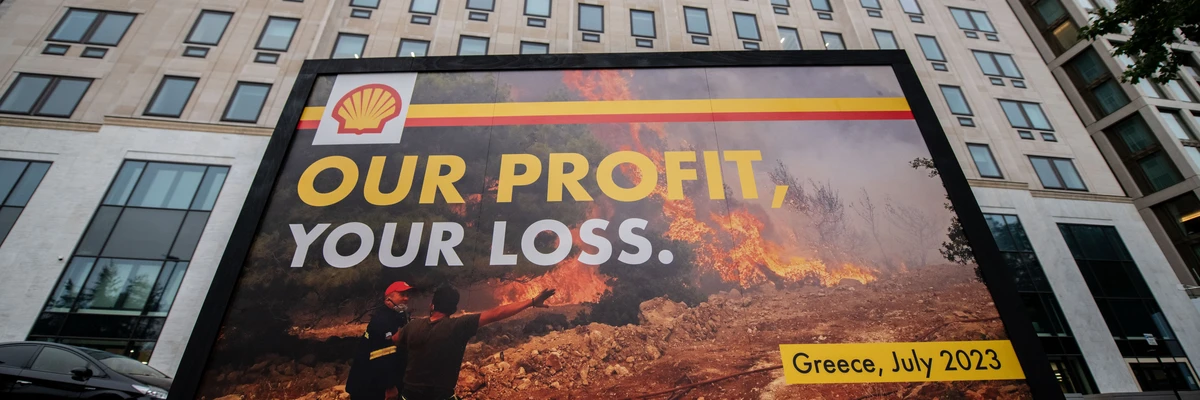
    Greenpeace activists display a billboard during a protest outside Shell headquarters on July 27, 2023 in London.
    Greenpeace activists display a billboard during a protest outside Shell headquarters on July 27, 2023 in London. (Photo: Handout/Chris J. Ratcliffe for Greenpeace via Getty Images)
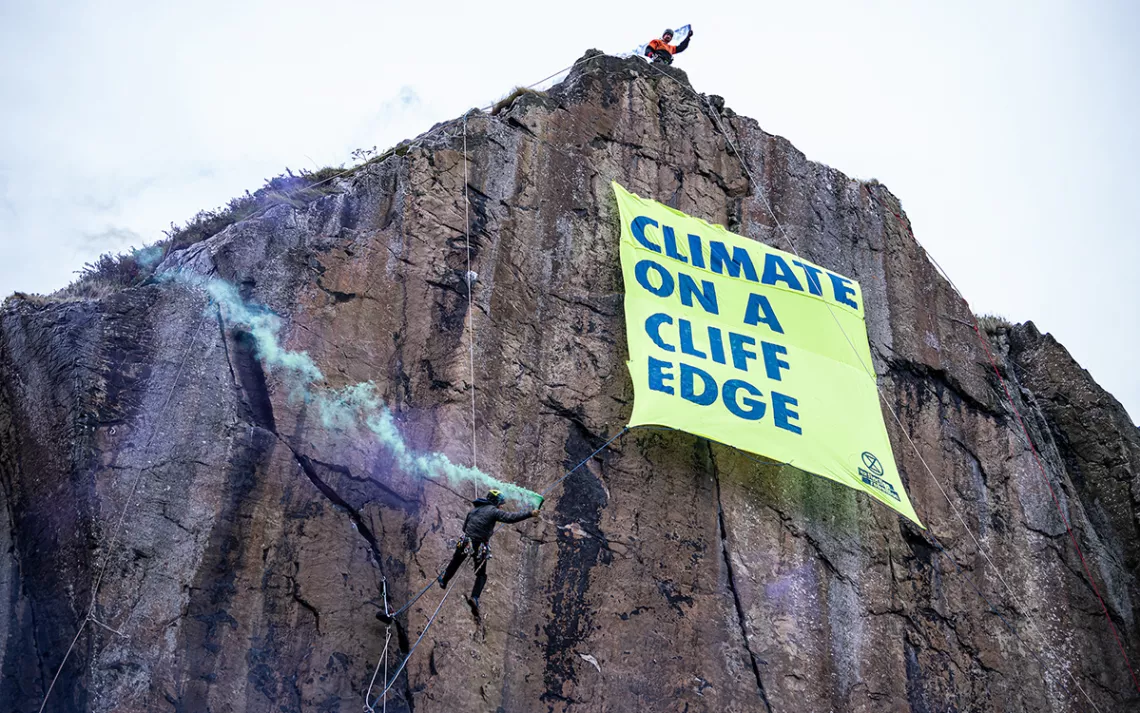
    Experienced climbers scale a rock face near the historic Dumbarton castle in Glasgow, releasing a banner that reads “Climate on a Cliff Edge.” One activist, dressed as a globe, symbolically looms near the edge, while another plays the bagpipes on the shores below. | Photo courtesy of Extinction Rebellion and Mark Richards
    Experienced climbers scale a rock face near the historic Dumbarton castle in Glasgow, releasing a banner that reads “Climate on a Cliff Edge.” One activist, dressed as a globe, symbolically looms near the edge, while another plays the bagpipes on the shores below. | Photo courtesy of Extinction Rebellion and Mark Richards

  • ‘The Diagnosis Is Unambiguous’: 2026 Planetary Health Report Finds Pressure Mounting on Earth Systems

    Spread the love

    Article by Julia Conley republished from Common Dreams under Creative Commons (CC BY-NC-ND 3.0).

    A protester is seen in Los Angeles during a climate change demonstration holding a placard that says, “There is no Planet B.” (Photo by Ronen Tivony/SOPA Images/LightRocket via Getty Images)

    “Seven of nine planetary boundaries are transgressed, and pressure on all seven is at its highest recorded level,” said one scientist.

    Like other recent warnings from climate scientists, the message sent by the latest Planetary Health Check report on Monday was clear: “We need to move fast,” as the director of the Potsdam Institute for Climate Impact Research, the group behind the report, said.

    “Seven of nine planetary boundaries are transgressed, and pressure on all seven is at its highest recorded level,” said Johan Rockström, director of the Potsdam Institute (PIK).

    RECOMMENDED…

    Trump salutes as soldiers carry a flag-draped casket

    ‘Unforgivable Sin’: Pentagon Reportedly ‘Hiding’ US Deaths in Iran War

    Senator Mitch McConnell Returns To Capitol Hill After Months-Long Absence

    McConnell Returns to Congress—After 3 Months of Paid Leave With Taxpayer-Subsidized Healthcare

    The report finds that seven measures of the Earth’s health are no longer within the “safe operating space”: ocean acidification, freshwater change, land system change, climate change, modification of biogeochemical flows, introduction of novel entities, and change in biosphere integrity.

    Just two markers, stratospheric ozone depletion and the increase in atmospheric aerosol loading, have shown improvement over the last decade, said the Planetary Boundaries Science Lab at PIK.

    “The diagnosis is unambiguous,” said Boris Sakschewski, the lead author of the report. “Pressure is rising across every planetary boundary already outside the safe operating space. It means that the risk of large-scale, persistent, and potentially irreversible change is increasing, while our margin for error in tackling these problems is shrinking.”

    The scientists behind the report emphasized that with recent news regarding the state of the planet’s crucial coral reefs, forests, and extreme weather events like heatwaves and flooding, it should come as no surprise that the Earth’s boundaries have been transgressed, as continued fossil fuel emissions have caused runaway planetary heating.

    Earlier this month, United Nations scientists said the planet can no longer avoid at least a temporary temperature rise above 1.5°C over preindustrial levels.

    Oceans have also become so warm that stressed coral reefs have less and less time to recover from climate damage, as Common Dreams reported last month, and a UN report last year found that the world’s governments are not moving fast enough to end the destruction of forests.

    Last month and the summer of 2026 both set heat records, with extreme heat killing more than 1,000 people across Europe, and wildfires spreading across the continent and Canada. Record-breaking heat was also recorded in parts of Asia and the Middle East.

    In June, the UN Children’s Fund found that nearly every child on Earth is now exposed to at least one climate hazard driven by fossil fuel emissions, including flooding, heatwaves, and drought.

    “Pakistan’s 2025 monsoon floods affected more than 6.9 million people,” said PIK. “Global ocean heat content reached a new record in 2025, with Hurricane Melissa rapidly ramping up to a Category 5 hurricane and striking Jamaica after passing over exceptionally warm seas. From January 2023 to September 2025, bleaching-level heat stress impacted about 84.4% of the world’s coral reef area, making it the largest global coral-bleaching event observed to date.”

    Hindou Oumarou Ibrahim, chair of Planetary Guardians, implored readers of the Planetary Health Check report to “read that list again: Pakistan, the Caribbean, Europe, the reefs beneath our oceans. These are not separate emergencies; the planet is telling us, in every region at once, that it is out of balance.”

    “As chair of Planetary Guardians, I hear this same story wherever I go, whether from a pastoralist watching the rains fail season after season or a coastal community watching the sea rise,” said Ibrahim. “The 2026 Planetary Health Check puts data behind what communities on the frontlines already know from living it. We do not have the luxury of treating these as separate crises any longer.”

    Rockström emphasized that while “we do not have the luxury of time… we do have the knowledge, capacity, and solutions to change course.”

    “Accelerating action to return to the safe operating space across all planetary boundaries is essential to protect lives and livelihoods,” said Rockström, “and to deliver on the promise of shared future prosperity.”

    Article by Julia Conley republished from Common Dreams under Creative Commons (CC BY-NC-ND 3.0).

    Donald Trump urges you to ignore facts and reality and be a Climate Science denier like him. He says that he makes millions and millions for destroying the planet, Burn, Baby, Burn and Flood, Baby, Flood.
    Donald Trump urges you to ignore facts and reality and be a Climate Science denier like him. He says that he makes millions and millions for destroying the planet, Burn, Baby, Burn and Flood, Baby, Flood.
    Orcas comment on killer apes destroying the planet by continuing to burn fossil fuels.
    Orcas comment on killer apes destroying the planet by continuing to burn fossil fuels.
    Climate science denier Donald Trump confirms that he knows nothing about democracy and that more liquid gold is being secured according to his policy of global privateering.
    Climate science denier Donald Trump confirms that he knows nothing about democracy and that more liquid gold is being secured according to his policy of global privateering.
  • Analysis: ‘Super El Niño’ reaches ‘remarkable’ all-time record

    Spread the love

    Article by Dr Zeke Hausfather republished from Carbon Brief under a CC license.
    Stormy seas: CHROMORANGE / Bruno Kaegi / Alamy Stock Photo

    This year’s so-called “super El Niño” is entering into record-breaking territory. 

    Sea surface temperatures in the tropical Pacific now equal the previous daily record set in 2015 and will likely keep rising in the days ahead.

    El Niño is a naturally occurring climate phenomenon in the Pacific that reshapes weather patterns around the world and temporarily boosts global temperatures. 

    The current El Niño event – which has been underway since June and is expected to last until next year – has been developing faster than any previous event on record. 

    The strength of an event is tracked using the “Niño 3.4 anomaly”, which measures how much warmer sea surface temperatures in a section of the central Pacific are than average. 

    As of 19 September, the daily anomaly in the Niño 3.4 region stands at 3.07C, putting it in a statistical tie with the previous record of 3.08C.

    Some scientists, using a different baseline for calculating the anomaly, have already called the new record. 

    Either way, this is remarkable, in part because of how early in the calendar year it is occurring. El Niño typically peaks in the winter months, most commonly in November or December. 

    Every strong El Niño on record has continued to strengthen after mid-September – and there is every reason to think that this one will as well.

    (For more on El Niño, see Carbon Brief’s recent interactive explainer.) 

    Record territory

    El Niño events are typically classed as “weak” when the Niño 3.4 anomaly reaches 0.5C, “moderate” above 1C, “strong” above 1.5C and “very strong” above 2.0C.

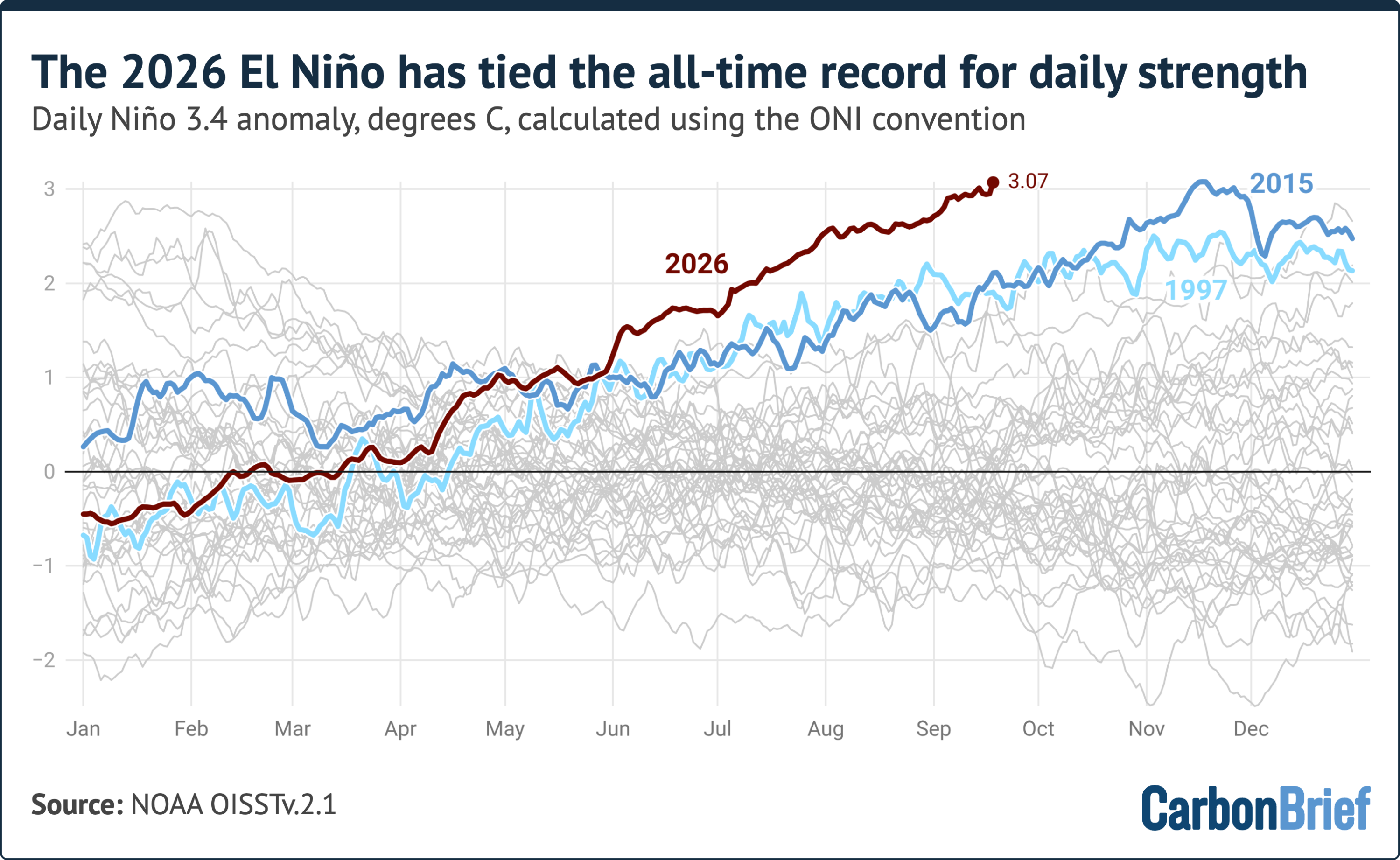
    For this year’s event, the Niño 3.4 anomaly has now reached 3.07C, which puts it in a statistical tie with the record set on 18 November 2015, set during a “very strong” El Nino event.

    The chart below shows how the strength of the current El Niño (red line) is dramatically outpacing both 2015-16 (blue) and another “very strong” event in 1997-98 (light blue).

    The 2026 El Niño has tied the all-time record for daily strength. Daily Niño 3.4 anomaly, degrees C, calculated using the ONI convention. A line chart shows 2026 rising sharply to a record high of 3.07 by October, well above major previous events in 1997 and 2015. Source: NOAA OISSTv.2.1 - (alt text generated by Google Gemini)
    Daily Niño 3.4 sea surface temperature anomalies, 1982-2026, each relative to a centred 30-year climatology (ONI convention). Chart by Carbon Brief.

    To analyse the developing El Niño, Carbon Brief followed the convention of the US National Oceanic and Atmospheric Administration’s (NOAA) Oceanic Niño index (ONI).

    ONI is calculated by subtracting the latest 30-year average temperature in the Nino 3.4 region from daily sea surface temperatures. This approach allows for the most recent years to be compared against the most recent 30-year period. It removes much of the influence of longer-term, human-driven warming from the index. 

    (While meteorological organisations typically track changes to ONI on a three-month rolling average basis, Carbon Brief’s analysis looked at how the metric is changing on a daily basis.)

    If ONI is calculated using a baseline of 1991-2020 then the current El Niño has already set a new record.

    Since the start of June, El Niño’s strength has been greater than any other year. In early September in both 1997 and 2015, anomalies were around 1.9C – more than one degree below where they are this year.

    An alternative index 

    There is another commonly used metric – the relative Oceanic Niño index (RONI) – used to study El Niño. 

    Introduced by NOAA in 2024, the RONI index adjusts for tropical ocean warming linked to human-caused climate change. To do this, it takes sea surface averages in the Nino 3.4 region and subtracts out temperature anomalies observed across the tropical oceans (between the latitudes of 20 degrees north and south). 

    This approach may better remove the influence of climate change in this specific region, but can also diminish the apparent strength of strong El Niño events, such as the current one, which extend well outside the Niño 3.4 region.

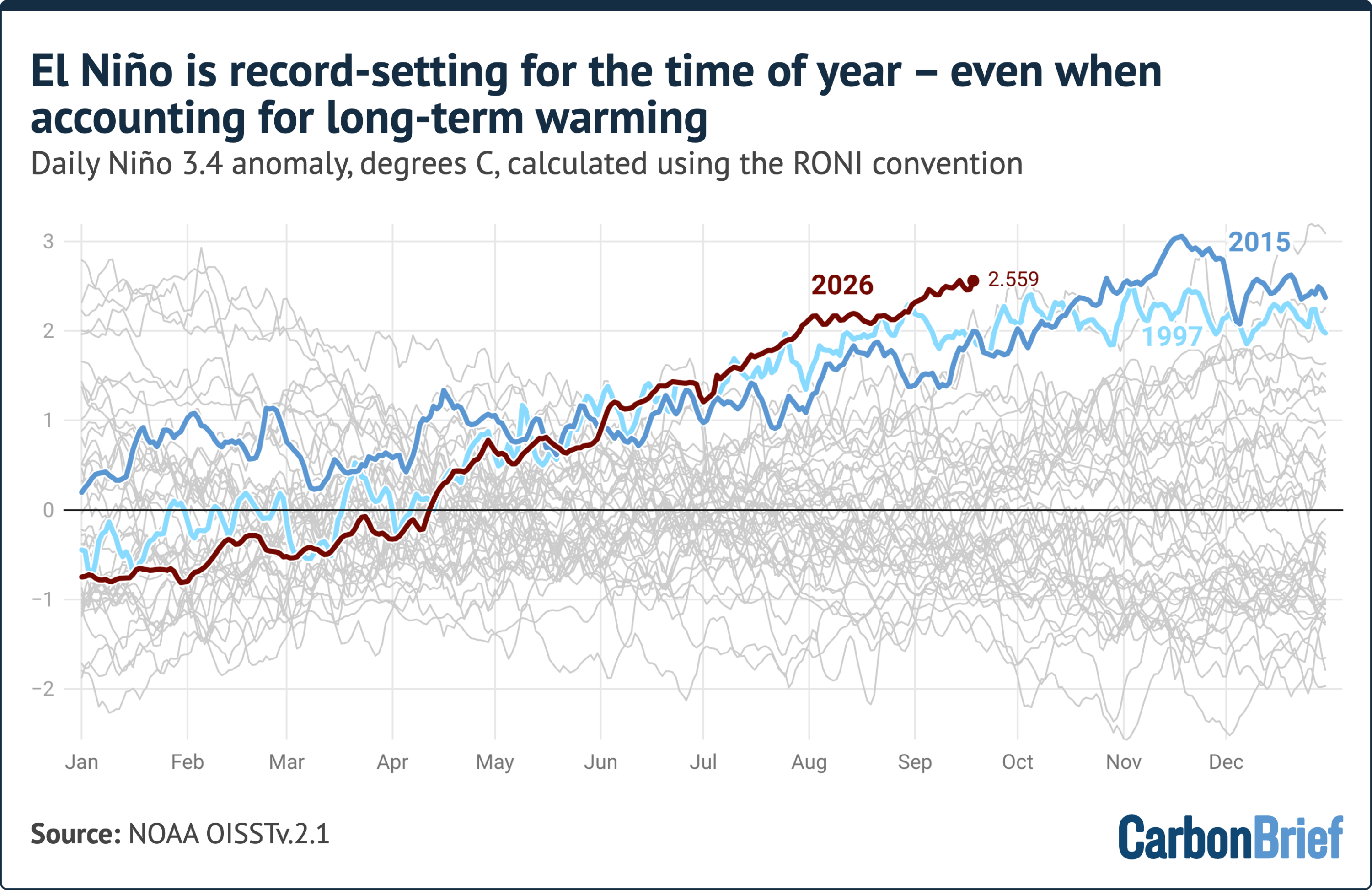
    The chart below shows daily RONI values, which are record setting for this time of year, but remain below an all-time daily record set during the 1982-83 El Niño event.

    El Niño is record-setting for the time of year – even when accounting for long-term warming. Daily Niño 3.4 anomaly, degrees C, calculated using the RONI convention. Line chart showing 2023 anomalies surpassing 1997 and 2015 levels from July to October, reaching 2.559. Source: NOAA OISSTv.2.1 - (alt text generated by Google Gemini)
    Daily relative Niño 3.4 (RONI) anomalies for every year, 1982-2026. Chart by Carbon Brief.

    RONI stood at around 2.5C in mid-September, some 0.7C below the 1982 record. 

    However, that record was set in late December, at the peak of the event. 

    The 1982-83, 1997-98 and 2015-16 events added between 0.5C and 1.9C to their RONI values between mid-September and their peaks.

    On track to smash monthly and seasonal records  

    Because daily El Niño values are noisy, scientists typically turn to monthly or seasonal averages to compare El Niño events. 

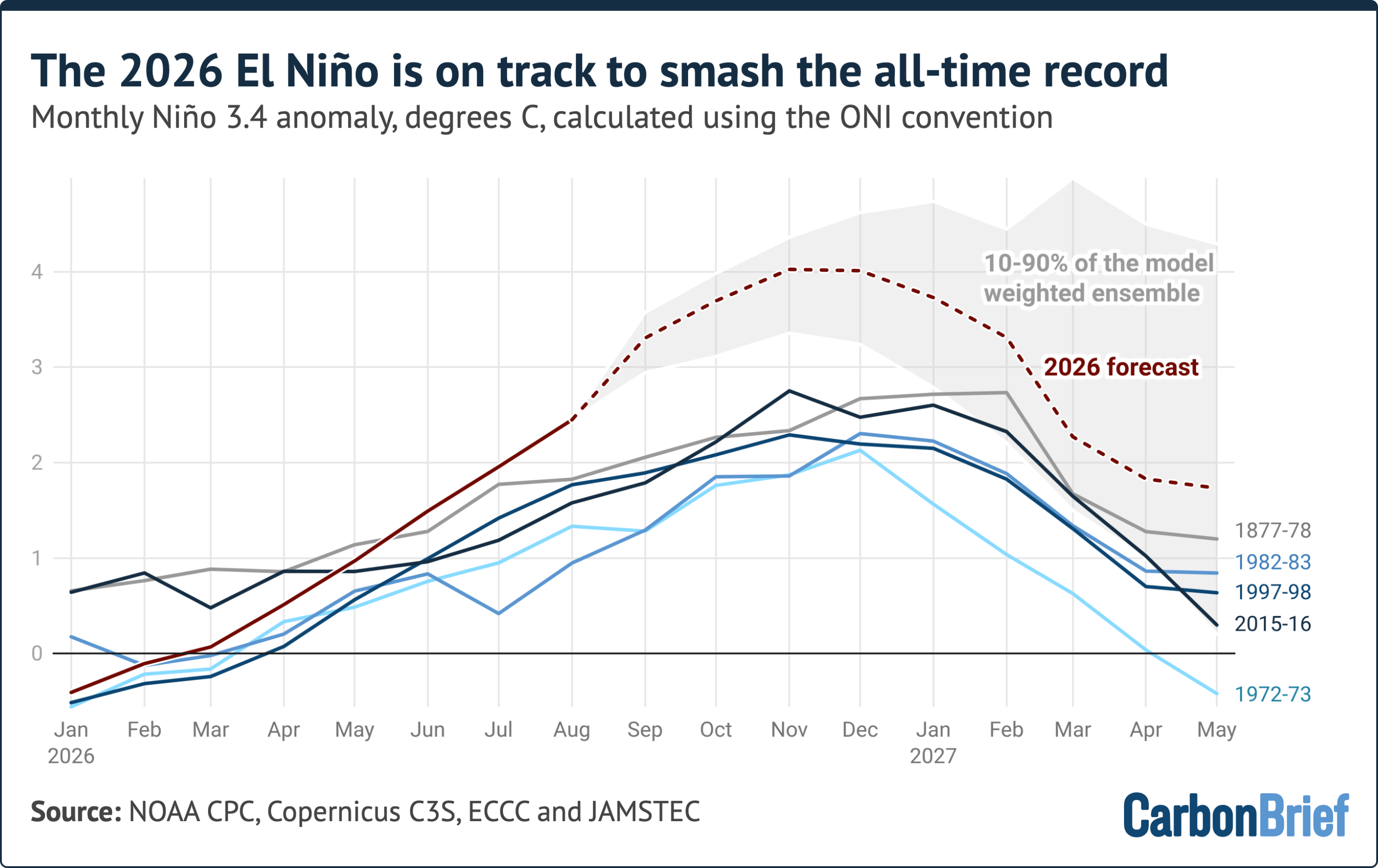
    The latest full calendar month for which data is available – August 2026 – had a Niño 3.4 anomaly of around 2.45C. This is higher than the peak of every prior El Niño event on record except 2015-16 – where the anomaly reached 2.75C – and 1877-78, when the anomaly sat at around 2.7C, based on a reconstruction of sea surface temperatures using sparse ship data.

    The figure below shows the monthly evolution of the five strongest El Niño events on record alongside 2026, as well the current forecast from 14 seasonal forecast models.

    The 2026 El Niño is on track to smash the all-time record. Monthly Niño 3.4 anomaly, degrees C, calculated using the ONI convention. Line chart shows the 2026 forecast peaking around 4°C in late 2026, well above historical records below 3°C. Source: NOAA CPC, Copernicus C3S, ECCC and JAMSTEC - (alt text generated by Google Gemini)
    Monthly Niño 3.4 anomaly (degrees C) for the five strongest El Niño events on record, for 2026 through August and the 2026-27 forecast across 14 models, each relative to a centred 30-year climatology (ONI convention). Data from NOAA CPC, Copernicus C3S, ECCC and JAMSTEC. Chart by Carbon Brief.

    Taken together, the models project a peak monthly anomaly later this year of around 4.1C, with 80% of the 674 individual model runs falling between 3.4C and 4.6C. 

    Every single model run peaks above the 2015-16 record. The projected margin over that record, some 1.3C, is larger than the entire gap between the strongest and fifth-strongest El Niño of the past 150 years.

    Some caution here is warranted, however. No seasonal forecast system has ever been verified against an event of this size, because none has ever occurred. The models also predicted temperatures slightly warmer than observed this summer, with real-world observations for August coming in around 0.3C below forecasts.

    However, all strong El Niño events on record have continued to strengthen well into the winter – and the models are in near-unanimous agreement that this one will, too. If the forecast holds, the current event will peak between November and January at a level far beyond any event previously observed in the instrumental record.

    El Nino’s effect on global temperatures typically lags rising ocean temperatures in the Pacific by several months, so most of the impact will be felt in 2027 rather than 2026. 

    Carbon Brief’s most recent “state of the climate” quarterly analysis found 2026 on track to be the warmest or second-warmest year on record. The next update in early October will examine what a record El Niño means for 2027.

    Article by Dr Zeke Hausfather republished from Carbon Brief under a CC license.

    El Niño: Indonesia fire emissions in 2026 ‘on track’ to match record for this century

    Explainer: How the ‘super El Niño’ will reshape the world’s weather

    Analysis: What are the causes of recent record-high global temperatures?

    State of the climate: First quarter of 2020 is second warmest on record

    Donald Trump urges you to ignore facts and reality and be a Climate Science denier like him. He says that he makes millions and millions for destroying the planet, Burn, Baby, Burn and Flood, Baby, Flood.
    Donald Trump urges you to ignore facts and reality and be a Climate Science denier like him. He says that he makes millions and millions for destroying the planet, Burn, Baby, Burn and Flood, Baby, Flood.
    Nigel Farage urges you to ignore facts and reality and be a climate science denier like him and his Deputy Richard Tice. He says that Reform UK has received £Millions and £Millions from the fossil fuel industry to promote climate denial and destroy the planet.
    Nigel Farage urges you to ignore facts and reality and be a climate science denier like him and his Deputy Richard Tice. He says that Reform UK has received £Millions and £Millions from the fossil fuel industry to promote climate denial and destroy the planet.
    Elon Musk urges you to be a Fascist like him, says that you can ignore facts and reality then.
    Elon Musk urges you to be a Fascist like him, says that you can ignore facts and reality then.