Wind turbines seen at the Altamont Pass wind farm on January 13, 2026 in Livermore, California. (Photo by Justin Sullivan/Getty Images)
“The most corrupt presidency ever—and it’s not even close,” said one critic.
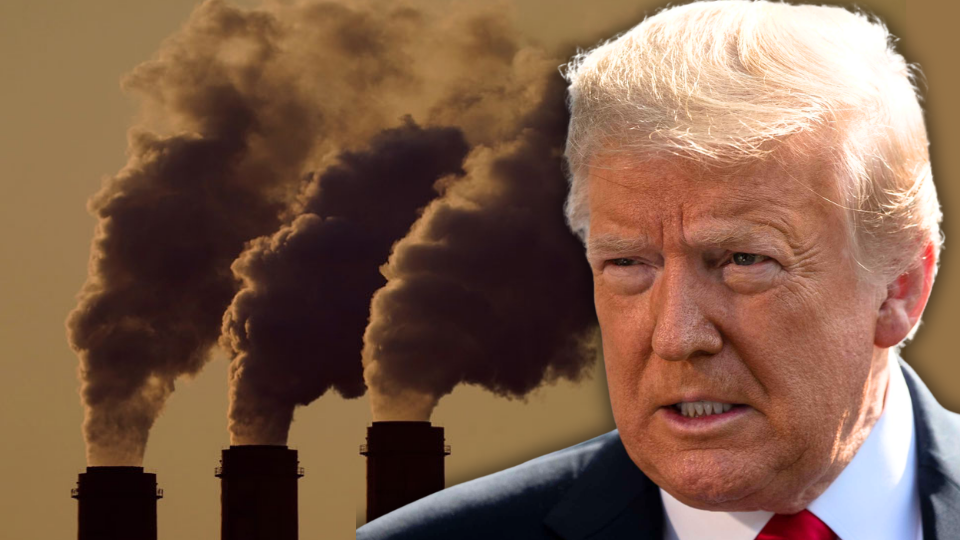
Critics slammed the Trump administration on Monday after it announced a deal to pay almost $1 billion to a French energy company to cancel its plans to construct wind farms across the eastern US.
As reported by The New York Times, French firm TotalEnergies has agreed to forfeit its leases in federal waters off the coasts of New York and North Carolina, and will instead invest the money it received from the Trump administration into oil and gas projects in the US, “including a facility in Texas that would export liquefied natural gas to global markets.”
TotalEnergies paid nearly $928 million for the rights to access federal waters during former President Joe Biden’s administration.
The Times described the agreement as “an extraordinary transfer of taxpayer dollars to a foreign company for the purposes of boosting the production of fossil fuels, a main driver of climate change, while throttling offshore wind power.”
Patrick Pouyanné, the chief executive of TotalEnergies, said that the firm decided to abandon its US wind farm plans due to “practical” considerations, while emphasizing that the firm wasn’t giving up on wind power all together.
“When the Trump administration came to power and began setting US energy policy, we said that we’ll have to reconsider, clearly, these offshore wind project developments,” explained Pouyanné, adding that “we continue to invest in onshore solar, onshore wind, batteries.”
Many critics expressed disbelief that the Trump administration would go to such extraordinary lengths to kill a clean energy project, especially after the president sent oil and gasoline prices soaring earlier this month when he launched an unprovoked and unconstitutional war with Iran.
“Let’s call this what it is: a taxpayer-funded bribe to kill homegrown clean energy and hand the money straight to oil and gas executives,” wrote climate advocacy organization Evergreen Action in a social media post. “Trump is once again making Americans pay more for energy so his Big Oil donors can rake in even more profits.”
Melanie D’Arrigo, executive director of the Campaign for New York Health, expressed a similar sentiment.
“$1 billion of our tax dollars to kill a clean energy program that creates jobs, just so Trump’s Big Oil donors can make more profit,” D’Arrigo wrote. “The most corrupt presidency ever—and it’s not even close.”
Matt Gertz, senior fellow at press watchdog Media Matters for America, argued that the agreement was a corrupt bargain aimed at hurting the president’s political foes, including the Democratic leaders of New York and North Carolina.
“Climate/renewables arguments aside, this is the president’s administration paying a foreign company to invest in states where Republicans are in charge rather than ones where Democrats are in charge,” Gertz wrote, “using tax dollars to punish people who didn’t vote for his party.”
US Sen. Lisa Blunt Rochester (D-Del.) said that the deal to kill the planned wind farms was yet another example of the Trump administration making life in the US less affordable.
“This administration just spent $1 BILLION of your money to make sure wind farms don’t get built,” Blunt Rochester wrote. “You’’ll have them to thank for higher electric bills each month.”
Neo-Fascist Climate Science Denier Donald Trump says Burn, Baby, Burn.Experienced climbers scale a rock face near the historic Dumbarton castle in Glasgow, releasing a banner that reads “Climate on a Cliff Edge.” One activist, dressed as a globe, symbolically looms near the edge, while another plays the bagpipes on the shores below. | Photo courtesy of Extinction Rebellion and Mark RichardsDonald Trump warns against following the Onaquietday.org blog, says that he’s heard that she’s a which with a black cat and a dangerous kitchen.
Policymakers, civil society, investors, business, and the media all must answer key questions fast — before the regulatory rollback turns into a rout.
The European Union’s package of major corporate environment and sustainability laws was years in the making — and has just been quietly gutted.
A debate that reshaped corporate Europe unfolded almost entirely within Brussels policy circles. Millions of Europeans who believe climate action should be prioritised and favour greater corporate accountability never realized the regulations were under threat.
This should prompt serious reflection among those of us who believe that the climate and human rights focus of the regulations was deadly serious, but that support among politicians was not.
The so-called “Omnibus” rollback — a regulatory rationalisation ascribed to competitiveness concerns amid pressure from the United States – has exempted 90 percent of Europe’s companies from climate reporting. In parallel, supply chain reporting has been seriously watered down and postponed until the end of the decade.
The overturned rules included mandatory reporting by most EU companies of their impact on climate change, and how environmental dangers could affect their business. They also forced companies selling products on the continent to report on child and forced labour issues, as well as potentially dangerous working conditions in their international supply chains.
In today’s economy, corporate lobbyists seize moments of regulatory weakness to ram home anti-growth or relative competitiveness arguments that instantly gather financial and political support.
Indeed, the printer ink had barely dried on the official publication of the EU Omnibus — finalised this month — before companies started attacking the EU’s 20-year-old Emissions Trading System (ETS) carbon pricing regime on similar international competition grounds.
If we don’t quickly digest the lessons of the Omnibus debacle, sterner tests will come as populists challenge for power across the bloc.
Why Was the Rollback Invisible?
Why was the European public largely unaware of such a huge regulatory rollback?
The reason is that it took place in a legacy media vacuum. No major polling organisation measured citizen awareness. The BBC, The Guardian, Le Monde, and Der Spiegel barely — if at all — covered the vote.
Further, how can we support and defend policies when we hide them behind letter jumbles like CSRD, SFDR, CSDDD — acronyms that mean nothing to the public? (The Corporate Sustainability Reporting Directive, Sustainability Finance Disclosure Regulation, and Corporate Sustainability Due Diligence Directive, respectively.)
Fluency in Brussels acronyms becomes a political liability when success requires public mobilisation.
Campaigns succeed with vivid phrases that citizens quickly understand. Surveys consistently show that large numbers of Europeans support corporate accountability when it’s described in plain language. Germany’s “Supply Chain Law” campaign gathered over 200,000 supporters by using a clear, native-language label.
No comparable EU-wide branding effort for the sustainable finance regulations emerged. Defenders of the EU sustainability rules never attempted an equivalent translation.
By contrast, industry lobbyists framed their arguments with accessible language such as “simplification” and “cutting red tape,” while pushing the convenient elements of the Draghi report on EU competitiveness. Advocates countered with “transposition deadlines,” “ESRS requirements,” and “regulatory coherence.” The contrast was decisive.
Post-defeat reflection on this communications failure has been nearly non-existent.
Green Groups: Bureaucratised and Compromised?
Typically, the rallying call to voters on environmental and rights regulations comes from non-governmental organisations (NGOs). In the case of the EU climate and sustainability Omnibus, more than 360 NGOs and other civil society organisations signed a coalition statement against the “disastrous” and “dangerous” deregulation.
Over the decades, many European climate and human rights groups have evolved into Brussels-based policy shops that are staffed by lawyers and technical experts fluent in EU procedure, but which seem to be relatively poorly equipped for mass public and political campaigning.
Their efforts produced no mass protests, no breakthrough petitions, and no broad public mobilisation.
Some NGO funding structures appear to reinforce this limitation. Major foundations often restrict grants against “political or partisan activities,” while EU funding frameworks have introduced reputational-risk benchmarks that discourage confrontational advocacy. Funders also often seek short-term results to long-term problems that require deep, structural change, not “hope-for-the-best” strategy thinking.
A coalition spanning 27 countries that relies on consensus decision-making could not move quickly. The NGOs deployed the only tools their structures supported: letters, technical briefings, and procedural complaints. The limitation was not a strategic choice; it was institutional.
Big-spending corporate lobbyists, meanwhile, began organising months before public announcements on the Omnibus were made. In addition, the accelerated legislative timeline of the Omnibus compressed the opposition response time from multiple years to less than one, leaving opponents flat-footed.
ExxonMobil alone is reported to have had more than 25 meetings with the European Commission to lobby against the CSDDD, and allegedly threatened to withhold $20bn in renewables spending in Europe if it was not rolled back.
We hear there have been reflections by major NGOs on what went wrong. To stop mistakes from recurring, the publication of these learnings is essential.
Why Doesn’t Capital Defend Itself?
Institutional investors representing €6.6 trillion in assets had strong financial incentives to oppose the Omnibus. Their risk analysis was clear: Stranding of major fossil-fuel assets would likely accelerate without transition planning; weakened disclosure rules would leave investors short of necessary climate information; regulatory uncertainty would stall long-term investment; and Europe would forfeit advantages in green technology.
Citizens’ pensions and long-term savings could face potential portfolio-wide losses if systemic climate risks go unmanaged.
Investors wrote detailed letters explaining these dangers.
Then they watched the regulations collapse.
They did not mobilize beneficiaries, fund public campaigns, or coordinate with the 362 NGOs in the field. The UN-backed Principles for Responsible Investment, the huge investor environment, sustainability and governance (ESG) coalition, could only muster a hundred or so of its 5,000-plus investors to sign a letter warning against a serious unravelling of the regulations. Many of the heavyweight investors in its ranks weren’t there.
The failure reveals a deeper structural problem: Even when capital’s interests align with regulation, financial institutions often lack the political capacity and institutional mechanisms to defend those interests against coordinated opposition.
Why Didn’t Progressive Business and Labour Fight?
Allies with different tools and constituencies struggled to convert shared positions into effective action.
Eighty-eight companies — including Unilever, Mars, Nestlé, Ferrero, DP World, and Primark — signed letters opposing the rollback and acknowledged that customers demanded consistent sustainability standards.
Why didn’t they also launch consumer campaigns, threaten relocation, withdraw from trade associations backing deregulation, or apply coordinated market pressure?
Competitive dynamics discouraged unilateral action by business, and company executives feared appearing overtly political during an ESG backlash. Meanwhile, trade associations often lobbied in the opposite direction.
Trades unions showed similar restraint. Despite representing tens of millions of workers, major confederations limited their involvement largely to signing coalition letters.
Unions excel at domestic workplace negotiations but often struggle with international supply chain issues and EU-level regulatory processes. When industry framed the debate as “regulation kills jobs,” unions faced an apparent dilemma between global labour protections and local employment security.
Did the Regulation Work?
Businesses and investors respond to clear regulatory signals. They rarely get out ahead of politics or the market without a strong policy or pricing foundation to lean on.
One of the overarching responses we’ve heard from business and finance professionals to the Omnibus policy rollback is that the EU regulatory approach in its Action Plan on green and sustainable finance suffered from a “first principles” problem, skewing heavily towards bureaucratic solutions for policy or incentives problems.
Many told us, for example, that the EU was not prepared to put the budget stimulus alongside hard regulations to seize the future green technology opportunity. Instead, they opted for a lower cost, weaker, reporting-led investment approach (more data encourages more finance) where actual green output (business R&D, investment flows) may be slow or unclear.
This risks creating a sort of Potemkin Village of climate and sustainability progress, because reporting and compliance solutions cannot replace market drivers such as incentives, infrastructure, or price signals.
Some of these issues are being addressed, but they have been long in the amendment, despite concerns being raised.
To work, reporting frameworks require a clear, gradual shift in rules or pricing that can surmount competition barriers by underpinning market shifts.
Without it, data collection and research are costly and lack an underlying economic “materiality” (policy push, pricing, time-horizon). They quickly become a comparative drag.
The addition of important but complicated regulations, like supply chain reporting, then gets scapegoated as a further cost to EU companies in globally competitive markets. Bureaucratic overreach is easily lobbied against on competitiveness grounds. Policy row-back then becomes itself highly disruptive, creating a cycle of negativity.
Rationalising data points for corporate reporting and focusing, for example, on the biggest corporate CO2 emitters, as the Omnibus proposes, are not in themselves problematic reforms.
But it is vital to ensure that policy is smart, joined-up, backed by developments in the real economy, competitive, and road-tested for outcome.
This will be key to embedding regulations that align with the capital spending decisions that companies are already taking (according to EU data) as a result of the EU’s green taxonomy for sustainable activities.
How Should We Understand the Authoritarian-Fossil Fuel Alliance?
The Omnibus was not a result of routine corporate lobbying. It reflected a broader geopolitical alignment.
Corporate actors, political movements, and transnational advocacy networks converged around shared economic and ideological interests. Months before public announcement, extensive lobbying campaigns began, leveraging substantial financial resources to coordinate messaging across institutions.
This alignment shifted the terrain from a conventional policy dispute to a power asymmetry.
Civil society coalitions and institutional investors faced opponents with larger budgets and stronger political backing. Investor inaction and NGO limitations become more understandable in this context: The imbalance was structural, not incidental.
We need to reflect deeply on this and what it means for EU sustainability regulations.
Europe’s Own Leverage: What Can Still Work?
The Omnibus outcome is not final. The EU rules can be improved and made to work with the right public and business support, political will, and technical know-how.
Member states can move ahead independently, setting stronger national standards like Germany’s Supply Chain Law, which companies must meet to access their markets. The EU can lean in to sustainability initiatives via issues of global security, energy transition, and justice.
The economic momentum favours transition: Renewable energy capacity continues to expand and market trends are rewarding low-carbon shifts.
Practical paths forward include coordinated member-state regulation, economic-sovereignty instruments tied to market access, judicial challenges, cross-sector coalitions among cities and businesses, and clearer public narratives that link sustainability to competitiveness and security.
Europe’s regulatory influence remains significant when it acts decisively. Large markets can still set de facto global standards. But to get there we need to start answering these hard questions.
Donald Trump urges you to be a Climate Science denier like him. He says that he makes millions and millions for destroying the planet, Burn, Baby, Burn and Flood, Baby, Flood.Nigel Farage urges you to ignore facts and reality and be a climate science denier like him and his Deputy Richard Tice. He says that Reform UK has received £Millions and £Millions from the fossil fuel industry to promote climate denial and destroy the planet.Elon Musk urges you to be a Fascist like him, says that you can ignore facts and reality then.
Responding to the Climate Change Committee’s (CCC) finding that the cost of Net Zero is less than the cost of the 2022 Ukraine oil price shock, the Green Party has today said we need to transition to clean energy as quickly as possible to protect people and the economy from future oil shocks.
Contrary to Reform UK’s unfounded claims about the cost of Net Zero, the CCC has today confirmed that the benefits of Net Zero outweigh the costs: “for every £1 spent there will be £2 to £4 in benefits” they conclude.
Green party leader Zack Polanski (Green Party of England and Wales). Image: Bristol Green Party Creative Commons CC0 1.0 Universal Public Domain Dedication.
Green Party leader Zack Polanski said “Our dependency on fossil fuels is a strategic vulnerability for the UK – as evidenced by the war between Russia and Ukraine and the now the war on Iran. We need to make the transition to clean energy as fast as we can to protect people and our economy from the price shocks and instability that come when oil prices spike.”
Green Party’s Bristol Central MP Carla Denyer on BBC Question Time.
Green Party MP Carla Denyer, who leads on energy security and net zero, said “This report makes a compelling case: that cutting carbon emissions makes sense for our economy, as well as for the safety of our climate.
“The numbers speak for themselves – investing in Net Zero pays dividends, avoiding the billions of pounds in climate damages that we would face as the cost of not acting, while also giving us warmer homes, cheaper bills, cleaner air and healthier lives for us and future generations.”
Nigel Farage urges you to ignore facts and reality and be a climate science denier like him and his Deputy Richard Tice. He says that Reform UK has received £Millions and £Millions from the fossil fuel industry to promote climate denial and destroy the planet.
The Ras Tanura oil refinery in Saudi Arabia. Eliminating the UK’s reliance on fossil fuels would be the most cost-effective option for the UK economy, the CCC said. Photograph: Ahmed Jadallah/Reuters
Climate change committee finds move to renewable energy would also bring health, economic and security benefits
Achieving the UK’s net zero target by 2050 will cost less than a single oil shock and bring health and economic benefits while insulating the country against future costs, the government’s climate advisers have forecast.
Eliminating the UK’s reliance on fossil fuels by adopting renewable energy and green technologies, such as electric vehicles and heat pumps, would be the best and most cost-effective option for the future economy, the Climate Change Committee (CCC) found.
Reaching net zero would cost about £4bn a year, the CCC found, or close to £100bn by 2050, which was roughly equivalent to the energy-related costs of the fossil fuel shocks that followed Russia’s invasion of Ukraine.
The findings contradict widespread claims made by rightwing thinktanks and populist politicians including the Reform party that net zero would represent a crippling cost of £9tn to the UK’s economy. As well as exaggerating costs, these estimates failed to take into account the cost of paying for the fossil fuels needed for energy if we do not reach net zero.
Nigel Topping, chair of the CCC, said the real costs were not only manageable but offered protection against future fossil fuel supply crunches and against the impacts of the climate crisis. “In light of current world events, it’s more important than ever for the UK to move away from being reliant on volatile foreign fossil fuels, to clean, domestic, less wasteful energy,” he said.
Nigel Farage urges you to ignore facts and reality and be a climate science denier like him and his Deputy Richard Tice. He says that Reform UK has received £Millions and £Millions from the fossil fuel industry to promote climate denial and destroy the planet.Donald Trump urges you to be a Climate Science denier like him. He says that he makes millions and millions for destroying the planet, Burn, Baby, Burn and Flood, Baby, Flood.Elon Musk urges you to be a Fascist like him, says that you can ignore facts and reality then.
Hannah Spencer (left) and Zack Polanski. A new technique that predicted Spencer’s byelection win forecasts that Labour could lose Hackney and Lambeth to the Greens. Photograph: Stefan Rousseau/PA
[Guardian] Exclusive: Senior party figures share data suggesting Green surge could put Labour in fourth place in capital in May
Senior Labour politicians across London have warned the government not to take progressive voters for granted, with concerns the party faces a “political earthquake” in the capital in May after a surge in support for the Greens.
They have been privately circulating new data that suggests Labour could drop from first to fourth place in London in the May elections – losing control of all but two of their councils – with the Greens soaring into first place to take nine.
“The government needs to demonstrate that they’re not taking liberal, progressive voters in the capital for granted,” a senior London Labour figure warned.
Another added: “It’s going to be a total catastrophe for us in London. If we lose swathes of voters on our progressive flank then we’re doomed. We need to start listening to them.”
A new technique, which builds on MRP modelling and correctly predicted the Gorton and Denton byelection result, forecasts that Labour, which holds 21 boroughs in London, could lose flagship authorities such as Hackney and Lambeth to the Greens.
The modelling, from the data firm Bombe, will spook Labour MPs, who hold 59 of London’s 75 parliamentary seats, and include Keir Starmer, David Lammy, Steve Reed and Wes Streeting.
According to the forecast, the party would lose more than half its council seats – many to the Greens – in the prime minister’s own back yard, Camden, which would fall to no overall control.
…
Mike Joslin, the chief executive of Bombe, which is non-political, said: “Labour is facing wipeout in London in the face of a Green tidal wave. The data shows that Labour’s core voters think Keir Starmer disagrees with them on Gaza, social equality issues and Brexit. They want someone that shares their values.
‘Labour’s core voters think Keir Starmer disagrees with them on Gaza.’ Demonstrators at a pro-Palestine march in 2024. Photograph: Antonio Olmos/The Observer
Keir Starmer objects to criticism of the IDF. He asks how could anyone object to them starving people to death, forced marches like the Nazis did, bombing Gaza’s hospitals and universities, mass-murdering journalists, healthworkers and starving people queuing for food, killing and raping prisoners and murdering children. He calls for people to stop obstructing his genocide for Israel.Orcas discuss Genocide-supporting and complicit Zionists. Donald Trump, Keith Starmer, David Lammy, Rachel Reeves, Angela Rayner and Wes Streeting are acknowledged as evil genocide-complicit and supporting cnuts.Keir Starmer says that the Labour Party under his leadership is intensely relaxed about assaulting those least able to defend themselves – the very poorest and most vulnerable.