THREE million households are doomed to remain trapped in fuel poverty by 2030 as the government is set to fail to meet its energy efficiency targets, according to new research.
The report surfaced as the Office of National Statistics (ONS) issued new data today that found that some four in 10 adults reported finding it “very” or “somewhat” difficult to afford their energy bills, while 14 per cent of those finding it hard to keep warm in their home also experienced difficulties affording food.
The National Energy Action and Energy Action Scotland report has found that the poorest households could be left paying £480 more a year to meet their energy needs while remaining in cold, damp and unhealthy homes.
It found that the government is projected to miss its target to upgrade the energy efficiency of homes to at least a band C “by a staggering margin.”
An independent analysis by Gemserv found there is a funding shortfall of at least £18 billion for the measures needed to meet the legal requirement to ensure fuel-poor homes in England are brought up to standard by 2030.
One of our planet’s most vital defences against global warming is itself being ravaged by climate change.
It was the main driver of the Amazon rainforest’s worst drought in at least half a century, according to a new study.
Often described as the “lungs of the planet”, the Amazon plays a key role in removing warming carbon dioxide from the atmosphere.
But rapid deforestation has left it more vulnerable to weather extremes.
While droughts in the Amazon are not uncommon, last year’s event was “exceptional”, the researchers say.
In October, the Rio Negro – one of the world’s largest rivers – reached its lowest recorded level near Manaus in Brazil, surpassing marks going back over 100 years.
As well as being a buffer against climate change, the Amazon is a rich source of biodiversity, containing around 10% of the world’s species – with many more yet to be discovered.
…
One trigger for these dry conditions is El Niño – a natural weather system where sea surface temperatures increase in the East Pacific Ocean. This affects global rainfall patterns, particularly in South America.
But human-caused climate change was the main driver of the extreme drought, according to the World Weather Attribution group
The bank’s work for businesses expanding production of fossil fuels is a stark contrast to its climate change promises
Every year business and world leaders jet into Davos to discuss climate change and other global issues at the World Economic Forum. And every year they are met with vigorous accusations of hypocrisy. Those accusations may well be levelled at the executives from HSBC – one of the world’s top funders of fossil fuel expansion – as they mingled with their peers in the pretty Swiss ski town this week, discussing how to develop a long-term strategy for climate, nature and energy.
HSBC says delivering a net-zero global economy is “a pillar of our strategy as a business”. In December 2022, the bank made the shock announcement that it would stop financing new oil and gas fields. Environmental campaigners celebrated, with the responsible investment charity ShareAction saying the decision set “a new minimum ambition for all banks committed to net zero”.
But on the same day, HSBC bankers started selling shares in the refining business of Saudi Aramco, one of the most aggressive expanders of oil and gas. An investor in HSBC told the Bureau of Investigative Journalism that the bank’s policy has been cleverly worded to allow it to fund some of the world’s biggest polluters while boasting about its green credentials.
An analysis of Refinitiv data by TBIJ has found that in the year since HSBC’s new policy was announced, the bank has helped raise more than $47bn (£37bn) for companies that are expanding the production of oil and gas, despite dire warnings from scientists that this will push the world beyond its survivable limits.
Fatih Birol, executive director of the International Energy Agency, told ITV News: “In the world, if we make large scale oil, gas and coal development, we cannot reach our 1.5 degrees target, full stop.” He said if a bank is serious about aligning its business with net zero, it cannot continue to fund companies developing new oil and gas fields.
Andrew Harper, chief responsibility officer at Epworth, an investment manager that holds HSBC shares, said: “[HSBC’s] policy, which is supposed to act as a safety net for the climate, is by design letting the bank circumvent its pledges by allowing them to adhere to the letter rather than the spirit of what they’re claiming.
“As investors, we’re not going to be fooled by the marketing, by the pledges, by these policies. We want to see real change and for them to seriously end new fossil fuel financing, no loopholes. Anything short of that is the bank trying to dupe its key stakeholders.”
HSBC said its policy allows the bank to continue providing finance “at a corporate level” and its approach “is based on the latest science for achieving net zero and follows the UN-backed approach for climate target setting and net zero alignment for banks”.
New projects, no problem
In its feted policy, HSBC notes that global demand for oil and gas to 2050 is “more than met by existing [oil and gas] fields”. It says the bank will therefore no longer provide finance for “new oil and gas fields and related infrastructure whose primary use is in conjunction with new fields”.
However, that has not stopped HSBC from funding companies that are exploiting new oil and gas fields, and providing the necessary infrastructure to do so.
In the first half of last year, HSBC, with other banks, helped the UAE’s state oil and gas company, Adnoc, raise $3.2bn from selling shares in its gas and logistics businesses. Adnoc will receive a further cash boost of $3bn in hefty dividends from Adnoc Gas.
Separately, HSBC helped arrange a $3.2bn loan for Borouge 4, a petrochemicals plant that will be a key customer for Adnoc’s gas, and was described by its project director as “an enabler of Adnoc’s growth strategy”.
Scientists agree that we cannot develop any new oil and gas fields if we are to limit global heating to 1.5C. Adnoc plans to increase oil production by 25% between 2023 and 2027, however, which would dramatically overshoot these limits.
Last year, Adnoc rubber stamped the exploitation of a vast new gas field off the UAE coast, which threatens a vital habitat for sea cows. Burning the gas Adnoc plans to extract from this field would produce 30m tonnes of carbon dioxide per year – more than Denmark’s annual emissions.
HSBC has similarly close ties with Saudi Arabia’s national oil company. The share sale for Saudi Aramco’s refining business, Luberef – which HSBC bankers were working on as it unveiled its new oil and gas policy – raised $1.3bn. After the share sale, Saudi Aramco remains a 70% shareholder of Luberef and has management control of the business.
A couple of months later HSBC bankers helped raise $3bn in bonds for Greensaif, a company set up for the sole purpose of taking a stake in Saudi Aramco’s gas pipelines business, alongside Saudi Aramco, which retained the controlling stake.
And in another wildly successful share offering, HSBC helped raise $1.2bn for Ades Holding, which provides oil drilling rigs primarily to Saudi Aramco, among other oil and gas expanders in the region. Adnoc and Saudi Aramco declined to comment.
Adnoc is investing heavily in offshore expansion in the United Arab Emirates Giuseppe Cacace/AFP via Getty Images
HSBC rejected the suggestion that its policies allow for financing that is at odds with a net zero transition. “Net zero-aligned scenarios require continued, though declining, financing of fossil fuel supplies to meet energy demand, security, and affordability during the transition.”
The bank said its policy makes clear that it will continue to provide finance for companies with transition plans that align with its climate commitments. “HSBC’s approach is to engage with our major oil and gas clients on their targets and transition plans, and to align our oil and gas financing portfolio to a 2030 net zero aligned financed emissions target.”
Transition plans
Saudi Aramco, the world’s biggest polluter, does not appear to be preparing for a transition away from fossil fuels. The company expects to grow oil production by 8% by 2027, and increase gas production by up to 60% by 2030. Last year UN experts sent a letter of concern to Aramco – and its banks, including HSBC – saying its ongoing expansion of fossil fuel production threatens human rights by worsening climate change.
HSBC has chased business in the oil-rich Middle East and was last year named the region’s best bank for financing by Euromoney. Julian Wentzel, HSBC’s head of global banking in the region, told the magazine: “We have been at the nucleus of every major deal in the region, providing the full suite of banking services to our valued partners.”
Ed Matthew, campaigns director of think tank E3G, told TBIJ: “There’s a complete conflict between [HSBC’s] ambition to be at the heart of Middle Eastern oil and gas development and their commitment to start to pull out of fossil fuel financing globally.
“They can’t have their cake and eat it. Either they’re serious about delivering on the Paris Agreement or they’re not. At the moment, they’re putting short-term profits ahead of a habitable planet.”
Aggressive fossil fuel expansion
HSBC also funded oil and gas businesses far beyond the Middle East. In December, the bank helped arrange a $5bn loan for TransCanada Pipelines, which is among the top companies in the world expanding infrastructure for oil and gas, according to the Rainforest Action Network. (TC Energy, which owns TransCanada Pipelines, said: “Sustainability is foundational in everything we do.”) A few weeks later, the bank helped secure a $4.7bn loan for Occidental Petroleum, which is buying a Texas oil driller to expand its operations in the biggest shale field in the US.
In Europe, HSBC was among the banks that arranged a $3.3bn loan for Eni, the Italian oil and gas expander. Eni announced last year that it plans to increase its oil and gas extraction by 3-4% a year until 2027.
Experts have praised HSBC’s oil and gas policy for prohibiting funding for infrastructure linked to new oil and gas fields, in addition to the projects themselves. But the bank has continued to raise money for companies involved in the frantic building of export terminals for natural gas on the US southern coast.
The expansion of gas drilling and export in the region has been described as a “carbon bomb” – if all the planned projects are built, the associated annual emissions would outstrip those of Russia. Last year, HSBC, together with a slew of other banks, helped arrange loans worth $14.3bn for two of the companies building gas export hubs in the region.
HSBC was also among a group of banks to arrange loans worth $6bn for Baker Hughes, which provides oilfield services and equipment to oil and gas companies around the world. It helped raise a further $790m in share sales for oil drilling services companies Saipem and Nabors during the year.
At Davos there has been plenty of debate about how to limit global heating to 1.5C but campaigners fear it will remain just that. “Davos has always been a lot of talk and not much action,” said E3G’s Matthew. He would like to see stricter regulation of fossil fuel funding. “We can’t just leave it in the hands of banks, we need stronger action by governments and central banks to help prevent these investments. They need to introduce penalties for banks which are continuing to finance fossil fuel expansion.”
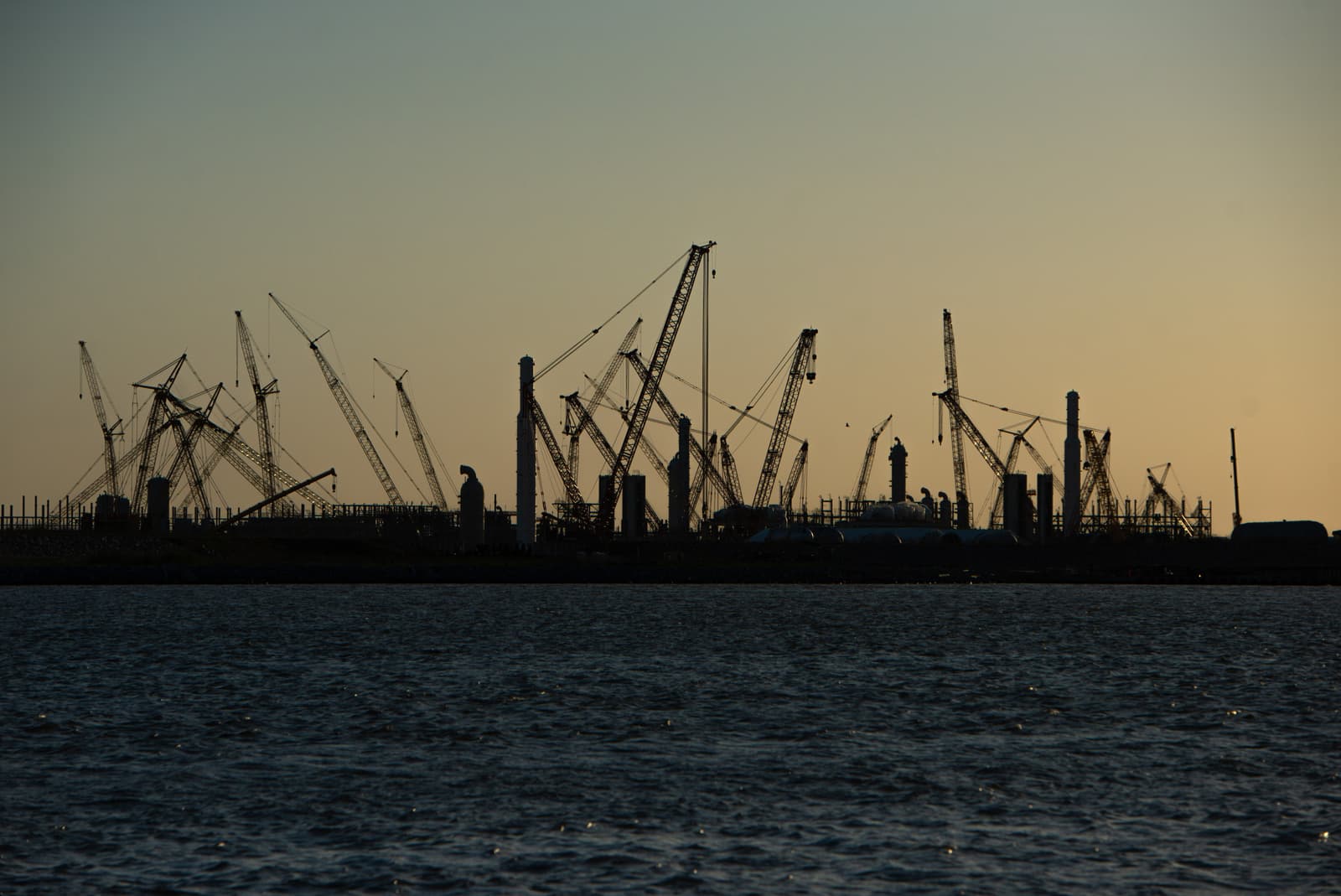
Header image: A liquified natural gas terminal on the Texas Louisiana border in the United States. Credit: The Washington Post via Getty Images.
Reporters: Josephine Moulds Environment editor: Robert Soutar Impact producer: Grace Murray Deputy editor: Chrissie Giles Editor: Franz Wild Production editor: Frankie Goodway Fact checker: Alice Milliken
This reporting is funded by the Sunrise Project. None of our funders have any influence over our editorial decisions or output.
Climate activist Greta Thunberg is joining local residents, Extinction Rebellion activists and climate change campaigners outside Farnborough Airport today (27 January) to protest against plans to increase private jet flights from 50,000 to 70,000 a year. The protesters are also calling for a total ban on private jets, which are up to 30 times more polluting than passenger airliners.
Greta Thunberg said: “The fact that using private jets is both legally and socially allowed today in an escalating climate emergency is completely detached from reality.
“There are few examples that show as clearly how the rich elite is sacrificing present and future living conditions on this planet so they can maintain their extreme and violent lifestyles.”
Hundreds of protestors will gather in Farnborough town centre at 11am today to march alongside Thunberg to Farnborough Airport, setting off pink smoke flares and waving banners proclaiming ‘Flying to Extinction’, ‘Stop Private Flights Now’, ‘No to Airport Expansion’ and ‘Private Flights = Public Deaths’.
This is the latest in a series of protests against the airport’s planning application, which seeks to more than double weekend flights and boost the use of heavier, more polluting private jets. In 2022, there were 33,120 flights to and from the airport, a 27% increase compared to 2021’s total of 26,007. Flights to and from Farnborough averaged just 2.5 passengers per flight. Currently 40% of flights to and from the airport are empty, according to research by campaign group Possible. Despite claiming the majority of flights are for business use, the research showed that most Farnborough flights are headed to holiday destinations. Last September a ‘pets on jets’ service launched to fly dogs and their owners from Dubai to Farnborough and back.
Todd Smith, former airline pilot and Extinction Rebellion spokesperson, said: “Flying is the fastest way to fry the planet, and private jets are the most polluting way to fly. Surely it’s a no brainer to ban private jets and stop expanding these luxury airports in the midst of a climate crisis? Survey after survey, as well as several citizens’ assemblies have shown this would be very popular and has widespread support from the general public.
“For most people, life has become more difficult. The cost of heating our homes, buying food and paying our bills has increased massively. So imagine looking out our windows to see yet more private jets flying billionaires around.
“Is this a fair society that we live in, or is there one set of rules for the majority, and another for the elites? Plans to expand the UK’s largest private jet airport seem to make this clear.”
Godalming resident Chris Neill, 67, a retired psychotherapist, said: “We’re in a global climate and ecological emergency. We need to reduce carbon emissions fast and there’s no realistic plan for taking the carbon out of jet fuel. Until there is, we need to fly much less, not more.
“This plan to expand a luxury airport used exclusively by very wealthy people at a time when ordinary people are struggling to manage everyday life is reckless, stupid and selfish. We need a government which has the courage to stop this.”
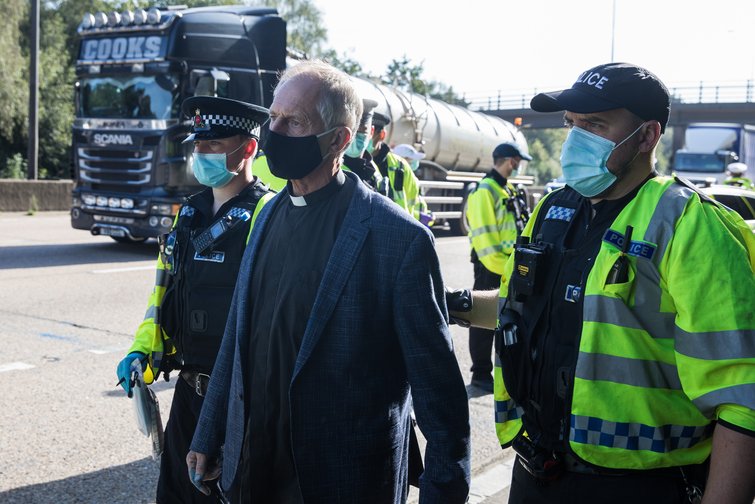
Just Stop Oil member Tim Hewes has to lead church services with an ankle tag on – despite not yet having faced trial
The 73-year-old priest has long taken part in direct action with other campaign groups including Insulate Britain, Extinction Rebellion and Christian Climate Action calling for climate justice | Mark Kerrison/In Pictures via Getty Images
A 73-year-old priest accused of helping plan a climate protest on the M25 has been forced to lead church services while wearing a GPS ankle tag for two years.
Tim Hewes, from Oxfordshire, is among at least ten members of Just Stop Oil who were given the tags despite not having been convicted of a crime. Hewes, who previously sewed his lips shut outside a newspaper office, is also barred from going on the M25 or taking part in any actions to oppose the climate crisis.
On one occasion, Hewes said he was thrown into the back of a police van and locked up overnight after being accused of breaking his bail conditions because his ankle monitor failed to charge. He says the tag was faulty and he was released once the court realised.
“Now if there’s a knock at the door, I think, well, it’s either the tag team or the police,” he told openDemocracy.
“The difficulty with the GPS is that, although I don’t have a curfew, I’ve still got to sleep at home.
“I asked my solicitor: ‘What if I want to go and see the dawn, or something like that?’ and she said: ‘Well, between 12 and five is probably about your limit.’ So, that would rule out midnight mass… Why should I not be able to do that? You know where I am.
“We’re supposed to be able to protest… The perpetrators of real, serious harm in this country are actually in government. What are we supposed to do?”
Hewes, who was speaking to openDemocracy in December and was in fact able to attend midnight mass without a hitch on Christmas Day, had been arrested in November 2022 and charged with conspiracy to cause a public nuisance. He has worn the tag since January 2023 after being held on remand at Wandsworth Prison for six weeks, and has to keep it on until his trial begins in February 2025. Tags must be worn at all times for as long as the court decides.
While he denies the charge, Hewes’s tag prohibits him from going on the M25 and taking part in or organising climate protests. Following previous action with other climate campaign groups such as Extinction Rebellion, Insulate Britain and Christian Climate Action, he says he has faced increasingly harsh treatment from the police and justice system.
Hewes was arrested on a Sunday afternoon. He said he had just put his collar on as he prepared to take part in a church service when he looked out of the window and saw his garden “swarming with police”.
“They shouted up: ‘If you don’t come down and open the door, we’re going to break it down now.’ And they got what they call a ‘big red key’, which is a euphemism for the battering ram. It was scary.”
He added: “Sunday afternoon was just never the same for me.”
Hewes said he was initially embarrassed to lead services with his tag on, and believes climate activists are being heavily criminalised in order to silence and discredit them.
“Suella Braverman talked about Just Stop Oil in the same breath as terrorists,” he told openDemocracy. “That’s outrageous. We’re peaceful protesters. The climate crisis is an existential threat.”
Braverman, the former home secretary who was forced out after inciting a far-right mob to storm the Cenotaph in November, referred to the activist group as “extremists” in 2022 and said they were “out of control” following a series of protests on the M25.
Marcin Wawrzyn, 42 – who was arrested after 20 minutes of ‘slow marching’ with Just Stop Oil in November – told openDemocracy that being given a tag felt “unfair” and “disproportionate”.
“It felt like a punishment and for what?” he said. “I was marching in the road – where else would you protest? The judges of ECHR say roads are the most appropriate places for protests and anything under 90 minutes cannot be seen as disruptive.”
Mentally, it was harsh – I felt like a dog on a leash
Wawrzyn was charged under section 7 of the Public Order Act 2023, which bans any act that “interferes with the use or operation of any key national infrastructure”. He has pleaded not guilty, and his case is expected to begin in 2025.
Under the conditions of his tag, Wawrzyn was prohibited from crossing the River Thames from his home in Wandsworth, south-west London, and from going into north London for a month. Though his tag has now been removed, he described feeling isolated.
“Despite my work being in north London, I was excluded from my office for a month, which is something a court shouldn’t do. But that’s what happened to me. Mentally, it was harsh – I felt like a dog on a leash.
“I felt detached and like I was prevented from having human contact with people I really care about.”
Hewes agreed. “I’m a marked and tracked man,” he said. “It’s really frustrating. As activists, one of the things that helps our mental health is the fact that you are trying to do something, however feeble it might appear to other people.”
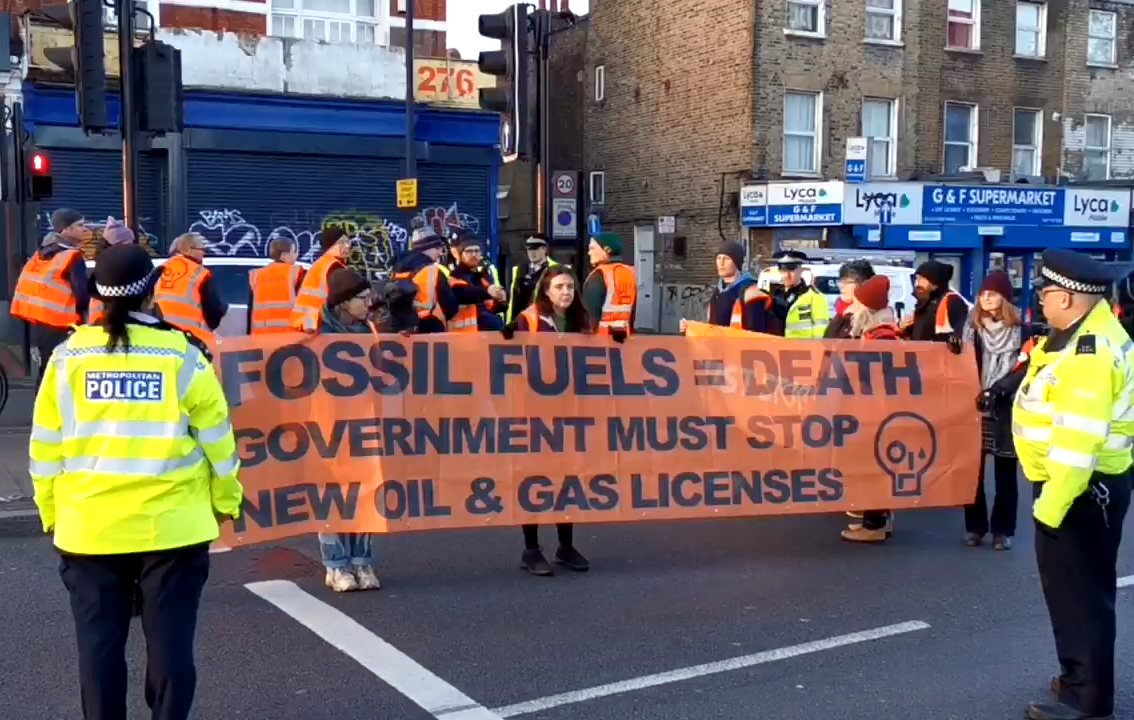
Last month, Just Stop Oil wrote to the Met Police after the force claimed that policing the group’s protests cost almost £20m. Just Stop Oil said that “arresting non-violent grandmothers, teenagers, vicars, medics, engineers” was a “waste” of resources.
But Wawrzyn added that campaigners have not been deterred by the crackdown. “The fact that the state reacts in such a way only emboldens us and gives us the assurance that they’re actually noticing what we’re doing and they are actively fighting us,” he said. “If anything, we’re galvanised and we’re drawing more and more people in.”