Category: Climate Crisis

  • Why the world’s first flight powered entirely by sustainable aviation fuel is a green mirage

    Spread the love
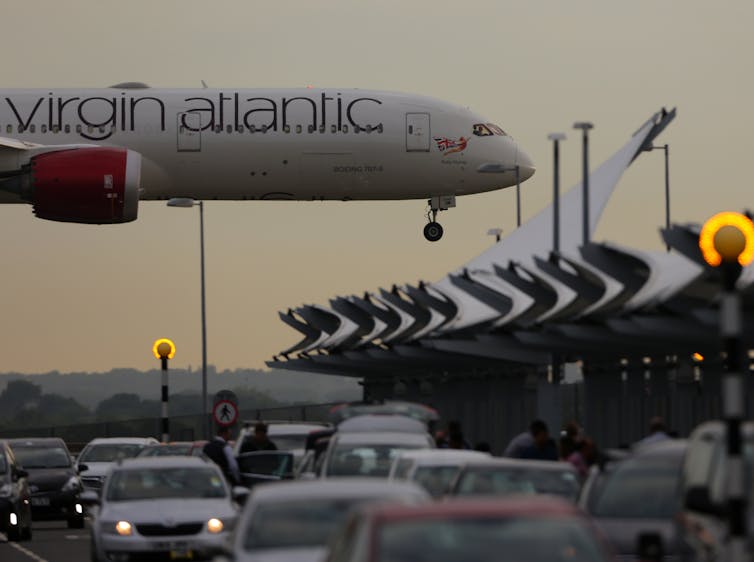
    A Boeing 787 Dreamliner landing at Heathrow international airport in London.
    Fasttailwind/Shutterstock

    Gareth Dale, Brunel University London and Josh Moos, Leeds Beckett University

    A Boeing 787 Dreamliner is set to take off from Heathrow on November 28 and head for JFK airport in New York, powered by so-called sustainable aviation fuel (SAF). According to its operator, Virgin Atlantic, the world’s “first 100% SAF flight” will mark “a historic moment in aviation’s roadmap to decarbonisation”.

    It is proof of concept, we are led to believe, of the dawn of “guilt-free” flying. Unfortunately, we have been here before, and the results last time were anything but green.

    Based on our research into how wealth and power shape the environment, we argue that continued growth of the aviation sector, as with the economy in general, is incompatible with preventing runaway climate change. The technology currently being developed by the aviation industry has zero chance of changing that. And the fuels being used in Virgin’s latest experiment are not significantly more sustainable than those in its previous attempt.

    Virgin’s sustainability initiative dates back to the 2000s, when British business magnate Richard Branson was at the helm. In 2008, to some fanfare, a Virgin aircraft flew from London to Amsterdam using a fuel derived in part from palm oil and coconuts. Technically, the mission was a success, but the sustainability claims were laughable.

    To have fuelled that short hop with 100% coconut oil would have consumed 3 million coconuts. The entire global crop would supply Heathrow for only a few weeks — and it is one of 18,000 commercial airports worldwide. Following this stunt, Virgin gave up on coconut oil.

    Virgin’s latest flight is simply a repeat of 2008. It’s a smoke-and-mirrors exercise to convince governments that SAF will enable aviation to continue its relentless growth on a sustainable basis – and in this, it is succeeding.

    Even waste products aren’t sustainable

    Virgin’s defence rests on the claim that its new SAF no longer comes exclusively from crops. It is blended with waste products. One of the main suppliers for Virgin’s transatlantic flight is Virent, an organisation based in Wisconsin. Virent makes SAF from conventional sugars such as corn, mixed with wood, agricultural waste and used cooking oil.

    As with coconuts, any crop grown for fuel competes with foodstuffs and pushes the agricultural frontier further into forests and peatlands, with large releases of carbon.

    But what of the waste products? Surely reusing cooking oils offers a sustainable solution? Unfortunately, in a notoriously unregulated market, it seems not.

    Another of Virgin’s suppliers, Neste, collects cooking oils from sources worldwide, including McDonald’s restaurants in the Netherlands and food processing plants in California, Oregon and Washington. The US Department of Agriculture alleges that some trade in SAF feedstocks – including from Indonesia to Neste’s refinery in Singapore – may be “fraudulent”.

    Neste has denied the claim. But, even if its used cooking oil is entirely legitimate, there is still an allegation that palm oil from plantations responsible for tropical deforestation is being marketed as used cooking oil.

    Virgin Atlantic maintains that the SAF it uses is made entirely from used cooking oil. However, if the aviation industry bets big on used cooking oil, it is feared it will turbocharge tropical logging and the extermination of the orangutan and countless other endangered species.

    Orangutan in the rainforest on Borneo island with trees and palms behind.
    More tropical logging would threaten the orangutan and countless other endangered species.
    Michail_Vorobyev/Shutterstock

    The real kicker is that even if all used cooking oils were traceable and sustainably sourced, they are not scalable. The US collects around 600,000 tonnes of used cooking oil each year. If every last drop were diverted to SAFs, it would meet at most 1% of America’s current aviation demand.

    Capturing the White House

    The problems of scalability, the competition of agricultural inputs with foodstuffs, forests and wildlife, and the carbon emissions that result from land use change are just three of the shortcomings that ensure SAFs will not be the magic bullet that the aviation industry would have us believe. Despite this, SAF fever has won over the White House.

    The Inflation Reduction Act set targets for SAF production at 3 billion gallons by 2030 and 35 billion by 2050. These targets are fantasies. But, to the extent that they are approached, they will only add to the pressure on food prices and wildlife.

    That SAF is being touted so zealously attests to the shortage of alternative technologies. Battery-powered planes are viable but only as short-haul “flying taxis” that compete with ground transport. The other panacea, hydrogen, confronts colossal technological and infrastructural barriers, problems of scalability, competing uses, and environmental concerns.

    Tinkering with aircraft technology, such as engine size or wing shape has also faced diminishing returns. Efficiency improvements lag far behind the sector’s growth, which is why aviation emissions are still soaring.

    Where do we go from here?

    Ahead of the 2008 coconut-fuelled flight, Virgin’s chief executive Steve Ridgway explained its logic. He said the aviation industry needs “to be seen to be doing something”. Fifteen years on and the playbook remains the same.

    The Virgin Atlantic SAF flight promises to rescue the airline from the threat of climate change, allowing them and their passengers to “keep calm and carry on”. In buying into this fantasy, governments give themselves an excuse to avoid taking climate breakdown seriously – an emergency that requires radical action if the planet is to remain habitable for humans.

    There is the potential to create a good life for all within planetary boundaries. But getting there requires clipping the wings of the aviation industry.

    This would begin, for short-haul, with ground-based alternatives. Within the US, many flights could be swiftly replaced by coach travel, and over a quarter of flights between EU destinations could be replaced by high-speed rail. For long-haul, the first step is demand management, which will expedite the use of virtual conferencing, marine transportation and other alternatives.

    Modern high-speed train driving past a station in a city.
    Many flights could be replaced by high-speed rail.
    aappp/Shutterstock

    Developing alternatives would be practical, efficient and create jobs. And now is a good time to begin. Americans have been “falling out of love with flying” in recent years, in part due to large numbers of flight cancellations following bad weather, which is only likely to increase with climate breakdown.

    As the weather chaos worsens, the aviation industry will find it harder to shrug off its responsibility through PR stunts and greenwashed gimmickry.

    In response to this article, a Virgin Atlantic spokesperson said that the organisation is committed to achieving net zero by 2050, and has set interim targets, including 10% SAF by 2030. It sees SAF as a mid-term solution for decarbonising aviation, and that Flight100 aims to demonstrate the safe use of 100% SAF within existing infrastructure. Virgin Atlantic referred to a Sustainable Aviation report, which indicates that there is sufficient feedstock to meet the government’s 2030 target without environmental impact or competition with crop production.

    Imagine weekly climate newsletter

    Don’t have time to read about climate change as much as you’d like?

    Get a weekly roundup in your inbox instead. Every Wednesday, The Conversation’s environment editor writes Imagine, a short email that goes a little deeper into just one climate issue. Join the 20,000+ readers who’ve subscribed so far. The Conversation


    Gareth Dale, Reader in Political Economy, Brunel University London and Josh Moos, Lecturer in Economics and Politics, Leeds Beckett University

    This article is republished from The Conversation under a Creative Commons license. Read the original article.

  • Greens call for president of COP to go following oil and gas deal revelations

    Spread the love

    Following revelations that the president of COP28, Dr Sultan al-Jaber – who is also CEO of the United Arab Emirates state oil company – was planning to be part of a UAE delegation seeking to use the climate talks as an opportunity to strike oil and gas deals with other countries, co leader of the Green Party Adrian Ramsay said: 

    Green Party Adrian Ramsay October 2023.
    Green Party Adrian Ramsay October 2023.

    “It was always highly dubious appointing the CEO of a giant state oil company to be COP president. Dr Sultan al-Jaber has now been caught red handed trying to stitch up oil and gas deals when he should be trying to persuade countries to move away from fossil fuels. He is totally inappropriate and has demonstrated himself to be completely compromised. The Green Party calls on him to go and we expect the UK government to do the same – it’s a fair cop.” 

    “One of the main reasons why the world is failing to deal with the climate crisis is because politicians in the UK and across the world are in the pockets of the oil and gas industry. Or in the case of Sultan al-Jaber, they are the oil and gas industry.  

    “We need a new generation of political leaders who will end our dependence on fossil fuels and create a home grown, renewable energy transformation with all the benefits that will bring for lower bills, new jobs and a safe environment. And the UN now needs to quickly appoint someone as president of COP who has a clear track record on a commitment to climate action.” 

  • Australia’s largest-ever civil disobedience protest stops half a million tonnes of coal exports

    Spread the love

    https://priceofoil.org/2023/11/27/australias-largest-ever-civil-disobedience-protest-stops-half-a-million-tonnes-of-coal-exports/

    Image: Rising Tide

    They are calling it the largest civil disobedience climate protest in the history of Australia.

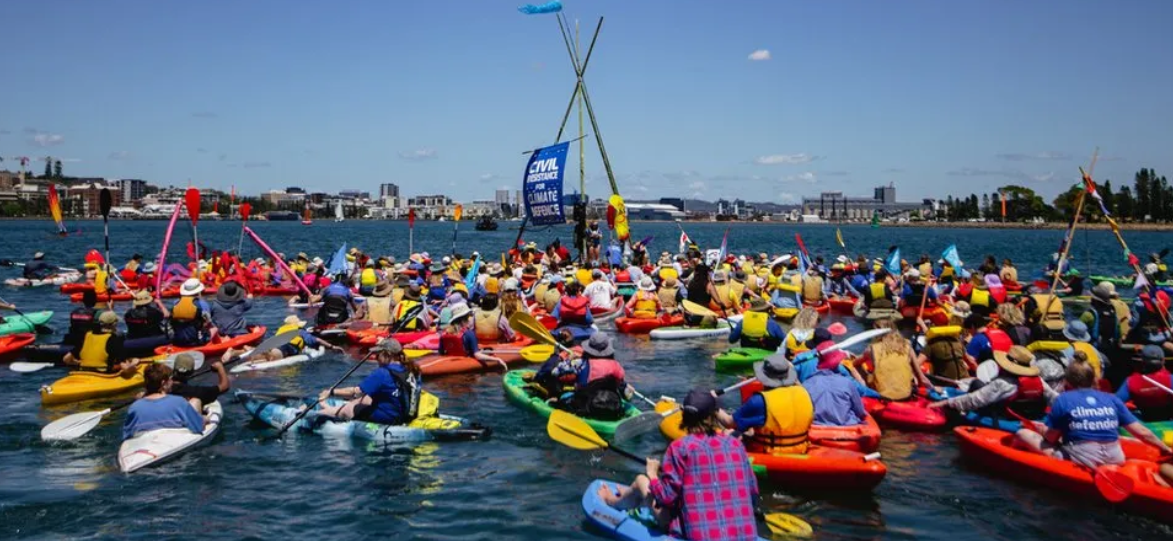
    This weekend, thousands of activists, young and old, from across the country descended on the world’s largest coal port at Muloobinba (Newcastle), on Awabakal and Worimi land and water.

    The organizers labeled it a family-friendly event with live music and speeches. The plan also included blockading the plant by a sea blockage by kayak, boat, or even surfboard. It was the first time a blockage was planned overnight.

    The protest was a huge success. In the end, some three thousand people prevented coal ships leaving for thirty-two hours and stopped half a million tonnes of coal from being exported.

    Some tweets from the action:

    https://twitter.com/TheRealEwbank/status/1728195874243961189?ref_src=twsrc%5Etfw%7Ctwcamp%5Etweetembed%7Ctwterm%5E1728195874243961189%7Ctwgr%5E63c4de088664e318b41d4d6686b8c7dde6ffb244%7Ctwcon%5Es1_c10&ref_url=https%3A%2F%2Fpriceofoil.org%2F2023%2F11%2F27%2Faustralias-largest-ever-civil-disobedience-protest-stops-half-a-million-tonnes-of-coal-exports%2F

    …

    In total, one hundred people were arrested, including 97 year old Reverend Alan Stuart who said: “I am doing this for my grandchildren and future generations.” He became the oldest person ever to be arrested in Australia.

    …

    https://priceofoil.org/2023/11/27/australias-largest-ever-civil-disobedience-protest-stops-half-a-million-tonnes-of-coal-exports/

  • XR Glues Shut Barclays Across UK for Financing ‘Climate Breakdown’

    Spread the love

    Original article by JESSICA CORBETT republished from Common Dreams under Creative Commons (CC BY-NC-ND 3.0). 

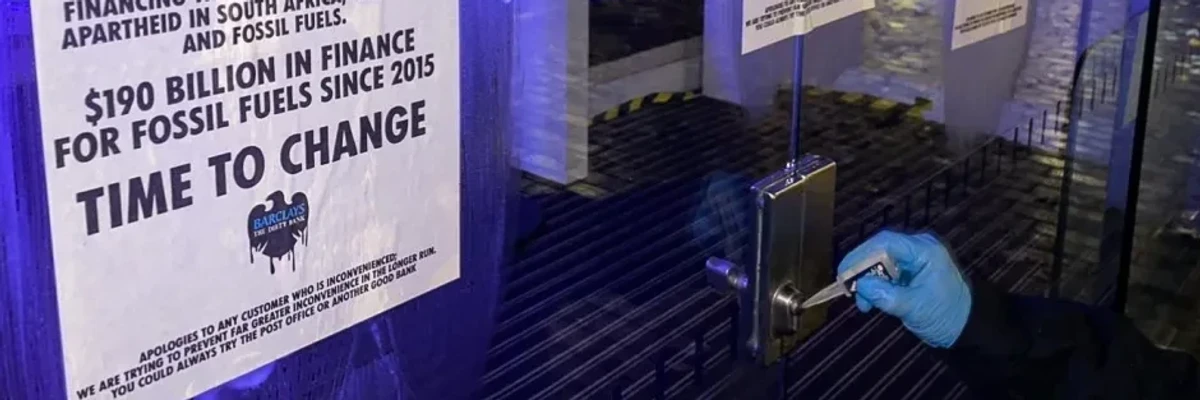
    Climate activists glued shut doors at nearly 50 Barclays branches across the United Kingdom on November 27, 2023.  (Photo: Extinction Rebellion)

    “The inconvenience we’ve caused this morning is small in comparison to the catastrophic events already happening due to Barclays’ financing of fossil fuels,” said one campaigner.

    “We have closed this bank today.”

    That’s the opening line on an explanatory poster, plastered on dozens of Barclays branches across the United Kingdom on Monday.

    “Barclays has been on the wrong side of history for centuries,” the poster continues. “Financing the Atlantic slave trade, apartheid in South Africa, weapons, and fossil fuels. $190 billion in finance for fossil fuels since 2015. Time to change.”

    “Barclays are choosing short-term profits over a livable future and a lot of us are sick of the measly progress they’re making.”

    The posters were left overnight by activists with Extinction Rebellion (XR), sister organization Money Rebellion, and allied groups, who superglued the doors shut at nearly 50 branches—inspired by a 2020 Greenpeace action targeting the bank.

    “We’re responding to public attitudes and targeting the perpetrators of climate breakdown, not ordinary people, and we apologize for any inconvenience caused to staff and customers,” said an XR campaigner in a statement. “The inconvenience we’ve caused this morning is small in comparison to the catastrophic events already happening due to Barclays’ financing of fossil fuels.”

    The climate groups pointed to this year’s annual Banking on Climate Chaos report, which shows that Barclays has poured $190.58 billion into the fossil fuel industry since 2015, when world leaders finalized the Paris agreement. Parties to that deal aim to keep global temperature rise this century “well below” 2°C, with an ultimate goal of limiting it to 1.5°C.

    Already, “human activities, principally through emissions of greenhouse gases, have unequivocally caused global warming, with global surface temperature reaching 1.1°C,” relative to preindustrial levels, according to a March Intergovernmental Panel on Climate Change (IPCC) report.

    A United Nations analysis published last week ahead of the upcoming COP28 U.N. climate talks projects that currently implemented policies put the world on track for 3°C of warming by 2100.

    Responding to the Monday action, a Barclays spokesperson toldITV that “aligned to our ambition to be a net-zero bank by 2050, we believe we can make the greatest difference by working with our clients as they transition to a low-carbon business model, reducing their carbon-intensive activity whilst scaling low-carbon technologies, infrastructure, and capacity.”

    “We have set 2030 targets to reduce the emissions we finance in five high emitting sectors, including the energy sector, where we have achieved a 32% reduction since 2020,” the spokesperson added. “In addition, to scale the needed technologies and infrastructure, we have provided £99 billion of green finance since 2018, and have a target to facilitate $1 trillion in sustainable and transition financing between 2023 and 2030.”

    Climate campaigners argue that such policies are far from enough, given that the bank continues to finance fossil fuel projects.

    “Barclays are pumping billions into the fossil fuel industry, completely at odds with advice from the International Energy Agency, United Nations, and IPCC,” said a Money Rebellion activist who took part in the action. “Barclays are choosing short-term profits over a livable future and a lot of us are sick of the measly progress they’re making, as they hide behind their lies and greenwash.”

    Original article by JESSICA CORBETT republished from Common Dreams under Creative Commons (CC BY-NC-ND 3.0). 

  • Wellbeing ‘Beyond GDP’: How Humanity Can Benefit From Alternatives to Capitalism

    Spread the love

    Original article by JON QUEALLY republished from Common Dreams under Creative Commons (CC BY-NC-ND 3.0). 

    An activist holds up a sign against capitalism during scattered left-wing protests in Kreuzberg district on May Day during the novel coronavirus crisis on May 1, 2020 in Berlin, Germany.  (Photo by Sean Gallup/Getty Images)

    “Whenever it’s claimed that there are no alternatives to capitalism, it really exposes the lack of imagination and willingness to develop a better future, not the lack of alternatives.”

    “Can you imagine a place where growth is linked to life and justice rather than profit and the economy?”

    That’s one of the key questions at the heart of a new publication by Greenpeace which lays out a series of detailed alternatives to rapacious capitalism that dominates the global economy and ruling governments worldwide.

    Titled Growing the Alternatives: Societies for a Future Beyond GDP, the report puts a target on neoliberalism’s obsession with gross domestic product and how skewed understandings of what’s considered valuable undermine efforts to build happier, more equitable, and efficient societies.

    “Today, a country’s economic growth is used as an indicator of living standards,” the report states. “In other words, the higher a country ranks on the Gross Domestic Product (GDP) list, the better the prospects for that country. But that is far from reality when the wellbeing of people and nature is considered.”

    The report argues that “the focus on economic growth has led to an anachronism that prioritizes planet-depleting activities and inequalities while overlooking wellbeing.”

    According to Paula Tejón Carbajal, the Alternative Futures Campaign lead at Greenpeace International, “Whenever it’s claimed that there are no alternatives to capitalism, it really exposes the lack of imagination and willingness to develop a better future, not the lack of alternatives.”

    Greenpeace says that even while GDP remains the economic index most countries use to measure economic health, “its one-size-fits-all approach rewards waste and pollution and does not take into account vital aspects such as people’s wellbeing or the limits of nature.”

    The report states:

    The world today faces multiple crises that pose an existential threat to the future of human civilization. The modern industrialised world depends on the over-exploitation of nature, which is destroying the Earth’s ecosystems, triggering catastrophic climate change, biodiversity loss, and pollution. These are related problems with devastating consequences that have been building for decades. This is due to the collective failure of governments and businesses to act with sufficient urgency to counter the status quo of a system based on infinite growth, and dependent on fossil fuels, extraction, overproduction, overconsumption, and waste.

    Across three detailed chapters, the group’s publication focuses on numerous principles for “wellbeing economies” that challenge the supremacy of economic growth GDP, including: “people and planet over profit and growth”; “equitable distribution of wealth and power”; “wellbeing at the core”; “the common good”; “circular economies”; “nature restoration”; and “real participatory democracy.”

    In a world beset by war, human rights abuses, astronomical levels of inequality, and the fast-moving threat of rising temperatures and the climate crisis, Greenpeace argues that the alternatives to profit-at-all-costs capitalism are not only available but plentiful.

    “All the examples we have gathered exist, work, and prove that there is a dynamic landscape for many alternative futures,” Tejón Carbajal said.

    While the Greenpeace report was made available online last month, it was officially presented Wednesday during a virtual event attended by more than 160 people worldwide.

    “In a world wracked by polarization, inequality, climate change, ecological breakdown, and a crisis of hope and imagination, we can’t use the same thinking that created the problem in the first place. Greenpeace calls for governments and global institutions to drive their decision-making according to sufficiency and the wellbeing of people and planet, so that what we really value becomes the new measure of success and can thrive and flourish across the world,” added Tejón Carbajal.

    “To create a sustainable and just future for all,” one section of the report concludes, “we must move beyond GDP and develop a measurement framework for wellbeing, inclusion, and sustainability.”

    Original article by JON QUEALLY republished from Common Dreams under Creative Commons (CC BY-NC-ND 3.0). 

    Growing the Alternatives: Societies for a Future Beyond GDP