Tesla CEO Elon Musk boards his private jet before departing from Beijing Capital International Airport on May 31, 2023.
Who are the polluter elite and why do they matter?
The richest 1% of people are responsible for as much carbon output as the poorest 66%, research from Oxfam shows. Luxury lifestyles including frequent flying, driving large cars, owning many houses, and a rich diet, are among the reasons for the huge imbalance.
Jason Hickel, an economist, argues: “We have to think about the rich in terms of how much they are depleting the remaining carbon budget. Right now, millionaires alone are on track to burn 72% of the remaining carbon budget for 1.5C. The purchasing power of the very rich needs to be curtailed. We are devoting huge amounts of energy to facilitate the excess consumption of the ruling class – in the midst of a climate emergency, that is totally irrational.”
The problem goes far beyond the greenhouse gas emissions arising from these lifestyles, substantial though they are. The polluting elite have an outsized influence on the climate in many ways. Hickel notes: “While personal consumption-related emissions are important, what matters most is control over investible assets. When we account for investments in polluting industries, we find that each billionaire is responsible for a million times more emissions than the average person in the bottom 90%. Who is making the decisions about investment and production in the world economy? About energy systems? When it comes to the question of responsibility, that’s what we need to be focusing on.”
…
It is simply impossible to have a polluting elite and a livable climate, argues Farhana Sultana, professor at Syracuse University and fellow at the International Centre for Climate Change and Development in Bangladesh. Along with many developing country economists, she regards the high emissions of rich people in industrialised countries in terms of colonialism. “Carbon inequality is effectively a colonisation of the atmosphere by the capitalist elite of the planet through hyper-consumption and pollution, while the cost of that climate coloniality is borne disproportionately by the marginalised and vulnerable communities in developing countries.”
The culture of rich people, and rich countries, built on use and discard cannot continue in a world of finite resources and planetary boundaries. “What the 1% do is overuse the earth’s resources through extraction, hyperconsumption, a discard culture that produces enormous amounts of waste and pollution – all these processes together create significant strains to planetary systems,” she says.
…
One of the many occasions climate change denier and UK Prime Minister Rishi Sunak uses a private jet.
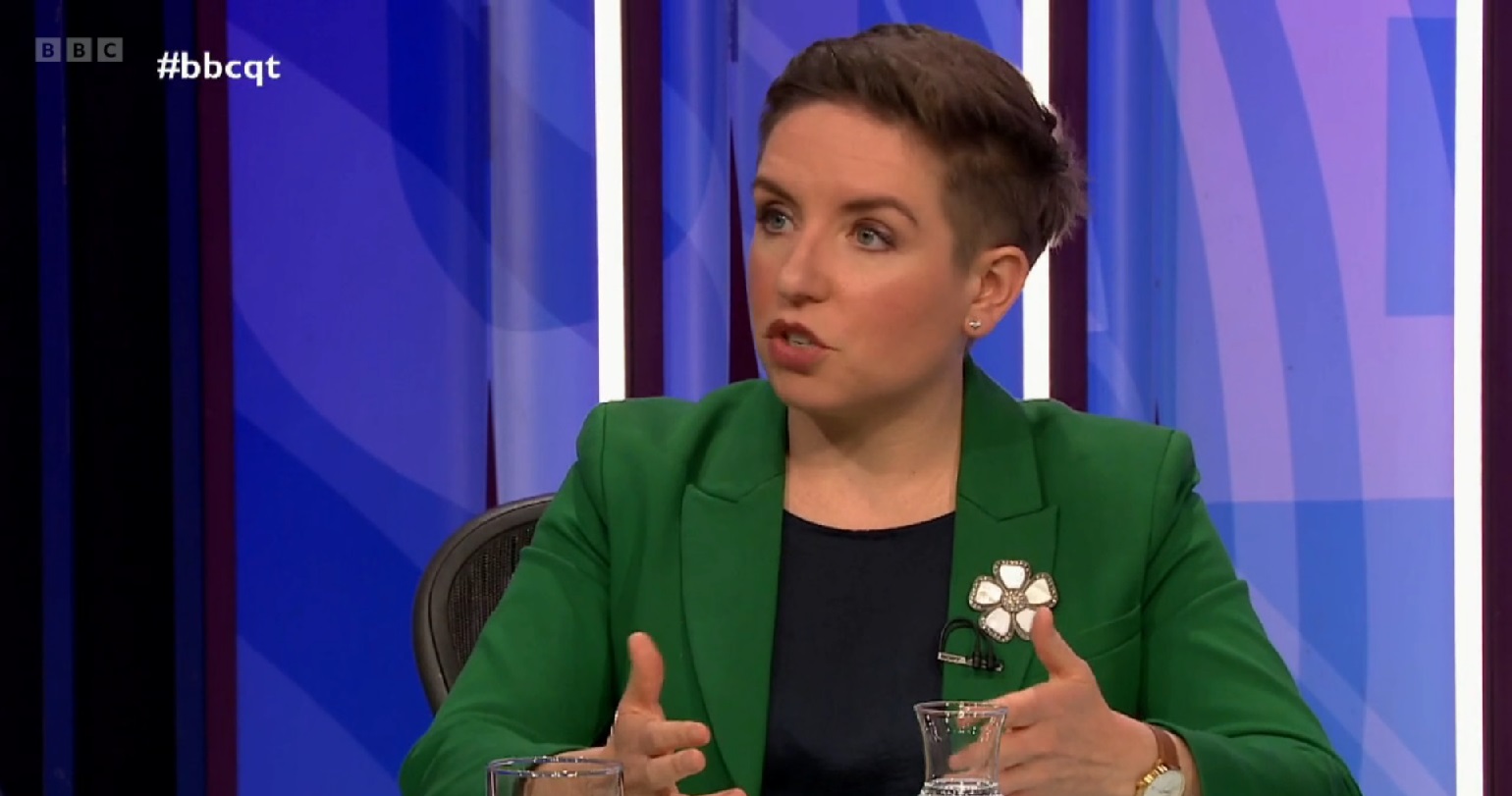
Image of the Green Party’s Carla Denyer on BBC Question Time.
Reacting to the Autumn Statement announcement, Green co-leader Carla Denyer said:
“The government has chosen headline-grabbing pre-election tax cut bribes over doing their job properly – providing good public services and protecting citizens from harm caused by the cost-of-living crisis and the climate crisis.
“Indeed, this was a particularly cruel statement for the long-term sick and some disabled people who will now be forced into work or lose their benefits.
“People won’t be fooled by a few extra quid in their pay packet when they can’t get a dentist, the wait to see the GP is getting ever longer, and the impacts of the climate crisis are becoming ever more obvious and close to home.
“The government is fishing for a day’s worth of General Election friendly headlines at high long-term costs to public services, people’s quality of life and the environment.
“The country cannot afford pre-election tax cut bribes from this failed Tory government. They mean postponing, yet again, the action we need to tackle the climate crisis – action that would create new, secure, well-paid green jobs.
“Living in a decent society means investing in public services that meet the needs of people and planet. We can afford better public services. We can protect the environment and the most vulnerable in society, keep people warm and lift people out of poverty.
“With more Green MPs in Parliament after the next General Election, we would rebalance the tax system so that the super-rich pay their fair share and use the money to mend the NHS, invest in preventative public health services, support those in greatest need, and boost the transition to a greener economy and all the benefits that will bring.”
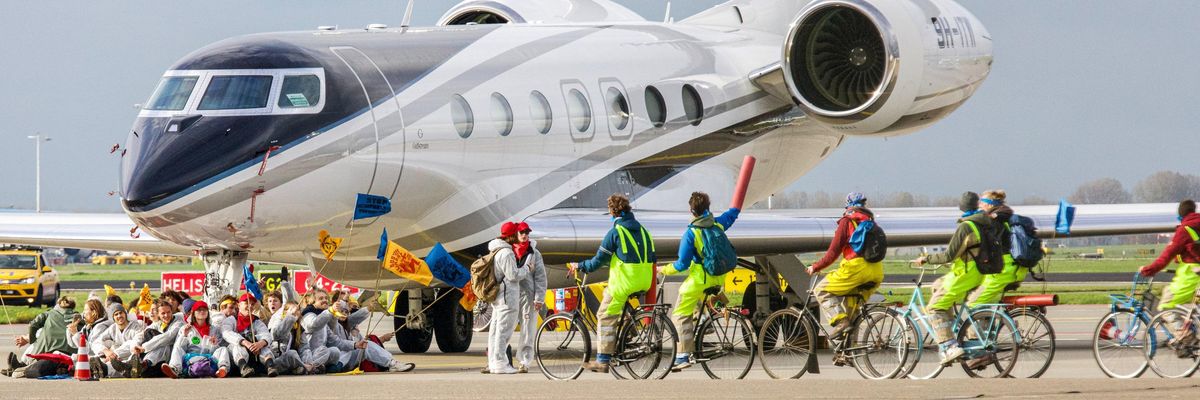
Greenpeace Netherlands and Extinction Rebellion activists block a private jet at the Schiphol Airport in Amsterdam on Saturday, November 5, 2022. (Photo: (c) Marten van Dijl/Greenpeace)
The planes tracked by a new Guardian report belong to celebrities, billionaires, CEOs, and their families, among them the Murdoch family, Taylor Swift, and the Rolling Stones.
The private jets of just 200 rich and famous individuals or groups released around 415,518 metric tons of climate-heating carbon dioxide between January 2022 and September 22, 2023, The Guardian revealed Tuesday.
That’s equal to the emissions burned by nearly 40,000 British residents in all aspects of their lives, the newspaper calculated.
The planes tracked by the outlet belong to celebrities, billionaires, CEOs, and their families, among them the Murdoch family, Taylor Swift, and the Rolling Stones. All told, the high-flyers made a total of 44,739 trips during the study period for a combined 11 years in the air.
“Pollution for wasteful luxury has to be the first to go, we need a ban on private jets.”
Notable emitters included the Blavatnik family, the Murdoch family, and Eric Schmidt, whose flights during the 21-month study period released more than 7,500 metric tons of carbon dioxide equivalent. The Sawiris family emitted around 7,500 metric tons, and Lorenzo Fertitta more than 5,000.
The Rolling Stones’ Boeing 767 wide-body aircraft released around 5,046 metric tons of carbon dioxide, which is equal to 1,763 economy flights from London to New York. The 39 jets owned by 30 Russian oligarchs released 30,701 metric tons of carbon dioxide.
Taylor Swift was the only celebrity or billionaire in the report whose team responded to a request for comment.
“Before the tour kicked off in March of 2023, Taylor bought more than double the carbon credits needed to offset all tour travel,” a spokesperson for the pop star told The Guardian.
Swift appears to have responded to public pressure to reduce private jet use. Her plane averaged 19 flights a month between January and August 2022, when she received criticism after sustainability firm Yard named her the celebrity who used her plane the most. After that point, the plane’s average monthly flights dropped to two.
The Guardian’s investigation was based on private aircraft registrations compiled by TheAirTraffic Database and flight records from OpenSky. Reporters calculated flight emissions based on model information found in the ADSBExchange Aircraft database and Planespotters.net and emissions per hour per model found in the Conklin & De Decker’s CO2 calculator and the Eurocontrol emission calculator.
The report was released the day after an Oxfam study found that the world’s richest 1% emitted the same amount as its poorest two-thirds. Given their high carbon footprint and luxury status, private jets have emerged as a rallying point for the climate justice movement.
“It’s hugely unfair that rich people can wreck the climate this way, in just one flight polluting more than driving a car 23,000 kilometers,” Greenpeace E.U. transport campaigner Thomas Gelin said in March. “Pollution for wasteful luxury has to be the first to go, we need a ban on private jets.”
In the U.S., a group of climate campaigners is mobilizing to stop the expansion of Massachusetts’ Hanscom Field, the largest private jet field in New England. An October report found that flights from that field between January 1, 2022, and July 15, 2023, released a total of 106,676 tons of carbon emissions.
“While plenty of business is no doubt discussed over golf at Aberdeen, Scotland, or at bird hunting reserves in Argentina (destinations we also documented), this is probably the least defensible form of luxury travel on a warming planet when a Zoom call would often do,” Chuck Collins, who co-authored the Hanscom report, wrote for Fortune on November 14.
A woman cools off with a hose as fans of singer Taylor Swift queue outside the Nilton Santos Olympic Stadium before Taylor Swift’s concert amid a heat wave in Rio de Janeiro on November 18, 2023. (Photo by Tercio Teixeira/AFP via Getty Images)
The heat index—which combines air temperature and humidity—hit an astounding 58.5ºC (137ºF), the highest index ever recorded, in Rio de Janeiro on Tuesday.
Amid a stifling heatwave this week Brazil is experiencing its highest temperatures ever recorded—a milestone that comes alongside global trends and fresh scientific data showing the world is far from meeting stated ambitions to reduce greenhouse gas emissions to curb the climate emergency.
According to the National Institute of Meteorology, temperatures in the southeastern city of Araçuaí hit 44.8ºC (112.6ºF) on Sunday, breaking the previous record set in 2005.
It was so hot over the weekend that international pop star Taylor Swift was forced to reschedule concerts nationwide.
Meanwhile, the heat index—which combines air temperature and humidity—hit an astounding 58.5ºC (137ºF), the highest index ever recorded, Tuesday morning in the country’s second-most populous city of Rio de Janeiro.
The extreme heat is having a severe and negative impact on people’s ability to work and live comfortably and putting a crush on the nation’s power grid. As the Associated Pressreports:
Brazilians turned to fans, air conditioners and dehumidifiers to cool down, with utilities reporting record energy demand. Power outages were reported in Sao Paulo and Rio de Janeiro.
Amid the high heat, wildfires are burning widely in the Pantanal biome, the world’s biggest tropical wetlands spanning parts of Mato Grosso and Mato Grosso do Sul states. The fires have ravaged an area about the size of Cyprus, or more than 947,000 hectares (about 3,600 square miles), according to the Environmental Satellite Applications Laboratory of the Federal University of Rio de Janeiro.
The wildfires are arriving earlier in some places and with much more intensity. With summer not even at its height, fears are growing of what’s to come:
“The Pantanal is a region that’s used to fires,” biologist Gustavo Figueiroa, head of the environmental group SOS Pantanal, toldAl-Jazeera on Monday. “Normally, it regenerates naturally. But this many fires isn’t normal.”
Attributed in part to the El Niño effect, the historic temperatures in South America’s largest country mirror the trend happening worldwide, with 2023 on track to be the hottest in 125,000 years, the result of burning fossil fuels and release of other heat-trapping gasses since the Industrial Revolution.
In addition to the heatwave and fires, heavy rains and damaging storms have brought severe flooding to other regions of the country, some resulting in the death of local residents and tens of thousands displaced.
Despite global efforts to reduce emissions and transition away from coal, oil, and gas, the latest figures from the United Nations in its 2023 Emissions Gap Report, released Monday, show that humanity is expanding its use of fossil fuels instead.
“The report shows that the emissions gap is more like an emissions canyon,” U.N. Secretary-General António Guterres said in a statement. “A canyon littered with broken promises, broken lives, and broken records. All of this is a failure of leadership, a betrayal of the vulnerable, and a massive missed opportunity.”
Here’s DeSmog’s take on what to expect at this year’s climate summit, from Big Oil’s influence, to a new Big Ag agenda, to promotion of sketchy solutions that would keep oil and gas burning for decades to come.
The United Arab Emirates’ pavilion at COP27. Credit: Adam Barnett
The annual United Nations climate negotiations are just a week away. Known as COP28 — since it’s the 28th year of the “conference of the parties” to the United Nations climate agreement — it will be hosted by the United Arab Emirates in Dubai from November 30 through December 12.
COP28 will be especially significant, as it will feature the first-ever “global stocktake,” of how much progress — or lack thereof — countries and other stakeholders have made toward meeting the goal established in 2015’s Paris Agreement of limiting warming to “well below” 2º degrees Celsius.
Negotiators at COP28 will also aim to make progress on key climate issues including loss and damage finance, a just energy transition, and closing the emissions gap.
As the climate crisis accelerates, so, too, do efforts by the fossil fuel industry to derail steep reductions in carbon pollution by mid-century, in part by promoting false solutions. Below, we’ve rounded up recent coverage to help you make sense of the key denial and greenwashing narratives that will be front and center during the event.
A Big Presence from Big Oil
After all, this is the first annual climate conference with a Big Oil exec at the top: COP28 President Sultan Ahmed Al Jaber.
Al Jaber, the person leading these global climate negotiations, is the CEO of the Abu Dhabi National Oil Company (ADNOC). He has openly called for fossil fuel companies’ “help to drive the solutions,” and advocated overcoming “the hurdles to scale up and commercialize hydrogen and carbon capture technologies” — two so-far unproven climate solutions being heavily promoted by the fossil fuel industry. A big presence from Big Oil would be in line with trends at the past two summits: 636 fossil fuel lobbyists registered to attend last year’s conference in Sharm el-Sheikh, Egypt, while 503 registered for 2021’s gathering in Glasgow.
The fossil fuel industry will paint carbon capture and storage (CCS) as a climate solution during this year’s conference. Critics argue it is anything but.
Of the 32 commercial CCS facilities operating worldwide, 22 use most, or all, of their captured carbon dioxide (CO2) to pump more oil out of depleted wells. Burning that oil creates far more CO2 than what is captured.
DeSmog recently analyzed 12 large-scale CCS projects around the world and found countless missed carbon capture targets, as well as cost overruns, with taxpayers picking up the tab via billions of dollars in subsidies. Despite these failures, Big Oil publicly champions CCS and pushes projects over communities’ objections. Privately, the industry shares critics’ concerns.
With the Biden administration channeling billions of dollars into investments and tax credits for CCS, the United States is likely to be a key CCS supporter at the conference.
This year’s climate conference is coming on the heels of the world’s hottest year, with devastating floods around the world affecting the global food supply, and more than 330 million people worldwide facing famine. So COP28 leaders have released a four-point “food and agriculture” agenda for the summit that calls for governments and industry to collaborate on finding new solutions to climate change–driven food insecurity.
However, some of the biggest companies in agribusiness, are using greenwashing to shift the debate away from meaningful action. DeSmog has debunked six concepts that the world’s largest food and farming companies will be co-opting in hopes of swaying debates and discussions in Dubai — including “regenerative agriculture,” “nature-based solutions,” and “climate neutrality.” Stay tuned for DeSmog’s coverage from Dubai — our team will be keeping a close eye on Big Ag.
Ever wonder how a top oil-producing nation like the United Arab Emirates earned hosting duties for this year’s climate summit, or why the chief of UAE’s state oil company ADNOC, Sultan Ahmed Al Jaber, has ascended to one of the top roles in global climate negotiations? Reporting by DeSmog revealed that from 2007 to 2009, Edelman, the largest public relations firm in the world, ran a campaign to bolster the UAE and Al Jaber’s green images.
Disinformation strategies and narratives will be on display throughout the summit — much as we reported during COP27, where fossil fuel-linked groups spent around $4 million on social media ads that spread false climate claims.
The disinformation may flow thicker and faster than ever during COP28. As DeSmog has reported, over the past five years climate greenwashing has “gone through the roof,” as major polluters turn to greenwashing to avoid accountability for the climate crisis. In part, this may be a response to the increasing number of climate lawsuits and legal complaints against misleading climate claims. Attorneys general across the U.S. have charged fossil fuel companies with defrauding consumers by lying about the impacts of burning coal, oil, and gas — while activists and campaigners in Europe seek to hold Big Oil accountable under regulations against misleading advertising.
To understand disinformation tactics and where they come from, dig into DeSmog’s reporting about past greenwashing campaigns. We recently shone a light on the way the gas industry borrowed Big Tobacco’s tactics to promote doubt over the health effects of gas stoves. Or read our investigation into how corporate polluters and their political allies have been using the same rhetoric of delay for the past six decades when faced with the prospect of regulation.