Category: Climate Crisis

  • ‘Draconian and undemocratic’: why criminalising climate protesters in Australia doesn’t actually work

    Spread the love
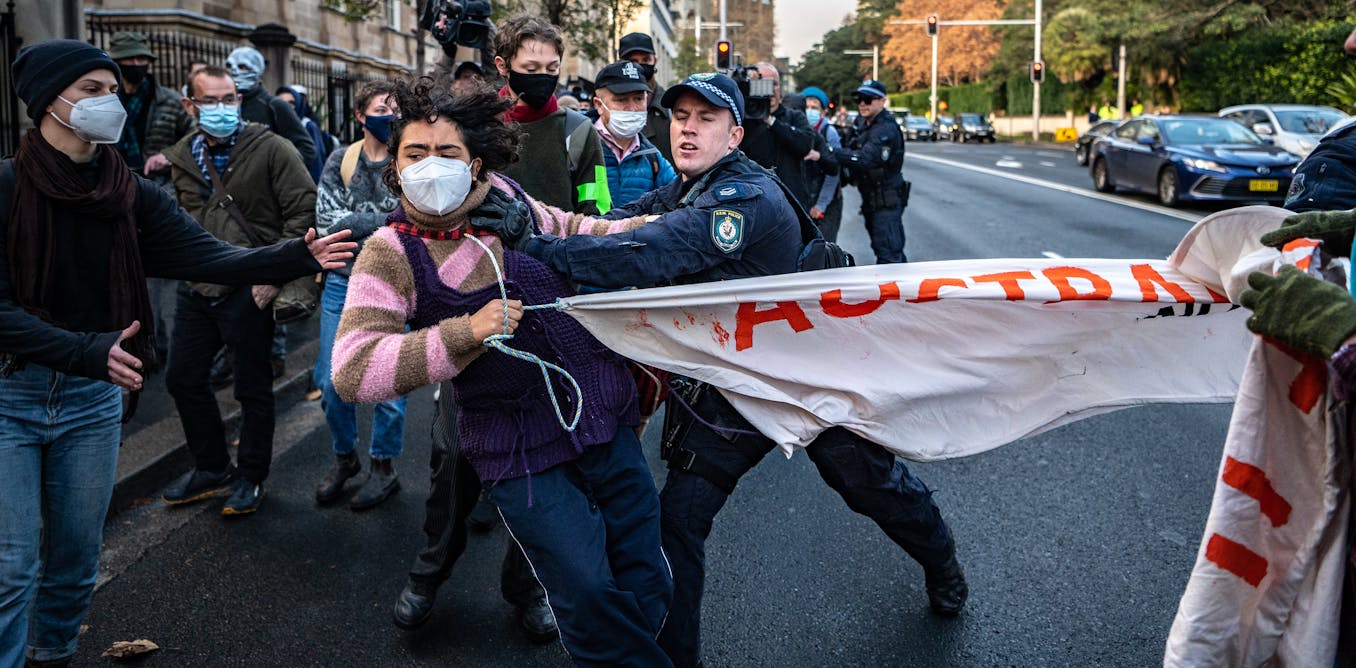
    Police officers dispersing a protestor during a Blockade Australia rally in Sydney this week. AAP Image/Flavio Brancaleone

    Robyn Gulliver, The University of Queensland

    A man who drove through a climate protest blocking the Harbour Tunnel this week has copped a A$469 fine, while multiple members of the activist group were arrested. The protest was among a series of peak hour rallies in Sydney by Blockade Australia, in an effort to stop “the cogs in the machine that is destroying life on earth”.

    Disruptive protests like these make an impact. They form the iconic images of social movements that have delivered many of the rights and freedoms we enjoy today.

    They attract extensive media coverage that propel issues onto the national agenda. And, despite media coverage to the contrary, research suggests they don’t reduce public support for climate action.

    But disruptive protest also consistently generates one negative response: attempts to criminalise it.

    Tasmania, Victoria and New South Wales have all recently proposed or introduced anti-protest bills targeting environmental and climate activists. This wave of anti-protest legislation has been described as draconian and undemocratic.

    Let’s take a look at how these laws suppress environmental protesters – and whether criminalisation actually works.

    How do governments criminalise protest?

    The criminalisation of environmental protest in Australia isn’t new.

    Tasmania provides a compelling example. The Tasmania Workplaces (Protection from Protestors) Act 2014 sought to fine demonstrators up to $10,000 if they “prevent, hinder, or obstruct the carrying out of a business activity”. Described as a breach of the International Covenant on Civil and Political Rights, it was subsequently voted down by the Tasmanian Legislative Council.

    The bill was resurrected in 2019, but also voted down, an outcome described by the Human Rights Law Centre as a “win for democracy”.

    But yet again in 2022, the freedom to protest in Tasmania is under threat. The Police Offences Amendment (Workplace Protection) Bill 2022 proposes fines of up to $21,625 and 18 months jail for peaceful protest.

    Activities such as handing out flyers, holding a placard or sharing a petition could fall within the offences.
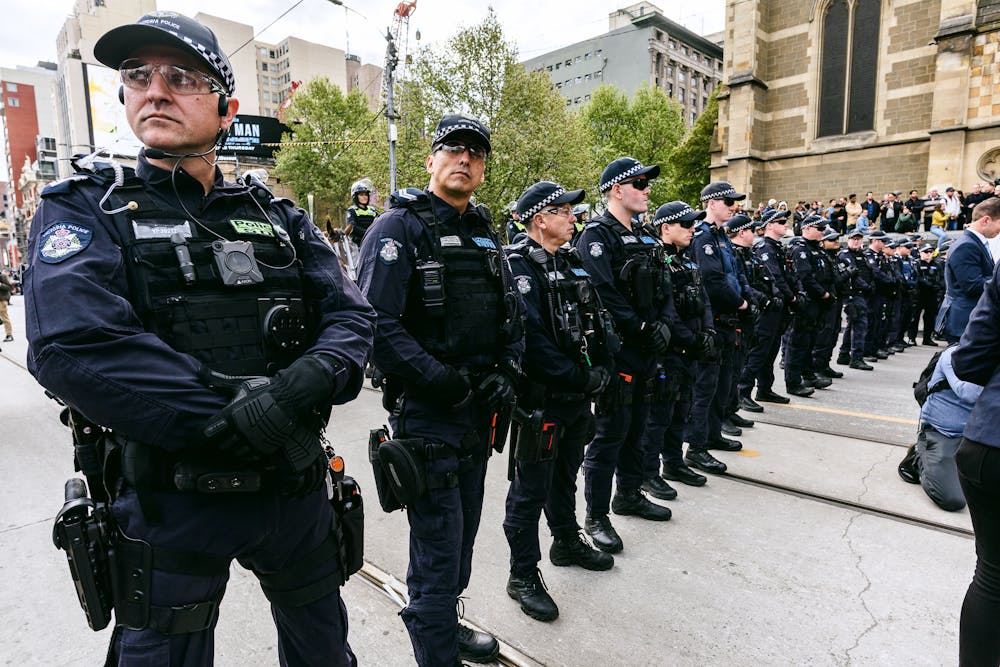
    Heavy police presence is often a feature at Extinction Rebellion blockades.
    Julian Meehan/Wikimedia Commons, CC BY

    Tasmania is not an outlier. After the Port of Botany and Sydney climate blockades in March this year, NSW passed the Roads and Crimes Legislation Amendment Bill 2022.

    Almost 40 civil society groups called to scrap the bill, which used vague and broad wording to expand offences with up to two years in jail and a $22,000 fine.

    Similarly, the Andrews government in Victoria is introducing the Sustainable Forests Timber Amendment (Timber Harvesting Safety Zones) Bill 2022, which raises penalties on anti-logging protest offences to $21,000 or 12 months imprisonment.

    Other ways Australia criminalise protest

    Legislation isn’t the only tool in the toolbox of protest criminalisation. The expansion of police and government discretionary powers is also often used. Examples include:

    Corporations also use discretionary powers. Adani/Bravus coal mining company reportedly used private investigators to restrict Wangan and Jagalingou Traditional Owners’ access to their ceremonial camp.

    It also reportedly bankrupted senior spokesperson Adrian Burragubba in 2019, sued one climate activist for intimidation, conspiracy and breaches of contract, surveilled his family, and is pursuing him for $600 million (now reduced to $17m) in damages.

    In statements to the ABC and the Guardian, Adani says it is exercising its rights under the law to be protected from individuals and groups who act “unlawfully”.

    Another tool for suppressing protest is the use of “othering” language. This language seeks to stigmatise activists, de-legitimise their concerns and frame them as threats to national security or the economy.

    We see it frequently after disruptive protest. For example, ministers have recently described Blockade Australia protesters as “bloody idiots”, who should “get a real job”.

    The Queensland Premier has described protesters as “extremists”, who were “dangerous, reckless, irresponsible, selfish and stupid”.

    Why do governments feel the need to implement harsher penalties?

    Some politicians have argued that anti-protest laws act as a “deterrent” to disruptive protest. Critics have also argued that government powers are used as a shield to protect corporate interests.

    In its new report, for example, the Australian Democracy Network shows how corporations can manipulate government powers to harass and punish opponents through a process called “state capture”.

    Non-profit organisations have also demonstrated the powerful influence of the fossil fuel industry, particularly in weakening Australian environmentalists’ protest rights.

    But it’s not only civil sector groups and protesters sounding the alarm. Increased repression of our rights to engage in non-violent protest have also been voiced by lawyers, scholars and observers such as the United Nations Special Rapporteur.

    Does criminalisation reduce protest?

    Numerous organisations have highlighted how criminalising protest and silencing charities threaten democratic freedoms that are fundamental to a vibrant, inclusive and innovative society.

    But more than that, these strategies don’t appear to work.

    Courts have used anti-protest legislation to instead highlight the importance of peaceful protest as a legitimate form of political communication. They have struck down legislation, released activists from remand, overturned unreasonable bail conditions and reduced excessive fines.

    Police, too, have refused to remove cultural custodians from their ceremonial grounds.

    And in general, research shows the public does not support repressive protest policing.

    Indeed, rates of disruptive protest are escalating, while protesters vow to continue despite the risk.

    The majority of Australians support more ambitious climate action. Many agree with Blockade Australia’s statement that “urgent broad-scale change” is necessary to address the climate crisis.

    Politicians may be better served by focusing their efforts on this message, rather than attacking the messengers. The Conversation

    Robyn Gulliver, Postdoctoral Research Fellow, The University of Queensland

    This article is republished from The Conversation under a Creative Commons license. Read the original article.

  • Tories branded ‘totally reckless’ as 2023 set to be hottest year on record

    Spread the love

    https://leftfootforward.org/2023/11/tories-branded-totally-reckless-as-2023-set-to-be-hottest-year-on-record/

    The Tories have also been accused of running a “government of destruction”

    Image of InBedWithBigOil by Not Here To Be Liked + Hex Prints from Just Stop Oil's You May Find Yourself... art auction. Featuring Rishi Sunak, Fossil Fuels and Rupert Murdoch.
    Image of InBedWithBigOil by Not Here To Be Liked + Hex Prints from Just Stop Oil’s You May Find Yourself… art auction. Featuring Rishi Sunak, Fossil Fuels and Rupert Murdoch.

    Leading climate scientists have said that 2023 will go down in history as the hottest year on record, as the climate crisis continues to accelerate. Samantha Burgess, the deputy director of the Copernicus Climate Change Service today said: “We can say with near certainty that 2023 will be the warmest year on record, and is currently 1.43C above the pre-industrial average.”

    The news is a stark warning that governments are failing to get a grip on the climate emergency mere weeks before a crucial climate summit in Dubai later this month. World leaders will be meeting for the COP28 summit from November 30 to December 12 in pursuit of international agreements to reduce carbon emissions.

    It also comes just one day after Rishi Sunak’s government used the King’s Speech to confirm plans for further licensing of oil and gas fields in the North Sea.

    As a result, the Tory government has come under heavy criticism for its climate policies. Green Party co-leader Carla Denyer branded the government ‘totally reckless’ for continuing to push ahead with more fossil fuel extraction.

    …

    https://leftfootforward.org/2023/11/tories-branded-totally-reckless-as-2023-set-to-be-hottest-year-on-record/

  • Theresa May urges government ‘not to roll backwards’ on net zero commitment

    Spread the love
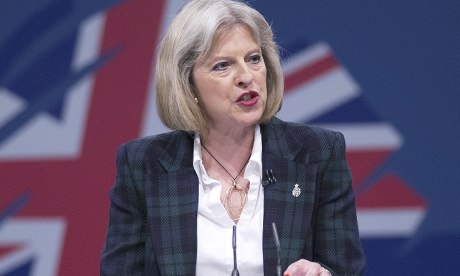
    Image of former UK Prime Minister Theresa May
    Former UK Prime Minister Theresa May

    https://www.politics.co.uk/news/2023/11/08/theresa-may-urges-government-not-to-roll-backwards-on-net-zero-commitment/

    Theresa May has said the “best long-term decision” the government can make is on climate change because action is integral to the “long-term future” of the UK.

    Speaking in the debate on the King’s Speech yesterday, the former prime minister suggested the government was not being sufficiently “strong in ambition” to meet the 2050 net zero target.

    …

    The King’s Speech contained plans to have licences for oil and gas projects in the North Sea awarded annually. 

    There have recently been questions raised about the government’s ability to meet its 2050 net zero target, with its climate advisers warning the UK risks falling behind without much faster action.

    In its latest progress report, the Committee on Climate Change (CCC) said the “expansion of fossil fuel production is not in line with net zero“.

    …

    https://www.politics.co.uk/news/2023/11/08/theresa-may-urges-government-not-to-roll-backwards-on-net-zero-commitment/

  • 25 Just Stop Oil mothers arrested

    Spread the love
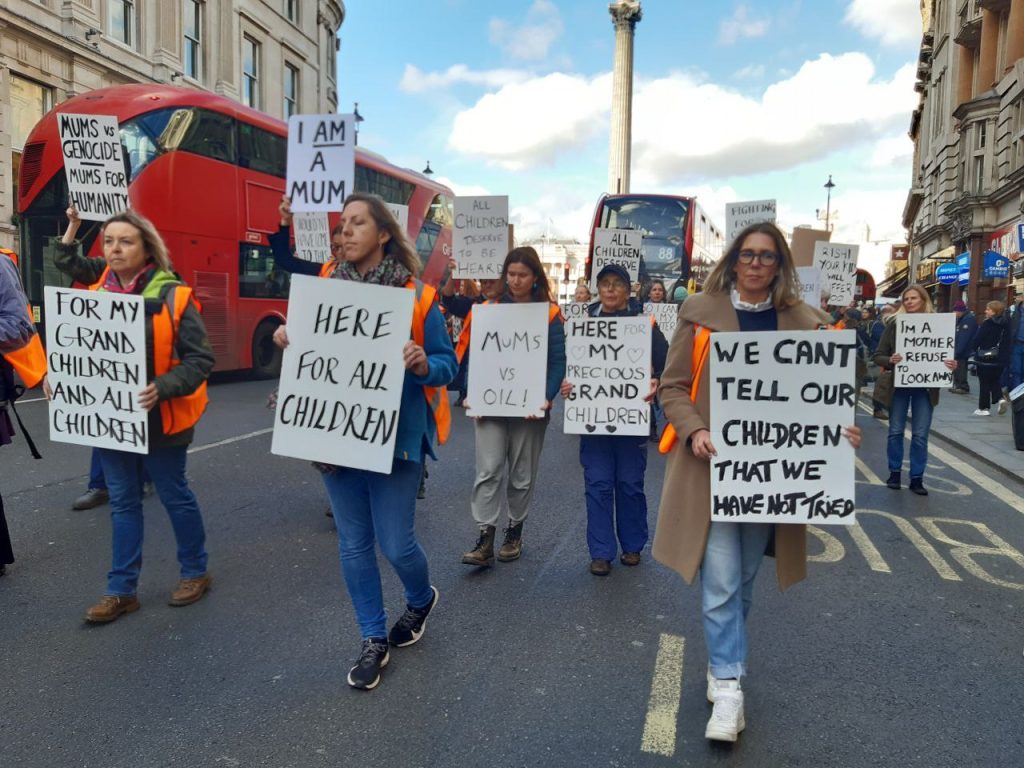
    25 Just Stop Oil mothers arrested for slow marching London 6 Nov 2023.
    25 Just Stop Oil mothers arrested for slow marching London 6 Nov 2023.

    A group of mothers and grandmothers were arrested this afternoon while slow-marching in London in support of Just Stop Oil’s demand for the government to end new oil and gas.

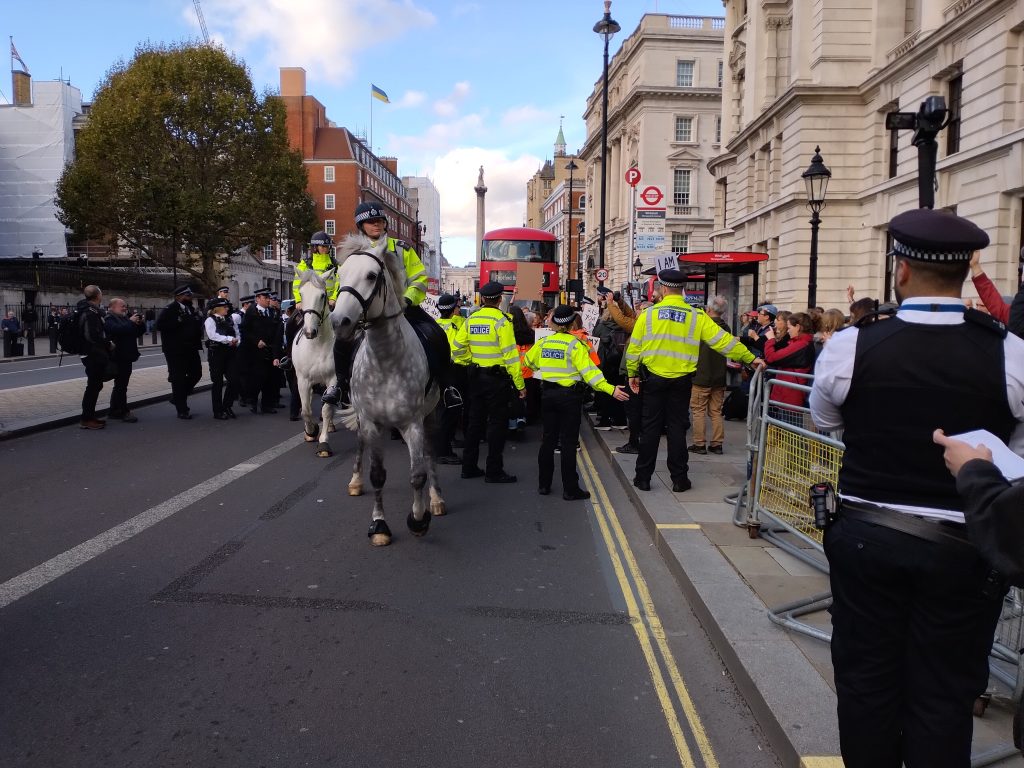
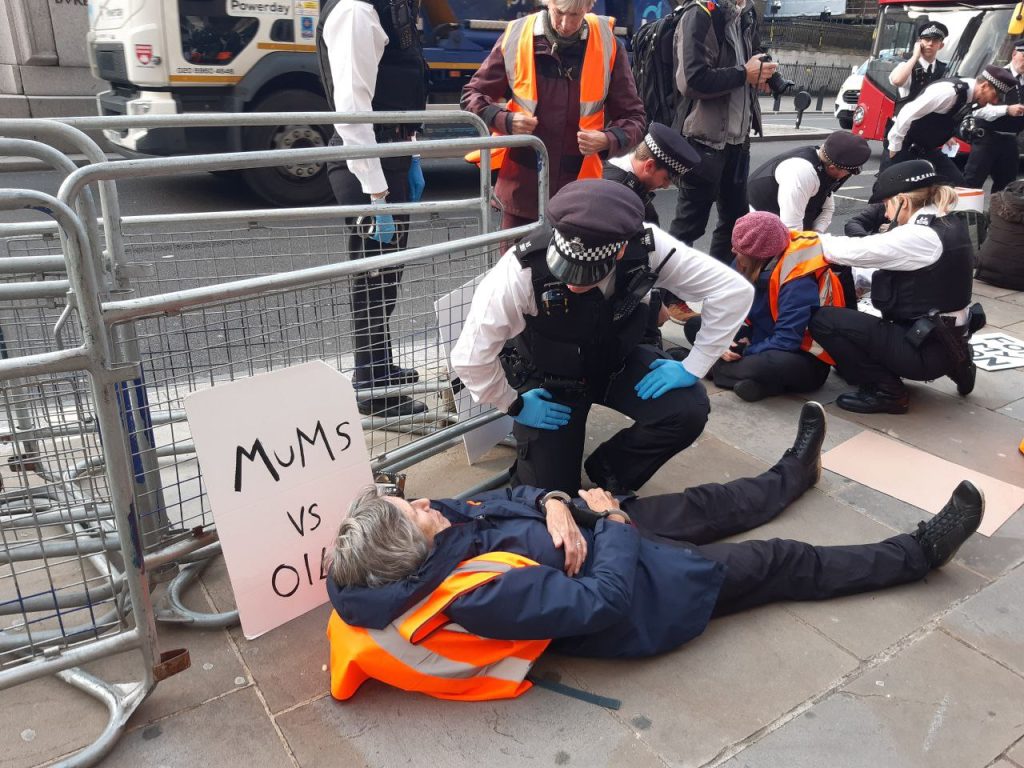
    33 Just Stop Oil supporting mothers and grandmothers began marching down Whitehall from Trafalgar Square. Metropolitan Police kettled the group before arresting them, including a grandmother aged 79 and a great grandmother. They were detained for allegedly breaching Section 7 of the Public Order Act 2023.

    Since Just Stop Oil’s most recent campaign began a week ago, police have refused to respect their rights to protest and have opted for immediately arresting slow marchers, but this group of mothers refused to be intimidated.

    The mothers say that they refuse to stand by while government policies continue to support the fossil fuel industry, leading to global suffering on an unprecedented scale. The marching mums carried placards explaining why they felt compelled to resist: for their children, for all the world’s children and future generations.

    25 Just Stop Oil mothers arrested for slow marching London 6 Nov 2023.
    25 Just Stop Oil mothers arrested for slow marching London 6 Nov 2023.

    Gill Tavner, a mother of two daughters, aged 19 and 21, from Stroud said

    “We’re marching here to oppose corporate greed with maternal love. For years we’ve watched in mounting disbelief as global leaders have failed to take the necessary action to reduce the burning of fossil fuels. This government is travelling in completely the wrong direction.

    “It’s crazy that in asking for a liveable world for our children we are vilified and criminalised. My heart aches when I think about the difficulties ahead for my girls, and even more so for less privileged children in the world. If we could rely on responsible leadership, this action would not be necessary, but politics is broken and so I’m compelled to take action. It’s the most important thing I can do as a mother.”

    Angela Holland, 79, a mother of three and grandmother of five, from Bristol said:

    “I’m inspired to march and risk arrest by my grandson and whole family. Their determination has pushed me to read the research on climate breakdown, to understand the urgency for action and to try and adjust my lifestyle accordingly. As George Monbiot says, survival requires disobedience!”

    25 Just Stop Oil mothers arrested for slow marching London 6 Nov 2023.
    25 Just Stop Oil mothers arrested for slow marching London 6 Nov 2023.

    Her daughter, Sophie Holland aged 52, a speech therapist and also a mother of three, said:

    “I’m here because where else would I be? The world is disappearing before our eyes – flooded, burnt, species after species vanishing. Scientists are telling us, loud and clear, this is our last chance. The UN secretary general, the International Energy Agency, Sir David Attenborough, Chris Packham are all saying we are facing catastrophe if we continue to burn fossil fuels. Why isn’t everyone who has children, or knows children, or sees pictures of already displaced and starving children; on the streets, demanding change from our self-serving, criminal government?”

  • 130 Just Stop Oil activists shut down Whitehall

    Spread the love
    just Stop Oil shut down Whitehall 6 Nov 2023. 130 arrests.
    just Stop Oil shut down Whitehall 6 Nov 2023. 130 arrests.

    Just Stop Oil activists are continuing their campaign of peacefully marching in the streets of London, to the point of arrest. They are demanding the government immediately halt all new oil, gas, and coal projects in the UK.

    130 Just Stop Oil supporters from the North and South West of England began marching down Whitehall from Trafalgar Square this morning. A small number of Metropolitan Police arrived at 11:37am. By 11:52 am they has started arresting Just Stop Oil activists for allegedly breaching Section 7 of the Public Order Act 2023. They were unable to bring the march to a halt at this stage, and the supporters made their way to Parliament. By 12:13 there were more than 100 police present and all Just Stop Oil activists were arrested, with most peaceully refusing to comply with the police.

    Today marked the start of a second week of slow marching. According to the Metropolitan Police, a total of 111 people were arrested last week, with 54 being people charged, 4 put on tag, and 3 held on remand at Wandsworth, Thameside and Bronzefield prisons. Last week, police officers arrested Just Stop Oil supporters for simply handing out leaflets on the pavement, causing one man to suffer a fit after being violently restrained. 

    Laura Fretwell, a 23 year old retail worker from Ilkeston said:

    “I’m taking action with Just Stop Oil because if we don’t end new oil and gas, everything we know and love will be destroyed because of the greed of a select few. The government needs to take drastic action now to prevent climate chaos. Their refusal to do so condemns us all.”

    “I will march, facing the threat of violence and arrest, because our children deserve better than to be living on a dying planet. We owe it to them to create a better world, as our elders have done for us.”

    Justin Jago, 53, a registered blind guide dog user from Bristol said:

    “I am marching in response to government plans to issue over 100 new oil and gas licences.  I am angry that this government has failed to address the catastrophe that is killing people around the world and threatens the future of humanity without immediate action. Soaring temperatures and adverse weather conditions are causing forest fires and flooding, killing countless people and causing mass displacement of families. 

    “Historically civil disobedience has been the catalyst for positive change when governments have failed us, and I can’t ignore the facts. We owe it to children and young people facing a frightening future to act.”

    Just Stop Oil is calling on people to join them everyday at midday in Trafalgar Square from 20th November to march in London until the government ends new oil and gas.