
US Wields ‘Hand of Genocide’ by Vetoing Yet Another UN Gaza Cease-Fire Resolution
Original article by Brett Wilkins republished from Common Dreams under Creative Commons (CC BY-NC-ND 3.0).

Original article by Brett Wilkins republished from Common Dreams under Creative Commons (CC BY-NC-ND 3.0).
“This latest shameful U.S. veto—one in a long list—gives Israel the green light to continue its genocide of Palestinians in Gaza,” said the head of Amnesty International.
For the fifth time since Israel launched its genocidal assault and siege of the Gaza Strip—and for the first time during President Donald Trump’s tenure—the United States has vetoed a United Nations Security Council resolution calling for a cease-fire, a move that came as Palestinians continue to suffer daily massacres, mass starvation, and ethnic cleansing in the embattled enclave.
U.S. Ambassador to the U.N. Dorothy Shea—a former political officer at the American Embassy in Tel Aviv, Israel—was the lone vote against the Security Council draft resolution demanding an “immediate, unconditional, and permanent cease-fire” in Gaza and the release of all remaining hostages held by Hamas and other Palestinian resistance groups.
“Any product that undermines our close ally Israel’s security is a nonstarter,” Shea explained after sinking the resolution. In addition to diplomatic cover, the U.S. provides Israel with tens of billions of dollars in armed aid, including weapons that have been used in some of the Israel Defense Forces’ (IDF) deadliest massacres in Gaza.
The resolution was put forth by the 10 non-permanent Security Council members—Algeria, Denmark, Greece, Guyana, Pakistan, Panama, Sierra Leone, Slovenia, Somalia, and South Korea—who explained Wednesday in a joint statement that the measure was “prompted by our deep concern over the catastrophic situation in Gaza, which deteriorated further after the resumption of hostilities in March.”
According toThe Palestine Chronicle, Hamas—which governs Gaza and led the October 7, 2023 attack on Israel—said the U.S. veto shows “Washington’s blind bias towards the occupation government” and support for Israel’s “crimes against humanity in Gaza.”
At least hundreds of Gazans, mostly children, have recently died from malnutrition and lack of medical care amid Israel’s tightened siege, according to local officials. Israeli airstrikes continue to kill and wound scores of Palestinians—and sometimes more—daily, and upward of 100 Gazans have been shot dead while desperately trying to secure humanitarian aid in recent days.
“This latest shameful U.S. veto—one in a long list—gives Israel the green light to continue its genocide of Palestinians in Gaza,” Amnesty International secretary general Agnès Callamard said in a statement. “It allows Israel to continue starving Palestinian civilians and creating conditions of life meant to bring about their destruction.”
In addition to vetoing five Security Council cease-fire resolutions, the U.S. last year used its veto power to block Palestine’s bid to become a full U.N. member. The U.S. also abstained from voting on two Security Council cease-fire resolutions during the Biden administration.
“The U.S. has squandered yet another crucial opportunity to demand that Israel ends civilian bloodshed,” Callamard added. “What possible justification can there be for blocking action by the U.N. Security Council that could help to end the harrowing starvation and suffering, free hostages, and lift Israel’s suffocating aid restrictions?”
All told, more than 194,000 Palestinians have been killed or wounded—including over 14,000 people who are missing and believed dead and buried beneath rubble—during 606 days of an onslaught for which Israel is facing a genocide case at the World Court and Israeli Prime Minister Benjamin Netanyahu is wanted by the International Criminal Court for alleged war crimes and crimes against humanity including extermination and weaponized starvation.
Upward of 2 million Palestinians have also been forcibly displaced, often multiple times, most recently during Operation Gideon’s Chariots, the IDF’s ongoing campaign to indefinitely occupy and ethnically cleanse Gaza, possibly to facilitate Israeli recolonization, as pushed by far-right figures.
On Wednesday, International Committee of the Red Cross president Mirjana Spoljaric said conditions in Gaza are “worse” than last month, when she described them as “hell on Earth.”
All this, as a cease-fire proves as elusive as ever due to what pro-Palestine critics say is Netanyahu’s desire to prolong the war in order to delay his own criminal corruption trial and Hamas’ demand for a guaranteed end to Israel’s onslaught.
“The world is watching, day after day, horrifying scenes of Palestinians being shot, wounded, or killed in Gaza while simply trying to eat,” Tom Fletcher, the U.N.’s top humanitarian chief, said Wednesday. “We must be allowed to do our jobs. We have the teams, the plan, the supplies, and the experience.”
“It’s simply unconscionable to stand in the way of this resolution.”
Amnesty International USA executive director Paul O’Brien said: “Once again, the U.S. government, this time under Trump’s leadership, is on the wrong side of history. While it’s not a surprise the U.S. vetoed this resolution, it’s nonetheless devastating.”
“The language is focused on the urgency of the unconditional release of all hostages and unfettered access to humanitarian aid,” O’Brien added. “When children are dying of starvation and the fate of the hostages is uncertain, it’s simply unconscionable to stand in the way of this resolution.”
Original article by Brett Wilkins republished from Common Dreams under Creative Commons (CC BY-NC-ND 3.0).


- ‘Disgraceful’: US Abstains After Watering Down UN Gaza Resolution
- US Abstains as UN Security Council Demands ‘Immediate Cease-Fire’ in Gaza
- UN Security Council’s Gaza Cease-Fire Resolution Is Not Enough—But It’s a Start
- As Israeli Forces Fire on Starving Palestinians, US Again Vetoes UN Cease-Fire Resolution
- After Another US Security Council Veto, UN General Assembly Votes for Gaza Cease-Fire
- In 14-1 UN Security Council Vote, Lone US Veto Kills Gaza Cease-Fire Resolution
Half the world endured extra month of extreme heat due to climate change

 A man walks on a hot summer day in Srinagar, India-controlled Kashmir, July 25, 2024
SCIENTISTS say four billion people — about half the world’s population — experienced at least one extra month of extreme heat from May 2024 to May 2025 because of human-caused climate change.
The extreme heat caused illness, death, crop losses and strained energy and healthcare systems, according to the analysis from World Weather Attribution, Climate Central and the Red Cross.
“Although floods and cyclones often dominate headlines, heat is arguably the deadliest extreme event,” the report said.
Many heat-related deaths are unreported or are mislabelled by other conditions like heart disease or kidney failure.
The study shows how much climate change boosted temperatures in an extreme heat event and calculated how much more likely its occurrence was because of climate change.
…
Article continues at https://morningstaronline.co.uk/article/half-world-endured-extra-month-extreme-heat-due-climate-change

Swiss Glacier Collapse That Buried Village Likely a ‘Direct Result of Our Warming Climate’
Original article by Brett Wilkins republished from Common Dreams under Creative Commons (CC BY-NC-ND 3.0).
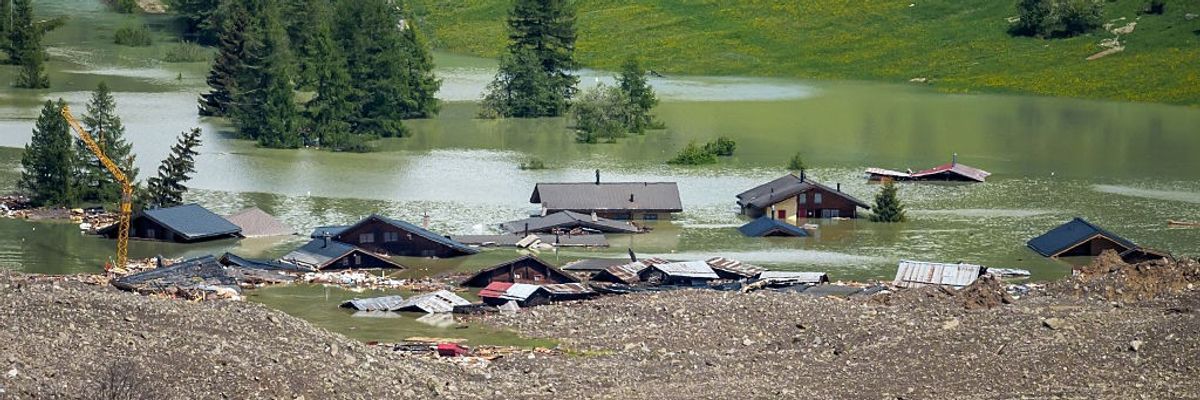
“What happened to Birch Glacier is what we would expect from rising temperatures in the Alps and elsewhere,” one scientist said.
Thawing permafrost exacerbated by human-caused global heating is the likely culprit behind a massive glacier collapse that buried nearly the entire Swiss town of Blatten, one scientist said Thursday while warning of the likelihood of similar disasters in the future.
The alpine hamlet of 300 inhabitants—who were evacuated earlier amid warning signs of disaster—was almost completely wiped out on Wednesday after the Birch Glacier, located in the Lötschental Valley in northern Switzerland, collapsed. The glacial avalanche, laden with boulders and other debris, cascaded down the mountainside and into the village, obliterating everything in its path. Local officials said around 90% of Blatten was buried.
“We’ve lost our village,” Blatten Mayor Matthias Bellwald told reporters. “The village is under rubble. We will rebuild.”
While there are no verified casualties from the disaster, one 64-year-old man has been reported missing.
Mathieu Morlighem, a glaciologist at Dartmouth College in New Hampshire, told ABC News that permafrost thaw under and along the sidewalls surrounding the glacier likely caused the collapse.
“What happened to Birch Glacier is what we would expect from rising temperatures in the Alps and elsewhere,” he explained. “I think we can expect more events like this in the future.”
As ABC News reported:
Glaciers in Switzerland have lost almost 40% of their volume since 2000, and the loss is accelerating, according to the Swiss Federal Institute for Forest, Snow, and Landscape Research. Record-high summer temperatures in 2022 and 2023 caused a 10% glacial ice loss in the country.
Experts warn that Switzerland’s glaciers could disappear completely by 2100 due to the climate emergency.
As Common Dreams reported in March, the crisis is planetary and is predicted to adversely affect nearly 2 billion people who depend upon glaciers for agricultural irrigation and drinking water.
“Most of the world’s glaciers, including those in mountains, are melting at an accelerated rate worldwide,” a United Nations Educational, Scientific, and Cultural Organization report published earlier this year warned. “Combined with accelerating permafrost thaw, declining snow cover, and more erratic snowfall patterns… this will have significant and irreversible impacts on local, regional, and global hydrology, including water availability.”
The Swiss collapse happened a day before Thursday’s opening of the High-Level International Conference on Glaciers’ Preservation in Tajikistan, which aims to “highlight the vital role of glaciers in maintaining global ecological balance and addressing water-related challenges.”
Original article by Brett Wilkins republished from Common Dreams under Creative Commons (CC BY-NC-ND 3.0).
Guest post: How marine life provides climate benefits worth billions of dollars
Original article by Dr Damien Couespel republished from Carbon Brief under a CC license.
The ocean plays a vital role in regulating the climate, storing roughly 50 times more carbon dioxide (CO2) than the atmosphere.
Marine life plays a significant part in this process, as organisms transfer carbon from the ocean surface to the deep sea upon death or as they migrate.
Our new research, published in Nature Communications, suggests the contribution of ocean biology to climate regulation is more complex than previously thought.
To explore how ocean biology shapes the past, present and future climate, we explore an extreme scenario where all marine life has been wiped out.
We find that – in a pre-industrial climate – CO2 levels would rise by 50% without marine life, leading to 1.6C of global warming.
In a separate study in Nature Climate Change, we estimate that ocean biology sequesters the equivalent of 10bn tonnes of CO2 each year.
This is more than one quarter of annual fossil-fuel emissions from human activity.
We also calculate that the contribution of marine life to carbon storage is worth hundreds of billions of dollars each year.
Biological carbon pump
The ocean takes up and stores vast amounts of CO2 every year through two mechanisms known as “carbon pumps”.
The first is the “solubility pump”. This is the process by which dissolved CO2 in seawater is transported from the ocean’s surface to its depth through the sinking and upwelling of water mass.
The second is the “biological carbon pump”. This is the process where carbon is converted into organic materials by plankton and other marine organisms at the ocean’s surface and then transported to the deep sea when they die or migrate.
Scientists have long known that the biological carbon pump played an essential role in maintaining low atmospheric CO2 levels before the industrial revolution.
However, the conventional view is that the solubility pump has been responsible for the ocean’s steady absorption of rising CO2 emissions caused by human activity.
Our findings challenge this view, by showing the biological carbon pump plays a crucial role in the modern ocean’s sequestration of atmospheric CO2.
We find that, without marine life, the ocean’s capacity to capture CO2 emissions would be significantly diminished.
Two scenarios
To get an estimate of the contribution of the marine carbon pump in a stable pre-industrial climate, we simulate the planet’s climate as it was before the industrial era using a complex Earth system model.
(This is the second generation of the Norwegian Earth system model, which contributed to the sixth Coupled Model Intercomparison Project.)
We then explore what would happen to the Earth’s climate system under two scenarios:
- A reference, “healthy ocean” scenario where ocean biology conditions were as realistic as possible.
- An “abiotic” scenario where all marine life is removed.
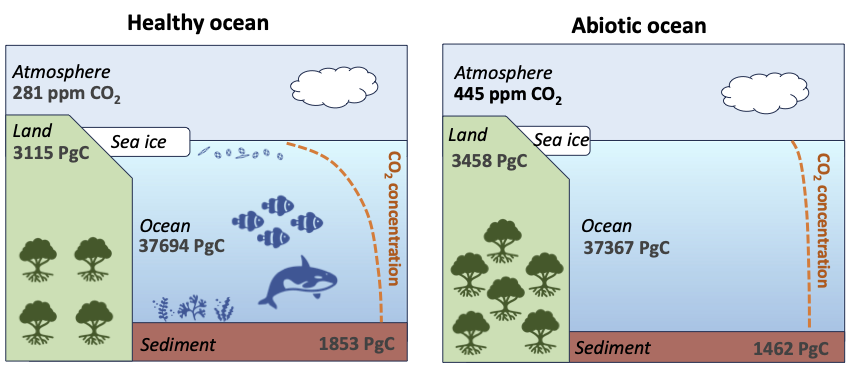
In a pre-industrial scenario with no marine life, we find that atmospheric CO2 levels would rise to 445 parts per million (ppm). This is an increase of more than 50% on the “healthy ocean” scenario, where CO2 levels are 282ppm.
(This suggests that the influence of marine life on global CO2 levels is greater than the sum of all human activity, which has – so far – raised atmospheric CO2 concentrations to around 425ppm).
The rise in CO2 levels caused by the absence of marine life would result in about 1.64C of global warming at the surface and a 1.15C increase in global sea surface temperature.
This warming would have considerable impacts on the wider world, including declines in sea ice area at the Arctic and Antarctic of close to 25% and an Atlantic Meridional Overturning Circulation that was around 9% weaker.
The value of exploring such an extreme scenario is to investigate the role biological processes in the ocean play in carbon storage, as well as the implications of damage to marine life.
The role of terrestrial ecosystems
Our estimation that pre-industrial atmospheric CO2 would rise by 163ppm without ocean biology is on the lower end of the 150-240ppm range approximated by some previous studies.
However, previous estimates of the contribution of the biological carbon pump in a pre-industrial climate neglect the interactions between oceanic and terrestrial biospheres.
Our research reveals that terrestrial ecosystems – such as tropical forests and grasslands – play a crucial role in compensating for the increase in CO2 concentrations when ocean life declines. (This is due to the CO2 fertilisation effect, when higher CO2 concentrations speed up photosynthesis).
We find that in the extreme pre-industrial scenario, approximately half the carbon lost from the ocean is absorbed by the land.
The figure below illustrates the Earth’s carbon reservoirs in a pre-industrial climate with (left) and without (right) marine life. It shows how, if marine life is wiped out, carbon content decreases in the ocean and marine sediment, whereas more carbon accumulates in the atmosphere and on land.
Ramifications for the future
Today, the ocean captures approximately 25% of human-caused CO2 emissions – which allows it to play a crucial role in slowing global warming.
In order to estimate the overall importance of marine life to carbon sequestration in the ocean, we also conduct experiments for various future emission pathways – both with, and without, marine life.
In all cases, we find that more CO2 emitted by human activities remains in the atmosphere when there is no marine life.
One might think that the ocean’s lower concentrations of carbon in the pre-industrial climate, relative to the atmosphere, might mean it would be able to absorb more additional carbon.
However, we find the absence of marine life fundamentally alters the vertical distribution of carbon in the ocean. Although the total amount of carbon stored is lower, there is more carbon at the surface due to an absence of organisms. This, in turn, hinders additional CO2 from entering the ocean.
Another surprising finding of the simulations was that the terrestrial biosphere’s capacity to absorb excess CO2 by increasing its vegetation mass diminishes over time, potentially due to limited nutrients.
The figure below shows the distribution of human-caused CO2 in the Earth’s carbon reservoirs under two 2100 scenarios. The chart on the left shows a scenario with ocean life, and the chart on the right shows one without ocean biology.
It illustrates how, without marine life, more CO2 stays in the atmosphere and less goes into the land and the ocean.
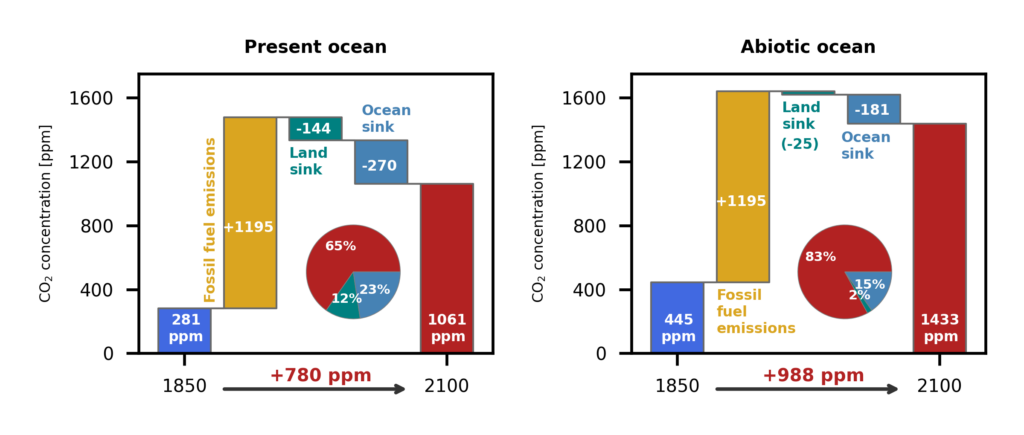
The study shows that in the absence of marine life, future warming would occur faster and more intensely.
This acceleration in warming would potentially trigger other processes that could further amplify warming, such as greater ocean stratification, longer sea-ice free Arctic summers and greater loss of permafrost.
Economic benefits
Damaging marine life is economically costly given the many and various benefits – or “ecosystem services” – provided by carbon sequestration.
We estimate that the sinking of organic matter sequesters approximately 2.8bn tonnes of carbon annually, locking it away from the atmosphere for at least 50 years.
This carbon sequestration capacity is equivalent to 10bn tonnes of atmospheric CO2 – or roughly 27% of emissions generated by fossil fuels in 2024.
We estimate – based on a carbon price of $90 per tonne of CO2 – that the carbon storage provided by the marine carbon pump is worth $545bn per year in international waters and $383bn per year within national waters. Its total value is projected to exceed $2.2tn by 2030.
Carbon storage is valuable because it helps avoid climate impacts.
This economic value is important for developing countries, particularly small island developing states whose national waters are collectively responsible for 11% of biological carbon pump sequestration activity, in terms of carbon stored.
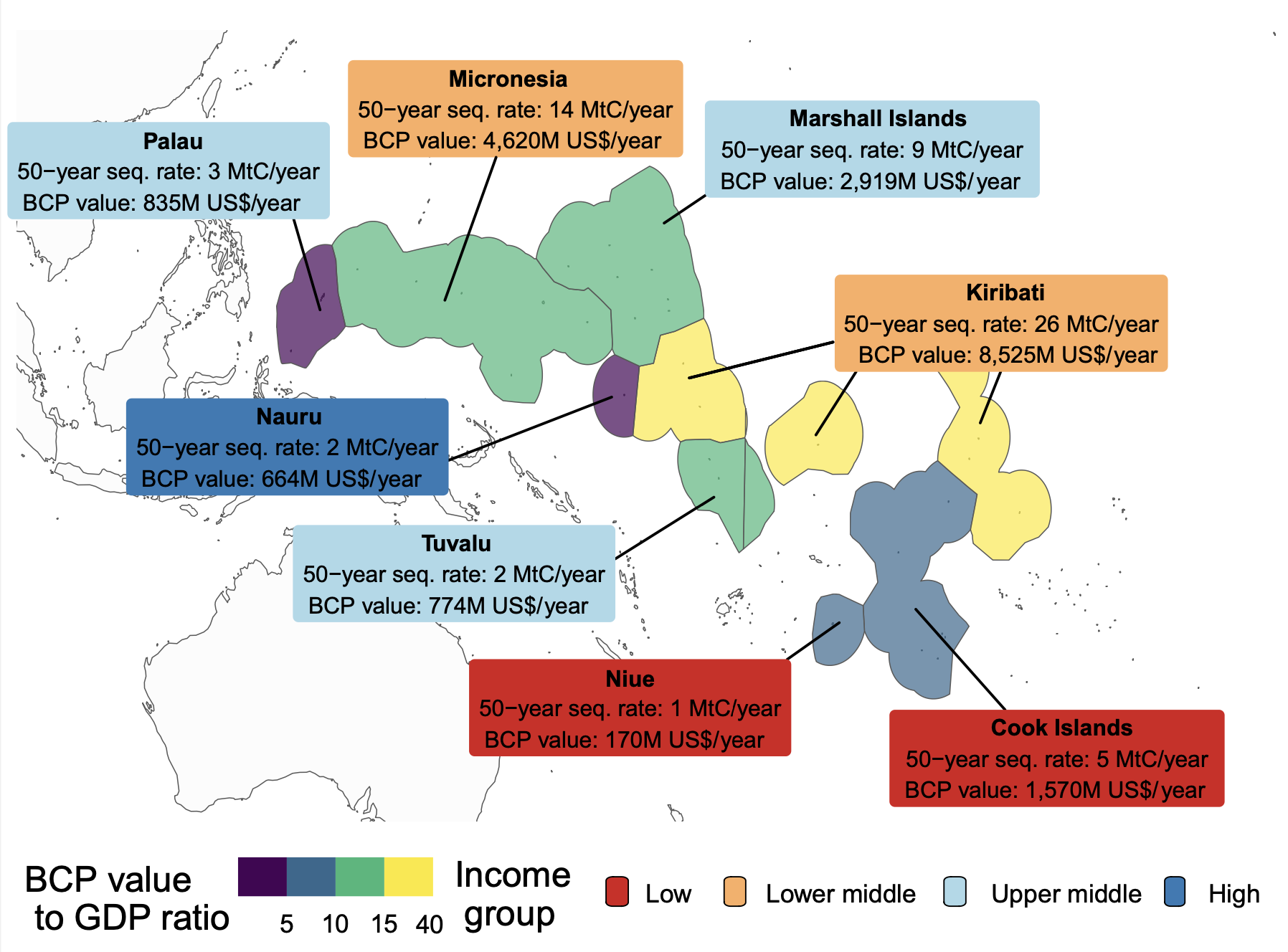
The top eight countries where the biological carbon pump value is highest in proportion to gross domestic product (GDP) are small island states. These are the Cook Islands, Kiribati, the Marshall Islands, Micronesia, Nauru, Niue, Palau and Tuvalu. Of these nations, just one – the Cook Islands – is classified by the World Bank as high income.
These climate-impacted nations’ key role in preserving ocean health should be considered in discussions of international climate finance.
The figure below shows the economic value of carbon sequestration of the biological carbon pump for each of these eight small island states, calculated on the basis of a carbon price of $90 per tonne of CO2.
For example, it illustrates how Micronesia and Kiribati have an estimated biological carbon pump value of $4,620m and $8,525m each year, respectively.
A healthy ocean buys the world time in the battle against global warming, but the window to protect it is closing rapidly.
Marine ecosystems remain vulnerable to a raft of human activities, including industrial fishing, pollution, shipping and deep-sea mining. Stronger conservation policies, enhanced financial incentives for lower income countries and increased international cooperation are essential to protect the services provided by ecosystems.
These are important steps towards not only protecting 30% of the global ocean as agreed under the new Global Biodiversity Framework – but it will help to reach the Paris Agreement’s climate target.
There are a number of tools at governments disposal to protect the valuable services provided by marine ecosystems. This includes promoting sustainable fishing and ecotourism, establishing marine protected areas and undertaking robust environmental impact assessments.
Nations can also support protection of the biological heat pump within international waters by ratifying the High Seas Treaty, which recognises the importance of protecting biogeochemical cycles.
Guest post: More than 70% of adaptation plans for European cities are ‘inconsistent’
Guest posts|
14.05.25
Guest post: How climate science is – and is not – shaping adaptation planning in southern Africa
Guest posts|
01.05.25
Guest post: Why hydrogen cars are being outsold by Ferraris
Guest posts|
22.04.25
Guest post: Exploring the risks of ‘cascading’ tipping points in a warming world
Guest posts|
15.04.25
Tjiputra, J.F. et al. (2025): Marine ecosystem role in setting up preindustrial and future climate, Nature Communications, doi:10.1038/s41467-025-57371
Berzaghi, F. et al. (2025): Global distribution, quantification and valuation of the biological carbon pump, Nature Climate Change, doi:10.1038/s41558-025-02295-0
Original article by Dr Damien Couespel republished from Carbon Brief under a CC license.