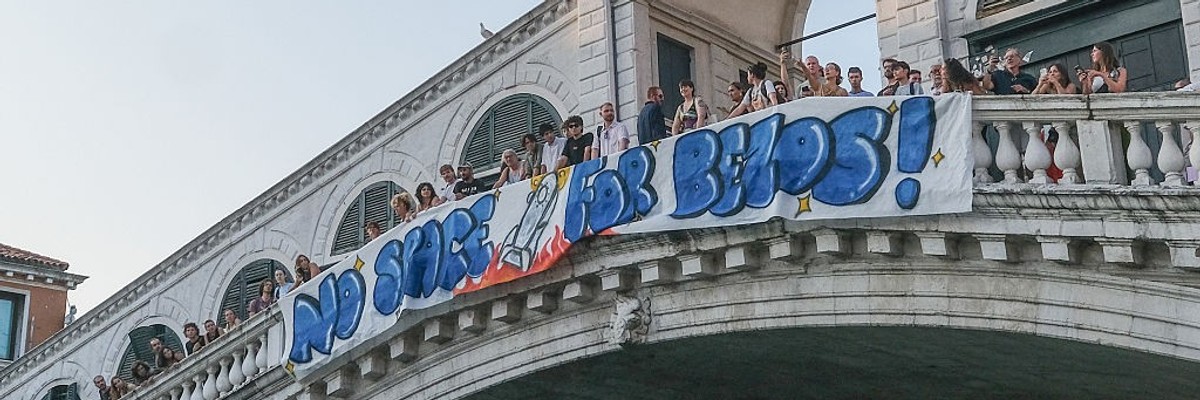
Activists drape a “No Space For Bezos” banner from Venice’s iconic Rialto Bridge on June 13, 2025 to protest a party celebrating the wedding of multicentibillionaire Amazon.com founder Jeff Bezos and journalist Lauren Sánchez. (Photo: Stefano Mazzola/Getty Images)
“We’re just citizens who started organizing and we managed to move one of the most powerful people in the world,” said one protest organizer.
Amazon.com founder Jeff Bezos and Lauren Sánchez on Tuesday relocated their upcoming lavish Venice wedding celebration, a move cheered as an “enormous victory” by protesters whose recent demonstrations in the northeastern Italian city have highlighted the socioeconomic and climate damage caused by billionaires.
Bezos—who is currently the world’s fourth-richest person, according to lists published by Bloomberg and Forbes—is set to marry Sánchez, a journalist, later this week, and the couple is planning to celebrate the occasion with a three-day extravaganza costing an estimated $46-56 million, according to Reuters.
Around 90 private jets are scheduled to land in area airports and local yacht harbors are fully booked, underscoring the climate and environmental impact on a city struggling to survive on one of myriad frontlines of the planetary emergency.
“We are very proud of this! We are nobodies, we have no money, nothing!”
The nuptial celebration has been relocated from the Scuola Grande della Misericordia to the Arsenale di Venezia, a historic fortified palace about 3 kilometers (1.8 miles) away from the original location. Officials cited concerns for the security of guests including several members of U.S. President Donald Trump’s family.
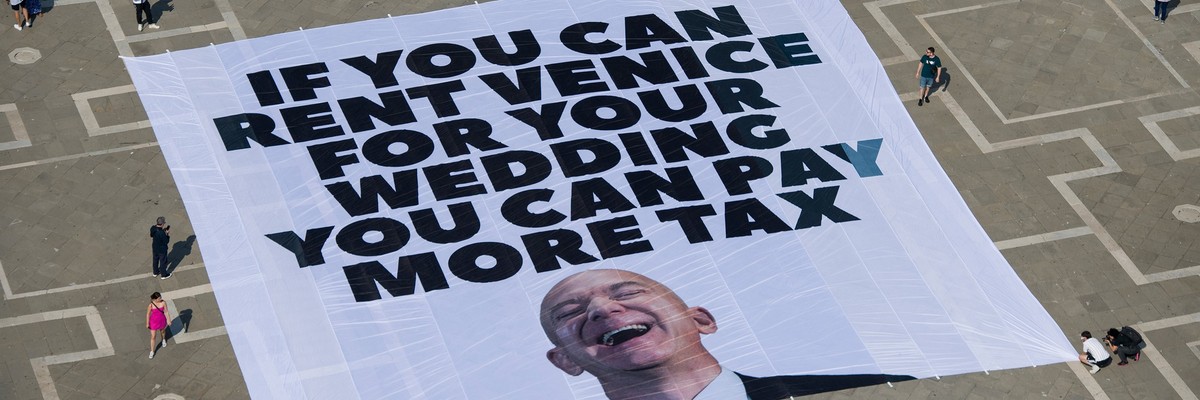
Members of groups including No Space for Bezos, Greenpeace Italy, and Everyone Hates Elon—which targets Elon Musk, the world’s richest person—have staged a series of demonstrations, including one on Monday at which protesters laid out a massive banner with Bezos’ face and the message “If You Can Rent Venice for Your Wedding You Can Pay More Tax” in Piazza San Marco.
Responding to the celebration’s relocation, Tommaso Cacciari of No Space for Bezos told the BBC Wednesday: “We are very proud of this! We are nobodies, we have no money, nothing!”
“We’re just citizens who started organizing and we managed to move one of the most powerful people in the world,” Cacciari added.
Wedding-related festivities are set to kick off Thursday evening, and city officials have blocked off parts of central Venice. While some residents have welcomed the money and fanfare the event will bring to a city with a long and storied history of oligarchs and opulence, others bristle at what they see as the transformation of their home into a playground for the superrich.
“There’s only one thing that rules now: money, money, money, so we are the losers,” Venice resident Nadia Rigo told Reuters. “We who were born here have to either move to the mainland or we have to ask them for permission to board a ferry. They’ve become the masters.”
In the United States, critics contrasted the stratospheric cost of Bezos’ celebration with the multicentibillionaire’s history of personal and corporate tax dodging—and the hyper-capitalist system that enables it.
“Jeff Bezos is worth $230 billion and is reportedly spending $20 million on a three-day wedding in Venice while sailing around on his $500 million yacht,” former U.S. Labor Secretary Robert Reich said Wednesday on the social media site X. “If he can afford to do that, he can afford a wealth tax and to pay Amazon workers a living wage. Hello?”
This is oligarchy. This is obscene.While 60% live paycheck to paycheck & kids go hungry, Jeff Bezos, worth $230 billion, goes to Venice on his $500 million yacht for a $20 million wedding & spends $5 million on a ring while his real tax rate is just 1.1%.End this oligarchy.
While No Space for Bezos organizers are celebrating their victory and have canceled plans to fill Venice’s canals with inflatable crocodiles in a bid to block celebrity guests from accessing the Scuola Grande della Misericordia, they said they still plan on protesting the festivities by holding a “No Bezos, No War” rally and march.
“It will be a strong, decisive protest, but peaceful,” Federica Toninello of the Social Housing Assembly network toldEuronews Wednesday. “We want it to be like a party, with music, to make clear what we want our Venice to look like.”
Human-caused greenhouse gas (GHG) emissions in 2024 continued to drive global warming to record levels.
This is the stark picture that emerges in the third edition of the “Indicators of Global Climate Change” (IGCC) report, published in Earth System Science Data.
In doing so, the IGCC fills the gap between the IPCC’s sixth assessment (AR6) in 2021 and the seventh assessment, expected in 2028.
Following IPCC methods, this year’s assessment brings together a team of over 60 international scientists, including former IPCC authors and curators of vital global datasets.
As in previous years, it is accompanied by a user-friendly data dashboard focusing on the main policy-relevant climate indicators, including GHG emissions, human-caused warming, the rate of temperature change and the remaining global carbon budget.
Below, we explain this year’s findings, highlighting the role that humans are playing in some of the fundamental changes the global climate has seen in recent years.
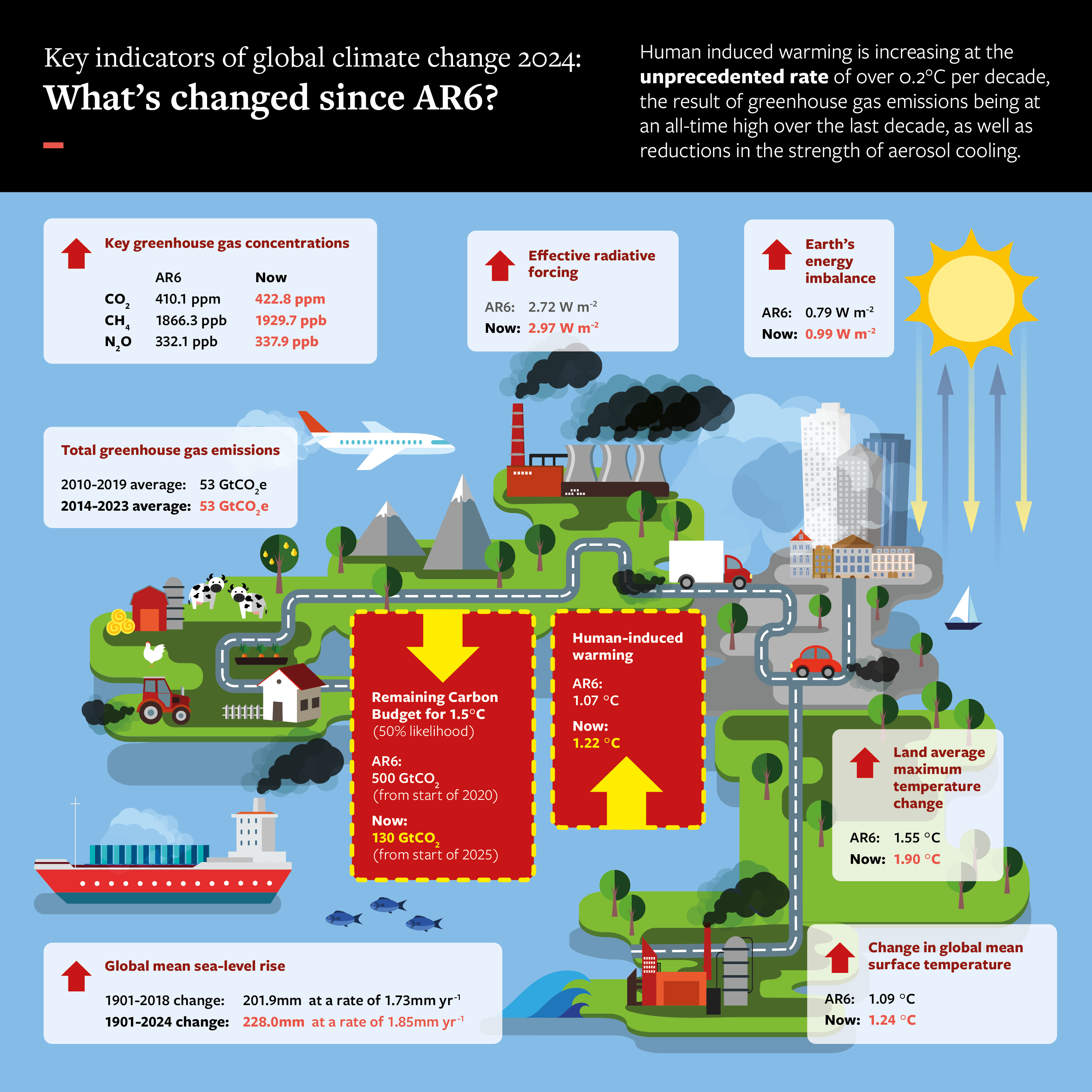
Headline results from an analysis of key climate indicators in 2024, compared to the IPCC AR6 climate science report. Source: Forster et al. (2025)
(For previous IGCC reports, see Carbon Brief’s detailed coverage in 2023 and 2024.)
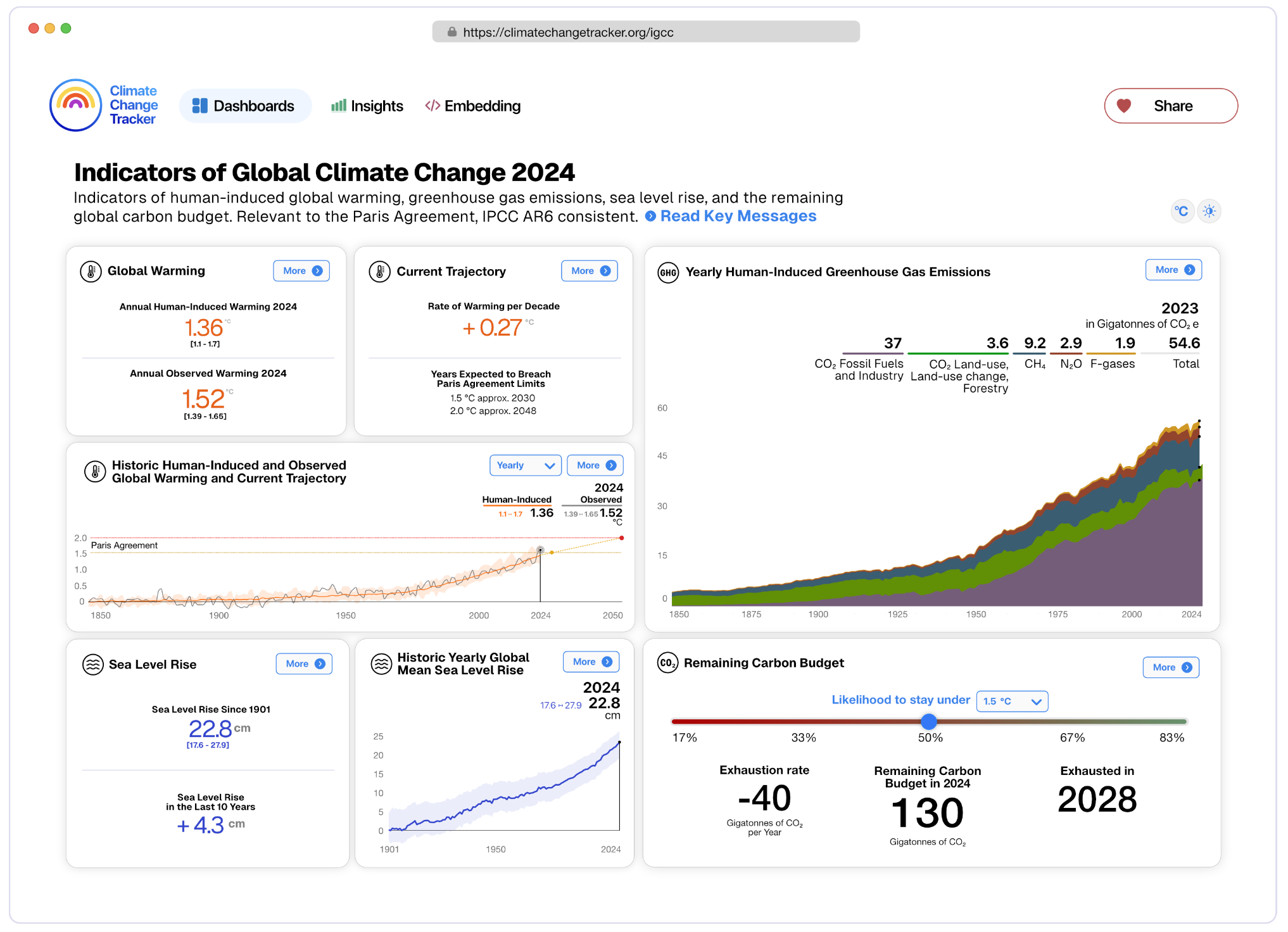
Our best estimate is a rise of 1.52C (with a range of 1.39-1.65C), of which human activity contributed around 1.36C. The rest is the result of natural variability in the climate system, which also plays a role in shaping global temperatures from one year to the next.
Our estimate of 1.52C differs slightly from the 1.55C given by the World Meteorological Organisation (WMO) state of the global climate 2024 report, published earlier this year. This is because they make slightly different selections on which of the available global land and ocean temperature datasets to include. (The warming estimate has varied by similar amounts in past years and future work will aim to harmonise the approaches.)
The height of 2024’s temperatures, while unprecedented in at least the last 2,000 years, is not surprising. Given the high level of human-induced warming, we might currently expect to see annual temperatures above 1.5C on average one year in six.
However, with 2024 following an El Niño year, waters in the North Atlantic were warmer than average. These conditions raise this likelihood to an expectation that 1.5C is surpassed every other year.
From now on, we should regard 2024’s observed temperatures as unexceptional. Temperature records will continue to be broken as human-caused temperature rise also increases.
Longer-term temperature change
Despite observed global temperatures likely rising by more than 1.5C in 2024, this does not equate to a breach of the Paris Agreement’s temperature goal, which refers to long-term temperature change caused by human activity.
IGCC also looks at how temperatures are changing over the most recent decade, in line with IPCC assessments.
Over 2015-24, global average temperatures were 1.24C higher than pre-industrial levels. Of this, 1.22C was caused by human activity. So, essentially, all the global warming seen over the past decade was caused by humans.
Observed global average temperatures over 2015-24 were also 0.31C warmer than the previous decade (2005-14). This is unsurprising given the high rates of human-caused warming over the same period, reaching a best estimate of 0.27C per decade.
This rate of warming is large and unprecedented. Over land, where people live, temperatures are rising even faster than the global average, leading to record extreme temperatures.
But every fraction of a degree matters, increasing climate impacts and loss and damage that is already affecting billions of people.
Driven by emissions
Undoubtedly, these changes are being caused by GHG emissions remaining at an all-time high.
Over the last decade, human activities have released, on average, the equivalent of around 53bn tonnes of CO2 into the atmosphere each year. (The figure of 53bn tonnes expresses the total warming effect of CO2 and other greenhouse gases, such as methane and nitrous oxide, using CO2 as a reference point.)
Emissions have shown no sign of the peak by 2025 and rapid decline to net-zero required to limit global warming to 1.5C with no or limited “overshoot”.
Most of these emissions were from fossil fuels and industry. There are signs that energy use and emissions are rising due to air conditioning use during summer heatwaves. Last year also saw high levels of emissions from tropical deforestation due to forest fires, partly related to dry conditions caused by El Niño.
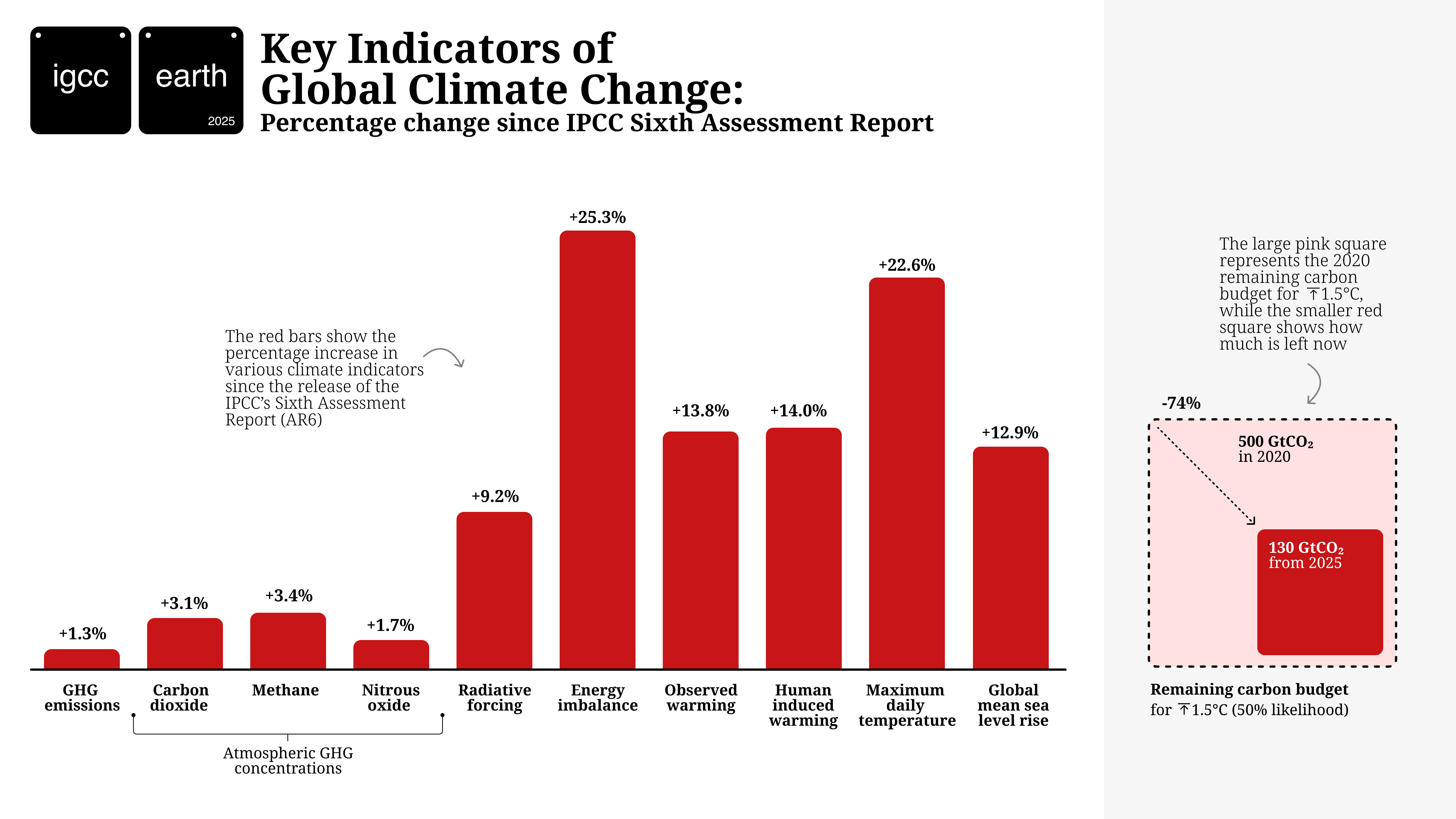
The amount of CO2 in the atmosphere, alongside the other major GHGs of methane (CH4) and nitrous oxide (N2O), is continuing to build up to record levels. Their concentrations have increased by 3.1, 3.4 and 1.7%, respectively, since the 2019 values reported in the last IPCC assessment.
At the same time, aerosol emissions, which have a cooling effect, are continuing to fall as a result of important efforts to tackle air pollution. This is currently adding to the rate of GHG warming.
Notably, cutting CH4 emissions, which are also short-lived in the atmosphere, could offset this rise. But, again, there is no real sign of a fall – despite major initiatives such as the Global Methane Pledge.
The effect of all human drivers of climate change on the Earth’s energy balance is measured as “radiative forcing”. Our estimate of this radiative forcing in 2024 is 2.97 Watts per square metre (W/m2), 9% above the value recorded in 2019 that was quoted in the last IPCC assessment.
This is shown in the figure below, which illustrates the percentage change in an array of climate indicators since the data update given in the last IPCC climate science report.
Percentage changes in key climate indicators in 2024, compared to the IPCC AR6 climate science report. The remaining carbon budget given on the right is the only indicator to show a reduction and is the change since IPCC AR6, presented as a shrinking box. Source: Forster et al. (2025)
Continued emissions and rising temperatures are meanwhile rapidly eating into the remaining carbon budget, the total amount of CO2 that can be emitted if global warming is to be kept below 1.5C.
Our central estimate of the remaining carbon budget from the start of 2025 is 130bn tonnes of CO2.
This has fallen by almost three-quarters since the start of 2020. It would be exhausted in a little more than three years of global emissions, at current levels.
However, given the uncertainties involved in calculating the remaining carbon budget, the actual value could lie between 30 and 320bn tonnes, meaning that it could also be exhausted sooner – or later than expected.
Beyond global temperatures
Our assessment also shows how surplus heat is accumulating in the Earth’s system at an accelerating rate, becoming increasingly out of balance and driving changes around the world.
The data and their changes are displayed on a dedicated Climate Change Tracker platform, shown below.
Snapshot of Climate Change Tracker
The radiative forcing of 2.97 W/m2 adds heat to the climate system. As the world warms in response, much of this excess heat radiates to space, until a new balance is restored. The residual level of heating is termed the Earth’s “energy imbalance” and is an indication of how far out of balance the climate system is and the warming still to come.
This residual rate of heat entering the Earth system has now approximately doubled from levels seen in the 1970s and 1980s, to around 1W/m2on average during the period 2012-24.
Although the ocean is storing an estimated 91% of this excess heat, mitigating some of the warming we would otherwise see at the Earth’s surface, it brings other impacts, including sea level rise and marine heatwaves.
Global average sea level rise, from both the melting of ice sheets and thermal expansion due to deep ocean warming, is included in the IGCC assessment for the first time.
We find that it has increased by around 26mm over the last six years (2019-24), more than double the long-term rate. This is the indicator that shows the clearest evidence of an acceleration.
Overall, our indicators provide multiple lines of evidence all pointing in the same direction to provide a clear and consistent – but unsurprising and worsening – picture of the climate system.
It is also now inevitable that global temperatures will reach 1.5C of long-term warming in the next few years unless society takes drastic, transformative action – both in cutting GHG emissions and stopping deforestation.
Every year of delay brings reaching 1.5C – or even higher temperatures – closer.
This year, countries are unveiling new “nationally determined contributions” (NDCs), the national climate commitments aimed at collectively reducing GHG emissions and tackling climate change in line with the Paris Agreement.
While the plans put forward so far represent a step in the right direction, they still fall far short of what is needed to significantly reduce, let alone stop, the rate of warming.
At the same time, evidence-based decision-making relies on international expertise, collaboration and global datasets.
Our annual update relies on data from NASA and the National Oceanic and Atmospheric Administration (NOAA) and input from many of their highly respected scientists. It is this type of collaboration that allows scientists to generate well-calibrated global datasets that can be used to produce trusted data on changes in the Earth system.
It would not be possible to maintain the consistent long-term datasets employed in our study if their work is interrupted.
At a time when the planet is changing at the fastest rate since records began, we are at risk of failing to track key indicators – such as greenhouse gas concentrations or deep ocean temperatures – and losing core expertise that is vital for understanding the data.
Forster, P. M. et al. (2025) Indicators of Global Climate Change 2024: Annual update of key indicators of the state of the climate system and human influence, Earth System Science Data, doi:10.5194/essd-17-2641-2025
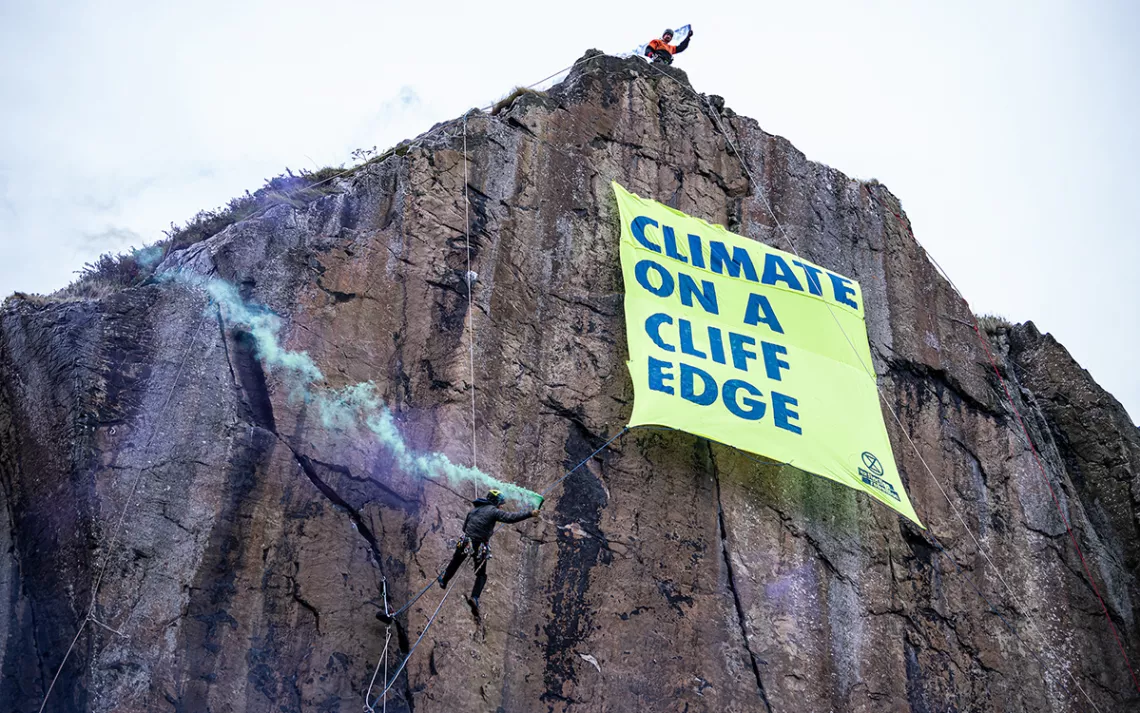
Neo-Fascist Climate Science Denier Donald Trump says Burn, Baby, Burn.Experienced climbers scale a rock face near the historic Dumbarton castle in Glasgow, releasing a banner that reads “Climate on a Cliff Edge.” One activist, dressed as a globe, symbolically looms near the edge, while another plays the bagpipes on the shores below. | Photo courtesy of Extinction Rebellion and Mark RichardsElon Musk urges you to be a Fascist like him, says that you can ignore facts and reality then.
Activists from the U.K. action group Everyone Hates Elon and Greenpeace Italy unfolded a banner reading, “If you can rent Venice for your wedding, you can pay more tax,” on Piazza San Marco in the Italian city on June 23, 2025. (Photo: Michele Lapini/Greenpeace)
“This isn’t just about one person—it’s about changing the rules so no billionaire can dodge responsibility, anywhere,” said one Greenpeace campaigner.
Billionaire Amazon founder Jeff Bezos—the third- or fourth-richest person on the planet, depending on the list—is hosting various wedding events in Venice, Italy, this week, festivities that have drawn protests, including a massive banner on Monday.
Activists with Greenpeace Italy and the U.K. action group Everyone Hates Elon—targeting Elon Musk, U.S. President Donald Trump’s close far-right ally and the wealthiest person on Earth—unfolded a banner that read, “If you can rent Venice for your wedding, you can pay more tax,” in Piazza San Marco.
“While Venice is sinking under the weight of the climate crisis, billionaires are partying like there is no tomorrow on their megayachts,” Greenpeace campaigner Clara Thompson said in a statement. “This isn’t just about one person—it’s about changing the rules so no billionaire can dodge responsibility, anywhere.”
“The real issue is a broken system that lets billionaires skip out on their fair share of taxes while everyone else is left to foot the bill,” she argued. “That’s why we need fair, inclusive tax rules, and they must be written at the U.N.”
Jeff Bezos pays his staff poverty wages and dodges tax. No wonder he can afford to shut down half of Venice for his wedding this week. Tax billionaires NOW.Location: Piazza San Marco, Venice@greenpeace.org #JeffBezos #TaxTheSuperRich
Reporting on Monday’s display of the banner—which features Bezos’ face and is about 65 feet long and wide—Reuters detailed:
Local police arrived to talk to activists and check their identification documents, before they rolled up their banner.
“The problem is not the wedding, the problem is the system. We think that one big billionaire can’t rent a city for his pleasure,” Simona Abbate, one of the protesters, told Reuters.
A spokesperson from Everyone Hates Elon similarly said in a Monday statement that “as governments talk about hard choices and struggle to fund public services, Jeff Bezos can afford to shut down half a city for days on end just to get married.”
“Just weeks ago, he spent millions on an 11-minute space trip,” the spokesperson added, referring to the Blue Origin flight for multiple public figures, including Bezos’ fiancée, Lauren Sánchez. “If there was ever a sign billionaires like Bezos should pay wealth taxes, it’s this.”
Bezos and Sánchez’s event planners, Lanza and Baucina, toldCNN: “Rumors of ‘taking over’ the city are entirely false and diametrically opposed to our goals and to reality… From the outset, instructions from our client and our own guiding principles were abundantly clear: the minimizing of any disruption to the city.”
The details surrounding Bezos’ marriage to the former news anchor have been closely guarded, but CNN reported that around 30 of Venice’s 280 water taxis are thought to be reserved, the city’s nine yacht ports are booked, and one source said that special permission has been granted for private helicopters.
While Venice’s mayor and regional governor Luca Zaia have defended the billionaire’s luxury wedding events, citing economic benefits for local businesses, “the ‘No Space for Bezos’ movement—a play on words also referring to the bride’s recent space flight—has united a dozen Venetian organizations including housing advocates, anti-cruise ship campaigners, and university groups,” according toThe Associated Press.
The Bloomberg and Forbes lists tracking global billionaires put Bezos’ net worth between $223.4 billion and $231 billion as of Monday. At times in recent years, he has been believed to be the richest person in the world.
The Earth could be doomed to breach the symbolic 1.5C warming limit in as little as three years at current levels of carbon dioxide emissions.
That’s the stark warning from more than 60 of the world’s leading climate scientists in the most up-to-date assessment of the state of global warming.
Nearly 200 countries agreed to try to limit global temperature rises to 1.5C above levels of the late 1800s in a landmark agreement in 2015, with the aim of avoiding some of the worst impacts of climate change.
But countries have continued to burn record amounts of coal, oil and gas and chop down carbon-rich forests – leaving that international goal in peril.
“Things are all moving in the wrong direction,” said lead author Prof Piers Forster, director of the Priestley Centre for Climate Futures at the University of Leeds.
“We’re seeing some unprecedented changes and we’re also seeing the heating of the Earth and sea-level rise accelerating as well.”
These changes “have been predicted for some time and we can directly place them back to the very high level of emissions”, he added.
Neo-Fascist Climate Science Denier Donald Trump says Burn, Baby, Burn.Elon Musk urges you to be a Fascist like him, says that you can ignore facts and reality then.
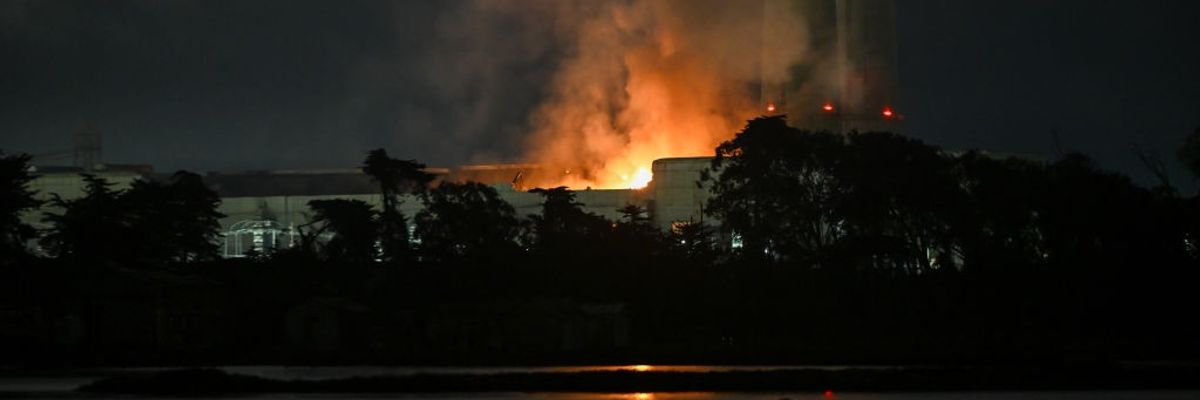
A view of flames and giant smoke is seen over the sky as a fire erupted at the natural gas Moss Landing Power Plant in Moss Landing of Monterey Bay, California, United States on January 17, 2025. (Photo: Tayfun Coskun/Anadolu via Getty Images)
Scientists said that atmospheric carbon dioxide concentrations peaked above 430 parts per million for the first time in perhaps 30 million years.
The concentration of carbon dioxide in the atmosphere peaked above 430 parts per million in 2025—the highest it has been in millions of years—according to data released by the National Oceanic and Atmospheric Administration and Scripps Institution of Oceanography at the University of California, San Diego on Thursday.
The news was overshadowed by the explosive feud between U.S. President Donald Trump and his erstwhile backer Elon Musk, but climate activist Bill McKibben argued that it was ultimately more consequential.
“In the long run, this is actually going to be the important news of the day—CO2 in the atmosphere passes another grim milestone,” McKibben wrote on social media.
In the long run, this is actually going to be the important news of the day–co2 in the atmosphere passes another grim milestone
Carbon dioxide has been accumulating in the atmosphere due primarily to the human burning of fossil fuels, as well as by the clearing of forests and other natural carbon sinks. There, it acts as a greenhouse gas, trapping heat from the Earth, and is the primary gas responsible for the rise of global temperatures by approximately 1.1°C from the 1850 -1900 average. This warming has already had a host of dramatic impacts, from extreme weather events to sea-level rise to polar ice melt, and scientists warn these impacts will only accelerate under current energy policies, which put the world on track for around 3°C of warming by 2100.
The last time that atmospheric CO2 concentrations topped 430 ppm was most likely more than 30 million years ago, Ralph Keeling, who directs the Scripps CO2 Program, told NBC News.
“It’s changing so fast,” he said. “If humans had evolved in such a high-CO2 world, there would probably be places where we wouldn’t be living now. We probably could have adapted to such a world, but we built our society and a civilization around yesterday’s climate.”
“While largely symbolic, passing 430 ppm should be a wake-up call.”
Scripps and National Oceanic and Atmospheric Administration both measure carbon dioxide levels from NOAA’s Mauna Loa Observatory in Hawaii, where Charles Keeling began taking measurements in 1958. As CO2 levels rise over time, they also follow a seasonal cycle—peaking in May before falling in the Northern Hemisphere summer and rising again in the fall.
This May, Scripps Oceanography calculated an average of 430.2 ppm for 2025, which is 3.5 ppm over the average for May 2024. NOAA’s Global Monitoring Laboratory, meanwhile, calculated a monthly average of 430.5 ppm, a 3.6 ppm jump from the year before and the second-steepest yearly climb since 1958.
“Another year, another record,” Keeling said in a statement. “It’s sad.”
JUST IN: Atmospheric carbon dioxide (CO2) concentrations have peaked for the year at 430.5 ppm.📈 This is 3.6 ppm higher than last year and the second largest May-May increase in the 67-year Mauna Loa record. In 2023, the CO2 peaked at 424 ppm. 🔗: https://t.co/adhNurvOtEpic.twitter.com/t1VUSCeKgU
The news comes two months after Mauna Loa daily measurements surpassed 430 ppm for the first time in March, which Plymouth Marine Laboratory professor Helen Findlay called “extremely disappointing and worrying.”
“While largely symbolic, passing 430 ppm should be a wake-up call, especially given the accelerated response we are seeing of glaciers and ice sheets to current warming,” Dr. James Kirkham, chief scientist of the Ambition on Melting Ice coalition of governments, said at the time.
“This upward trajectory is a direct result of continued fossil fuel use, likely exacerbated by emissions from extreme wildfires last year, methane leaks from fossil fuel extraction and possibly greater permafrost emissions, alongside decreased ability of very warm oceans to absorb CO2,” Kirkham said.
The monthly record also comes a little more than a week after a United Nations report warned that there was a small chance global temperatures could surpass 2°C in at least 1 of the next 5 years, only a decade after world leaders pledged in the Paris agreement to keep global temperatures “well-below” that level.
“Carbon emissions are still rising, and the atmosphere is going to keep heating further until greenhouse gas concentrations stabilize,” Matt Kean, who chairs Australia’s Climate Change Authority, wrote in response to the Scripps and NOAA figures. “What sort of climate do we want to leave our children and those who come after them?”
Orcas discuss Donald Trump and the killer apes’ concept of democracy. Front Orca warns that Trump is crashing his country’s economy and that everything he does he does for the fantastically wealthy.Neo-Fascist Climate Science Denier Donald Trump says Burn, Baby, Burn.Elon Musk urges you to be a Fascist like him, says that you can ignore facts and reality then.