Category: Green Party

  • UK Climate Campaigners Get ‘Utterly Disproportionate’ Sentences

    Spread the love

    Original article by OLIVIA ROSANE republished from Common Dreams under Creative Commons (CC BY-NC-ND 3.0). 
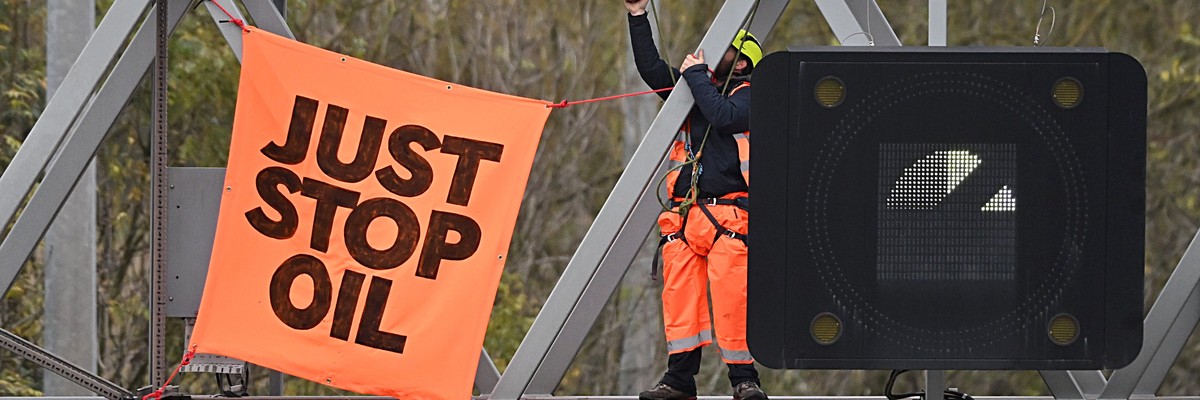
    An activist puts up a banner reading “Just Stop Oil” atop an electronic traffic sign along M25 on November 10, 2022 in London, United Kingdom. (Photo: Leon Neal/Getty Images)

    “Rulings like today’s set a very dangerous precedent, not just for environmental protest but any form of peaceful protest,” a U.N. official said.

    In a decision that one United Nations official called “beyond comprehension,” a U.K. judge on Thursday sentenced five Just Stop Oil activists to a combined 21 years in prison over a Zoom call in which they discussed plans to disrupt London’s orbital M25 highway.

    The sentences are believed to be the longest on record for nonviolent protest in U.K. history, The Guardian reported.

    “The sentences handed to the five Just Stop Oil campaigners are utterly disproportionate,” environmentalist and author George Monbiot wrote on social media. “Four and five years in prison for peaceful protest? This is what you might expect in Russia or Egypt, not in a supposed democracy.”

    “Why are we punishing the people trying to prevent disaster while allowing the oil company giants causing it to reap super profits?”

    The five activists—Roger Hallam, Daniel Shaw, Louise Lancaster, Lucia Whittaker De Abreu, and Cressida Gethin—were found guilty last week of conspiring to cause a public nuisance due to a four-day direct action protest on the M25 that Just Stop Oil ultimately held in November 2022. All of the defendants participated in a Zoom call in which they planned to recruit volunteers for the protest, which was intended to pressure the U.K. government to end oil and gas exploration in the North Sea, a policy that the incoming Labour government has now adopted. The Zoom call had been infiltrated by a Sun journalist, who shared its contents with the Metropolitan Police.

    On Thursday, Judge Christopher Hehir sentenced Hallam to five years in prison and Shaw, Lancaster, De Abreu, and Gethin to four each.

    The sentences sparked outrage from humans rights advocates and environmental campaigners.

    Michel Forst, U.N. special rapporteur on environmental defenders who also observed part of the trial, said the sentencing “marks a dark day for peaceful environmental protest, the protection of environmental defenders, and indeed anyone concerned with the exercise of their fundamental freedoms in the United Kingdom.”

    Forst added: “Rulings like today’s set a very dangerous precedent, not just for environmental protest but any form of peaceful protest that may, at one point or another, not align with the interests of the government of the day.”

    Former Green Party leader and Member of Parliament Caroline Lucas called the sentences “obscene.”

    “Why are we punishing the people trying to prevent disaster while allowing the oil company giants causing it to reap super profits?” she asked on social media.

    Current Deputy Leader of the Green Party Zack Polanski said: “‘Conspiracy to commit a public nuisance’ is a deeply authoritarian description that should send shivers down the spine of all of us who want to live in a free society. Even worse when the real crime is consecutive governments who have played down the climate emergency.”

    Campaigners and experts also criticized the trial itself, in which Hehir did not allow the defendants to present evidence about the climate crisis to explain their actions.

    “Defendants should be allowed to explain why they have decided to use nonconventional but yet peaceful forms of action, like civil disobedience, when they engage in environmental protest,” Forst told The Guardian after attending part of the trial.

    Bill McGuire, emeritus professor of geophysical and climate hazards at University College London—who Hehir did not allow the defendants to call as a witness—called the trial and verdict a “farce.”

    “They mark a low point in British justice, and they were an assault on free speech,” McGuire in a statement said Thursday. “The judge’s characterization of climate breakdown as a matter of opinion and belief is completely nonsensical and demonstrates extraordinary ignorance. Similarly to suggest that the climate emergency is irrelevant in relation to whether the defendants had a reasonable case for action is crass stupidity.”

    The verdict and sentencing also come amid an increasing crackdown on climate protest, both globally and in the U.K. The previous longest known civil disobedience sentences in the country were also for Just Stop Oil activists.

    “The U.K. is a nightmare for climate activists from this point of view, in the sense that the sentences imposed in other countries are neither that harsh, nor that widespread,” Forst said July 12.

    Greenpeace U.K.’s program director Amy Cameron said on Thursday: “These sentences are not a one-off anomaly but the culmination of years of repressive legislation, overblown government rhetoric, and a concerted assault on the right of juries to deliberate according to their conscience. It’s part of the mess the Labour government has inherited from its predecessor, and they must fix it by giving back to people the right to protest that’s been slowly being taken away from them.”

    Forst also called on the new government to reverse course.

    “Given the gravity of the situation, I urge the new United Kingdom government, with absolute urgency and without undo delay, to take all necessary steps to ensure that Mr. Shaw’s sentence is reduced in line with the United Kingdom’s obligations under the Aarhus Convention,” Forst wrote on Thursday.

    Original article by OLIVIA ROSANE republished from Common Dreams under Creative Commons (CC BY-NC-ND 3.0). 
  • Greens propose that equalising capital gains tax could pay for lifting the two-child benefit cap many times

    Spread the love
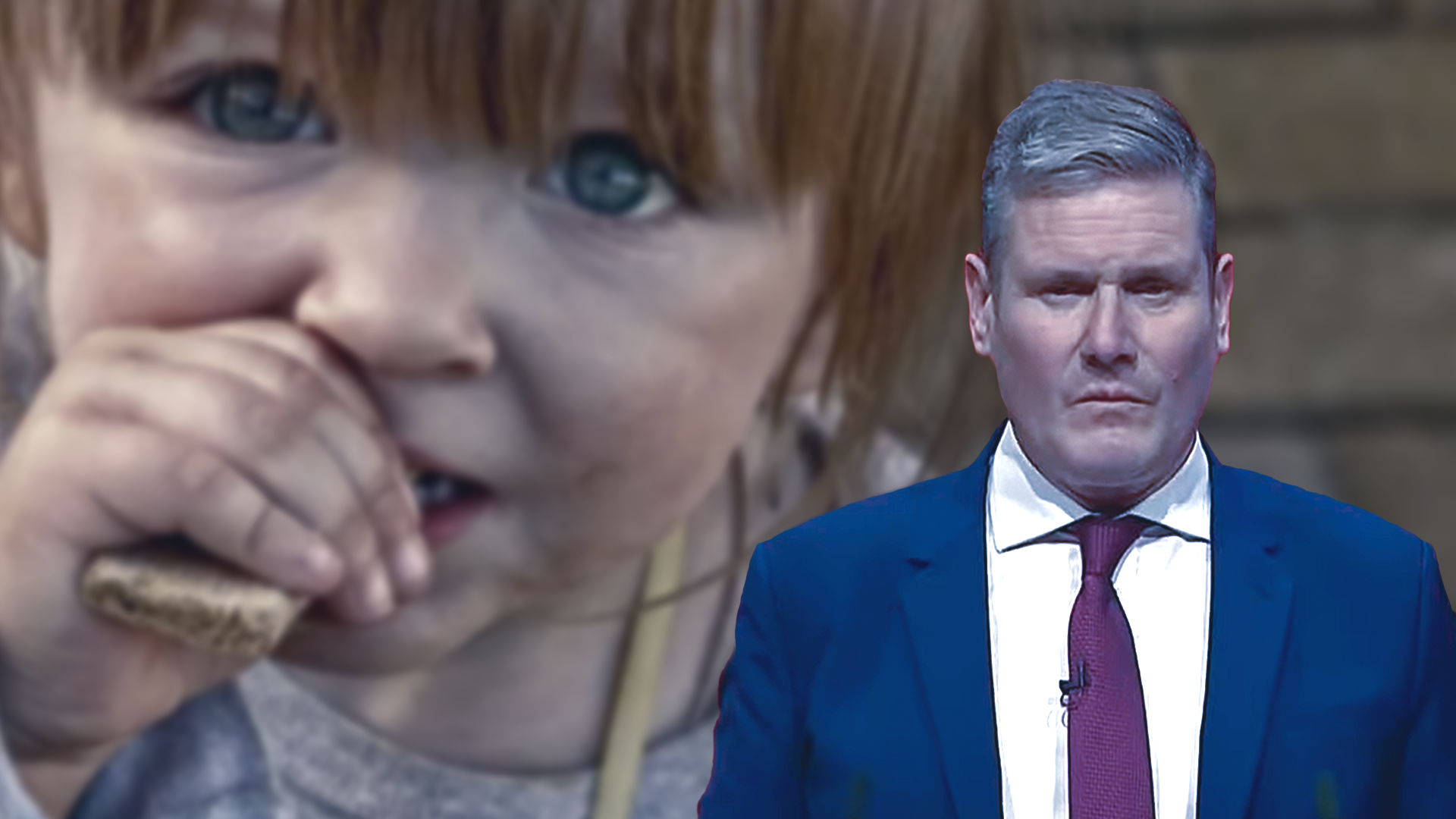
    Image of Keir Starmer and a poor child.
    Zionist Keir ‘Kid Starver’ Starmer. Image thanks to The Skwawkbox.

    Capital Gains Tax is paid at a lower rate than Income Tax so that unearned income is taxed less than earned income: rich people who don’t even have to watch it coming in are taxed less than the hard-working families that we hear so much about. The Green Party argues that hundreds of thousands of children can be lifted out of poverty if Labour committed to equalising capital gains tax to pay to scrap the two-child benefit cap. The four newly elected Green MPs, will be proposing a reasoned amendment to the King’s Speech that includes the scrapping of the two-child benefit.  

    The IFS estimates that the cap will impact 2.63 million children by the end of this parliament and that scrapping the cap would cost in the region of £3.4billion – before taking into account the wider economic impact of poverty on health and welfare systems. In their recent manifesto, the Green Party estimated that making Capital Gains Tax fairer could raise £16bn, a move that would impact less than 2% of income taxpayers. This £16bn figure is supported by research conducted by Arun Advani, a tax expert at the University of Warwick, who estimated that equalising CGT and income tax rates would raise £16.7bn a year.

    Green MPs will today propose an amendment to propose the government scraps the two-child benefit cap. Green Party Co-Leader and Bristol Central MP Carla Denyer, speaking on behalf of the Green group of MPs said

    “I think Labour are serious when they say they want to change the country. But the change they are looking to achieve will always be hamstrung for as long as they limit their own potential to raise additional revenue to spend on frontline services. The impact of this approach is already clear. Every day we have children going hungry, unable to concentrate in school or struggling to ascertain even the very basics – this is the real world impact of child poverty.  And so today we’re offering Labour a positive fairer taxation that will allow them to redistribute money from some of the wealthiest to some of the very poorest. This is a political choice that they must now make.”   

    Green Party Work, Employment and Social Security Spokesperson, Prof Catherine Rowett said, “Scrapping the two-child benefit cap is a moral and practical imperative. It is a matter of social, economic and racial justice. Today we have outlined one way that Labour, if they had the political will, could choose to help millions of children. And child poverty blights lives and costs millions, as generations of children are condemned to lower achievement and a lifetime of poor health. When they say there is no money, remember this is a political choice – they’re ignoring the political, social and economic costs of keeping children in poverty.”  

  • Young people led surge for smaller parties but no Reform ‘youthquake’, says UK election survey

    Spread the love

    Stuart Fox, University of Exeter

    One of the defining features of contemporary electoral politics in Britain is the age divide. Young people are far more likely to support Labour, and older people to support the Conservatives. This divide is still apparent following the 2024 election – but it hides the complexity of how young people in particular choose to vote.

    To the extent that there is a “youth vote” in Britain, it is characterised not by support for a single party, but by a particularly fierce rejection of the Conservatives – alongside greater enthusiasm than their elders for left-wing, socially liberal alternatives to Labour.

    YouGov surveyed 2,182 adults of all ages between July 5 and 8 for my research team at the University of Exeter. The sample was selected to be representative of the British adult population.

    The data from this survey – published here for the first time – gives a snapshot of how people of different ages say they cast their votes. Five per cent of our respondents under 30 didn’t tell us how they voted so we don’t know how their votes might have changed the overall picture. More research in the coming months may give a fuller account.

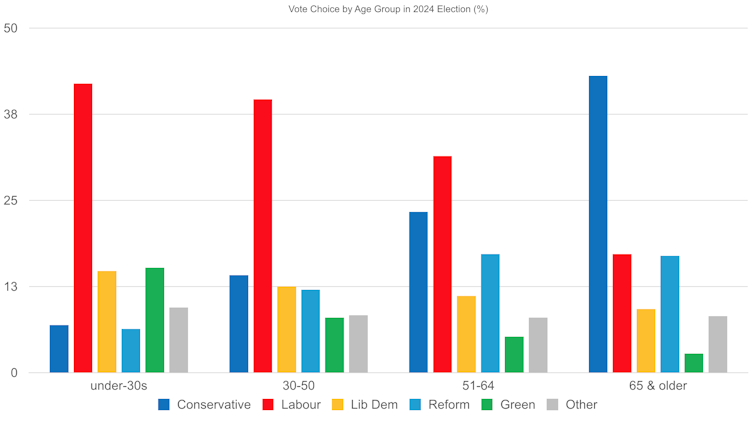
    As the graph below shows, it’s only among the over-65s that the Conservatives won more support than Labour (by around 26 percentage points). They trailed Labour by around 8 points among the 51-64 age group, 26 points among 30- to 50-year-olds, and 35 points among the under-30s. Almost incredibly for Britain’s oldest and most successful political party, the Conservatives won barely 7% of the vote of under-30s in the survey.

    Parties voted for by age group:

    Bar chart showing vote choice by age group. Source: YouGov for University of Exeter, 5-7 July 2024., CC BY-NC-ND

    Another key characteristic of the 2024 election is the record-low combined vote share for Labour and the Conservatives, and concurrent record-high vote share for smaller parties. This was not a blip. Voters have been steadily shifting away from the two major parties for years. But in 2024, the extent to which they did so was unprecedented: overall, the combined Labour/Tory vote share was just 57%.

    The rejection of the major parties is most profound among young voters. Their support has become fragmented to such an extent that it is not really accurate to speak of a singular “youth vote”. Less than half (49%) of under-30s surveyed voted for Labour or the Conservatives. This compares to 54% of 30- to 50-year-olds, 55% of 51- to 64-year-olds, and 60% of over-65s.

    The combined vote share for smaller parties among the under-30s was greater – at 46% – than the 42% who voted for the Labour party. The most successful challengers to the major parties for the youth vote were the Greens and Liberal Democrats, each of whom were backed by 15% of under-30s in the survey.

    “Others” – including the Scottish National Party, Plaid Cymru and independents – won a combined 10% of votes from young respondents aged under 30. But the young people surveyed were not simply casting around for any alternative to the major parties. Just 6% of under-30s in the survey said they backed Reform UK (compared with 17% among the over-50s).


    Want more politics coverage from academic experts? Every week, we bring you informed analysis of developments in government and fact check the claims being made.

    Sign up for our weekly politics newsletter, delivered every Friday throughout the campaign and beyond.


    No Reform youthquake

    In the closing days of the campaign, there was some suspicion that Reform might achieve a “mini youthquake” in this election or the next. A JLPartners poll found that Reform appealed strongly to soon-to-be-enfranchised 16- and 17-year-old voters, and mock school elections apparently saw Reform winning a great deal of support among schoolchildren across the country.

    Our data suggests this did not materialise in 2024. Reform has had some success in appealing to young voters: among under-30s from poorer households, for example, 13% said they supported Reform, compared with 4% for those from wealthier households.

    However, similar proportions of under-30s from poorer households also said they voted for the Liberal Democrats (11%) and the Greens (14%). While voters in older age groups who were fed up of Labour and the Conservatives were more likely to switch to Reform and may do so again in future, among the under-30s such voters appeared more likely to switch to the Liberal Democrats, Greens and nationalist parties in Scotland and Wales.

    Turnout

    Turnout is a crucial issue when considering how young people vote. They have always been less likely to vote than their elders in any particular election. This owes primarily to lower levels of political interest, as well as circumstances associated with early adulthood such as being financially precarious and being less settled in one location. This was true in 2024 as well.

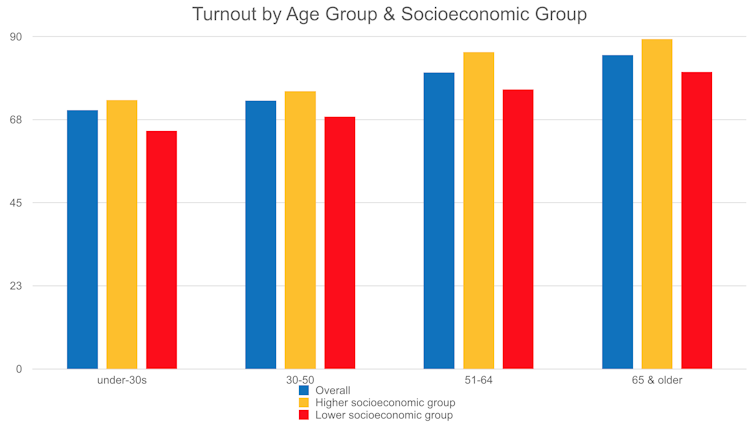
    The graph below shows self-reported turnout by age group. The figures are substantially higher than the true turnout numbers, reflecting the long-established tendency of people to exaggerate their voting behaviour in surveys, but they clearly illustrate the age divide: under-30s were the group most likely to say they hadn’t voted.

    Turnout by age group:

    Bar chart showing turnout by age group and socioeconomic group
    YouGov for University of Exeter, 5-7 July 2024., CC BY-NC-ND

    The graph shows not only was the turnout of under-30s lower than that of older age groups, but that of under-30s from poorer households was particularly low. Young people from poorer backgrounds are less likely to vote than their predecessors were 30 years ago, and so are under-represented in elections to an even greater extent today.

    People who vote during early adulthood establish habits that make them likely to vote for the rest of their lives. Those who don’t form such habits by their late 20s are likely to remain serial abstainers.

    Younger generations are becoming increasingly unlikely to vote in their first election, leading a greater proportion of them to develop lasting habits of non-voting.

    It is this tendency that lies behind one of the major democratic challenges facing the UK: rising levels of disengagement with politics and with voting, as younger people age but continue their youthful pattern of avoiding the ballot box.

    Stuart Fox, Lecturer in British Politics, University of Exeter

    This article is republished from The Conversation under a Creative Commons license. Read the original article.

  • George Monbiot exposes Starmer’s hollow victory

    Spread the love
    Rupert Murdoch supports the Red Tories (UK Labour Party) and needs his nappy changed.
    Rupert Murdoch supports the Red Tories (UK Labour Party) and needs his nappy changed.
    Zionist Keir Starmer is quoted "I support Zionism without qualification." He's asked whether that means that he supports Zionism under all circumstances, whatever Zionists do.
    Zionist Keir Starmer is quoted “I support Zionism without qualification.” He’s asked whether that means that he supports Zionism under all circumstances, whatever Zionists do.
  • Greens respond to OFWAT price rise

    Spread the love
    Green Party MP for Brighton Pavilion Siân Berry. Image by Kelly Hill, Wikimedia CC BY-SA 4.0.
    Green Party MP for Brighton Pavilion Siân Berry. Image by Kelly Hill, Wikimedia CC BY-SA 4.0.

    Responding to the publication of OFWAT’s a draft verdict on water companies’ five-year spending plans and bill increases to 2030, Green Party MP, Siân Berry said:  

    “We’re today calling on Prime Minister Keir Starmer to put all water companies into public hands.   

    “The provision of such a basic human right should not be based on profit.   

    “The idea that water companies will hike bills while so many people are struggling to get to the end of the month is horrific. Meanwhile, some companies, like Thames Water, are still paying shareholder dividends, which is deplorable.   

    “Public ownership is a matter of both social and environmental principle. But, as today’s verdict from OFWAT shows, it is also a pragmatic necessity.   

    “Why not take decisive action and show real leadership by saying that all water companies should be in public hands?