Green Party’s Carla Denyer arrives at the count (Image: PAUL GILLIS / Reach PLC) [Ani Stafford-Townsend is immediately to the right of Carla Denyer.]
As well as Bristol’s first-ever MP, the party finished second everywhere else
A Green surge right across Bristol not only saw the party’s first-ever MP in the city, but also saw voters put them in second place in every single other constituency.
The Green Party are now officially the main challengers to Labour in all five of Bristol’s constituencies – after Carla Denyer’s victory in Bristol Central was followed by strong support right across the city. A total of 65,762 people voted Green in the five Bristol constituencies.
In Bristol East, the Green Party candidate Ani Stafford-Townsend won more than 30 per cent of the vote to cut Labour’s majority down to just 6,606, while in Bristol South and Bristol North West, the Greens leapt from fourth place last time around to second.
Victorious Green MP Carla Denyer, the party’s co-leader, showed that her success – which was matched by Green wins in three other constituencies around the country – meant that people could vote Green and potentially get a Green MP.
The article is from a Bristol newspaper. The “the party finished second everywhere else” refers to everywhere else in Bristol.
Comments by dizzy: These comments may get extended and elaborated.
This article highlights a recurring theme in many analyses of the 2024 General Election: That the Green Party are the ruling Labour Party’s main threat.
The Green Party were mistaken in restricting their ambitions i.e. targetting only 4 seats. This article suggests that another 4 were within reach and to succeed in your goals suggests that those goals were too lax.
The rest of these comments is difficult because there are so many unknowns.
I would expect the Greens to do extremely well at the next General election. That’s assuming that general elections in the same way will be held in 4 or 5 years time.
The World is warming at a seriously alarming rate. Climate change is now and needs immediate action. The action needed is to stop burning fossil fuels and transition to renewable energy that doesn’t damage the climate. There are also other necessary measures: basically stop the rich trashing the planet with their ridiculously climate expensive lifestyles.
People are going to get very angry when they realise how their climate and future has been destroyed by a few rich cnuts.
later: The next few years are going to be extremely demanding, certainly beyond the capabilities of prospective presidential candidates.
Privatised water companies discharged raw sewage into rivers and the sea around England and Wales for 3.6 million hours in 2023 – double the previous year’s total. For a sense of how bad the problem is today, check this map of the south-east of the UK which shows how much sewage water companies are dumping right now and for how long.
As a water researcher, I am happy to see water quality high on the political agenda but aggrieved that it is because of the sewage scandal that has engulfed the UK, and especially England and Wales, in the past couple of years.
Companies have discharged more raw sewage than they are legally allowed to and the Environment Agency, as responsible regulator in England, has been unable to monitor and control offenders as its environmental protection budget was halved between 2010 and 2020. Water firms have neglected to invest in new and enlarged wastewater treatment works for decades and so the ageing system is struggling to meet demand.
An angry public demands cleaner water and changes to how water companies are regulated and run. All major political parties have at least something to say about it in their pitch to voters ahead of July 4 general election.
No clear blue water between Tories and Labour
The Conservative party doesn’t mention the word “sewage” in its manifesto. The party instead highlights what it sees as the government’s achievements in reducing leaks from water pipes, preventing supply interruptions and raising the proportion of designated bathing water sites classified as “good” or “excellent” from 76% in 2010 to 90% in 2023.
These “achievements” are misleading, however. Most of the 451 designated bathing water sites are around the coast, not rivers. Bathing sites only occupy a small stretch of a river (of which many are rated poorly) and most sewage dumpings take place elsewhere along the river, which is not accounted for in the statistics the Tories present.
The party would ban executive bonuses if companies commit a serious criminal breach (dumping sewage, for example) and use fines to invest in river restoration. The Tories evidently expect pollution to keep increasing. Forget working on the cause of the problem and preventing “serious criminal breaches” from happening in the first place.
The Labour party has said it will force water companies to “clean up our rivers” by putting them under “special measures” but does not explain what this means. Like the Conservatives, Labour wants to impose fines on water companies, block the bonuses of executives and improve independent monitoring. Again, Labour offers no further detail on what that would entail.
This is in stark contrast to election campaigns fought under Jeremy Corbyn, when Labour argued for renationalising the water industry.
Both Labour and the Tories propose fines which have proven to be no deterrent. The Environment Agency fined Southern Water – the company that provides water and wastewater services to more than four million people across Hampshire, Sussex and Kent – a record £90 million in 2021, yet illegal sewage discharges by water companies have only increased since then.
Ultimately, fines are a capitulation before the real problem of preventing illegal sewage discharges.
Lib Dems a bit bolder
Banning water companies from dumping raw sewage into rivers and giving them a duty to protect the environment is the goal of the Liberal Democrats.
The Lib Dems want to transform water companies into public benefit companies (but there’s no explanation of how these would differ from their present privatised form) and would ban bonuses for water company executives until rivers are clean (but there’s no definition of “clean”).
Ofwat, the economic regulator for the water industry, would be replaced with a new regulator with powers to prevent sewage dumping. The party also wants a sewage tax on water company profits to enforce existing regulations more effectively, set legally binding targets on the reduction of sewage dumping, create wetlands to stymie flooding and strengthen local authorities monitoring water quality – it’s unclear how this would meld with a “tough new regulator”, though.
Greens are pro-nationalisation
The Green party wants to bring water services back into public ownership along with Britain’s big five energy companies.
The Greens are the only ones putting numbers to the problem. The party estimates renationalisation would cost £5 billion and investment into water and sewage infrastructure a further £12 billion.
The experiment of privatisation has failed, they argue, and water should be treated as a public good.
Reform’s 50% offer
Reform UK does not mention the sewage scandal directly, but its manifesto proposes bringing 50% of each utility back into public hands. According to the party, this would save £5 billion across all utilities over five years.
Welsh water for Wales
Plaid Cymru wants more public control of Welsh resources, including water.
Lots of water stored in Welsh reservoirs goes to England, especially Birmingham and Liverpool. Plaid Cymru would align legislative competence over water with the geographical boundaries of Wales. In other words, Wales wants to fully take care of its water and improve its quality.
The SNP does not mention freshwater in its manifesto. Sewage dumping appears to be less common in Scotland, where the water industry is publicly owned. However, reports suggest official estimates are too low.
Northern Ireland’s Sinn Féin does not discuss water in its manifesto. The DUP acknowledges pollution in the UK’s largest inland lake, Lough Neagh, and asks for a concerted effort to preserve its water quality.
Watered down
The smaller parties have my sympathies for bringing forward bolder plans for water management in the UK. Unfortunately, both the Conservatives and Labour are very uninspiring in their hesitance to prevent pollution.
If better regulation, monitoring and enforcement is the most a new UK government will do then this will require a bigger budget for the Environment Agency, at least. Measuring the volume and composition of sewage outflows, not just the duration of pollution events, would also provide more accurate information.
Ofwat, the economic regulator for the water industry, needs reform too. The UK water industry is slow to innovate and misses opportunities to do so. As I have written before, the UK water industry is a small sector with a revolving door that leads former regulators to join the regulated, and vice versa. This creates obvious conflicts of interest and stymies change.
The experience of England and Wales implies that privatised water utilities are a bad idea. Margaret Thatcher believed this model would find admirers globally, but since the late 1980s, no other country has followed suit. In fact, the opposite has tended to happen: after a failed privatisation, Paris returned its water supply services to public hands.
Privatisation has excluded the public from discussing water management in the past 35 years. It is time to reconnect people with the very resource we all need to survive. Capping a CEO’s bonus does not go far enough.
The Green Party is today calling for an additional £22bn capital investment to bring crumbling NHS hospitals, primary care buildings and outdated equipment up to modern standards. This comes as the King’s Fund warns that without action, we will inevitably continue to have a ‘deteriorating NHS estate increasingly unfit for purpose’
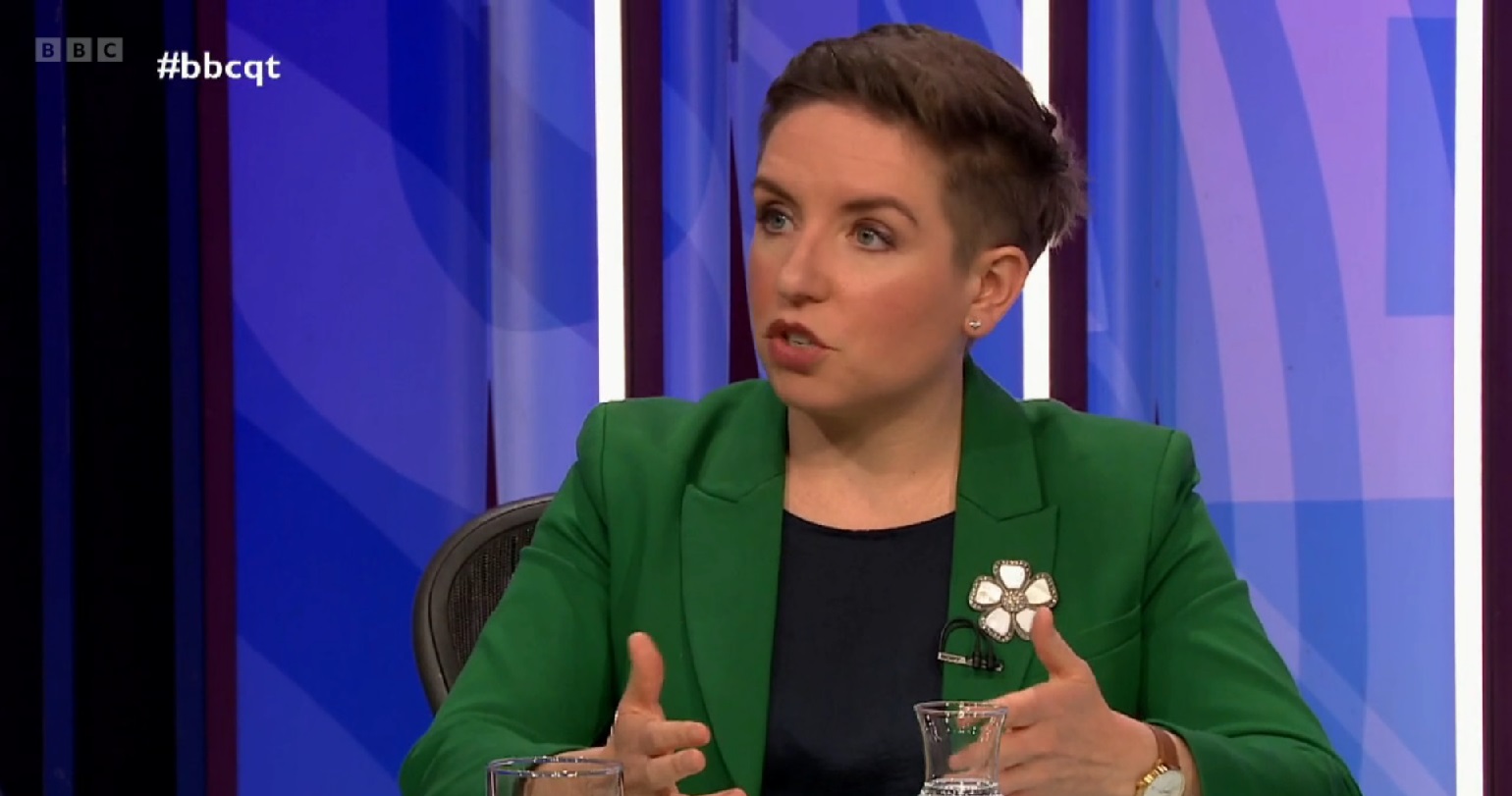
Image of the Green Party’s Carla Denyer on BBC Question Time.
Green Party co-leader, Carla Denyer, said: “No other political party is being honest enough with voters – the very fabric of our NHS is crumbling and must be repaired and rebuilt.
“The NHS is stretched to breaking point and so we are offering a package to train and retain staff and cut waiting lists, but we also need to recognise that we are asking over-worked staff to cope with outdated equipment and poor buildings.”
Rachel Birch, an intensive care nurse with 12 years’ experience in the NHS, added, “I’ve seen leaking ceilings in our intensive care unit, staff having to work out of portacabins, and wards in desperate need of improvements and modernisation.
“The buildings that we use treating patients are old and inadequate for use.
“Our department cares for critically ill patients needing maximum support that deserve the best facilities and treatment.”
Green MPs elected on Thursday would press for:
£22bn in capital investment over the next five years to bring our crumbling hospitals and old equipment up to standard
Including, a one off £2bn capital investment in primary care buildings, £1.1bn annually assigned to clear the maintenance backlog and £3bn a year to be spent on hospitals.
This £22bn capital investment fund will sit alongside a £30bn revenue expenditure that will see people accessing an NHS dentist, working towards GP appointments on the day of need for those in high need and significant uplift in pay for frontline staff.
“It is only the Greens who are offering a cast-iron guarantee to push back against the creeping privatisation of the NHS and rebuild it, so it is fit for the future.
Image of InBedWithBigOil by Not Here To Be Liked + Hex Prints from Just Stop Oil’s You May Find Yourself… art auction. Featuring Rishi Sunak, Fossil Fuels and Rupert Murdoch.
… UK political parties’ plans for climate and the environment have been jointly assessed by Greenpeace and Friends of the Earth in a new election scorecard published today, which ranks Labour far ahead of the Conservatives across all key green policy categories.
Published just 10 days before voters head to the polls on July 4th, the scorecard assesses the Labour, Conservative, Liberal Democrat and Green Party manifestos released in the past fortnight against 40 policy recommendations set out by the two environmental campaign groups.
Overall, the Green Party topped the league table with a near-perfect 39 score out of a possible 40 recommended policies, ahead of the Liberal Democrats in second place with 31.5.
Labour, meanwhile, scored 20.5 against the 40 green policy recommendations, over four times higher than the Conservatives’ which scored only five points.
Rishi Sunak on stopping Rosebank says that any chancellor can stop his huge 91% subsidy to build Rosebank, that Keir Starmer is as bad as him for sucking up to Murdoch and other plutocrats and that we (the plebs) need to get organised to elect MPs that will stop Rosebank.