Revealed: The Oil and Gas Lobbying Campaign to Water Down Windfall Tax
Original article by Adam Barnett republished from DeSmog.
Industry figures held more than 200 meetings with key politicians in the year following Russia’s 2022 invasion of Ukraine, new research finds.
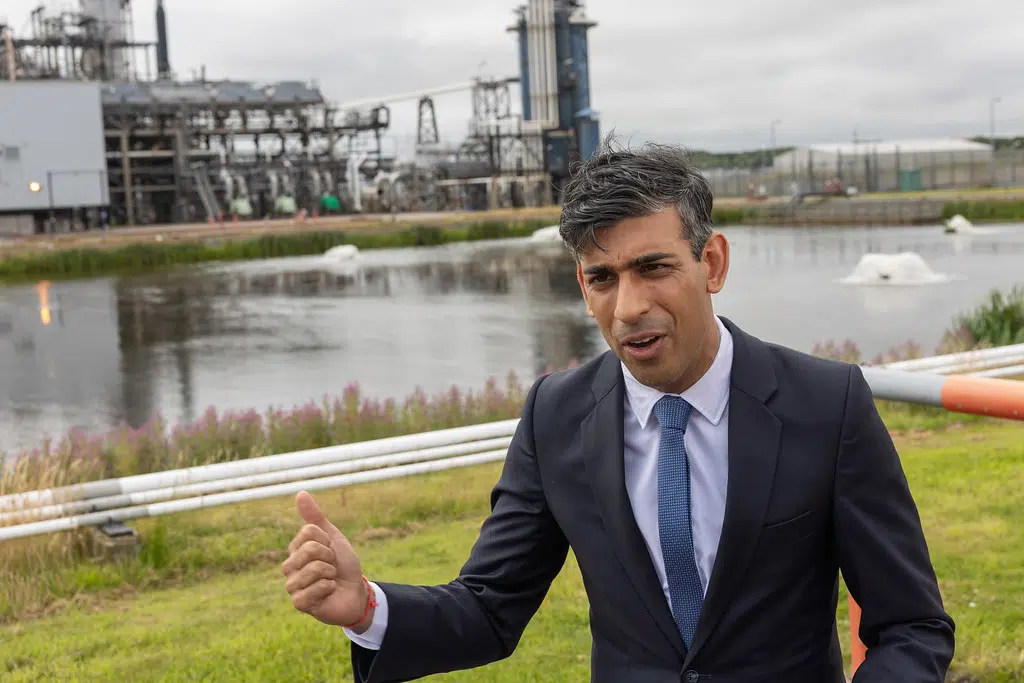
The UK government’s weakening of its windfall tax on energy profits matched the demands of a high-level lobbying campaign by the oil and gas industry, new research reveals.
Trade body Offshore Energies UK (OEUK), formerly Oil and Gas UK, and its operator members including BP, Shell, ExxonMobil, TotalEnergies, and Equinor, met with ministers at least 210 times in the 12 months following Russia’s 2022 invasion of Ukraine.
The meetings – which include in-person talks with the then Business and Energy Secretary Kwasi Kwarteng and his minister Greg Hands (now the Conservative Party chairman) – are revealed in research by Fossil Free Parliament (FFP), a group campaigning against fossil fuel influence on UK politics.
They form part of a lobbying blitz by fossil fuel firms against the windfall tax, conducted through meetings, drinks receptions, letters, parliamentary groups, and a “fiscal forum” with the Treasury attended by the then chancellor (and now prime minister) Rishi Sunak.
The evidence, published in a briefing today (October 24) and shared exclusively with DeSmog, indicates that certain changes requested by the oil and gas industry were accommodated by the government when developing the scope of the levy.
It comes as Sunak faces criticism for delaying some net zero targets and granting 100 new North Sea oil and gas licences, including Equinor’s Rosebank project. As DeSmog reported in March, the Conservative Party received £3.5 million from fossil fuel and polluting interests in 2022.
A spokesperson for OEUK defended its contact with the government: “We will always champion our industry to all parliamentarians on a cross-party basis and do so in an open and transparent manner.”
Caroline Lucas, Green Party MP for Brighton Pavilion, described the research as “shocking”.
“Fossil fuel giants have been committing countless climate crimes, polluting our planet and reaping obscene profits – while everyone else faces sky-high energy bills and a cost of living scandal,” she told DeSmog.
“This research reveals the extent to which the dirty fossil fuel lobby has been aided and abetted by this Tory government – taking their donations, offering privileged access, and handing over staggering tax breaks and subsidies to carry out yet more climate-wrecking damage.”
Windfall Tax ‘Loophole’
The Energy Profits Levy, known as the windfall tax, was announced by the government in May 2022 to tax energy companies’ billions in excess profits due to the global price spike fueled by Russia’s February 2022 invasion of Ukraine.
Then chancellor Sunak said the windfall tax would raise around £5 billion over the next year to help with cost of living. However, when the levy was passed in July 2022, it included a loophole where companies received 91p tax relief for every pound they invest in UK extraction, in what the independent Institute of Fiscal Studies called a “huge tax subsidy” for energy companies.
As of September 2023 the windfall tax had raised £2.6 billion, just over half of what was promised, and following a year of record profits by five oil majors. Between them, Chevron, ExxonMobil, Shell, BP and TotalEnergies made a total of £195 billion in profits last year.
The new research indicates this ‘loophole’ came about following a surge in meetings and lobbying between OEUK and its member companies with the government,
In June 2022, the month the windfall tax was being consulted on and drafted, meetings between the government and OEUK and its members nearly doubled from 15 to 29, according to the new research.
In the same month, OEUK also wrote letters to Sunak warning the proposed windfall tax would have a negative impact on oil and gas investments in the UK. The letters also called for an emergency summit, including a meeting of the “fiscal forum”, a talking shop between the industry and the Treasury. OEUK describes the fiscal forum as a tool for “facilitating coherent engagement with government authorities to drive the policy agenda”.
On 20 June, the day before the consultation’s launch, the British Offshore Oil and Gas Industry All-Party Parliamentary Group (APPG), which is co-run by OEUK, held a summer reception at the Houses of Parliament. The reception saw speeches from Conservative MP Peter Aldous, the APPG’s chair, and Greg Hands, then a minister in the Department for Business, Energy and Industrial Strategy.
At the reception, OEUK’s then chief executive Deirdre Michie gave a speech claiming the windfall tax could “undermine and disrupt” energy investment at a time when the UK needs to focus on “energy security and working for net zero”.
Three days later, Sunak, Hands and exchequer secretary Helen Whately attended an “Oil and Gas Roundtable”. The meeting, also known as a fiscal forum, was held in Aberdeen, Scotland, with OEUK and members including BP, Shell, Equinor, and TotalEnergies. According to a 28 June letter from Michie, the meeting discussed the “negative impact” of the windfall tax “on investor confidence”, while companies warned of its “damage to the UK’s competitiveness”.
Michie wrote: “While we remain disappointed at the decision to create the EPL [Energy Profits Levy], OEUK and our members want to work constructively with you to help rebuild investor confidence and ensure that the EPL is designed and implemented thoughtfully and is fit for purpose.”
OEUK’s concerns appear to have been taken into account by the government.
For example, in Michie’s 28 June letter she insisted that the windfall must tax end in 2025: “Industry needs certainty that the EPL will be terminated by the end of 2025 at the latest and we would hope that ministerial statements will continue to reinforce the timebound nature of the EPL.” A deadline of 31 December 2025 was later included in the EPL bill.
Michie’s letter also requested that the windfall tax should not apply to the Petroleum Revenue Tax (PRT), a tax break that oil and gas companies receive for decommissioning oil rigs, adding: “[we] have written to your officials with detailed proposals on the changes to the draft legislation and hope you will give this significant consideration”. The final windfall tax bill did not apply to PRT, as Michie had requested.
“This research makes it abundantly clear that our government has an open-door policy when it comes to the fossil fuel industry”, said Carys Boughton, a campaigner with Fossil Free Parliament.
“They ask for special treatment; they get special treatment, and the rest of us pay for it – with obscenely high energy bills, and a worsening climate crisis.”
She added: “Our political leaders should be channelling every effort into a just transition from fossil fuels, but this won’t happen until the industry with a vested interest in keeping us all hooked on oil, gas and coal is kicked out of our politics.”
Jeremy Hunt and the ‘Price Floor’
A tranche of additional documents, obtained by Fossil Free Politics and seen by DeSmog, shed further light on the extent of industry lobbying, which continued beyond the introduction of the windfall tax.
After Liz Truss’s disastrous September mini-budget, newly-installed chancellor Jeremy Hunt used his Autumn statement in November 2022 to extend the windfall tax to 2028 and increase it from 25 percent to 35 percent.
OEUK raised its opposition to these changes with Victoria Atkins MP, Financial Secretary to the Treasury, in a meeting on 17 November 2022.
Minutes of the meeting, obtained via a Freedom of Information request, show the body’s chief executive Deirdre Michie telling Atkins that the windfall tax extension “plays into investors being undermined”, and that the 10 percent increase “will impact companies borrowing and projects”.
Michie also complained of a “lack of engagement” with ministers, and brought up “the previous HMT [Treasury] fiscal forum”.
A few weeks later, on 9 December, Hunt hosted a fiscal forum in Edinburgh with OEUK and its members BP, Shell, Equinor, TotalEnergies and others. There he promised “more regular fiscal forum meetings in future”, according to a Treasury press release.
Ahead of the meeting, OEUK said it would urge the government to “scrap the windfall tax on homegrown energy when oil and gas prices fall back to normal levels”. This would mean that if prices drop below a certain point, the windfall tax could be removed before 2028.
Ahead of the Spring Budget in March 2023, OEUK repeated this demand, reportedly writing to Hunt to call for a “trigger price” which “switches off” the windfall tax.
Lobbying continued through the spring. In a meeting on 15 March with Treasury’s Exchequer Secretary James Cartlidge, OEUK’s new chief executive David Whitehouse told Cartlidge that the industry was “extremely disappointed that oil and gas did not get a mention in the budget” and called for more engagement and “a public signal” to “shore up confidence”.
On 9 June, OEUK got its wish. Hunt introduced a “price floor” to the windfall tax, which meant the tax would end before 2028 if wholesale energy prices fall back to normal levels – as OEUK and member companies had been requesting.
‘Cosy Relationship’
When contacted by DeSmog, OEUK did not address the evidence of lobbying specifically on the windfall tax. A spokesperson said the industry body was “proud” to provide a secretariat function to the all-party parliamentary group for offshore oil and gas.
“The offshore sector is a crucial part of the UK economy, supporting over 200,000 jobs in communities across the country and in nearly every parliamentary constituency,” they said.
“Our industry is playing a vital role in the UK’s low-carbon energy future and paid £11 billion in production taxes in 2022/23. It has paid a total of £400 billion in taxes over the lifetime of the basin.”
Shell referred DeSmog to OEUK for comment. All other companies named in this story were also approached but had not responded by publication.
The Conservative Party, Cabinet Office, and the Department for Energy Security and Net Zero were also contacted for comment.
Tessa Khan, executive director of Uplift, a North Sea campaign and research group, said the findings revealed the latest in the industry’s “long enjoyed unwarranted influence over our politics”.
“This is an industry that has made obscene amounts of money while millions of ordinary people – older and disabled people, families with young children – have struggled to heat their homes,” she said. “That they then lobbied in private against a windfall tax designed to claw back some of these profits, is disgusting if unsurprising.”
“The cosy relationship between government and profiteering oil and gas companies needs to end, not just for the sake of everyone facing unaffordable energy bills, but for a liveable climate too.”
Original article by Adam Barnett republished from DeSmog.