Iran warns any attack on its infrastructure will trigger ‘powerful’ response

Spread the love

This work by Middle East Monitor is licensed under a Creative Commons Attribution-NonCommercial-ShareAlike 4.0 International License

Iran warned Wednesday that any attack on its infrastructure would trigger a “powerful and decisive” response, saying countries supporting such strikes would be considered legitimate targets, Anadolu reports.

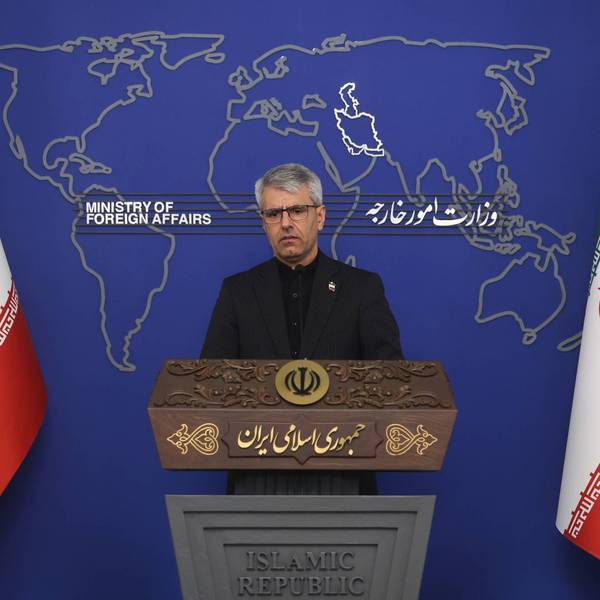
Foreign Minister Abbas Araghchi made the warning in a post on the US social media platform X, saying Iran’s defense doctrine was based on the principle of “eye for an eye.”

“Our defense doctrine is clear: eye for an eye,” Araghchi wrote.

“Any aggression against Iran, including our infrastructure, will compel a powerful and decisive response.”

He added that “those who contribute to such aggression, whatever the kind of support, will also be considered as legitimate targets.”

READ: Trump warns US will bomb bridge or power plant for every attack on ship in Hormuz

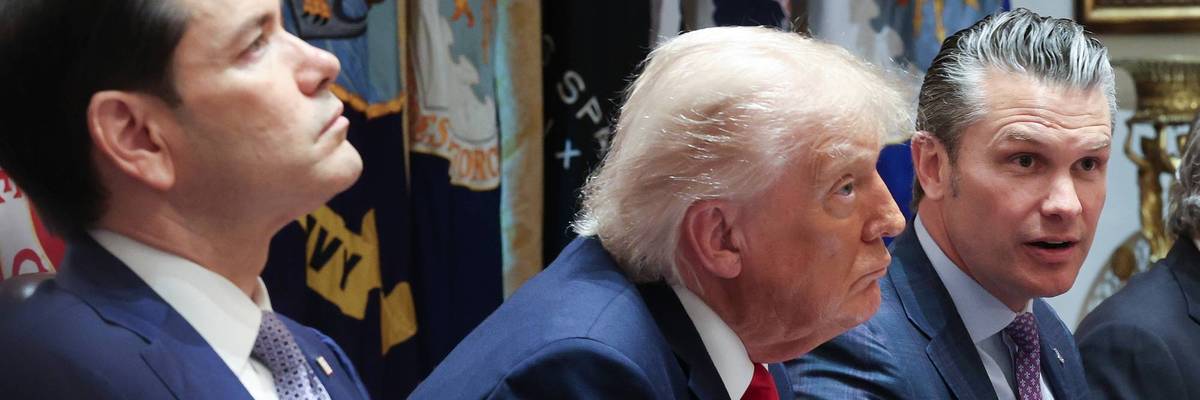
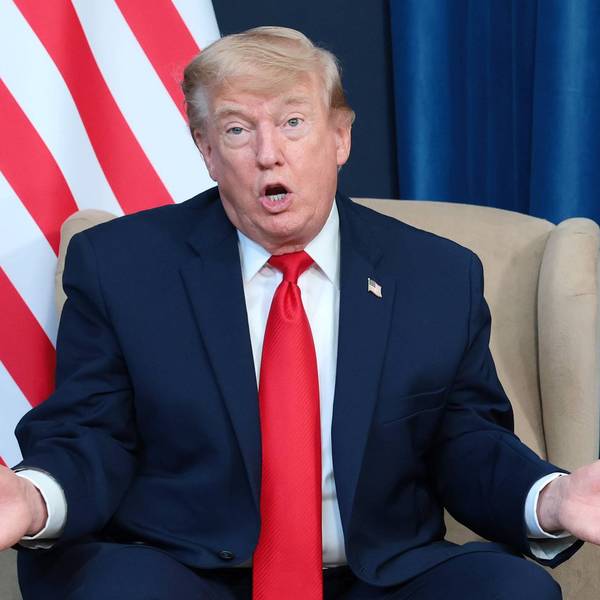
The remarks came hours after US President Donald Trump warned that Washington would strike Iranian infrastructure if Tehran attacked commercial vessels transiting the Strait of Hormuz.

Trump said the US would target Iranian bridges or power plants in response to any Iranian missile, drone or other attack on commercial shipping in the strategic waterway.

Earlier, Iranian Parliament Speaker Mohammad Bagher Qalibaf warned that no country in the region would be able to sell oil if Iran was prevented from doing so, adding that the Strait of Hormuz would not return to its pre-war status and that regional security depended on the absence of US forces.

​​​​​​​The exchange reflects rising tensions over the Strait of Hormuz following the Iran-US war and continuing disputes over navigation and security arrangements in the strategic waterway.

READ: Iran threatens attacks on regional energy infrastructure after Trump’s threat over Hormuz

This work by Middle East Monitor is licensed under a Creative Commons Attribution-NonCommercial-ShareAlike 4.0 International License

Keir Starmer objects to criticism of the IDF. He asks how could anyone object to them starving people to death, forced marches like the Nazis did, bombing Gaza's hospitals and universities, mass-murdering journalists, healthworkers and starving people queuing for food, killing and raping prisoners and murdering children. He calls for people to stop obstructing his genocide for Israel.
Keir Starmer objects to criticism of the IDF. He asks how could anyone object to them starving people to death, forced marches like the Nazis did, bombing Gaza’s hospitals and universities, mass-murdering journalists, healthworkers and starving people queuing for food, killing and raping prisoners and murdering children. He calls for people to stop obstructing his genocide for Israel.
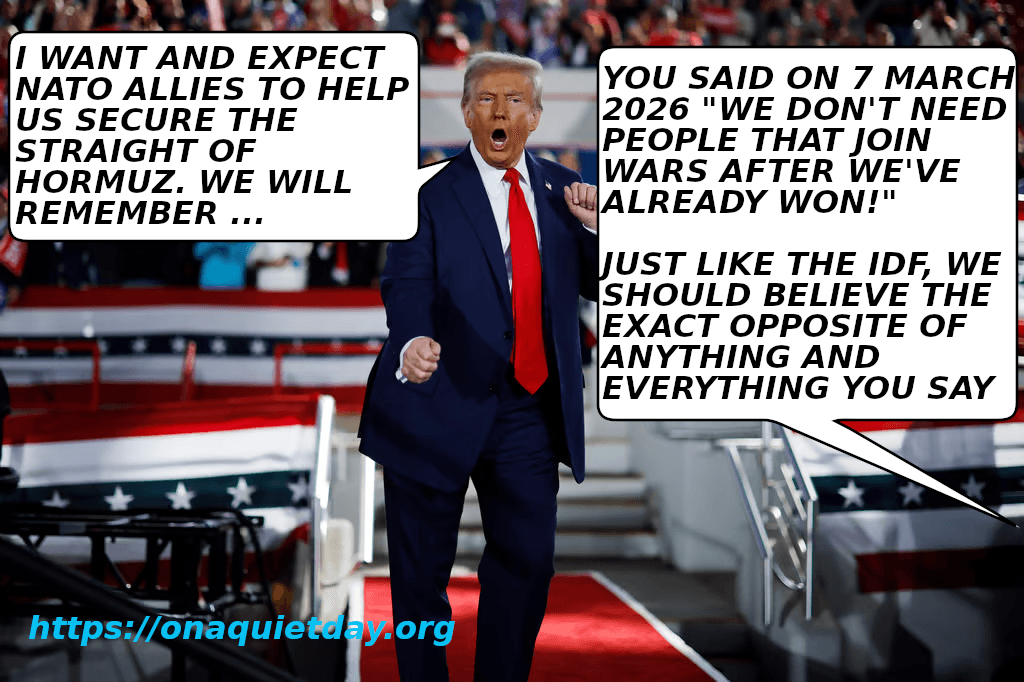
Donald Trump calls for help from NATO allies in securing the Strait of Hormuz despite saying on 7 March 2026 that they don't need people to join wars after they've already won. He's challenged with the claim that he lies as much as the IDF.
Donald Trump calls for help from NATO allies in securing the Strait of Hormuz despite saying on 7 March 2026 that they don’t need people to join wars after they’ve already won. He’s challenged with the claim that he lies as much as the IDF.
Orcas discuss rotting brain, front Orca says Sundown Syndrome is a dead givaway and he wishes someone would Lock Him Up

Continue ReadingIran warns any attack on its infrastructure will trigger ‘powerful’ response

Trump warns US will bomb bridge or power plant for every attack on ship in Hormuz

Spread the love

This work by Middle East Monitor is licensed under a Creative Commons Attribution-NonCommercial-ShareAlike 4.0 International License

US President Donald Trump holds a press conference at the Presidential Complex during the 36th NATO Summit of Heads of State and Government in Ankara, Turkiye, on July 8, 2026. [Doğukan Keskinkılıç – Anadolu Agency]

US President Donald Trump on Wednesday said that Washington would bomb an Iranian bridge or power plant each time Tehran attacks a commercial ship in the Strait of Hormuz, Anadolu reports.

“From this point forward, any time the Islamic Republic of Iran shoots at a ship in the Strait of Hormuz, whether it be by Missile, Rocket, Drone, or any other device or weapon, the United States will bomb and destroy ONE BRIDGE OR POWER PLANT, including those located next to, or in, the Capital City of Tehran,” Trump wrote on his Truth Social platform.

The US has been carrying out a series of strikes across Iran since last week, while Tehran has responded with strikes targeting facilities and bases it said were used by the US military in several countries across the region.

The exchange of fire has continued despite a Pakistani-brokered framework agreement signed by the US and Iran in June to end the war that began in February and pave the way for a lasting peace deal.

READ: Trump says 18 US troops killed during war with Iran

Keir Starmer objects to criticism of the IDF. He asks how could anyone object to them starving people to death, forced marches like the Nazis did, bombing Gaza's hospitals and universities, mass-murdering journalists, healthworkers and starving people queuing for food, killing and raping prisoners and murdering children. He calls for people to stop obstructing his genocide for Israel.
Keir Starmer objects to criticism of the IDF. He asks how could anyone object to them starving people to death, forced marches like the Nazis did, bombing Gaza’s hospitals and universities, mass-murdering journalists, healthworkers and starving people queuing for food, killing and raping prisoners and murdering children. He calls for people to stop obstructing his genocide for Israel.
Donald Trump calls for help from NATO allies in securing the Strait of Hormuz despite saying on 7 March 2026 that they don't need people to join wars after they've already won. He's challenged with the claim that he lies as much as the IDF.
Donald Trump calls for help from NATO allies in securing the Strait of Hormuz despite saying on 7 March 2026 that they don’t need people to join wars after they’ve already won. He’s challenged with the claim that he lies as much as the IDF.
Orcas discuss rotting brain, front Orca says Sundown Syndrome is a dead givaway and he wishes someone would Lock Him Up

Continue ReadingTrump warns US will bomb bridge or power plant for every attack on ship in Hormuz

Iran is turning into the sort of ‘forever war’ that Donald Trump promised to avoid

Spread the love
Savvapanf Photo#Shutterstock

Bamo Nouri, City St George’s, University of London and Inderjeet Parmar, City St George’s, University of London

When Donald Trump returned to the White House, he promised to avoid another Middle Eastern “forever war”. After the costly experiences of Iraq and Afghanistan, that pledge resonated with an American public weary of prolonged military intervention.

For a brief moment, it appeared that this promise might be realised. The memorandum of understanding (MoU) signed by the US and Iran on June 17 seemed to offer a pathway away from escalating confrontation. Markets stabilised, regional tensions eased and there was cautious optimism that Washington and Tehran had stepped back from the brink.

That optimism has proved remarkably but unsurprisingly short-lived. US military strikes have resumed and Iran has retaliated against American and its allies across the Gulf. Iran’s proxy allies, the Houthis, have declared themselves ready to close the Red Sea chokepoint at the Bab-el-Mandeb Strait, which has provided an alternative transit route for some oil exports, particularly from Saudi Arabia.

Washington continues to combine military pressure with calls for renewed negotiations. But rather than representing the collapse of an isolated peace initiative, these developments may confirm the reality of grey zone conflict – where diplomacy manages war rather than ends it.

When Americans think of forever wars, Iraq and Afghanistan understandably dominate the discussion. Those conflicts were characterised by invasions, prolonged occupations, attempts at nation-building and the deployment of hundreds of thousands of troops over many years. Their enormous political, financial and human costs eventually became impossible to sustain.

The confrontation with Iran is fundamentally different. It is unlikely to require occupation of territory and no serious or sustained attempt directly to remake the Iranian state. Instead, it is fought through air strikes, cyber operations, sanctions, maritime confrontation, intelligence activity and proxy warfare. Military escalation is followed by diplomacy, diplomacy gives way to renewed confrontation, and each episode is presented as a separate crisis.

Viewed collectively, these episodes are better understood as the latest phase of a strategic confrontation that began with the 1979 Iranian Revolution rather than as isolated crises. The conflict has evolved over the years through sanctions, proxy warfare, covert operations and cyber conflict into a more direct military confrontation.

The repeated breakdown of de-escalation efforts is often attributed to mistrust or diplomatic failure. Both undoubtedly matter, but they do not fully explain why the MoU has unravelled so quickly.

Many of its core provisions have become sources of dispute. Israel has continued military operations in Lebanon, despite expectations that regional hostilities would subside. Washington initially signalled greater economic flexibility towards Iran, including easing restrictions on oil exports and discussions surrounding Iranian assets. Yet sanctions have subsequently expanded and further economic measures have been introduced.

From Tehran’s perspective, these actions represent a breach of the spirit – and, in some cases, the letter – of the agreement. From Washington’s perspective, they are responses to continued Iranian activity that it considers destabilising.

The Strait of Hormuz illustrates how quickly ambiguity can become renewed confrontation. Article 5 of the MoU envisaged Iran facilitating the safe passage of commercial shipping through the waterway. Commercial traffic initially increased following the agreement.

But disagreement soon emerged after Oman – in coordination with the International Maritime Organization and with US backing – established a temporary maritime corridor closer to the Omani coast. Tehran viewed this as inconsistent with the agreed framework and argued that it undermined Iranian responsibility for administering safe passage. Washington rejected that interpretation, maintaining that additional security measures were necessary to protect international shipping.

The competing interpretations rapidly became another source of escalation.

The conflict itself has also evolved. What began largely as strikes against military infrastructure has increasingly extended to facilities with direct consequences for civilian life. This has included energy infrastructure and desalination plants that are essential to freshwater supplies across parts of the Gulf.

Transport infrastructure, including bridges, has also been targeted. This has prompted debate among military analysts about whether operational objectives are expanding beyond coercive signalling – using limited military force to pressure or influence an opponent’s behaviour – towards broader military aims. It has also raised questions about whether some attacks could violate international humanitarian law and, depending on the circumstances, amount to war crimes.

Despite huge anti-government protests in January, the war with the US has prompted many Iranians to rally round the flag. AP Photo/Vahid Salemi

While the expansion of US strikes in this way does not in itself demonstrate that a US ground offensive is imminent, it reflects a widening conflict whose effects increasingly reach civilian populations.

Diplomacy is managing conflict, not resolving it

The deeper problem is that the strategic objectives of main players here remain fundamentally incompatible. The US continues to insist that Iran’s nuclear programme and regional influence must be constrained. Iran regards those same capabilities as essential to its security and deterrence. Israel continues to view a strategically stronger Iran as an unacceptable security threat.

These objectives cannot all be achieved simultaneously. As a result, diplomacy struggles – not because negotiators lack skill, but because they are attempting to reconcile goals that remain at odds. The MoU temporarily reduced tensions, but it did not alter the structural realities driving the conflict.

This has important implications for how the current crisis should be understood. Much of the debate focuses on whether the latest escalation will produce a wider regional war. That possibility cannot be dismissed. Yet another scenario may be equally, if not more, plausible. The US and Iran are settling into a prolonged cycle of calibrated confrontation that lasts far longer than many currently anticipate.

Trump promised to end America’s forever wars. Ironically, his presidency may instead come to symbolise the evolution of a new kind of forever war without a clearly defined beginning or end. The greatest danger may therefore not be another Iraq. It may be the gradual normalisation of an enduring conflict that repeatedly disappears from the headlines, only to return in new forms because the political conditions necessary for genuine peace have yet to emerge.

This is a new normal for a US foreign policy establishment that retains militarist mindsets, a massive global military capacity and footprint, and values global primacy in an age of power shifts towards a more multi-polar world.

Bamo Nouri, Honorary Research Fellow, Department of International Politics, City St George’s, University of London and Inderjeet Parmar, Professor in International Politics, City St George’s, University of London

This article is republished from The Conversation under a Creative Commons license. Read the original article.

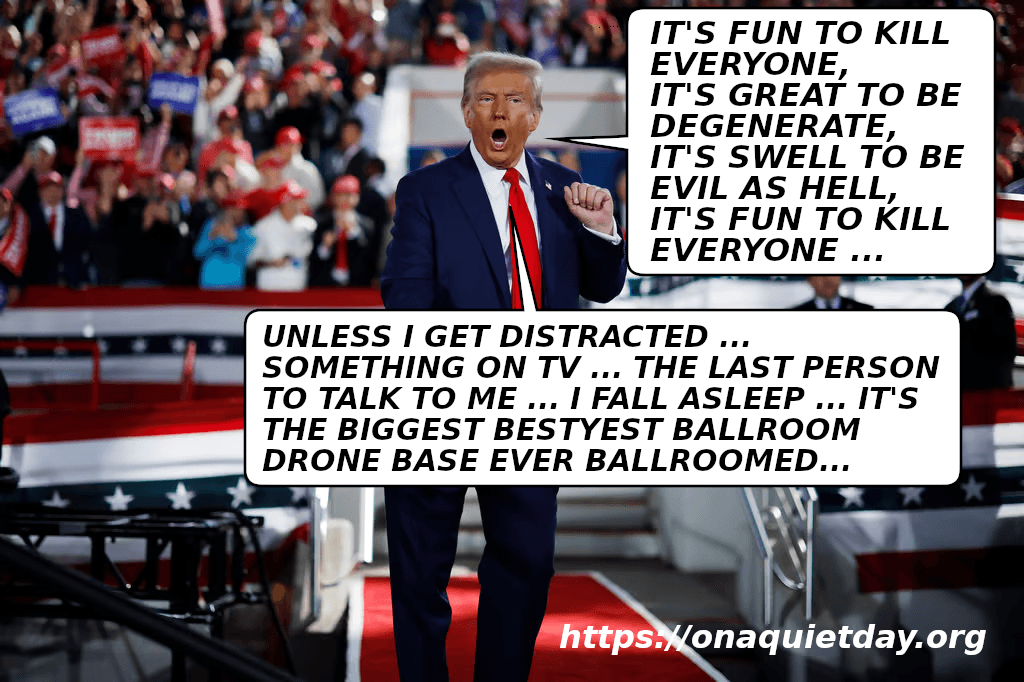
Donald Trump sings and dances, says that it's fun to kill everyone ... unless he gets distracted or falls asleep.
Donald Trump sings and dances, says that it’s fun to kill everyone … unless he gets distracted or falls asleep.
Orcas discuss rotting brain, front Orca says Sundown Syndrome is a dead givaway and he wishes someone would Lock Him Up
Orcas discuss rotting brain, front Orca says Sundown Syndrome is a dead givaway and he wishes someone would Lock Him Up.

Continue ReadingIran is turning into the sort of ‘forever war’ that Donald Trump promised to avoid

Israel floods US phones with AI messages in campaign to manipulate public opinion

Spread the love

This work by Middle East Monitor is licensed under a Creative Commons Attribution-NonCommercial-ShareAlike 4.0 International License

Artificial Intelligence, AI [Wikipedia]

Israel is using AI-generated text messages, conservative media and online influencers in an expanding campaign to stem the collapse in US public support, according to an investigation by The Wall Street Journal.

The effort reaches from millions of Americans having their mobile phones flooded with pro-Israel content, evangelical churches to university campuses, social-media feeds and even the online material used by AI chatbots.

According to the Journal, the Israeli government has retained at least six firms to conduct influence operations in the US, while around three dozen marketing and communications professionals have registered as foreign agents working on its behalf.

The campaign comes amid growing American opposition to Israel following its genocide in Gaza and war with Iran. A Pew Research Center survey conducted in March found that 60 per cent of US adults held an unfavourable view of Israel, compared with 42 per cent in 2022.

The campaign involves millions of AI-assisted text messages sent to American mobile phones. To pass of as a real campaign, senders are said to identify themselves as Emma, Sarah or John and claim to represent an organisation called Friends for Peace. They begin by asking recipients for their views about Israel, Iran or the US-Israel relationship before directing the conversation towards arguments supporting Israel.

However, the Journal found no evidence that Friends for Peace exists as a registered non-profit organisation or company. Recipients could not find a website identifying who runs or finances the group.

When people asked how it had obtained their numbers, the system replied that the information came from publicly available sources.

The text operation is run by Sparkfire, a company specialising in AI-assisted political outreach. It had received $6.5 million by mid-May, although the company maintained that human employees supervise the conversations and sometimes communicate directly with recipients.

Sparkfire’s work forms part of a broader Israeli contract with Brad Parscale, a former adviser to US President Donald Trump who worked on his 2016 and 2020 election campaigns. The agreement, worth more than $45 million, covers digital advertising, AI messaging, websites and mass text campaigns.

Read: Israel to spend $730m on propaganda as global image collapses over Gaza genocide

Parscale also serves as chief strategy officer at Salem Media, a major conservative radio and podcast company carrying presenters including Hugh Hewitt, Scott Jennings and Lara Trump, the president’s daughter-in-law.

Parscale’s original contract with Israel proposed integrating campaign narratives into Salem’s media properties and associated distribution channels. More than $500,000 was subsequently spent on advertising through the network.

Israel has also sought to reinforce support among evangelical Christians, who remain one of its most dependable political constituencies in the US.

Show Faith by Works, a recently created US advocacy group contracted as part of Israel’s influence campaign, proposed using geofencing technology to target around four million people attending megachurches and Christian colleges in the south-western US.

Geofencing allows advertisers to send material to mobile devices detected within specified locations, including churches, campuses and religious gatherings.

Documents said the campaign would seek to create “positive associations” with Israel while linking Palestinians to extremist organisations. Its proposed budget exceeded $3 million.

Actor Chris Pratt and basketball player Stephen Curry were named as examples of celebrities who could serve as influential advocates.

Other parts of the campaign seek to reach younger and more socially liberal audiences through online personalities. Companies belonging to smaller online personalities have received payments as well.

Israeli Prime Minister Benjamin Netanyahu has met conservative influencers during recent visits to the US as his government seeks to counter the rise in support for Palestine in US.

The campaign is also attempting to influence the information Americans receive from AI chatbots. Parscale’s team has created websites, articles and links containing pro-Israel material designed to appear in search results and become sources for systems such as ChatGPT and Claude.

One example is Allyvia.org, a website promoting the US-Israel alliance which AI chatbots have reportedly cited when answering questions.

The campaign has provoked criticism within the Trump administration. US Vice President JD Vance accused Israeli officials of trying to manipulate American opinion to prolong the war with Iran and undermine negotiations.

Speaking to podcaster Joe Rogan, Vance alleged that officials were “manipulating and trying to change American public opinion to keep the war going on indefinitely”.

This work by Middle East Monitor is licensed under a Creative Commons Attribution-NonCommercial-ShareAlike 4.0 International License

Keir Starmer objects to criticism of the IDF. He asks how could anyone object to them starving people to death, forced marches like the Nazis did, bombing Gaza's hospitals and universities, mass-murdering journalists, healthworkers and starving people queuing for food, killing and raping prisoners and murdering children. He calls for people to stop obstructing his genocide for Israel.
Keir Starmer objects to criticism of the IDF. He asks how could anyone object to them starving people to death, forced marches like the Nazis did, bombing Gaza’s hospitals and universities, mass-murdering journalists, healthworkers and starving people queuing for food, killing and raping prisoners and murdering children. He calls for people to stop obstructing his genocide for Israel. Will I be replacing Andy Burnham for Starmer behind this speech bubble?
Keir Starmer explains that UK is actively supporting Israel's genocidal expansion and repeats his previous quotation that he supports Zionism "without qualification". Keir Starmer said “I said it loud and clear – and meant it – that I support Zionism without qualification.” here: https://www.jewishnews.co.uk/keir-starmer-interview-i-will-work-to-eradicate-antisemitism-from-day-one/
Keir Starmer explains that UK is actively supporting Israel’s genocidal expansion and repeats his previous quotation that he supports Zionism “without qualification”. Keir Starmer said “I said it loud and clear – and meant it – that I support Zionism without qualification.” here: https://www.jewishnews.co.uk/keir-starmer-interview-i-will-work-to-eradicate-antisemitism-from-day-one/
Orcas discuss Donald Trump and the killer apes' concept of democracy. Front Orca warns that Trump is crashing his country's economy and that everything he does he does for the fantastically wealthy.
Orcas discuss Donald Trump and the killer apes’ concept of democracy. Front Orca warns that Trump is crashing his country’s economy and that everything he does he does for the fantastically wealthy.

Continue ReadingIsrael floods US phones with AI messages in campaign to manipulate public opinion