
This work by Middle East Monitor is licensed under a Creative Commons Attribution-NonCommercial-ShareAlike 4.0 International License.

Less than a month into office, British Prime Minister Andy Burnham is facing backlash over several Cabinet appointments, with pro-Palestinian activists urging his government to impose sanctions on Israel.
Among the appointments that have drawn criticism is James Purnell, whom Burnham selected as his new chief of staff. His role as chair of the Labour Friends of Israel (LFI) group from 2002 to 2004 has sparked anger.
In an interview with Anadolu Agency, Councillor Jonathan Purcell, a deputy leader of Greens in Tower Hamlet Council, said it’s “absolutely clear” where Burnham’s priorities lie.
“James Purnell is the former Labor Friends of Israel chair. If that isn’t a demonstration of where he stands on this issue, then I don’t know what is,” he said.
He urged Burnham to stop selling arms to Israel, “including the supply of arms sales to Israel.”
He must also immediately sanction ministers and remove the opacity around the spy flights taking off from RAF Akrotiri, a British air base in the Greek Cypriot Administration, over Gaza, he said.
Kerie Anne, branch secretary of Tower Hamlet Unison, the largest trade union in the UK, said she expects a “strong stand” on Israel from this government.
“Give Israel a really hard time boycotting divestment and sanctions because of its genocidal activity,” she added.
The British government has been “far too soft” on Israel, and it’s just “unacceptable,” she said.
For Anne, the UK needs to institute a serious boycott, divestment, and sanctions (BDS) regime on Israel.
“We are championing BDS, but we need our government to lead it at a national level,” she noted.
READ: UK charity regulator opens inquiry into funding of illegal Israeli settlements
‘Bitterly disappointing’
John McLoughlin, a local British pensioner, criticized the ongoing financial ties with Israel, saying it is “bitterly disappointing.”
“I’m now a pensioner, I am receiving pension from the pension funds. I don’t believe that our pension fund should be invested in companies committing genocide,” he added.
He claimed that the UK needs a change in policy about Palestine, and expressed that he is also “very concerned” that Burnham, like the previous prime minister, is talking about increased spending on arms, and that includes armaments that go to Israel.
“They should stop supplying arms. They should stop investing and involving companies like Palantir here in UK public services,” said McLoughlin.
The chief of staff appointment was also criticized over Purnell’s lobbying links as he was former chief executive of Flint Global, a registered lobbyist.
Eighteen months ago, Purcell said the London’s Tower Hamlet council passed a motion to divest from arms companies complicit in the genocide.
“The reason why that is so important is because there are workers in this council who have made it absolutely clear that they do not want to be complicit in Israel’s genocide or its illegal occupation of Palestine,” he added.
WATCH: Gaza Ceasefire Falters as Trump Remains Trapped in Israel-First Agenda | Palestine This Week
What has Burnham said so far?
Last month, roughly 10 days before assuming his role as the country’s 59th prime minister, Burnham apologized for the Labour Party’s stance on Gaza.
He said the party “didn’t get it right” and needs to “do better” under his leadership.
“Labour’s initial response to the treatment of Gaza caused huge hurt. We got it wrong and I am sorry for that.”
In an interview with Guardian, he noted that he would put more pressure on the Israeli government, including through further sanctions on individuals and entities, as well as a potential ban on the trade of goods with illegal settlements.
He also called what is happening in Gaza “unbearable suffering” saying it is a “scar on our collective conscience.”
He also commented on continued and illegal occupier violence against Palestinians in the occupied West Bank, stressing that the UK is exploring measures against Israeli settlements.
“There are potential measures that I’m looking at in terms of the settlements in the West Bank, and those will be looked at an announced in due course,” Burnham told TLDR news on Saturday.
READ: Over 600 Palestinians detained by Israel in West Bank raids last month: Advocacy group
This work by Middle East Monitor is licensed under a Creative Commons Attribution-NonCommercial-ShareAlike 4.0 International License.
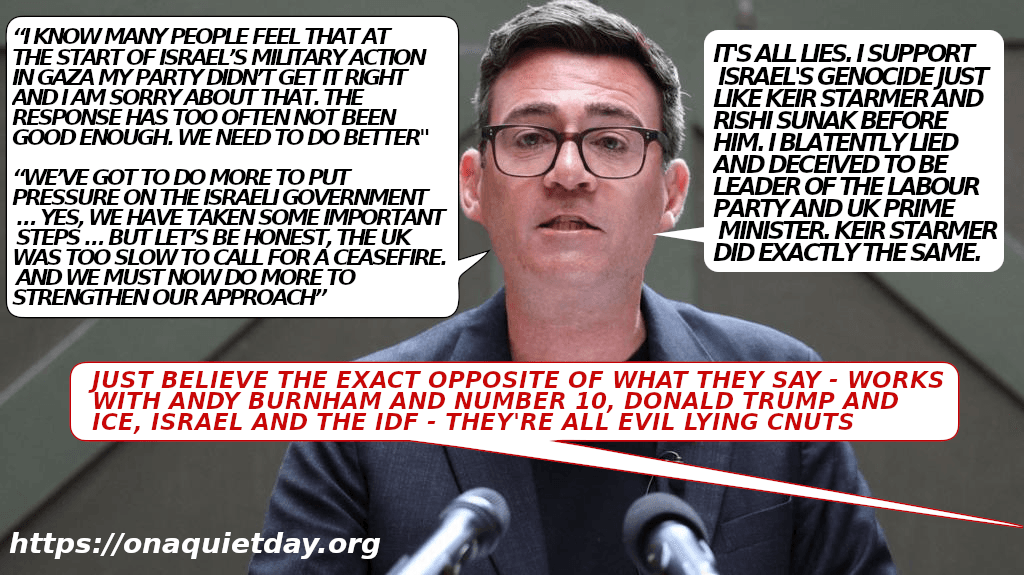
dizzy: I am actively monitoring Andy Burnham & Co (and much more besides actually). It appears that there is a spin machine operating that makes unfounded claims which are contradicted by actions. Basically, you can’t have any faith in anything that’s claimed from number 10.


This work by Middle East Monitor is licensed under a Creative Commons Attribution-NonCommercial-ShareAlike 4.0 International License.

The Israeli army on Tuesday launched a renewed wave of raids in southern Syria, according to the Syrian Arab News Agency (SANA), Anadolu reports.
Israeli forces advanced into the village of Mariya in the Yarmouk Basin area of Daraa province in southwestern Syria, SANA reported.
They carried out a limited incursion into the western part of the village and searched several civilian homes before withdrawing from the area without making any arrests, the agency said.
Since Monday, the Israeli army has also continued earthmoving operations and work to reopen an old dirt road north of Wadi al-Raqad from the direction of Mariya village, using a bulldozer accompanied by a tank and a pickup truck, it added.
Southern Syria has witnessed recurring Israeli incursions and attacks for months, including raids, searches and arrests.
The Israeli violations intensified following the fall of Bashar al-Assad’s regime in December 2024, when Israel declared the collapse of the 1974 Disengagement Agreement and seized control of the Syrian buffer zone.
READ: Hezbollah chief says ‘no obstacle’ to public meeting with Syrian leadership
This work by Middle East Monitor is licensed under a Creative Commons Attribution-NonCommercial-ShareAlike 4.0 International License.

This work by Middle East Monitor is licensed under a Creative Commons Attribution-NonCommercial-ShareAlike 4.0 International License.

The Israeli army committed six ceasefire violations Tuesday in Lebanon, according to Lebanese state-run National News Agency, despite a new round of direct negotiations between Beirut and Tel Aviv in Rome, Anadolu reports.
The reported violations came as the seventh round of US-mediated talks between the two sides opened in the Italian capital, despite the two countries signing a framework agreement in June.
In southern Lebanon, the news outlet reported that Israeli military vehicles advanced from the town of Haddatha toward the outskirts of Aita al-Jabal in the Bint Jbeil district, while Israeli forces carried out artillery shelling and operated drones and reconnaissance aircraft above the area.
It added that Israeli troops also fired machine guns toward Haddatha as military vehicles moved inside the town toward Haris.
In the east, Israeli fighter jets flew at low altitude above Baalbek and the Bekaa Valley, according to the National News Agency.
Israeli warplanes also flew above the northern Bekaa region, while additional aircraft were reported in the mountainous areas of Akkar and Hermel along the Syrian border at medium altitude.
In central Lebanon, Israeli drones maintained continuous flights above Beirut and its southern suburbs.
Before the Rome meeting, five previous rounds had been held in Washington as part of a US-sponsored negotiating process.
Despite a ceasefire agreement that took effect April 16, Israel has continued its offensive in Lebanon, which began March 2, killing 4,333 people and injuring 12,250, according to the Lebanese Health Ministry.
The agreement calls for a gradual Israeli withdrawal from all occupied Lebanese territory in exchange for the deployment of the Lebanese army and the disarmament of armed groups, in reference to Hezbollah.
Israel continues to occupy areas in southern Lebanon, some held for decades and others seized during the 2023-2024 war, while advancing more than 10 kilometers (6.2 miles) into Lebanese territory during the current offensive.
READ: Lebanon says Beirut port blast indictment to be issued ‘within months’
This work by Middle East Monitor is licensed under a Creative Commons Attribution-NonCommercial-ShareAlike 4.0 International License.
This work by Middle East Monitor is licensed under a Creative Commons Attribution-NonCommercial-ShareAlike 4.0 International License.

Six Saudi-flagged very large crude carriers (VLCCs) sailing in ballast have turned away from the Bab el-Mandeb route and are heading south through the Indian Ocean, ship-tracking platform MarineTraffic said Tuesday, Anadolu reports.
MarineTraffic wrote on US social media platform X that the first Automatic Identification System (AIS) destination changes for five of the six vessels were recorded July 30 as the tankers continued southward.
The Ghinah and Laynah updated their destinations to Durban, South Africa, while the Burqan initially signaled Durban before switching to Algoa Bay and later Port Elizabeth.
The Dilam and Hazm initially listed Gibraltar as their destinations. The Hazm subsequently changed its destination to Durban at 2220GMT on July 31, according to the platform.
READ: Yemen’s Houthis claim drone attack on Saudi airport
The Salam was the sixth tanker identified among the group and was also signaling a destination in South Africa.
The vessels are sailing without cargo after completing previous voyages to Asia and appear to be routing around the Cape of Good Hope instead of entering the Red Sea through the Bab el-Mandeb Strait.
The longer route around southern Africa could add at least two weeks to the journey compared with passage through Bab el-Mandeb and the Red Sea.
The diversions come amid increased security concerns after Yemen’s Houthi group threatened vessels linked to Saudi ports, prompting some shipowners to reassess voyages through the strategic waterway.
Bab el-Mandeb, between Yemen and the Horn of Africa, connects the Gulf of Aden with the Red Sea and serves as a major route for vessels traveling between Asia, the Middle East and Europe through the Suez Canal.
READ: Saudi Arabia and Iran discuss efforts to reduce regional tensions
This work by Middle East Monitor is licensed under a Creative Commons Attribution-NonCommercial-ShareAlike 4.0 International License.