Farage said Andrew Tate was ‘important voice’ for men in podcast interview

Spread the love
Image of Nigel Farage

https://www.theguardian.com/politics/article/2024/jun/20/nigel-farage-andrew-tate-important-voice-men-podcast-interview

Reform UK leader has also argued against diversity quotas and said people on benefits were ‘too stupid’ to work in appearances over past year

Nigel Farage has praised the misogynist influencer Andrew Tate for being an “important voice” for the “emasculated” and giving boys “perhaps a bit of confidence at school” in online interviews that appear to be aimed at young men over the past year.

The Reform UK leader spoke in favour of Tate for defending “male culture” in a Strike It Big podcast that aired in February, while acknowledging that the influencer had gone “over the top” and elsewhere that he had said some “pretty horrible” things.

Since December 2022, Tate has been facing charges in Romania of human trafficking, rape, and forming a criminal gang to sexually exploit women, which he denies.

Many politicians and teachers have spoken out against Tate’s influence on young boys in the UK, after the self-proclaimed misogynist said women belonged in the home and were a man’s property. “There’s no way you can be rooted in reality and not be sexist,” Tate said in one video.

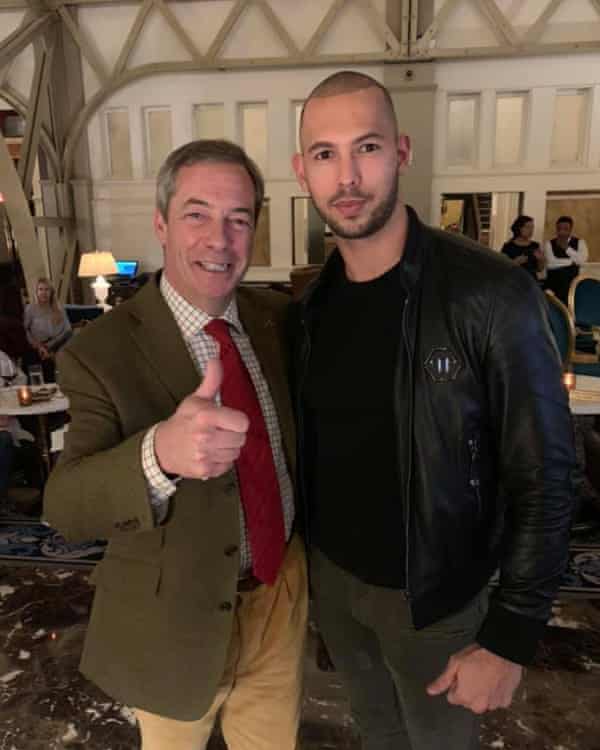
Andrew Tate pictured with Nigel Farage in a Facebook post by Tate from March 2019. The caption read: ‘Brexit baby.’ Photograph: Emory Andrew Tate/Facebook

Farage’s interview comments

February 2023
“‘I’m too fat, I’m too stupid, I’m too lazy, I don’t get out of bed in the morning. I smoke drugs, give me money’ … That’s what we’re saying. ‘I don’t need to work, the state will provide for me’ … We cannot afford it.

“I welcomed much of [Liz Truss’s] budget. I think if there is a criticism, they tried to do too much, too quickly, without prior explanation … What happened here is the backbenches wobbled really quite quickly because a lot of Conservative backbenchers are basically globalists and listened to those big noises from the multinationals and the IMF. As soon as she sacked Kwarteng, it was all over … I would much have preferred her to hold her nerve, keep making those arguments and see if the party dared get rid of them.”

August 2023
“I think Andrew Tate is a fascinating figure. I think his speaking to men, who because of the woke agenda were told they couldn’t be male in any way at all, was an important thing. But I feel some of his comments were pretty horrible.”

April 2024
Javier Milei is “Thatcherism on steroids – this is incredible, cutting and slashing public expenditure, doing all the things he’s done … That’s leadership … He is amazing.”

https://www.theguardian.com/politics/article/2024/jun/20/nigel-farage-andrew-tate-important-voice-men-podcast-interview

Continue ReadingFarage said Andrew Tate was ‘important voice’ for men in podcast interview

Reform targets Labour ‘red wall’ voters

Spread the love

https://morningstaronline.co.uk/article/-reform-targets-labour-red-wall-voters

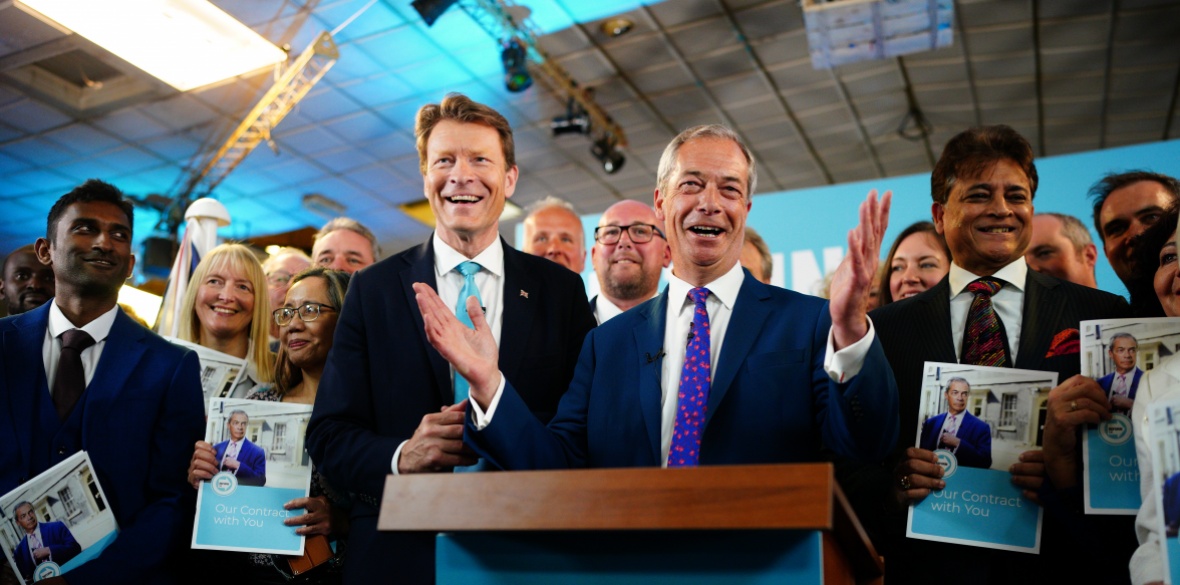
Reform UK chairman Richard Tice (left) and party leader Nigel Farage launch ‘Our Contract with You’ in Merthyr Tydfil while on the General Election campaign trail, June 17, 2024

REFORM started targeting Labour “red wall” voters today as the hard-right party launched its reactionary election manifesto in Wales.

The party’s owner and leader Nigel Farage went to Merthyr Tydfil, once represented by Labour pioneer Keir Hardie, to tell voters that “Labour is not very different to the Conservatives … it is just more incompetent.”

And he restated his aim of being the main challenger to Labour for government by 2029, likely date of the next general election following July 4.

The nationalist party’s platform is anti-migrant, opposed to climate action and supportive of NHS privatisation while cutting foreign aid and leaving the European Court of Human Rights.

It aims to take advantage of muted enthusiasm for Sir Keir Starmer’s Labour in working-class communities by rekindling the Brexit divisions it skilfully exploited in 2019.

Reform’s increasing prominence in the general election comes as the Tory Party’s campaign looks on the verge of expiring.

https://morningstaronline.co.uk/article/-reform-targets-labour-red-wall-voters

Continue ReadingReform targets Labour ‘red wall’ voters

Another election, another round of Nigel Farage hype, with no lessons learned

Spread the love
Image of Nigel Farage

Aurelien Mondon, University of Bath

Nigel Farage, a man who has never been elected to the House of Commons despite years of trying, has again been allowed to set the agenda in the UK.

Ten years after Ukip won the European parliament elections, throwing the Conservative party into turmoil and leading David Cameron to promise a referendum on the UK’s membership of the European Union, Farage is at it again. Or more precisely, he is being allowed to go at it again.

The mainstream elite in the media and in politics who claim to oppose Farage, and who pretend to stand as a bulwark against far-right politics, are again duly buying into the hype he has created for himself.

We could already feel that hype bubbling as Farage took over as leader of Reform. He’d seen the party’s fortunes rising and started to think there could be something in it for him to step into the campaign.

We could see it in the coverage of every move he made thereafter – every milkshake thrown, every inflammatory quip quoted and beer drunk, snapped and plastered all over the news as some kind of morbid excitement set in among the media. Finally, something exciting is happening in this otherwise rather dull campaign, where offers of “change” and pledges to be “bold” are hollow slogans for the sides of battle buses.

To understand how a party which only received 2% of the registered votes in the 2019 general election, failing to get even one MP elected, can get such attention, we must travel back in time.

Ukip was a party created by a eurosceptic elite, for a eurosceptic elite, to put pressure on the Conservatives via the EU elections. It all seemed a rather desperate move at the time, as the issue was marginal at best.

The party received 15.6% of the vote in the 2004 European elections and 16% in 2009. But these are second order elections, prone to low turnout and high protest vote. In these settings, Ukip really only received a mere 6% and 5.6% of the registered vote, once turnout was taken into account. Hardly the voice of the “silent majority”.

The 2005 and 2010 general elections clearly showed the limits of Ukip’s appeal. In 2005, the party received 1.4% of the vote and in 2010, it took 2%.

Ukip’s election vote share

A chart showing the performance of Ukip across general and European elections and what proportion that represented of the overall registered vote.
Ukip results in general elections (GE) and European elections (EU).
A Mondon., CC BY-ND

Still, the first “breakthrough” was in 2014 when Ukip won the EU elections with 26.6%. An “earthquake”, we were told. This was the start of the “left behind” myth which served Farage well as it diverted attention away from his elitist stance. The fantasised “white working class” would come to play a key role in shaping the narrative after the victories of both Donald Trump in the US and Brexit. Proper scrutiny of Ukip’s (and Reform’s) programmes (or Trump’s for that matter) would have also shown that beyond typical far-right measures and other gimmicks, their project was always deeply skewed in favour of the wealthy.

Yet even though Ukip really only received the support of one out of ten registered voters (9.5%) in 2014, in particularly favourable circumstances, the mainstream elite could not get enough of Farage. Finally, the UK had a “populist” contender worthy of the name. They too could feel the same voyeuristic thrills as their European counterparts, watching the “irresistible” rise of the far right (or “populism” to be politically correct, as we would not want to offend the far right, no matter how clear Farage has made his views).

What is striking is that it is this election which set in motion the 2016 referendum, even though Ukip was the only party running on a platform demanding that the UK leave the EU. For all the talk of “taking back control” and “sovereignty”, this reactionary experiment was decided based on the support of less than 10% of voters. Even in terms of votes cast, the referendum was forced onto almost three out of four voters who had decided to vote for parties who were not formally demanding the country leave the EU.

In case you missed it… Alamy/Urban images


All this is to say, Farage has simply never been that popular. This is despite him campaigning in incredibly fertile environments in which parts of the media are dedicated to propping him up, and where even those who seemingly oppose his politics cannot get enough of him – as demonstrated by his record number of appearances on the BBC or the countless articles on “populism” in the Guardian.

Just look at how much coverage a press conference given after one single poll has received, when other parties fail to get issues such as climate change, poverty or social care on the agenda.

And if you think this is because immigration is people’s key concern, think again. Indeed, as I explored with Lancaster university’s Aaron Winter in a report for the Runnymede Trust, the “immigration issue” is one that is clearly constructed in a top-down manner. Unsurprisingly, when people are asked about the key concerns in their personal lives, immigration doesn’t rate. Ironically, the exaggerated focus on immigration could be argued to be elite manipulation rather than the other way around.

So, what’s behind the rise of Farage? Well, the same processes which have been at play across much of Europe: the hyping of far-right politics as a diversion. As has become abundantly clear, there is no mainstreaming or rise of far-right politics without the active involvement of mainstream forces who normalise and platform them.


Want more election coverage from The Conversation’s academic experts? Over the coming weeks, we’ll bring you informed analysis of developments in the campaign and we’ll fact check the claims being made.

Sign up for our new, weekly election newsletter, delivered every Friday throughout the campaign and beyond.


The far right then plays a convenient role, serving to scare the electorate at a time when distrust in governing parties is sky high. The message is: “we are bad but they are worse”.

Yet this strategy is exhausted. Patience has run out and the far right is no longer as repulsive as it once was, now that most mainstream parties mimic its discourse.

The solution is simple. Stop fighting it on its turf. Instead, turn to issues which are not only core to people’s concerns, but far less amenable to far right hijacking. This takes bold actions and real change though – both being in short supply in our mainstream parties.The Conversation

Aurelien Mondon, Senior Lecturer in Politics, University of Bath

This article is republished from The Conversation under a Creative Commons license. Read the original article.

Continue ReadingAnother election, another round of Nigel Farage hype, with no lessons learned

Who are the wealthy climate sceptics funding rightwing UK politics?

Spread the love
Image of Nigel Farage

https://www.theguardian.com/politics/article/2024/jun/07/who-are-the-wealthy-climate-sceptics-funding-rightwing-uk-politics

A number of wealthy climate sceptics are giving funding to Nigel Farage’s Reform UK, rightwing Conservatives, and the climate science-denying thinktank the Global Warming Policy Foundation. But who are they and how are they linked?

The biggest donor to the Reform party this year is the shipping magnate Terence Mordaunt, the head of First Corporate Shipping. His personal company, Corporate Consultants Ltd, has given £200,000 to Reform over the past 12 months. He was previously chair of the Global Warming Policy Foundation (GWPF) and is now a trustee.

Reform was formerly known as the Brexit party and is the third highest polling political party, aiming to win over rightwing voters who are disenchanted with the Tories. It states on its website: “Net zero means reducing man made CO2 emissions to stop climate change. It can’t. Climate change has happened for millions of years, before man made CO2 emissions, and will always change. We are better to adapt to warming, rather than pretend we can stop it. Up to 10 times more people die of cold than warmth.” The party advocates for scrapping net zero targets and increasing fracking and new nuclear power.

The GWPF is the thinktank set up by the former Conservative chancellor Nigel Lawson in 2009. Since then, it has released reports claiming rising carbon dioxide levels are good for humanity, and opposed climate action. Though Mordaunt has not made many public proclamations on climate science, he said when joining the GWPF in 2017: “I am delighted to continue my support for the GWPF which has brought much needed rigour into the climate debate.” His donations could shed some light on his views; his company also donated £100k to Vote Leave in 2016.

Mordaunt is also, according to DeSmog, a significant donor to the Conservative party, having donated £34,600between 2003 and 2009, according to electoral register data. His companies have also donated at least £135,000 to the party since 2008, including a £25,000 donation in 2017.

Articles continues identifying more rich climate denying donors at https://www.theguardian.com/politics/article/2024/jun/07/who-are-the-wealthy-climate-sceptics-funding-rightwing-uk-politics

Continue ReadingWho are the wealthy climate sceptics funding rightwing UK politics?